Tags
Bali, day, last, observations, thoughts
11 Wednesday Feb 2026
Tags
Bali, day, last, observations, thoughts
01 Friday Aug 2025
I just spent July on Bali and Nusa Penida.
There’s an ancient connection between the people living in Tamil Nadu, in India, where I was born, and the island of Bali where I now sit, in the foothills of volcanic Mount Batur and the lake in its semi-collapsed caldera. I feel deep kinship with the people here, and I am not alone.
From Batur, it’s down through orange groves, through coffee plantations, through terraced fields of turmeric and ginger and rice paddies and finally to beaches that plunge into deep, clear ocean.
A significant majority of the population of this island are Hindu and their daily practices are similar to those conducted in India. Even a rudimentary comparison of the cultures shows the influence of the traders and explorers from South India who traveled by sea – or over land through Myanmar, Thailand, Cambodia and Viet Nam – to these islands, for over a millennium and a half.
The Ramayana and Mahabharata are taught in schools and the heroes of these ancient stories – tales significantly older and longer than the Iliad or the Odyssey – are featured prominently in public art works. I had numerous conversations with Balinese of all ages referencing our shared knowledge of say Arjuna, Krishna, or Yudhishthra.
This is the spine of our culture and we are older and more in number. Please stop interpreting us, shut up and take your talking to. The West is a failed experiment of genocidal maniacs. We observe you, not in shock, but in continued, ongoing disgust. “Western civilization would be a good idea.”
There are Ganeshas everywhere.
Differences in culture are manipulated all the time. Right now, just across the equator from here, in a battle over a religious site that lies between Cambodia and Thailand, the dispute is whether the site is Sivaite or Khmer Buddhist. But like so many conflicts, it’s a fight designed by local special interests. The “religious” otherness isn’t real.
The BBC and DW don’t know shit about it. Nor The China Daily. FOX and CNN use it to create their own global narrative from a position of total ignorance. We must leave the people from Arunachal Pradesh to here alone.
There is a village on Bali where the community square houses five temples of all different religions: Hindu, Buddhist, Muslim, Jewish, and even Christian, in one town square.
They coexist in peace because the Balinese allow it.
This small island is constantly energetic and vital. They move fast and forward here. I slowed people down often, to go my pace so I could learn. I was grateful for their patience – which is obviously an element of their peace – but they are quick to move on. There is much to learn from the Balinese.
Humanity is integrated with nature here. The seams are thin interconnections, made by human design and, I gather, via collectivization of experience over millennia. They let some things just grow. Yet they can be seen constantly pruning, cutting and trimming the voluminous vegetation for specific purposes.
Everything grows here. They take from, and carve, the natural world to compose elaborate expressions with as little interference with nature as possible. The wellness tourism is bringing permaculture farming and emphasizing natural practices.
Permanence is ignored for a constant organic harmony of creation. Nobody writes anything down. Nothing good lasts a short time. Gamelan. Barong. They continue until a drone-like tantra is achieved.
The Balinese have centuries of unified cultural practices that bind them. Cock fighting isn’t stopping anytime soon. This was a sparring practice between two cockerels. They would be armed in an actual fight, with a blade attached to one leg.
It is said ancient Kings and Princes from here to Southeast Asia even fought fish.
The island of these Hindus, devoid of caste and the rigor of Brahminical austerity, has allowed cross-cultural absorption into their ways. It has led to this unique culture, separate and distinct from traditional Hinduism in India.
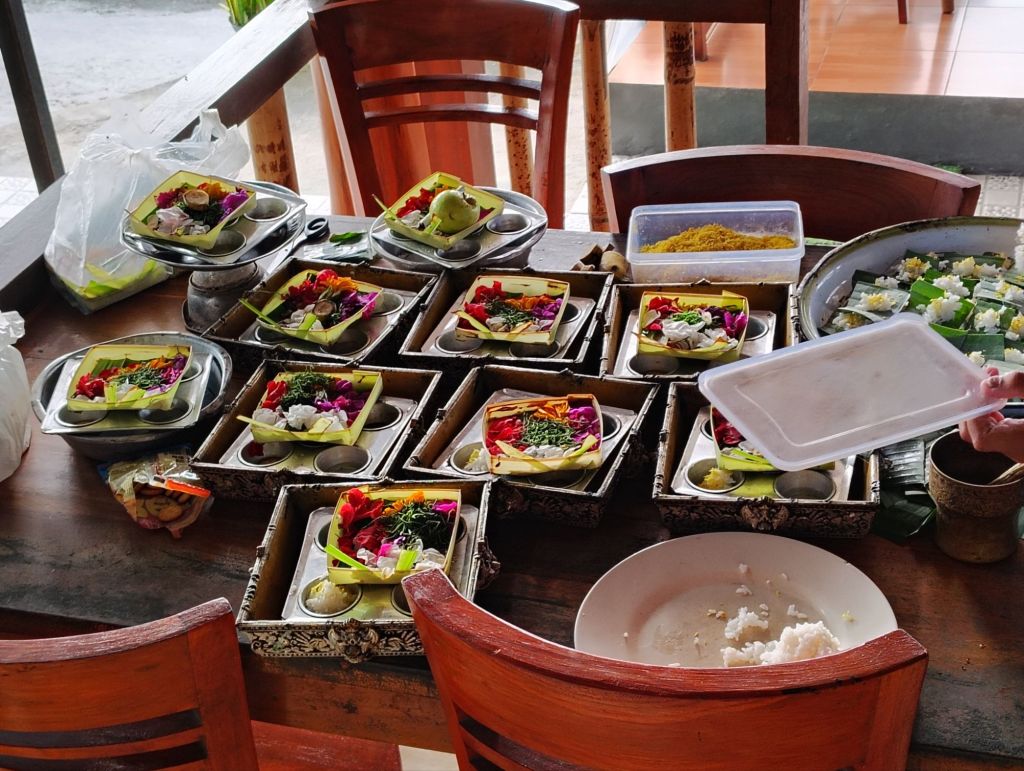
They absorb the cultural elements of those who arrive, yet remain Hindu, in essence. Particularly, their belief in circular energy and in principled service through tripartite daily offerings: to gods and the dead, to fellow humanity, and to nature.
Because of the tourists, everything is made available here, including beef, but the Balinese have a broad diet. The staple is rice (nasi goreng) but they eat chicken (ayam) and duck (bebek), fruit and vegetables, and fish (ikan). Spit-roasted suckling pig (babi guling) is enjoyed island-wide:
The tourism, which is robust and highly capitalized under the digital generation, moves at breakneck speed, and an agile, young, and brilliantly polyglot Balinese generation rises to meet it.
They do business in Russian, Chinese, French, Hindi and English – Aussie, Brit, Indian or American. Young people, working with foreign investors have created a huge tourist industry, filled with comforts for the Westerner.
It is a noisy island. Except for one day, when the entire island is silent. They call it Nyepi – and for 24 hours everyone in Bali stays in their homes and switches off all their lights. The transport network is shut down and the island observes silence. Tranquility.
A driver said, “Emergency services are sent around every regency and through villages as a precaution.” This year it was after the New Moon on the 29th of March. Next year it will be on the Ides.
I thought about how much I’d love to be in Bali for that, and then realized I would not do that. I would stay away and encourage others to reduce tourist/traveler traffic on the day of Nyepi to allow Balinese to have their island in tranquility, to unite and bond. They are the stewards of something very special.
Growth is countered by commitment to culture, and power struggles embodied in political discourse.
The Bali Sun reports that the current destruction of the Bangin Beach properties, that government has deemed unlicensed, is to be followed by properties at Balangang Beach. This destruction and evacuation continues during appeals by property residents. According to them, the land will be returned to the villages for greater public access.
Yet I met many entrepeneurs, property owners, and workers on staff and in gig economies, serving the tourism business on Bali in July and can report business is booming.
The new generation is capitalizing. Foreign investors abound. Dance clubs and gyms and international surf culture and digital wanderers have been a huge part of the tourism. Sentai gen!.
Meanwhile Balinese parents in villages consider investing in their children to go to Cruise Ship Schools and Tourism Academies for economically productive education. Sigh.
Though I met several young people committed to studying gamelan and village rites, and there’s strong generational commitment within families and villages to maintain continuity of language and culture through their children, the direction the tourist money pushes them is market-driven, not intellectual, or even cultural. If Balinese families seek to send one child away to study to help the family financially, it’s to tourism or hospitality schools.
Local Governors are taking note, curbing growth and redirecting profits. Long overdue infrastructure projects are getting resources and political attention. It’s a time of growth, tempered by overcrowdedness and culture clash.
“Instagram and social media have ruined” places, dozens of Balinese, and others, complained to me. “It’s an industry though.”
Now comes the explosion of the new tier of restaurants, bars and villas to serve the next visitors, following behind the digital culture: vacationing Aussie families, middle-aged Gen-Xers, boomers, the elderly.
They’re building a glass elevator to take them down to Kelingking Beach. It’s going to drastically increase traffic to an already heavily-trafficked site on a rural island. Infrastructure demands are many.

It’s not just the glass elevator to Kelingking, there’s tons of building going on to suit the newest arrivals to Bali.
The tourists are changing. Twice I was told, “Before pandemic mostly Chinese, after pandemic, Indian.”
I heard and saw many Russians, Australians, French, Brits, Dutch, Swiss, Germans. South Africans and Spanish.
I VISITED: ON JULY:
Pecatu 1st – 6th,
Canggu 6th – 9th,
Ubud 9th – 15th,
Nusa Penida 15th – 21st,
Candidasa 21st – 25th,
Kintamani 25th – 27th,
Canggu 27th – 31st
A Word About the WHEN of the Writing of this Piece
I left today, August 1st – which meant I had to pay two million Indonesian rupiah Overstay Penalty, that I withdrew from an atm in the airport before I went to immigration. I paid the tax and left.
That was today.
It’s still August 1st for me here in San Francisco as it was then, there in Bali, more than 20 hours ago, because I crossed the International Date Line. I gotta sleep.
So I’ve been back in SF 31 hours, but I left Bali 46 hours ago. I am writing and working on this during an invisible 15 hours that exists for me, separate from everyone around me.
An Archipelagic Conjunction of Culture
Placed at the Wallace line between the Sunda and Suhal tectonic shelves, you are as likely to find descendants of the Australian-Pacific as of Southeast Asia here – anywhere from India to New Zealand.
There are Asian influences from the North down through Viet Nam, Dravidian influences from Tamil Nadu by sea, Aryan ones from northern India by land, Australian influences from the Southeast.
Many languages meet: Sunda, Javan, Balinese, Indonesian. On Sulawesi, 114 native languages are spoken, all of which belong to the Malayo-Polynesian subgroup of the Austronesian language.
Thousands of islanders from thousands of miles away have come here for centuries to find the culture accepts, absorbs and encourages them, allows all to fit in, to find peace, and to thrive.
When I told a driver in Ubud that a millennium before Columbus was born, we Tamils had sailed here, he said to me, matter-of-factly: “Then, it was Hindus who came. Now it’s Muslims.”
Bali is a mostly Hindu island in the most populous Islamic nation, where the Buddhist protocol of discourse exists. It all culminates here on an island of the gods (plural) and of the spirits of the dead; an island of detente.
And now, of wellness tourism.
Denpasar/Pecatu – July 1st to 6th
I arrived at the I Gusti Ngurah Airport in Denpasar at 4pm on the first of July, a Tuesday.
I was met at the airport by the driver from my hotel, Sakura, who held a sign with my name printed on it in handwritten letters. When I asked Sakura if his name was the Japanese word for “cherry blossom,” he smiled broadly and said, “Yes! When I was born, my country and Japan had an important event, and my parents named me Sakura.” He was missing several teeth, but had an open, good-natured face. I guessed he was around my age.
Later I learned that Sakura was three years elder, born in 1964. That was the year the Olympics was held in Asia for the first time: hosted by Japan. But, Indonesia was prevented from participating. The International Olympic Committee banned Indonesia because in 1962, Indonesia had hosted the Asian Games in Jakarta and excluded Taiwan and Israel from participating. It was a direct retaliation for the exclusion of China and other nations from the ’64 Olympics by the IOC.
The International Olympic Committee accused Indonesia of politicizing the games. In the words of then IOC President Avery Brundage of the United States, Indonesia had “thrown down a challenge to all international amateur sports organizations, which cannot very well be ignored.”
In response, first Indonesian President Sukarno said: “The International Olympic Games have proved to be openly an imperialistic tool. Now let’s frankly say, sports have something to do with politics. Indonesia proposes now to mix sports with politics, and let us now establish the Games of the New Emerging Forces, the GANEFO, against the Old Established Order.” Sukarno created GANEFO as a rival event to the Olympics!
Ten countries (Cambodia, China, Guinea, Indonesia, Iraq, Mali, Pakistan, Vietnam, and the Soviet Union) announced plans to form GANEFO in April 1963, and another 36 signed on as members in November of that year. When the IOC subsequently banned athletes who participated in GANEFO from the 1964 Olympic Games, Indonesia and North Korea withdrew in protest. GANEFO faded away into obscurity.
Amidst all of this, Sakura was born, in a village in Pecatu on Bali, and his parents named him “cherry blossom,” in Japanese.
Thus the very first story I learned upon arrival expressed the principles of honesty, fairness, independence and acceptance that I would go on to find in the people of Bali in my month here.
Sakura’s aunt, a Hindu, owned the residence in which I was staying my first five nights on the island; villas named “Prasana,” a Sanskrit word meaning clear, bright, tranquil, pleased, delighted, cheerful, or gracious. It was why I chose the place.
Sakura taught me my first Balinese words and among them were the terms “b’lee,” and “adi,” for elder brother and younger brother, respectively. Sakura was my b’lee, I was his adi.
When we arrived at Prasana, I found that the villas had been given names instead of room numbers. I was staying in Chanakya.
It was Chanakya who ended Alexander’s attempt at global conquest. The way we learn it as children is that Alexander was marching across the Hindu Kush, having conquered Europe so much they still call him The Great (to us he’s Alexander the Greek).
The great sage Chanakya came down from his ashram to the palace to instruct the Gupta kings on how to stop this stampeding Aryan. Chanakya’s book, the Arthashastra, contains the lessons of his brilliant military and political tactics, including the often wrongly cited and oversimplified principle that “the enemy of my enemy is my friend.” Chanakya. Three hundred years before Christ. Taught here on this island thousands of miles away from India. For millennia.
The villas are placed up near the top of a sloping hill that eases down to the ocean, south and east toward the dawn. The view of the valley down to the sea is exquisitely natural – no tall buildings anywhere. Occasionally one can hear a motorbike go by, but you can’t really see the roads.
The lush, green vegetation on the island is dense. High above, dotting the sky, something hovers, swivels, and floats. There are just two or three of them and they seem to be riding air vents. Are they hawks? Eagles? They seem very like great raptors. But no, they are kites.
A kite is a reminder to look up.
Everywhere in Bali, you see kites, but not very many at any given time. It’s elegant how few there are and how high they’re flown – just enough to be tiny, beautiful dots in the sky without crowding it. This unique peppering of just a few kites in the air make them feel natural, totally integrated in this environment. They’re supposed to be there.
Mostly they are black and so high up you only see the form, drifting. Some have tails, but not many. As they are reeled in, one can make out colors and some shapes – birds, triangles. At night there are kites with glowing lights on them, some that flicker. They are flown so high up they could easily be mistaken for aircraft, or UFO’s by the gullible uninformed.
Meanwhile, the moon is upside down and the stars are from over another planet.
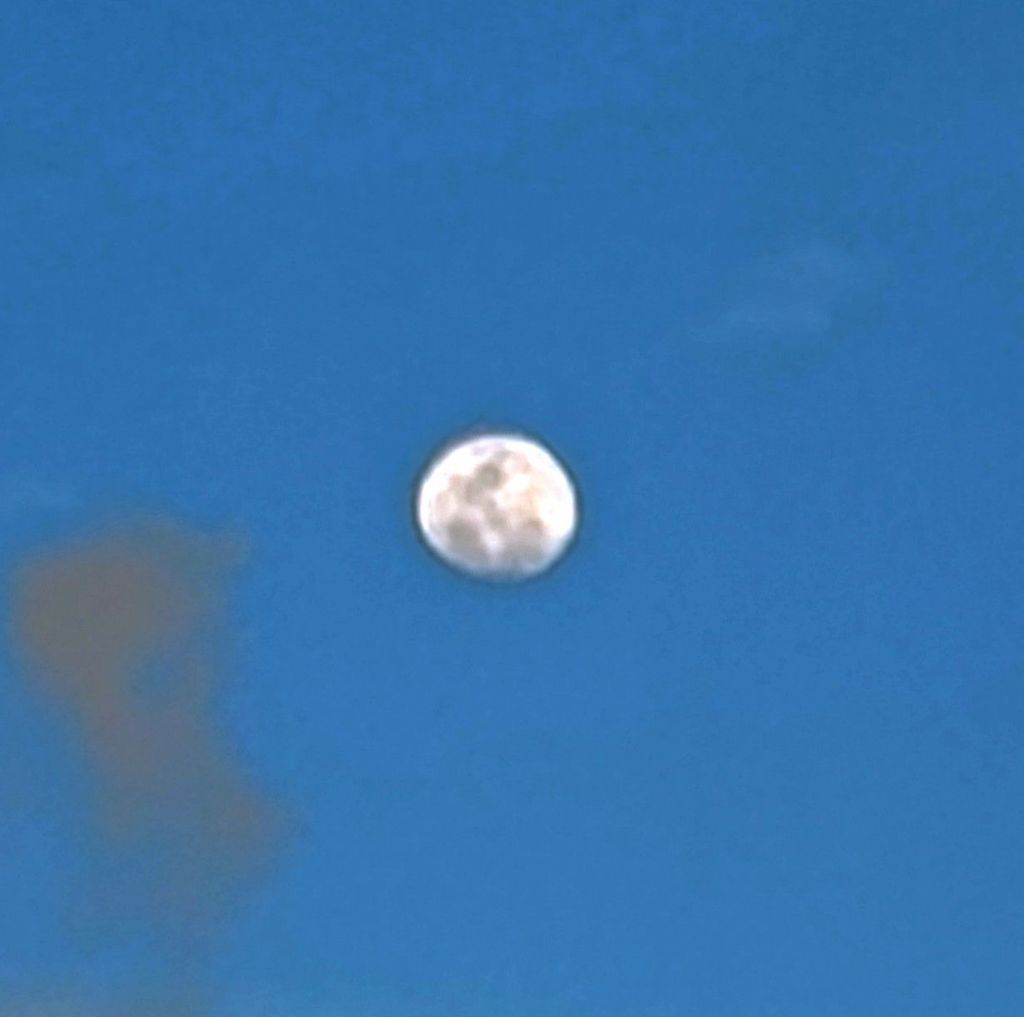
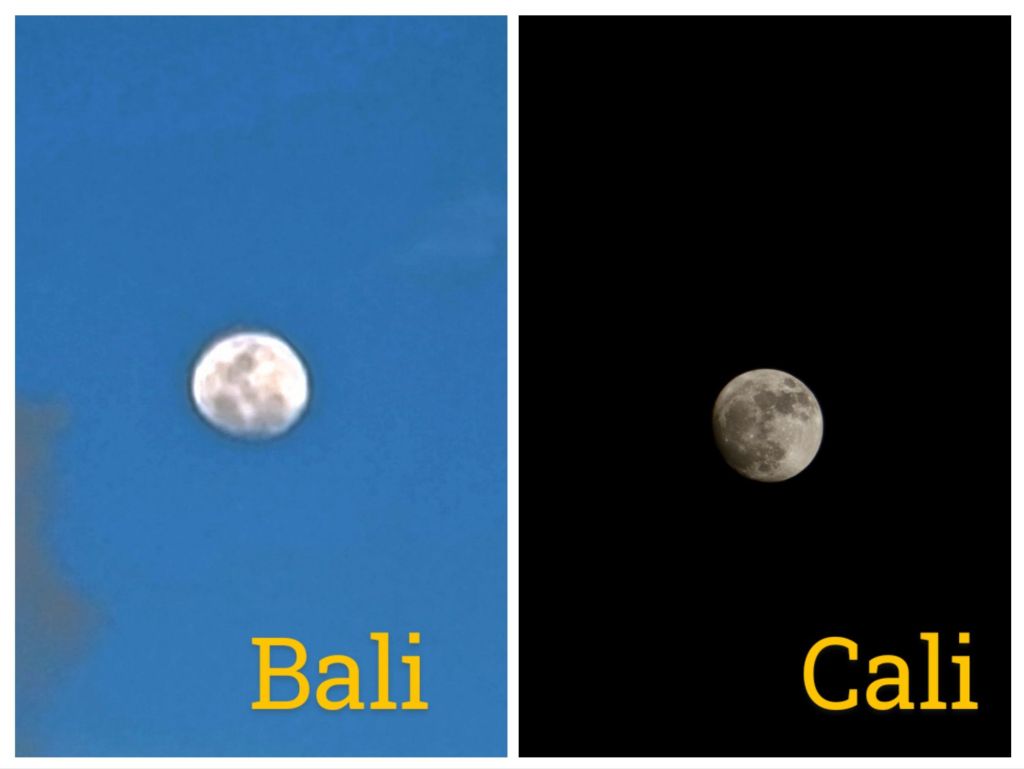
Well, it’s not really upside-down. but rotated about 90° counter clockwise and tilted forward, because I crossed the equator. I am sure as you travel further into the Southern Hemisphere the difference is even more pronounced.
I find it amazing to imagine that every child in the Southern Hemisphere has been born, lived and died with a completely different perception of the moon from me, and from every child born in the Northern Hemisphere.
It was partly cloudy for the first few days, but the stars peeking through the clouds were mysteriously arranged in the night sky.
I told Sakura I wanted to go snorkeling to see the biodiversity around reefs. He took me to his cousin Nico, who ran a water park business near the massive resort hotels on the south side of the island.
The water park was a crowded, insane place filled with crisscrossing craft carrying Indian couples. The recent years of economic success in India has led to this: young newlyweds with disposable income, honeymooning on Bali – a paradise just a few hours’ flight away.
The place was wild and somewhat out of control. Young boys drove speedboats and dragged young, newly married couples behind them, dressed in life jackets, clutching each other, grinning and laughing with joy as they parasailed. They hugged their guides tightly as they drove them about on jetskis and sails, cruising the bay before the massive hotels.
There is a dangerous side to Bali. Because the people here expect you to be in possession of yourself and your abilities and faculties, they often throw complete novices into pretty dicey situations. I saw it more than once. Here it was very inexperienced young Indian couples engaged in high speed water sports. Newlyweds. I saw some terrified young brides.
I had come to snorkel, which I did for a time, but Nico told me the best way to see fish around a reef was to use the new diving bell attraction. They took me on a boat out to a floating, anchored station which had oxygen tanks on it connected to diving bells
I put the heavy bell on my head, began breathing regularly and then lowered myself into the water. The oxygen filled bell remained free of water and I could see everything. My entire head was dry down to my shoulders as I dropped to a reef some seven or eight meters below.
It was incredible. There was a boat that had been sunk along with a stone sculpture (of Ganesha, of course) and reefs had slowly formed around them. There was a pathway with a railing I could grip as I walked on the sea floor and spent time observing the fish and other creatures living in the coral. I was standing, and indeed walking, on the Wallace Line.
A Word About Alfred Russell Wallace
If one Googles Alfred Russell Wallace in short order he is indentified as an explorer, naturalist, scientist and co-author, with Darwin, of the theory of natural selection, and by extension, evolution.
Wallace achieved this through observation, and, in his travels through the “Malay Peninsula,” coming to the fundamental breakthrough upon crossing what we now call, the “Wallace Line,” an imaginary line separating and defining the ecosystems of the Sunda and Suhal shelves; Southeast Asia and the Australian-Pacific.
Wallace is the father of “Bio-Geographical Evolutionary Science,” and arguably other fields like tectonics. He is also a highly romantic figure; a collector who became a naturalist and a scientist through rigorous methodology, allowing him to have data yielding a truly original breakthrough in thinking.
Generations of kids fantasize about doing this.
After the snorkeling trip, Sakura took me to a restaurant owned by his family near the airport.
The Ganesh restaurant is a small nondescript place where you can sit at simple tables under an umbrella on a sandy, south-facing beach. It’s in the wide, sheltered cove near the airport where the fishermen’s boats are moored in the afternoons, rising and falling with the occasional wave.
They are catamaran and are very similar to those found in Tamil Nadu. The word catamaran comes from Tamil. These are pontoon boats made from wood and painted mostly white with broad horizontal lines from bow to stern in two or three colors: green, blue, turquoise, red. There are usually two unpainted, white pontoons extending out on either side.
Waves arrive slowly, because the cove is so large, but when they crash it’s a thunderous sound.
Immediately to the right, West, is the airport. As I sat sipping a Bintang pilsner and eating fresh grilled red snapper – chosen from the day’s catch kept on ice in large plastic tubs – I watched planes landing regularly bringing hundreds of tourists and travelers like me.
To the left, Southeast, off in the distance, a tall, massive hulking form stands on the horizon. What is that?
It is difficult to make out because it’s so far away, but it’s clearly the tallest thing on the island by a 100 meters or more. It has a greenish-blue tint, and a rugged form, but it’s impossible to make it out unless you know what it is: the Garuda Wisnu Kencana.
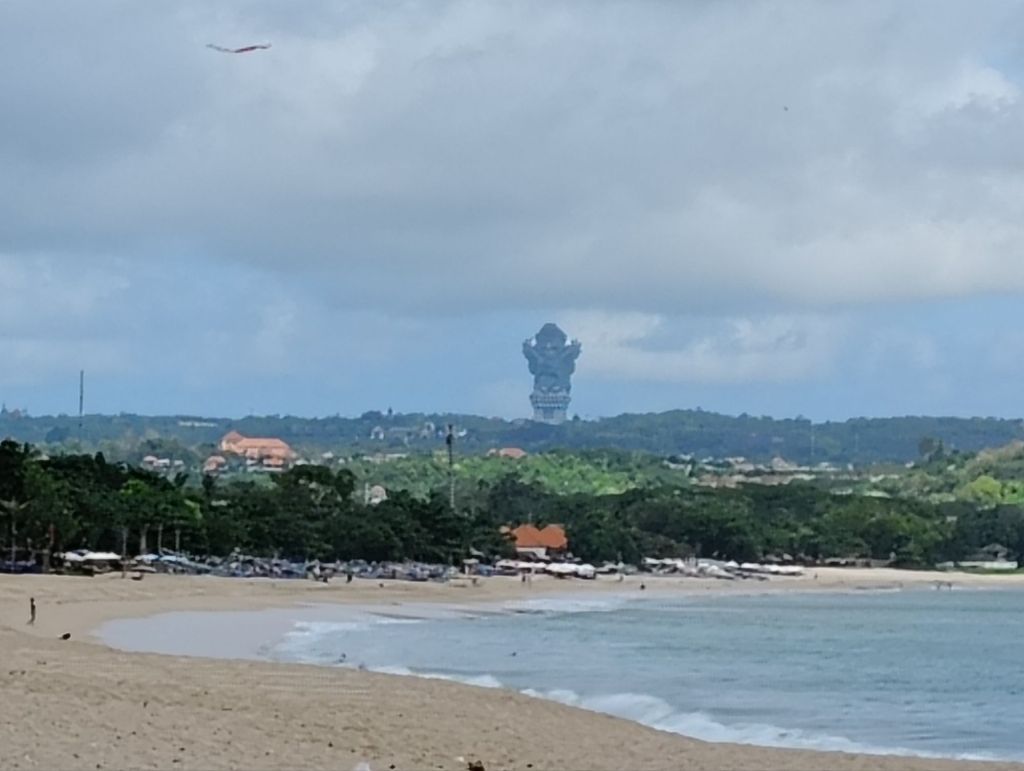
More on the WHEN of this Piece
I left Bali at 3:45ish in the afternoon yesterday, the first.
But by the calendar here, in California, where I’m sitting – for all of Internet recorded time – it will say that I wrote these words 31 hours later.
When in fact … it has been 46 hours since I left Bali. It’s 2:44 tomorrow in Bali now.
Every time I cross the dateline returning from Asia my phone cannot process the dateline. As soon as I connect at SFO, the images appear in my phone time- and date- stamped by the 24-hour clock and calendar of tech.
I made note of it coming back from Narita the last time I crossed the Pacific in this video:
This time, on the way to the airport, I made time-specific videos as placeholders in my phone:
That mantra is played daily on the radio at 6am, noon, and 6pm. So this video was 49 hours ago for me but will be recorded as 34 hours ago in the … whatever the internet is.
And just before I got on the flight from Taiwan to San Francisco, to cross the dateline I shot this:
It’s all TOTALLY OUT OF ORDER now on my phone. Photos and vids mixed together from both sides of the Pacific, all marked August 1st.
Those hours catch up to me in a commuter hotel in Millbrae by SFO that I chose to land and decompress in.
I’ve got to get sleep, but I want to post before midnight here on Saturday the 2nd, so I have just a few minutes. I am too tired to do quality work on these posts. The time difference and jet lag are impeding my mind, but on we go …
We are covering day four of July. My 4th of July was spent here:
The Garuda Wisnu Statue
I want to write about how the Garuda Wisnu Kencana is belittled by some visitors, made fun of as provincial and not visited because it is misunderstood.
The cultural center and park are on beautiful grounds where gamelan is constantly heard. There are barong and gamelan gong performances and cultural presentations held at regular intervals.
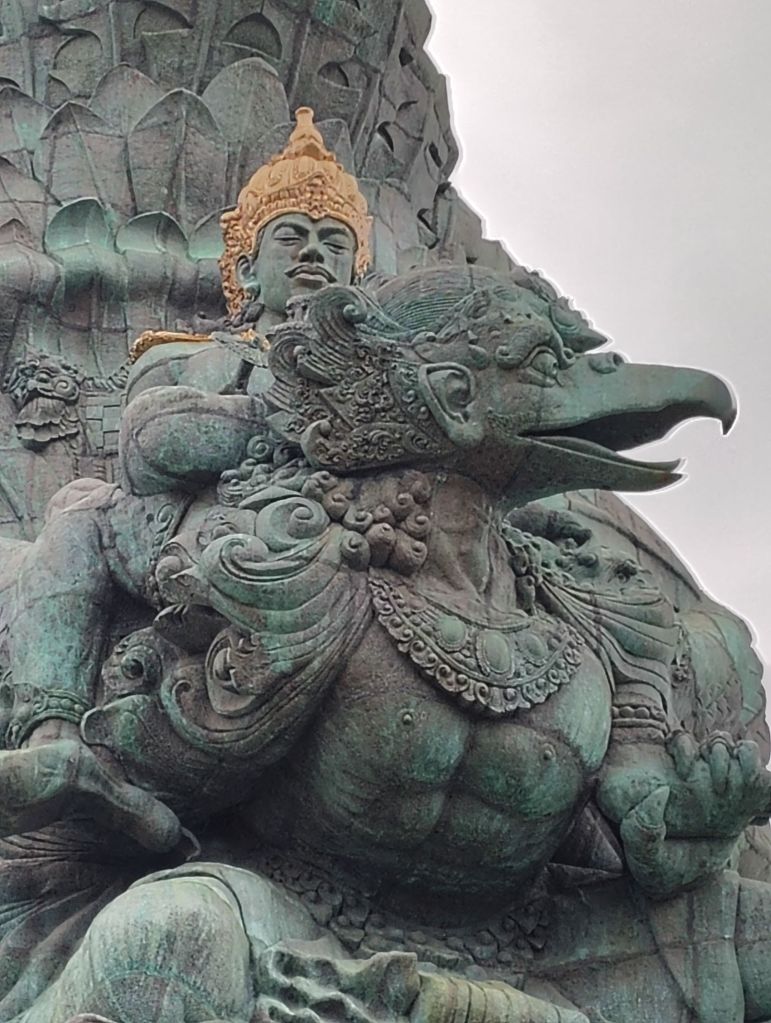
The Garuda Wisnu Kencana, or Garuda Wisnu Statue is 246 feet (75m) tall and 216 feet (66m) wide and made of treated Japanese copper and brass sheets placed on a reinforced steel frame and concrete core.
It was designed by Nyoman Nuarta and inaugurated September of 2018. Though the project was conceived in 1993, economic struggles prevented completion for years.
There were no accidents during construction, which I found phenomenal.
The building the statue stands on gives the statue a towering height of over 400 feet (122m). It can be seen from Nusa Penida, an island away, or from the airport when you land at Denpasar
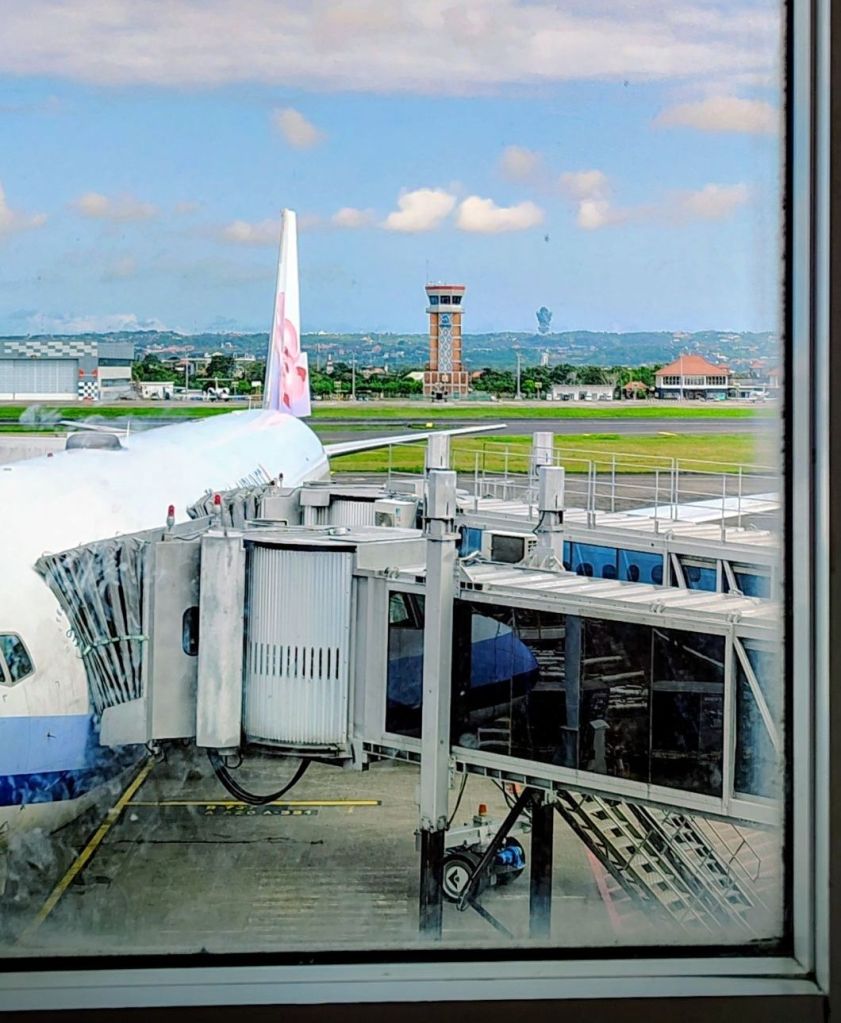
I joined a tour inside the GWK to learn about its construction. Inside, the funniest moment was when the (possibly Russian?) visitor protested the height of the statue includes the building that functions as its base. Look for that at 2:28, It’s great.
The Garuda story that the statue represents is not meant to be overtly religious, but rather folkloric. This was protested as nonsense by some Indian Hindus I overheard, but I found it profoundly moving.
It represents well the amalgamation of local culture with Hinduism. I admire this place very much precisely because it isn’t a religious structure, but a cultural center and park to learn about the Balinese.

It features a beautiful campus of sculptures of advanced design and execution, but I am too exhausted to do this post justice.



Wrapping up my first week, the first week of July on Bali, here’s a fast motion video of dawn from Pecatu:
I learned a handful of words from the staff at Prasana, and more importantly, to distinguish at least three different languages. For example:
‘Terimah kasih,’ is Indonesian and what I would have learned as “thank you,” had I used YouTube, while ‘Suksma’ is the regional language and, I came to learn, most widely used on Bali and Nusa Penida. One morning, I learned the Javan term for ‘ thank you.’
The realization of the living languages surrounding me that were agreeing to speak common tongues for a million reasons was one of the great joys of my vicarity as an Indian on this trip.
I started my language page at Prasana and tried to separate and delineate, but it looks like this now:

Guruduk! That’s ‘thunder’ in Balinese. Several other foreigners I met agreed ‘guruduk,’ corresponds with the deep, rumbling sound we associate with thunder.
In my first week, I learned that there is decorum here. It is graceful, unified and orderly amidst the tumbling overgrowth of nature.
My crude map, begun at Prasana, was equally imbued with scribblings that provoke instant memory
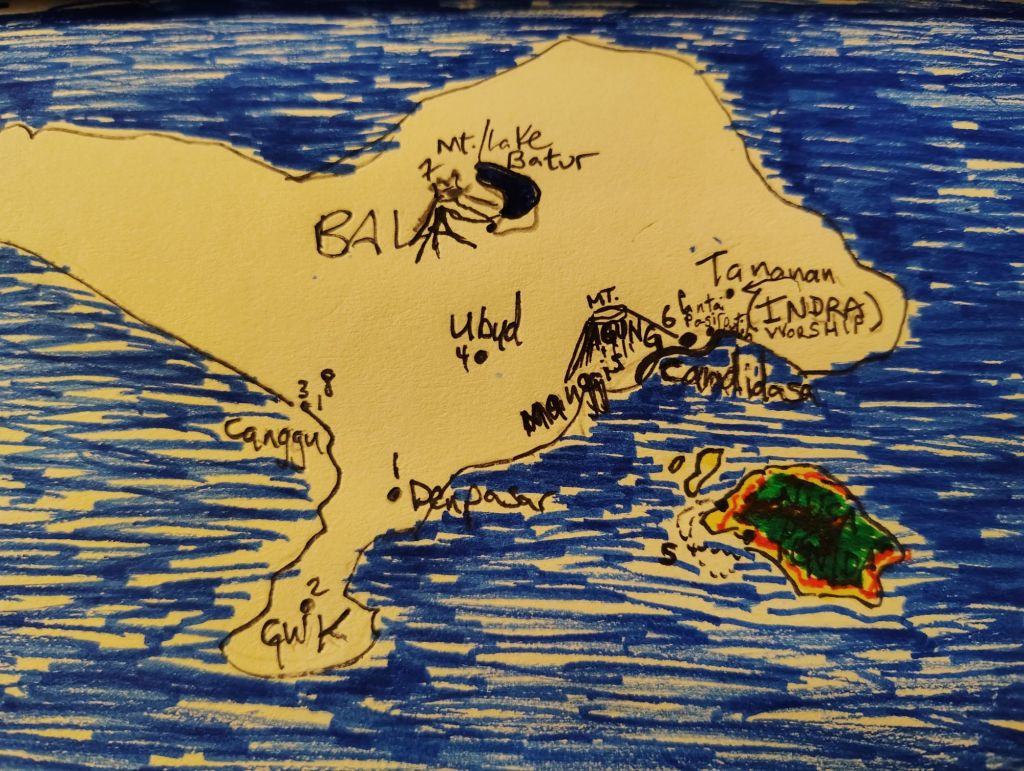
I filmed my first species in Pecatu, the common dove and bulbul. The Zebra dove has a chessboard neck and the bulbul ‘s yellow-vented:
And my flat mate was a very cool spotted gekko:
Pecatu was for me, an excellent introduction to Balinese culture. I was able to ask so many questions of Sakura, and of the young people who worked on staff.
They were from local villages and even if their English wasn’t great, they would be fluent in local languages or even Chinese, or Hindi or French, which are all more valuable in this tourist haven.
I was able to snorkel and to stand on the sea floor and see brilliantly colored fish of dozens of species and to enjoy walking on the sea floor, which I imagined to be the Wallace Line.
Finally, I got to see the Garuda Wisnu Kencana.
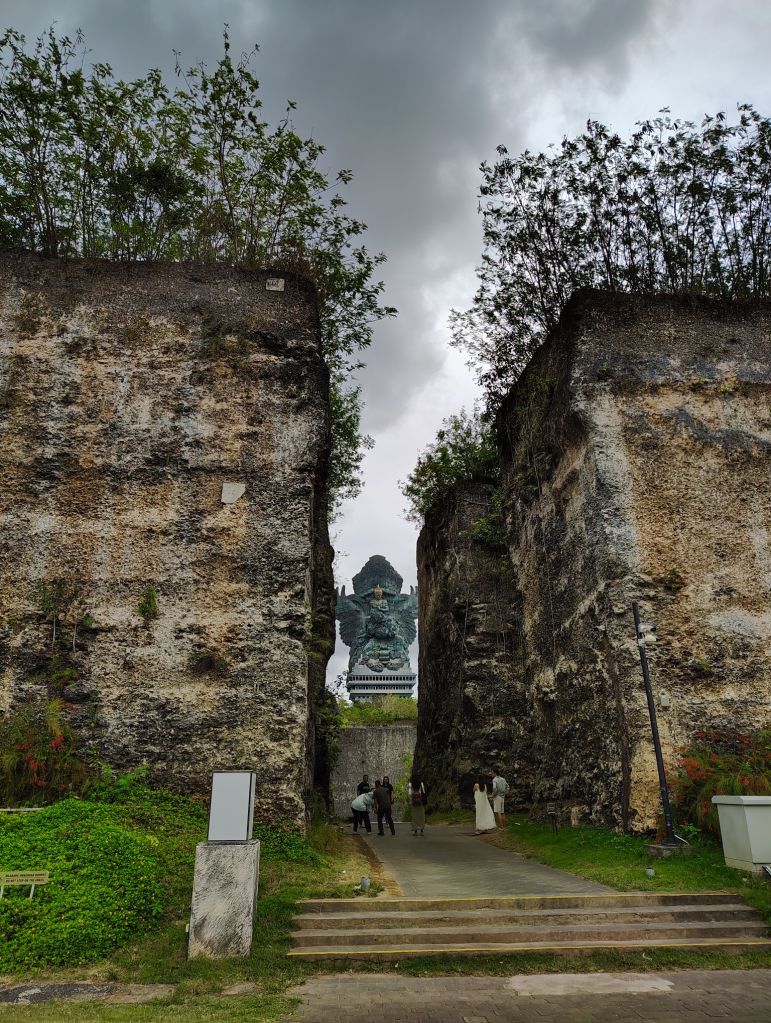
Which I consider a great national and Balinese accomplishment that has yet to be appreciated as the art object it is.
I spoke French, Chinese and as much Balinese as I could learn while I was on Bali and Nusa Penida in July. It wasn’t much, my language skills are rusty. My French would have to get much better for my next stop:
Going to Canggu and Ubud
The car from Pecatu to Canggu would be my first opportunity to see the traffic created by tourism on what should be called the one-road culture of Bali.
The island doesn’t have many roads, indeed the culture seems to be: one way in, one way out. There are perhaps six million native people living here and land is precisely divided. It’s much like Thailand and Cambodia.
The roads are small, two-lane affairs, teeming with motorcycles and scooters weaving between the cars. A funeral procession could block a road for a half hour. In recent times with the huge influx in tourism, this leads to very slow travel on very crowded roads.
The foreigners rent scooters or use Grab, the rideshare app, to call a scooter with a driver to get around. Often I saw two women calling two Grab scooters to ride together some place. It’s easy, but as I discussed in a previous post, it isn’t entirely safe. They give out helmets now, but it’s macho not to take one, so I didn’t. We weren’t going fast enough to warrant it in that heat.
While I had gone down to the ocean in Pecatu, passing through villages and past big resort hotels, and had seen honeymooning Indian couples in droves, it wasn’t a heavily trafficked drive. They mostly fly in, are driven to the resorts and stay there until they leave. I hadn’t yet seen the very tourist-driven economies of Seminyak or Canggu or Ubud. Canggu would be my first opportunity to hang like a white westerner. It wasn’t for me. Again.
I dreamt of coming here for the past thirty years, to examine the biodiversity that enamored Alfred Russell Wallace, and to meet these people, to hear their music and learn their culture.

Now, I feel late. The place is packed with tourists: Australians, Russians, Chinese, Indians, French, British, Spanish, Japanese, Koreans, and a few Americans … all coming to be massaged and to party and to surf and to snorkel and to meditate and to eat right and to do yoga at a price they can afford.
The Balinese have grasped what they want and provide it in rote, fast-paced, organized ways. They hardly care for the people they thrust into some situations, why should they? You asked to do this. I will explain what’s required and we’re off. It can end tragically. I always blame the tourist.
I am not on social media and don’t use WhatsApp, which is a real source of consternation and frustration to agents and hoteliers, drivers, and the digital generation. Sakura said he was just standing there with the sign and had no idea if I’d show up at all.
I’ll use Grab, sure, but I am in no rush and always leave early, so for me, everything is a cruise and nothing really flaps me. The current generation of digital travelers don’t understand why I didn’t want to give out my number, nor be on Insta or TikTok.
I like trying to travel in Asia the way I did in the early 1990’s, before the Internet. I always travel alone. I don’t really like tourists anymore. You’ve all earned my disappointment with your arrogant, condescending posturing and expectations and your loud, rude, stupid kids.
I separate myself from the digital generation’s methodology on purpose. I feel the way I travel connects me more directly, and there are less chances of miscommunication or of being lost in translation. It makes everybody have to take a little more care in communicating. Sadly, by the end of this trip, I was forced back on WhatsApp. I’ll be eliminating it again soon.
In one situation I was the only non-white, Westerner. People took me for staff. And that’s who I spent time with. I have experienced this otherness before. Where’s that fun? I have to act like a Westerner to be in Bali? No, thank you.
But it was in Canggu that I realized two weeks was nowhere near enough time to explore Bali. I extended the trip to a month.
I would make up the rest of the journey myself, as I went along, and spend all of July on Bali. It would be the best July of my life.
I’m not white. I am dark brown.
Sakura had gone back to his home village and so it was a younger man who drove me to Canggu. I commented that there were increasing numbers of foreigners as we went along, and he agreed, saying we were going to, “a very crowded area.” We didn’t have much to talk about. Perhaps his English wasn’t very good, and my Balinese, after only a week, was pretty much nonexistent. So I invented a game called “suss the whitey.”
If we passed a white couple or family or individual I would guess what country they were from strictly by their appearance. At first, my driver was reluctant, but he smiled every time I’d say, “oh definitely French.” or even just, “Oz.” – a few seconds after we passed someone. By the middle of the journey he was resisting my proclamations with his own. “Really? I think Russian.” or something like that. It was a fun game.
At one point he said to me, “The Russian accent sounds like invite you to fight.” Which I thought was hilarious. Many Balinese I talked to about the various tourists told me the Russians seemed different. Angry, disappointed somehow. It was a culture clash of forms.
In Canggu, I’d be staying in a French place. It was exceptional, but I am hesitant to write about my first time in Canggu and my time in Ubud because both were very western, tourist sites, both were somewhat disappointing to me.
The best thing of my time there was my visit to Bali Bird Park, a place I had wanted to go since 2006 because Rigo and Robert King Wilkerson had gone there, then, and they raved about it.
I got up early and went when the gates opened at 9am so I got to see all the birds on my own before the busloads of school kids arrived. I was able to film and sit with so many fantastic species! The hornbill was like something from prehistoric times.

I made a playlist of videos from there. I will let the images do the talking:
Epilogue: Can’t Write About It Anymore Cause I’m Back in the US
It’s disappearing now.
I have been back eight days and the feeling of Bali and Nusa Penida shrinks within me rapidly now, crowded out by what is required of me to be an American.
I’ve been an American citizen for 44 years. I’ve rejected much of what was proposed to me as valuable or righteous, and instead seized freedoms, particularly creative freedoms, to create the intellectual space in which I reside.
So I am extremely self-possessed.

I am the Brahmin son of a guru: learned at his knee, watched him teach students (sishya), and learned at his deathbed. I am learned.
I’ve purposefully stretched the definition of my Brahminism to contest its caste-based restrictions, picking up on a thread my father started by agreeing to be a professor in the West.
I took from what was afforded me so I could have this intellectual space. I am regarded as ungrateful or heretical by some. I consider them ignorant of history, culture or me. I am the author of this existence and its communications – whether in performance before you, in a video, or on this blog..
But the reason I cannot meaningfully write about Bali anymore is because I am back in the United States. The social truths forbid it. I will have to work now to compose messages to explain my experience, faithfully.
For the record, here are the three playlists of much of the video I shot there:
I am proud of the internal consistency of my thinking and expressions, tied to a deeper consciousness from our 5,000-year-old culture that has governed my approach.
When in Bali, I was Indian. The handful of instances in which I was an American were always with tourists from the West or China. No passport or oath or societal commitment can erase the connection I had with the Balinese as a Hindu. It is for us to interpret with each other. It is not for anyone else to translate, interpret or make known in some reduced way.
This, my life time, and its era of “culture” is immaterial. For now, my truths have been buried under an avalanche of American lies and social postures. We’ll work on it ’til I’m dead, I suppose.
This is the last picture of Bali I took as I left:
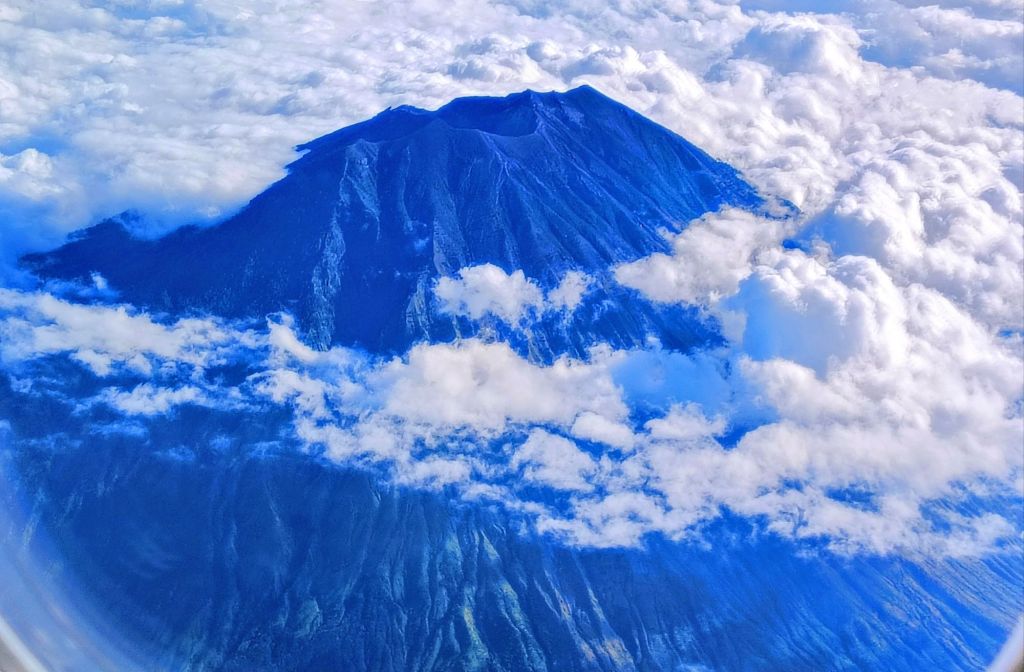
My last view of Mount Agung, the tallest and most active stratovolcano on Bali, a sacred place. 5,300 feet high, it last erupted in 2017 and 2019. It’s worst recorded eruption was in 1963. Thousands displaced, 1500 dead. If it erupts it influences everywhere from here to New Zealand.
Three views of Agung:

If I post here again it will be titled “Nusa Penida and Kintamani,” and I’ll add recollections of those places. But I need studio time now to refresh and create reflection.!
Best of luck to all,
Suksma Bali!
mtk
21 Monday Jul 2025
Posted in 2025, Asia, Bali, Commentary, travel
I’m exhausted just from observation. Wallace was a titan.
Manta
In the ocean, near the shore of Nusa Penida, very deep, strong tides above, massive reefs below, I swam with Manta rays.
I timed my dive and was able to hang with one ray for maybe thirty seconds. It was way bigger than me.
I put my arms out in front of it and used my flippers to stay in place. And he just hung there with me. right in front of my face. Immense, majestic.
That mouth, like a cavern, shaped almost exactly like my face mask. We just hung there looking at each other.
Reef Manta as filmed by the guide.
mtk, Bali
05 Saturday Jul 2025
Tags
04 Friday Jul 2025
Posted in 2025, Asia, Bali, Commentary, Tamil Coast, thoughts
Tags
art, Asia, Bali, culture, east, hindu, India, Indonesia, life, music, news, rumination, SE, south, Southeast, thought, writing
A millennium before Christopher Columbus was born, my people – since I am descendant of the Tamil Kings – embarked to sea without knowing what they would find; explorers, with ships filled with the best spices, jewelry and manufactured goods on the planet.
They were headed toward the dawn, open ocean to the East and South, with probably very well-thought-out research, because we’re Tamil, on what they’d find.
For the next twelve hundred years they met, traded with, loved and engaged with every single culture from my birthplace to the “Wallace line” – end of the Sunda shelf.
This is why, every time I travel in what you call South East Asia, I feel intense kinship with every person I meet. They feel it instantly, and I acknowledge it openly, with deference and appreciation.
My pleasure at the exquisite variations of the cultures here that were born from those now ancient relationships THRRRUMMMMS! with a harmony of centuries.
That I know this pleases everyone – and their cultures flower before me in brilliant ways:
Here’s a current playlist on my travels:
The White Man just. doesn’t. get it. It’s a god damn distant object of exotic fascination from what they perceive of falsely as a lesser culture.
My people had libraries and Universities while the European man was still crawling in the dirt.
Then slowly, they learned everything from us. Then they ran out of room for themselves, built ships and started “colonizing”: calling all other people animals and heathens and enslaving and murdering us. For five hundred years.
It’s certainly political. People don’t like us … Hindus. Because they’re not sure what they’re gonna get when they open the pack. Surprise! Wild card!
Rest assured, what you will get will be deeply civilized and intellectual.
Take me for example, I am not a practicing Hindu anymore, I have been studying Buddhism for three decades and am an atheist dedicated to a scientific interpretation of our universe for the good of all humanity.
Well look, I gotta go. But anyway, I’m in Bali and I love every single person from here to Tamil Nad. But not enough to call you back.
 MTK The Writist