I’m out on Long Island, NY, where I’ve spent a couple of weeks visiting my friend, Tom, who was my neighbor in Williamsburg, Brooklyn, 25 years ago, when we were both childless, unmarried and young.
Well, I was in my early-30’s. Tom and his roommates were recent college grads, starting their careers in the biggest city in the world. NYC was spectacular and singularly massive at the turn of the millennium. We were intoxicated and alive.
Tom is younger than me by seven years. In the time since I saw him last, he climbed the ladder in two separate career paths that crashed due to financial crises and has now climbed the ladder in a third: wine and spirits. He is an accomplished and successful Director of middle management.
He’s raised three children and supported his mother, and theirs. His father passed away; and his brother, an Iraq War vet, committed suicide.
Tom tracked me down four years ago after his father died. He told me he thought a necklace I gave him, cursed him. It brought him so much bad luck.
Close readers of this blog will remember when I threw the accursed necklace into the sea, but click the Tom and the Opera link and read about it if you haven’t.
When we reconnected, Tom and I had both just lost our fathers. His brother died some years before, and I have since lost my sister. We are brethren at mid-life. We often have half-hour to hour long phone conversations about enduring this world in our times. Since we reconnected, I’ve tried to give my friend a way to separate himself from his troubles.
In the last two and a half years, I showed up to help Tom move into his post-divorce apartment – when we went to the Metropolitan Opera for Rigoletto from center box seats. I flew him to Amsterdam for a four day vacation before the first ‘Thanksgiving and Xmas with split households’. And I paid for him to go to Africa to build a school with his daughter and her classmates.
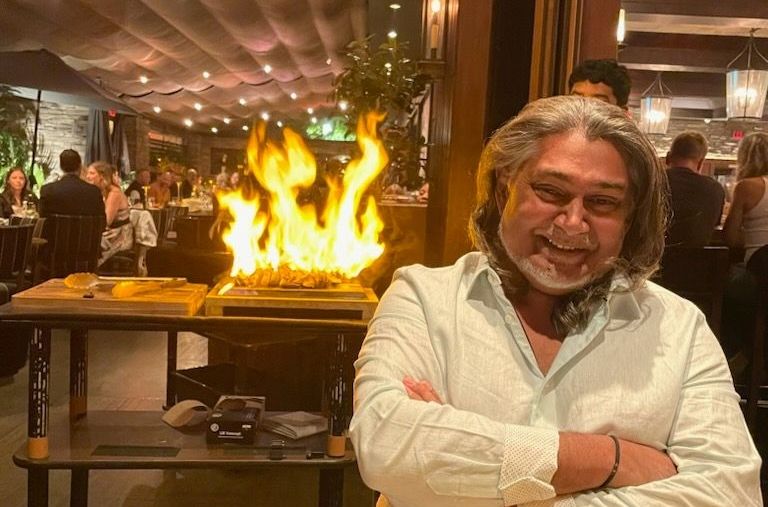
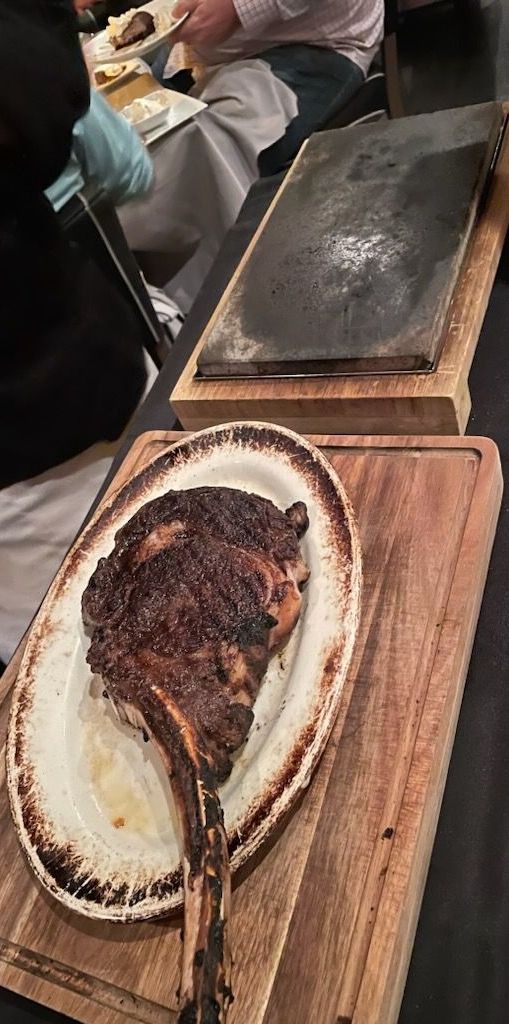
I’ve also treated us to several lush meals in diverse locations. The latest was at Blackstone here on Long Island. We had really delicious oysters from Canada, tuna sashimi, a Vietnamese-spring-roll-style sushi roll, lump crab, and a tomahawk Wagyu steak. I had a beaujolais. Tom had the banana cream pie.
It’s a fine dining restaurant in an area of strip malls. The interior was made to feel old-school, wooden, warm. Yet, the exterior is contemporary suburban monoculture – sigh, I guess that’s everywhere now. Here though, they take things they want and put them together for the convenience and then make them at the highest quality available in the same place … good steakhouse and good sushi, has emerged. The fish was fresh, prepared very well. The steak, unique, delicious.
Spending time with Tom has been exorbitant fun, controlled chaos and a good re-bonding experience. I know we’ve been helpful to each other, though we don’t discuss it. I worried about him when things were looking bad, I don’t now.
Tom, like many New Yorkers, does for himself and his own, but won’t ask for assistance. He will take what’s offeredwithout guilt and enjoy it lustfully, which I find fun and uplifting. Until it’s not. Then he gets arrogant and deaf.
I was walking through Golden Gate Park two weeks ago when my cel flashed, indicating my phone was ringing. Seeing it was Tom, I answered.
“Thought you were coming out this summer, ” he said.
“Well, there’s only Labor Day pool party left, unless you want to come New Year’s Eve for Phish.”
I put the phone down, bought a one-way ticket to JFK, booked a hotel in Long Beach for a week, and bought tickets for Arthur Ashe Stadium at the U. S. Open tennis grand slam.
It had been a year and eight months since we hung out and I knew I wouldn’t make NYE in NY. I rationalized, too, that Tom wanted me to visit so I could see that he’s cool now and things are going well.
I had been trying to help get him away from it all to process his thoughts. That’s why I took him to Amsterdam and the Opera and supported his travel to Africa – to wholly extricate him from his own life as a break.
Our meals in Manhattan, in Amsterdam and here, are all, in part, a separation from our lives – to talk deeply about things that matter. I was thrilled to help him travel with his daughter and their class to Senegal.
The Labor Day Pool Party at Tom’s townhouse in Lido is the final party at the pool before it’s closed for the off-season. All the families and friends of families enjoy swimming, food, drinks, music, a raffle, and the most important events: games!
The table tennis and cornhole tournaments are highly anticipated and competitive. Yet from the moment I arrived, Tom told me, “I’m winnin’ that.”
He crowed to every neighbor we saw for two days that he was winning the cornhole tournament. It got so ridiculous, at one point when we were alone in the car, I said, “Yo, man, you are talkin’ a lotta smack about this cornhole thing.”
Now cornhole, like shuffleboard, requires team play. I know these tournaments use random selection for team mates. How could he possibly guarantee he’d win? But the thing about Tom is …
It was done and dusted.
That’s something Tom gives me – and I think he gives it to everyone he knows – chutzpah.
It was a great time. I saw Tom’s mom and family. We all jumped in the pool together at the end of the party, by tradition. The food was great. Lovely day, wonderful people. I felt welcomed.
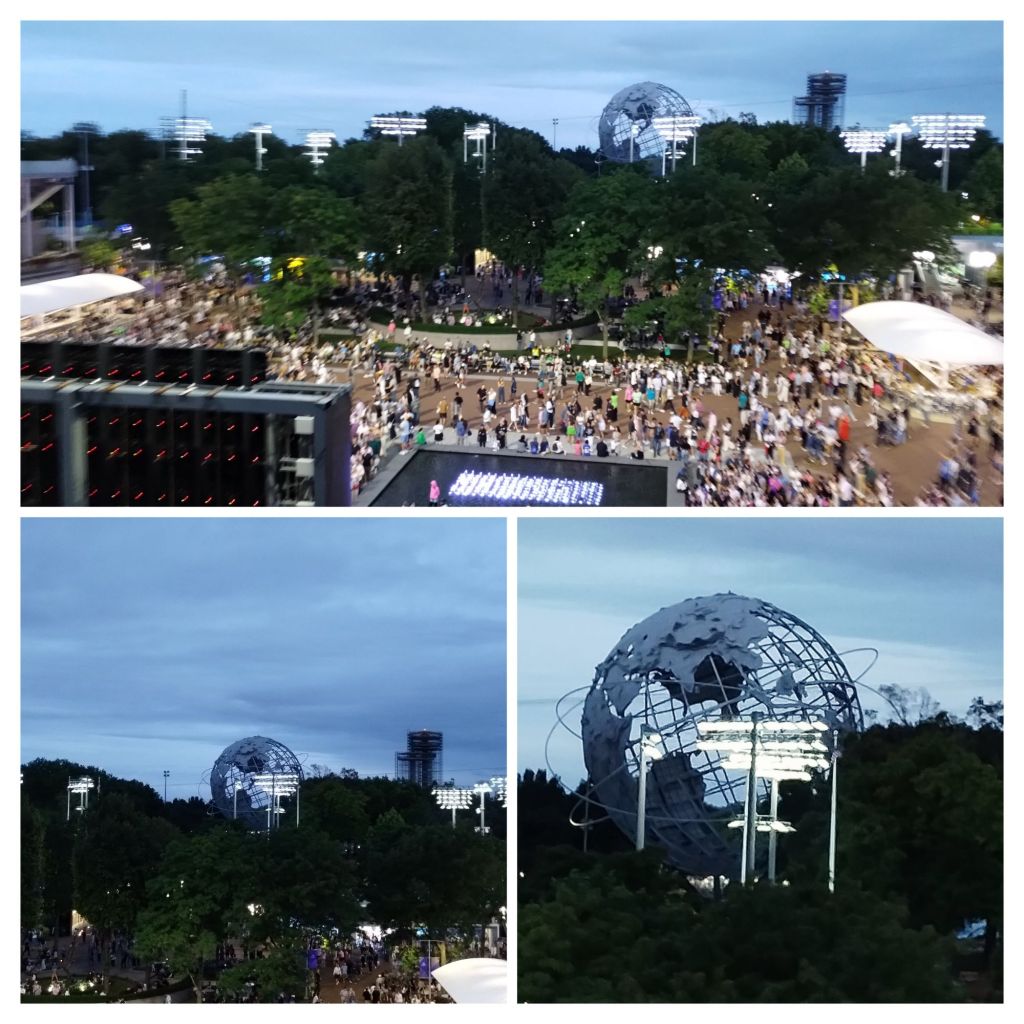
So for my contribution on this trip, I took Tom to the USTA Center in Flushing for a match at the U.S. Open Grand Slam tennis tournament, something he and his neighbors would never do.
I grew up with tennis because of my Indian parents. Tom’s people prefer hockey, football, basketball and baseball. I know I expand Tom’s cultural landscape, as I know he expands mine.
Through luck of the draw we got a match featuring perhaps the greatest tennis champion ever, Novak Djokovic, and, in a stunning upset, Nolé was defeated by Australian Alexei Popyrin.
I concluded it was because of fatigue from playing in every previous Grand Slam Final and then meeting in the Olympic Gold Medal match that Djokovic and Carlos Alcaraz, world number two and one respectively, were eliminated in the early rounds at New York.
Apparently the men’s endurance limit is four championship tournament finals. But it was pretty cool to see Nolé combat the Aussie Popyrin at Arthur Ashe Stadium.
By contrast to my material gifts, Tom has been generous with things that have no calculable value, including counsel and trusted conversation. He has picked me up, dusted me off and demanded I go at it again more than once.
On brief occasions, over the last four years, we’ve enjoyed food, wine, weed and travel as single men in mid-life.
We’ve shared meals and conversations and consulted one another on these occasions, separate from our responsibilities, to decide how we will make our way. He has lifted my spirit and confidence. This is priceless.
Tom has introduced me to his friends and family, who keep a tight circle. I am, for the first time, meeting his oldest friends and the people he has known for four decades, a community within which he is now the eldest surviving male of his family.
We both battle depression under the weight of our self-perception. We both do it in solitude, often not sharing it with anyone else.
Instead of staying in the city and visiting for a night, I’ve come out to LI to stay in Long Beach, with Tom for a couple of nights and in local hotels .
It’s now the season they call “locals summer,” when the tourists leave and the weather is pleasant and locals get to enjoy what the island has to offer before it gets too cold. It is a lovely, peaceful beach town now.
Long Island’s a place that has been described so often by others that it’s hard to put it in original terms anymore. From The Great Gatsby to Jaws to Everybody Loves Raymond, the literary, artistic, social, and now digital, presence of the place masks the reality.
The reality, which I am gaining an understanding of through Tom and his community and my extended visit to the area, is private, energetic, vibrant and physical. Long Beach is more diverse than I imagined. Other areas of Long Island are not.
Meanwhile, many helicopters and private planes still pass by the beach and overhead daily – shuttling the wealthy back and forth between the City and the Hamptons, or Montauk or wherever.
It’s half-September.
Many of my friendships have faded because all I do is get really close to people and then leave disgusted with where I am. For example, I could never live here.
New York remains a place that repels and attracts. I hate the way people look at me here for my long hair and wearing bright colors. I feel an almost constant basic racism of otherness. It’s a famously white and restricted place that demands you behave to belong.
My unwillingness to be treated less than for being exactly who I am has meant friends have faded from my frame of reference away into their own lives.
Now, at mid-life, some old ones re-appear. I find they are younger than me by just a few years and they are all going through what mid-life brings us: break-ups and deaths and a powerful existential energy.
The French call it “l’energie d’age.” Which is such a better term than “mid-life crisis.”
This was a really cool kite flown at Long Beach, Long Island
Since I’m on the East coast, I decided to try and see some other friends who, like Tom, reconnected with me just after Dad died, in that fateful Spring when the pandemic plunged us all into various solitudes.
These friends, a married couple with two sons in college, have been dealing with enormous soulache from numerous deaths in their family and community, including a fraternal suicide and a very recent loss to cancer.
The emotional weight of it is staggering. But when I saw them I was inspired by their resilience. It falls to us, in our 50’s to bear and manage the circumstances. We’re the adults now.
My rediscovered friends here on the East coast impress me deeply with their strength and fiercely organized approach to the spiritual and practical demands of mourning. They press on.
Though busy with funerals and memorial services, they were able to break away for a couple of days to spend time at a forested property in New Hampshire, where we had a good walk in the woods.
and lovely vistas of trees.
Though the visit was short, it was affirming. It’s good to trust others again.
When we returned from New Hampshire, I was in a suburb of Boston, with time on my hands. This gave me the opportunity to visit Fenway Park, the oldest major league stadium and a baseball-lover’s bucket-list destination.
This was indescribably wonderful. It’s an intimate place where they adore baseball. You can read about my first trip to Fenway on Giants Baseball Corner, my baseball blog, if you click that link.
and here are the Red Sox fans, in their glorious baseball Ashram, enjoying their song, Sweet Caroline by Neil Diamond:
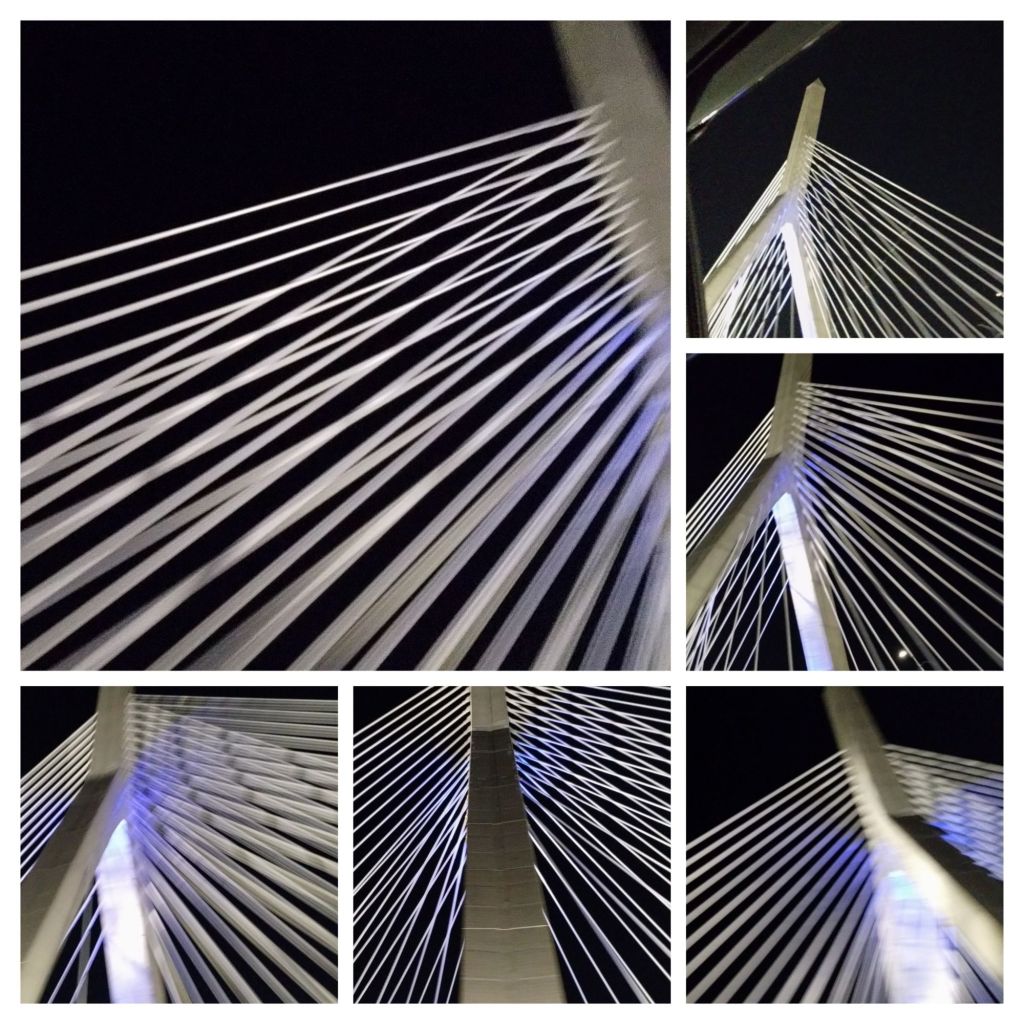
And here are some stills of Boston I took from the windows of various cabs:
I also managed to sneak in a visit to MFA Boston, the Museum of Fine Art which is, remarkably, open until 10pm on Thursdays and Fridays. I’m sure Friday it’s packed, but to have that place all to myself on a Thursday for four and a half hours was fantastic.
I will write a separate blog about that when I get a chance. Here’s the train back from Boston:
I refer to this broken bat double which swerved into play, as:
The Triple Kiss
This excellent .gif of The Triple Kiss is by @CorkGaines
Hunter Pence knocked in three runs when this ball left his broken bat after a crazy series of three collisions – the last of which caused it to swerve in the air and bound past the outstretched glove of the shortstop.
Second-year Cardinals shortstop Pete Kozma, who was very well positioned, reacted at lightning speed, but was caught going the wrong way for a fraction of a second because the third point of contact changed the ball’s direction.
The Triple Kiss happened in less than half a second. Watching it live, as broadcast, I had no idea the ball hit the bat three times; not until seeing it like this.
I knew it was a broken bat hit, my shoulders slumped at the same instant that Kozma jumped – and then suddenly, the ball took a crazy turn in the air and, as if it had eyes, bounced past the outstretched glove of the recovering Kozma, on the second base side.
The Triple Kiss was significantly faster than the human eye … even the highly trained eyes of a ballplayer, or an umpire. It affords us the opportunity to discuss the intense amount of new information that slow motion yields.
Slow motion was originally known – in analog filmmaking – as overcranking, a method by which the speed of the film was altered through handcranking the frames. Overcranking was first used in sports as long ago as the 1930’s in the coverage of boxing matches.
It took a long time for overcranking to become slow motion and in that time we got pretty used to it. We allowed slow motion to creep into our observation of games with such ease and normality that the NFL, NBA and MLB now all stop play to incorporate it as a tool in evaluating what has actually taken place.
But yesterday, after a fascinating conversation with an NCAA referee in another sport, David Ma, I began to wonder whether there’s a measurable visual side effect of using high definition slow motion when trying to call a game.
A paranoid part of me also began to wonder whether we’ve already begun what sci-fi feared: letting machines that are ‘more than us’ run our most human aspects.
David Ma believes we should alter the rules of instant replay review so that any referee or umpire using video replay should NOT be allowed to use the slow motion effect in the review.
Ma says, “I have no problem with the use of multiple camera angles for the review, but video review referees should not be allowed to use slow-motion.”
Ma believes there is a significant effect on the field when calling games with video review that includes slow motion, which he refers to as akin to “refereeing under a microscope.”
He points out that no human being could possibly see some of the things that slow motion reveals. In fact, Ma believes referees are already changing the way they call a game because of the presence of the super-slow-motion of HD:
“In pro football now there’s mandatory booth review on any score and in the final two minutes … if you’re a ref and you know that, why would you make a call? The camera can see everything you can’t so you’re most likely going to be wrong!”
Ma speaks with the authority of knowing what it’s like to have to make a call with a super-slow-mo eyeball looking over your shoulder: “With HD slow motion, by far, most of the time the referee’s call is going to be wrong.”
It opens up a discussion about what our perception of real-time is. For example would an umpiring or refereeing crew allowed only to watch the replays in real-time be more effective within the state of play? Ma believes assuredly yes.
This process by which we have accepted the super-slow-mo eyeball as the authority has taken place without significant consideration of the side effect – a human response to the presence of a machine that can see things we can’t.
But perhaps more significantly, the use of slow-mo in sports coverage points out that despite the presence of a tremendous amount of data being added to the information of the events of real-time by slow motion, it’s an effect we’ve subconsciously accepted without critique as a part of our capacity to watch something that has happened.
To David Ma, we’ve stepped onto an escalator which will take us to the point where it will be impossible for a human being to call a game.
I argued that perhaps the refereeing crew could judge the play on the basis of human terms: take in all the data, including the super-slow-mo stuff, and then the video review ref might say: ‘Well, sure we can see that under scrutiny, but there’s no way we could have seen that in real-time’ – thus overriding the machine.
But David Ma reminded me who pays the bills:
“The broadcast media, which is putting out incredibly detailed HD video in super slow-mo will grab that ref by the collar and say, you’re calling it like the nation just saw it, now.”
It rang true. But not one to make an issue of the problem without offering a solution, Ma says the only smart fix is to take slow-mo away from the refs. Alter our use of video replay to remove slow motion.
It’s a bold idea designed to keep the real-time on the field … well, real.
But there would emerge the huge issue that we, the fans, would have the access to all this information that the super-slow motion yields and would be stuck with an unresolvable dispute against the call made by humans trapped in a real-time consideration of events at hand.
The best example – when such frustration peaked – is the now infamous “intertouchdownception” that gave the Seattle Seahawks a victory in the waning seconds over the Green Bay Packers by virtue of a Hail Mary pass that was impossible to call with the human eye and replacement refs and the current NFL rules and the tacit agreement that management isn’t calling interference on Hail Mary’s (lol).
One of the refs on the field who signaled touchdown still believes he made an acceptable call as per one reading of the rule book. Fans remain unconvinced.
If, as Dave Ma suggests, we were to remove slow-motion from the toolbox for referees, could we as fans accept the difference of our view being an enhanced view from that of the refs?
Would we hound the refs for their inability to see what only a machine can see?
Or could we embrace the idea that we are keeping machines out of what is a fundamentally human exercise – sport.
In games like tennis and cricket, slow motion is used to define where or when a fast-moving object or person is at a given moment: the ball on or outside the line, the bat past the line before the ball strikes the wickets and so on.
The absolute exclusion of the slow motion effect would be a pointless exercise. However, it may be that the exclusion of slow motion from video review in certain situations would help keep the game real.
There’s a well known jinx in baseball that if a pitcher has a no-hitter going through five innings you don’t mention it.
It will guarantee its end.
Today, I tested the jinx against Twitter. I tweeted after the 5th that the Giants’ Ryan Vogelsong had a no-hitter going after five, purposefully, stating the experiment in the tweet. The very next batter hit a single and broke up the no-hitter. check the tweets @KarthikRajanSF
Lesson: NEVER tweet a no-hitter.
… best to do these things early in the season when the games don’t matter as much. That’s our Manager Bochy’s philosophy … and our GM Brian Sabean seems to agree. I am growing to understand it myself.














 MTK The Writist