Rent in Williamsburg has risen to the point where a small, clean, $700-a-month, one-bedroom apartment is impossible to find, requests for roomshares are on the rise and complaints about the cost-of-living are played out.
Next door on this very block, “loft building” banners have gone up across construction sites in two empty warehouses. The owners advertise cookie-cutter, 750-1200 square-foot apartments for $2000 – $4000 a month with amenities like all new appliances, double height ceilings, gas heat and hot water; on flyers at the local deli where, yesterday, a woman picked up a flyer, stared at it and seriously muttered, “there goes the neighborhood.”
Burns, a bicycle mechanic and bassist, and Dr. Tracer, an instructor at a local community college, live on a four-year-old lease and pay $1000 a month for perhaps 700 sq. ft. – the back space of which Burns has converted into his bedroom.
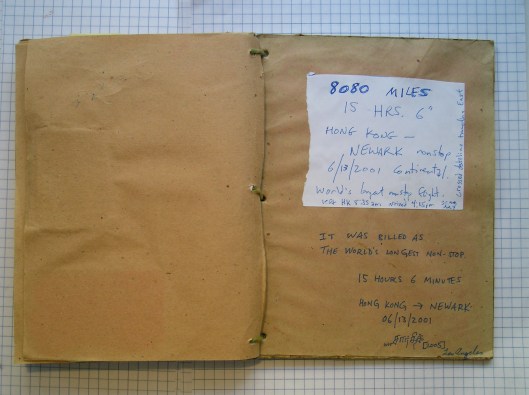
Ten days ago I took the world’s longest nonstop flight from Hong Kong to Newark.
I’ve been sleeping here in Burns’s room when he leaves for gigs or work and writing with his laptop on the nightshift.
I rose from my daysleep just after midnight to find Dr. Tracer had dropped acid. He was about an hour into his trip when I awoke and he offered me a tab. I meditated, ate and dosed.
It was 1:20 in the morning and I was awake and alert for the next 15 and a half hours for a cool, rainy trip on a Saturday morning in June in Brooklyn and Manhattan.
Dr. Tracer illustrated without malice, frustration or the use of traditional spoken language that as a result of only 180-degree sensory input, a person who cannot hear evolves under a powerful sentiment of paranoia about what is behind them or out of their field of vision.
We began walking through Williamsburg at 2:30 in the morning, past the swinging doors of a bar. Partied-out, Friday-night boozers stumbled into the street looking for taxi or subway or deli or restaurant doors, their eyes blearily seeking something recognizable, the stench of smoke and alcohol wafting off them. Music drifted faintly out the open doors.
We stopped at a deli, where a broad swath of bottletops had been crushed into the asphalt in a dense, rectangular splay of circles – a speckled count of the beers drunk at the cornershop on hot summer days, when tossing a bottlecap out onto the street meant it got stuck in black, melted goo. A girl was hanging around the pay phone, Brooklyn summer night; couples fell into each other, lazy eyes smiled, engines fired up, a black sedan pulled away from the curb.
We had a coffee and made our way to a bar off McCarren Park. I drank a couple of martinis, Tracer had cold white wine. We conversed until 4:30, discussing broad philosophical topics casually. We were specific on the matters of death, writing and deafness. At one point Tracer and I agreed that when we were children, we were surrounded by others who did not understand how to communicate with us, whose methods were sympathetic but crude. This we agreed, drove us to write.
Two women, a redhead and a brunette, walked in and seduced two men. The women sent one man home alone and, as he stumbled out, but before the door had fully closed, the brunette said coldly to the redhead: “T-G- H-G!”- in time with his steps, with the door swinging closed and with the click shut, she mock-laughed as she fell forward on her stool, elucidating: “Thank. God. He’s. Gone.” as she turned back to the man who remained. At last call, they walked home with the second man, the brunette told him they wanted to teach him something. We were the last customers and left shortly after this.
A few blocks away, we ran into Tracer’s former roommate, a German who shared his apartment for the three years before Burns moved in. The German’s wife and child were out of town and he was up at 5:00 in the a.m. strolling neatly out of a bar, wide-eyed, looking for cocaine, asking if we had any – we did not.
The sun rose quickly, early on one of the longest days of the year. Dr. Tracer and I returned to the apartment, rolled a joint and continued talking. The joint was affirmative and Tracer had a broad laughing fit while in the bathroom alone. We decided to travel.
We had a coffee, then took the G and the F trains to the ends of their lines, arriving at Coney Island just past 8:00 a.m. It was a rainy morning and thick, grey clouds masked the sun. The light was a cold-white glow behind them. The beach was a neat, empty, expanse of sierra-colored loam, darkened by wetness in neat lines by tractors pulling wide metal rakes. The sand was made soft by the thin, white line of foam that the edge of each wave drew as a loose parallel to the horizon, a black straight-edge between the gray sky and the grey sea.
We began walking from the boardwalk to the beach silently, occasionally signing as we walked. We passed an elderly, disheveled woman, who was entirely wrapped in a blanket lying on the beach. After we passed this lump of cloth and human flesh, I saw peripherally that she rose from her reclined position. I then clearly heard her say, “who knows … maybe they like walking on the beach.”
I have never known LSD to contribute to paranoia in me. My use of it has generally resulted in hyper-attenuated hearing and sight and an alertness and remoteness of character. But even now, I wonder about what I heard and saw in that moment.
It could have been a woman on a phone call talking to someone else about something else, but her physical movements implied awareness of us. It could have been a crazed, semi-lucid homeless person babbling incoherently to herself, afraid of people approaching and passing her encampment on the beach or, it could have been an agent of some U.S. policing department observing us as we visited the beach. More engagements with seemingly random others on our trip would increase my feeling that we were being closely observed.
Dr. Tracer and I sat by the ocean, waded, ate a bag of chips on the lifeguard’s chair, had Saturday morning at Coney Island Beach for forty minutes and decried the lack of sunshine. I tape-recorded the sound of the waves and the seagulls to listen to back in the city.
I hoped, pathetically, that the sun would emerge until Tracer pointed out that the storm off the coast was headed inland. We left the beach before the rain started. As we left the boardwalk, vendors were opening for business. We had a coffee. The first drops of rain struck us as we crossed the street to the subway. We decided to go to Chinatown.
We caught the N and smoked a bowl in an empty car during the long stretch between the end of the line and 50th. Then we switched to the operator’s car to watch people. On the way back, I glared out the windows at the grey sky defiantly until we went underground. Dr. Tracer finally joked, “when we get out on the other side the sun will be shining down on you … vindictively!”
A black, 40-plus-year-old man, clean shaven and slightly balding, got on and sat beside me carrying a rustly collection of objects in two plastic bags; black plastic covering a white plastic bag inside. He had a small band-aid strip stuck on his head exposed below his high hairlines. The obvious rectangular strip was set perpendicular across a straight, red line of blood above the temple – the wound was obviously fake, staged. The man fumbled with his possessions, continuously muttering to himself. He could as easily have been a semi-crazed denizen of New York as an undercover NYPD detective.
Once we moved from the empty car in the back to the operator’s car, many people who got on the subway on their way to Manhattan seemed like characters, with staged aspects, or too-perfect appointments. I wore headphones, listening to a CD of sarangi and hearing the outside world leak in. Two women with children sat beside us, a young boy in a stroller, his mother holding his infant sibling. They were northeastern Asians, maybe Korean. Their grandmother was gently inspiring the children to be friendly. The son, cool, observant and thoughtful, seemed worried; the baby was still at the age of wondering at the world.
This was the operator’s car on the N, Saturday morning at 10 o’clock from south Brooklyn to Manhattan on a rainy day in June and I report with the impunity of a witness: public space in New York is undeniably equally peppered with lonesome egos, expressors of unimaginable histories, and potentially dangerous operatives for larger interests, both governmental and mafioso.
Another example: Agent 99, who subsequently led us to Canal street, starts with a pair of plain, white leather sneakers with silver dots evenly-spaced along the edge of the sole – thumbtacks – and a short, hot, controlled blaze of red, orange and yellow flames painted on the outer skin of each shoe, burning up, licking at the clean white leather shoetops toward the short, white, rolled columns – socks – that lead to a pale leg elegantly colored with intricate flowers of reds and blues – tattoos – into a sea of limpid green: an opaque, green silk skirt with a lime-orange border.
She wore a plain blouse and her hair was colored with straight, serene blonde streaks. She was reading a hardback with a romance cover and flowery letters that read, “The Sorcerer’s Apprentice.” The glance of anyone on her side of the train who bent over to set something down, pick something up or tie a shoe was met with that leg, rocking up-and-down, regular as a pendulum, leading to a carefully put-together young woman on her way to Mallhattan.
We emerged from the subway to the rainstorm we’d seen hovering dark over the ocean. The World Trade Center Towers disappeared into thick, coal-colored clouds. The curved disks of the shoppers umbrellas floated through space, most were black, bobbing with the motion of their porters. The storm had traveled overhead as we traveled underground and was now present broadly over Canal street.
The huge, warm, tropical drops, falling down, on and around street signs and ads with Chinese and English text, reminded me of Taipei where I’d been two weeks before during the see-bei-oo rainy season.
We stood under the awnings of the Asian marketplace as rain poured down. Oblique, glowing flashes of white light flooded the clouds internally, leaked out the edges. Thunder rolled. Rain fell and we passed through it, mindless, walking between the drops.
We crossed between corners and in front of the slow-moving traffic. Many people shopped. Two tall women, one with a necklace that spelled, “dirty south,” in cursive, solid gold letters, awaited a man, shorter, rounder, balding, mustachioed, who was buying a souvenir. Young southern Europeans, women, were shopping. An elder, African-American man bought a pair of scarves. Il pleut.
We stopped at a Vietnamese cafe, had hot tea, then pho, rolls and beer. We returned to Brooklyn on the J. It was past noon.
Burns had gone to gig a wedding. His cats, Percy and Mingus wandered around the house, mewling for food. We fed them. We rolled another joint. We’d spent 27.00 on food, 25.00 on liquor, 4.50 on transportation and 3.00 for three coffees each, USD 59.50, total.
We were coming down. I was sitting in a chair opposite Dr. Tracer in his room in the apartment. It was silent. The grey light of the sky outside was only visible through crevices in the blinds and around their edges. Tracer had angled a desk in such a fashion that, sitting behind it, he could see himself and me and the door out, mirrors reflecting the interior of the room around him and nothing else. His back was to the window and the room behind him. I was able to see the window and the lightning that flashed outside.
This was the end of our trip, 12 hours after dosing and after a big meal and a long, wet walk in the rain. In my fatigued simplicity I became conscious of the sound of the weather. We were talking and the thunderstorm was accentuating Tracer’s speech. It grew in intensity and I could no longer focus on what Tracer was saying – the anxiety of it made me jump up. I suddenly remembered that the window in Burns’s room at the back of the apartment was open. I made my way to the back of the apartment saying, over my shoulder, “the rain! … I left the window open!” I realized only later that perhaps Tracer could not hear me or see my lips.
It was pouring. There was the continuous sound of thunder following ever-nearing lightning. At the back of the apartment, rainwater was hammering the wooden sill and dousing objects that lay near the window with a fine spray. Some water splashed my arm in just the time I took to shut the window. I went back to Tracer’s room flush with the excitement. He remained behind his desk, but was standing, pacing as he spoke.
I began to realize my error and clumsily showed him my arm, which now was hardly wet at all. He continued speaking and I realized I wasn’t following him. I sat down opposite him again, trying to compose the communication space that I had broken.
“… and <crack> … things that aren’t funny … No!” is what I heard him say as he took his seat and pointed down the hall.
Then, not immediately, but a second or two later – as Tracer continued speaking – there was an intensely loud, short, sharp <CRACK>! corresponding to a bolt of lightning that must have grounded somewhere very near to the apartment. It was shocking – by far the loudest sound I’d heard in days.
From the open window, I heard voices on the street raised in unison about the sound and flash – the remarks of people standing by the building outside for cover. Tracer’s face and posture showed no notice of any of it. I apologized for interrupting and we resumed our conversation about rent, writing and philosophy. The storm ended after twenty minutes.
Specifics of our conversation have been edited or lost to sobriety and the mindwash of sleep.
 Two Years Eight Months and Twenty-Eight Nights by Salman Rushdie
 MTK The Writist