• About
  • Collage
  • Fauna
  • Flora
  • Landscapes
  • Radio
  • sketchy stuff
  • Some Art
  • Writing

MTK The Writist

~ Homo sapiens digitalis

MTK The Writist

Tag Archives: Karthik

J.S. Bach's St. Matthew Passion, New York Philharmonic, Kurt Masur, 1998

18 Wednesday Feb 1998

Posted by mtk in journal entries, NYC, reviews

≈ Leave a comment

Tags

1998, bach, j.s., Karthik, kurt, m.t., masur, mtk, new, passion, philharmonic, st. matthew, york

2/18/98ce
–55 West 13th Street, Manhattan, New York, noon on the third of several grey, cloudy rainy days

Last night I heard the New York Philharmonic perform the St. Matthew Passion, by J. S. Bach, under the direction of Kurt Masur at Avery Fisher Hall (formerly Philharmonic Hall) at Lincoln Center.

The space is considerably less well designed than the Opera Hall in the same Center.  I have not yet visited the Alice Tully Hall space which completes the three.

Crossing the plaza and passing the small fountain as you approach the high-ceilinged, great glass front of the Metropolitan Opera House, two very large canvasses painted by Marc Chagall are visible from all directions.  They are something like 50 feet high and 30 feet wide.  The main stairway of the Opera House passes between the two pieces.  The Avery Fisher Hall is the auditorium to the right when facing the Opera House.  It is lower and more box-like, though it too has a tall, glass-fronted facade.

The Philharmonic Hall is long and rectangular.  The seats are arranged in horizontal rows forming a long rectangle from the stage back to the main doors on the floor of the auditorium.  Above these seats there are four tiers of balcony seats.  The box seats on the side are smaller and a little cramped.  They provide only an angled view of the stage and so one must continually turn one’s head to see the orchestra, the balcony seats in the rear of the auditorium are maybe 100 yards from the stage, but the line of sight is good and straight on from any of the seats in the back of the Hall.

Last night’s performance marked the second time I have heard the St. Matthew Passion by Bach.  I checked it out in San Francisco in 1997ce (see previous material).  This time, the stage set was completely different and the orchestration was somewhat changed as well.

The choir consisted of Thomanerchor Liepzig (The choir of St. Thomas Church, Leipzig) that Bach himself led, several hundred years ago.  They were perhaps 90 strong and provided the choir solo voices for the Apostle Peter and other parts from within their number.  They were split and arranged on benches at stage front left and front right, featured prominently.  The orchestration consisted of a small chamber group surrounding the conductor and a harmonium.  The harmonium was played by the director of the boy’s choir.  The chamber group was comprised of a cellist, bassist, first and second violins, and reeds.  On a platform behind the group were the six soloists.  The secondary strings and flutes and reeds were placed in the rear of the stage behind the soloists and Mr. Masur stood on a raised platform just to the right of the harmonium.

The performance was microphoned and amplified but the volume was far too low to enjoy complex changes in dynamics.  The sound in the corner seats in the rear boxes where we were (went with D.) was good but could have been louder and with more dynamic variance.  The seats were angled hard and somewhat cramped so we had to turn our heads to face the stage stereophonically.

The New York Times ran a review of the performance from the weekend past on the morning I saw the show (cf.: NYT, FEB 17, The Arts, p.4, aside: Siva Vaidyanthan on the cover for an unrelated story regarding a lost scrap of paper written upon by Mark Twain). The article said the work was among Masur’s first with the Philharmonic and suggested the changes and alterations (i.e. using St. Thomas Church choir from Liepzig) were Masur’s continuing efforts to come to know the music of Bach.

The performance was at a quick tempo, not workman-like, but regular. There were some lovely voices in the context of the piece, including the mezzo-soprano whose work was so beautiful.  The tenor who handled the part of the Evangelist may have been a little tired from a weekend’s worth of performance.  He was good, though.

The quality of live music performance in New York City is generally extremely high. Everywhere I go I hear bold, confident, passionate performances.  The players are eager and well-prepared.  In New York, the level of energy and play and quality of sound by any given performer is so much More More More than anywhere else I have been in the US.  There is little doubt or wavering.  The performers have in the context of their relationship to the venue and the audience, a certain confidence that frees them to try to be their best.  Or maybe they are scared witless and just playing their asses off so they can “make it in New York.” But it doesn’t “fee’” like the latter.  Rather it is just the general level of play, that the town attracts the nation’s best.  That is how it feels to me so far. (so why is the coffee so bad?)

The performance had some interesting moments:  the second mezzo-soprano solo in the second part, is predecessed and accompanied by an instrumental sectional.  There is a relationship here between the melody here and the melody of one of the six Violin Concerti for Violin and harpsichord.  The theme is augmented and then toyed with slightly, but check it out.

The section I awaited, had remembered from the last performance, was the simple harmony (or is it even unison?) calling out of the name of Barrabas.  It lacked the impact it had in SF.  There, the choir erupted in the name of Barrabas so loudly and strongly, one could hear the maddening crowd calling the name.  Here the section passed relatively quickly.  The tempo was speeded up and even-handed without such lingering drama.  Perhaps that is an aspect of performance here or by Masur.

He was beautiful to watch.  Had a relationship with the music as he conducted.  His body language, his expressiveness coaxed, pushed and pulled on the sound.  It was nice.  Masur’s an older man, balding (big centered patch over grey, evenly-cut hair all around), with a big frame.  maybe 6’2” or 3” tall.

<Break>


David Dinkins Lecture, Mingus Big Band, NYC, 1998

13 Friday Feb 1998

Posted by mtk in journal entries, NYC, reviews

≈ Leave a comment

Tags

1998, Band, Big, cafe, David, Dinkins, fez, Karthik, m.t., Mayor, Mingus, mtk, new, new york, ny, the, time, york

2/13/98ce
–55 West 13th Street, Manhattan, New York, noonish on a Friday

Yo, I was set up …  by Mingus
and knocked down  … by The Mingus Big Band
over gin and tonics at the Fez.

Last night after work I went to a lecture by David Dinkins, former Mayor of New York, sponsored by The New School.  It was a part of a series of lectures taking place this semester entitled, “Media and Race Relations.”   Dinkins feels like a really positive old guy.  Very forthright and direct and even-handed.  He read a prepared speech and then fielded questions from the crowd of maybe twenty or thirty people on hand.  The speech was rhythmic and well-paced, addressing the topic in general terms and peppered with a couple of extemporary examples.

He did not say anything too unusual, said what the ex-first-Black-Mayor-of-New-York-City-who-was-embattled-throughout-his-administration-and-who-lost-re-election-by-the-same-slim-margin-he-won-by-first-time-round might be expected to say, that, and I’m paraphrasing here, things under the current administration pretty much suck … unless you’re rich.  That the crime rate being down is a good thing, but that it was his previous administrations programs that were primarily responsible.  That the current Mayor is a bully.  He defended himself against the main controversy of his term.

He is a politician after all and was obliged thus to say some things about America and “this great City,” and so on.   He spoke eloquently about the disparities of this city, though.  Mentioned that the infant mortality rate on the Upper East Side of Manhattan is 5.4 per 1,000 live births and in Fort Green Brooklyn, less than twenty miles away, it is 24 per 1,000 live births.  A frightening and sad statistic.  He mentioned another statistic that I found staggering: regarding the media and it’s treatment of women and women’s issues.

In a recent media study, he reported, it was found that when a person is referred to in the Main section of the paper, 86% of the time it is a male person, in the business section 85%, and in the Metropolitan sections 76% of the time references are to men.  Of the occasions when women are mentioned in the paper, more than 50% of the time it is as a perpetrator of some crime or in some other negative connotation.

These numbers are weird and I can not understand really how they are conceived.  I’d like to look into that.

It’s funny how a thought becomes a statistic becomes a fact and a part of social truth.  Paz:  “the North American … substitutes social truth for real truth which is always disagreeable.”  Labyrinth of Solitude, 1950.

The lecture was good.  I look forward to the next one in the series by the Reverend Al Sharpton.

(Afterward, I came back here to the office and edited the third draft of “Mahmoud Singh.”  It’s a good first story for New York.  I feel tired of it now though.  It doesn’t breathe enough.  Need to make a new one.  When?  When I get some peace of mind.)

MB made 9:00 reservations for us at the Time cafe and Fez Supper Club.

While I was waiting for him at the school, I was chatting with the security guard and a young woman who was also waiting, to meet someone after class.  I said to the guard, “You’ve heard of home-sickness, right? … what do you call it when you have no home and yet you feel a sickness? That is, you have no place to be homesick for but you feel a sickness for a home that exists in your mind?”

The young woman said, “Identity Crisis.”

I waited for MB at my building until ten minutes to 9, then we hopped in a cab to the club at Great Jones and Lafayette streets in the East Village.  Arrived right at 9 and went in.  “Time” is labyrinthine with an upstairs glass-walled, fishbowl restaurant and then a blue archway leading to an inner red-boothed bar, both filled with the pretty people and then a stairwell down into the sanctum, a blue walled hallway leading to the supper club known as The Fez, where we were met by a beautiful young bronzey Black woman wearing a wireless headset who was responsible for seating us.  Girl was fine and had a sweet smile.  I said to her, looking as deeply as I could into her eyes in the darkness of the low-ceilinged club, “it must be difficult walking around with disembodied voices in your head.” and I smiled.  She looked puzzled at first and then was actually interrupted by the voice in the headset to which she responded first and then smiled that beautiful smile and said to me, “Yeah, it gets a little confusing when it’s busy.”  Fine.

We sat and ordered a round of drinks.  MB had the usual.  I was hungry and ordered some Salmon which was not great.  It was boring and tasted like nothing except the sauces and spices which were hardly placed on the plate.  Even the supposed blackened salmon with wasabi-vinagrette that sounded so nice was boring food, and too expensive.

The deal on the gig was that the cover was $18 and there was a two-drink minimum, but you could stay for the second set once you were inside.  Dinner was not included and we were wearing serious critics ears after dropping so much bread for the much-hyped Mingus Big Band.  Much of it was choice of course, because I wanted to estimate the place, quality of the food, seating etc.

I spent three bucks on the coatcheck and 18 to get in and 63 on drinks and dinner.  That’s $84 for the two of us with the show included.  We were there at 9:00 and the show started at 9:30.

The set up:

The Mingus Big Band is a Workshop group that plays the music of Charles Mingus.  They opened the set by telling us they were going to play some music they hadn’t practiced fully, that they hadn’t looked at in a long time.  It was odd.  The performance started with a chart called, “Slippers,” and they were literally signalling and calling out changes and sections to one another.  It felt crowded and unrehearsed. They were working shit out while they played.  It gave MB and I pause.  We figured we had been taken.  $18 and the drinks for this?  We are new to New York, him a year and a half and me a few months, we didn’t know any better than to attend the Mingus Big Band, thinking we’d hear some Mingus wicked-like.

They were struggling their way through the shit when I actually wrote on a napkin at one point, “MINGUS DONE 20 YEARS and STILL KICKING ALL Y’ALLS ASSES”

The band also recognized their benefactor, Sue Mingus who was in attendance, a blonde, short-haired (business cut) older white woman with a kindly, smiley way about her.  Then they introduced a Mingus contemporary, one Mr. Howard Johnson who played in a Mingus septet at one point and who charted an arrangement of “OP,” a tune originally written for Oscar Pettitford.  Mr. Johnson was to direct the band in playing it.  He introduced it with some discussion about his relationship with Mingus and then actually took a moment to remind the band of some changes and notations.  Again it was odd.  Like a practice session.

They flubbed the shit out of it so badly they had to be counted into the “D” section.  It was almost comical. But occasionally our thoughts crept to how much we’d paid to see the show.

The set break came and we decided to take a little stroll around the block.  We got back to try to find some better seats, since the second set was less crowded.  The sweet hostess with the headset made a little small talk with me and smiled that beautiful smile again.  She led us to a pair of seats front and center.  Many people left, but there were several sticking around for the second half.

The Knock Down

Bam! How can I describe the second set to you without explaining that we were HAD!  The dark, low-hanging ceiling of the Fez filled out with the radical sounds of Mingus!  It was crazy.  It was like a different group came on.  They were wild and soloing like crazy and just out of this world.  Hollering and yelling and playing tight tight tight Mingus licks like they weren’t even the same band as the first set.  It was too much.  MB and I kept staring across the table at one another and laughing.  They completely turned us around.  It ended with a raging take on Better Get Hit in Yo Soul which knocked the doors off the place.  It was two different gigs:  a rehearsal/workshop and a straight ahead performance!  Cool.

An instructor from the New School is the bass player in the band and he had a student come up and jam on harmonica at the gig, too.  It was right on to be associated with the cat.  Big-ass shoes to fill, and he did so respectfully and with modesty.  Even had some skills, too.

The deal

The Mingus Big Band plays at the Time Cafe in the Fez Club.  $18 for both sets OR with student ID, $10 for the second set only!!!  They’re saving the shit, man.  Go second half!!!  And find yourself the soul of Mingus kicking through a 15-piece, sweet-ass, tight-playing, booty-kicking band.  The food’s overpriced unless you get something like hummus or chips, and the two-drink minimum is worth it if you’re coming in that late anyway.  Mingus Big Band, a nice time.

So yo,  I was set up and knocked down by the Mingus Big Band over gin and tonics at the Fez.

Afterward we walked for a while and ended up at the Coffeeshop on Union Square for a bite to eat, then I cabbed it home.  Expensive nights are all too much fun in NYC.

Peace.

<Break>

working vacation

Mingus Big Band

13 Friday Feb 1998

Posted by mtk in NYC, poetry

≈ Leave a comment

Tags

1998, Band, Big, cafe, fez, Karthik, manhattan, mbb, Mingus, mtk, time


Yo, I was set up …  by Mingus

and knocked down  … by The Mingus Big Band

over gin and tonics at the Fez

snow my first night in Brooklyn, 1998

21 Wednesday Jan 1998

Posted by mtk in NYC, poetry

≈ 2 Comments

Tags

1998, brooklyn, Karthik, m.t., mtk, ny, poem, snow

I’m shivering –
can’t hold myself tightly enough and there’s no one else to hold me.
It’s cold.
It snowed last night on the spring equinox.
It only snowed once in New York this past winter –

that day, three full moons back, when I returned from Boston
to spend my first night in Brooklyn.

It fell in drifting, tiny, crisp, wispy flakes
that melted when they struck the concrete
and the earth of the city
mean

while it was snowing
in drifts up and down the east coast
shutting down whole swaths of automated New England
killing electricity for thousands
killing several who were inadequately housed.

My first night in Brooklyn was cold.
I fashioned a bed from a piece of sheetrock laid across cement cinderblocks,
and covered it in some of my warmest clothes.
My overcoat was a blanket.

I lit some candles.

there was no heat, no bath, and no electricity.
there was a toilet and a sink that gave no warm water
and I watched it snow and considered the english language

There is no snow where I am from.

Never.

There, it is either wet or dry and usually it is too hot to be outside for long.

Now, I have traveled far from where I am from
and have seen many things and kinds of things.
I have, along the way, learned new words.

I have heard english-speaking people say, in amazement:
“the Inuit have more than 30 words for snow.”

and that day in Brooklyn I wondered how
english could have snow for millennia
and yet have only one word
for the many different kinds of falling white
I’ve seen –

the cold, browzy, white haze at great heights
the soft, gentle quiet of an empty field
tiny flakes and slippery ice
hard rains of sleeting shards.

english has been arrogant.

It just feathered that day.

It was just a little feathering down.

a feathering of

Needles

08 Saturday Nov 1997

Posted by mtk in fiction, S.F.

≈ Leave a comment

Tags

1997, consuelo, dj, gomez, hayes, hayes valley, Karthik, mtk, needles, palace, record, records, roommates, san francisco, sf, short, spin, stan, story

There was an uncomfortable silence.  Stan would be home for the meeting soon so Lenny didn’t have the time to say anything really valid about the needles to the rest of us.  It was just that dead time of day when we usually talk about other things like ball games.

I figured somebody had to say something so I asked, “Anybody catch the Lakers?”  Lenny had seen the game and he broke it down for us while we waited.  Stan came in the middle of it and he picked up the description.  “Deal with it,” he calmly effused, “eleven three-pointers on sixty-eight percent shooting and eighteen of twenty from the line,” and we were all appreciative if for no reason other than the solidarity it lent.

We sat for just a second longer before Stan segued into the meeting: “Where’re we at?”

Lenny was silent and let somebody else do the talking thank god.  Stan could figure from the silence that the stuff hadn’t turned up.  It was uncomfortable but it wasn’t like there was anything to dispute.  Lenny’s brother and his girlfriend had been the only visitors the whole weekend and now the needles were gone.  Nobody even commented on the weed.

I proposed we each chip in fifty bucks for new needles and then Len said he’d ask his brother about them but nobody said anything.  Stan wanted to know if he could take his share out of the rent and we all supposed that would be all right. The most uncomfortable thing was that without the needles the turntables sat still and mute.  The red light on the amp was on as if the music had been interrupted in mid-groove.  The silence was a palpable souvenir of the needles’ absence.

We were just about to end the meeting when Kevin piped up. “But it’s bullshit,” he said.

Len was visibly stricken by a pang of tension.  Stan sighed, “what?”

“Well I mean, check it out,” he continued, “I mean I didn’t take the needles and lose them or whatever and I don’t have fifty bucks to just throw around.”

Stan started to say , kind of under his breath , that he could front Kevin the fifty but Kevin said he had it.  “I just want to know what we’re going to do in the future if something like this happens again.”  Len started to say something but stopped and I said, “Well, it isn’t going to happen again,” in a tone of voice that pretty much put an end to the meeting with my age advantage and all.  We left it at that.

I hate my life.  I don’t know what I am going to do about it and sometimes I feel so trapped and paralyzed by my existence I feel like I’m going to explode.  I know it can’t go on like this.  I live with a bunch of guys I know, at least — it could be worse — but it’s like I’m in college again.  I never thought thirty’d be this way.

I don”t think I ever had an image of it being any way, but I wouldn’t have ever guessed this.   I need to make a new plan but for some reason it isn’t coming together.  I always zigged and zagged before and lately it’s like I’m out of gas.  How can that be? I’m only thirty.  Shit.

—–

1988.  Autumn and I say “fuck this,” and move to China.  At least that’s how I tell it now. My three years in Asia have been reduced to a sidenote on my resume.  I mean I guess it started out as Taiwan before and became Malaysia and Thailand and India and Japan after … and now it’s “an experience which has given me a cultural appreciation for Asian cultures.”  The point is I split and so did everybody else I know.

I remember when we sat around the university local  and threw our passports on the table. Kevin was going to Paris, Ken to Guatemala City, me to Taipei and Tracy to the Peace Corps.  She hadn’t been assigned to Malawi yet.  And we laughed like fucking kids and threw our damn hands in the air and sucked down pitchers of beer and it was all good.

Now  me and Kevin are here, Tracy works in DC,  and none of us wants to talk about Ken except his mother who always wants us to “stop by any time” when we’re in Texas visiting our own families.  And it’s all bloody and sore and itches like an amputated leg’s supposed to.

Whatever.  I have to get something going for myself.  My doctor says I only have fifty more years left.  I mean if I’m lucky.

Le fin de siecle is a fucking joke.  Lenny exaggerates pitifully when he makes plans for it.  He talks about Times Square and Paris and some island in the Pacific off the date line, but it’s been four years since he’s traveled.  And that was Mexico.  I know he won’t do what he says he’s going to do anymore.

When we were kids, the year 2000 was like this crazy place where we’d all be in our early thirties and kings of the damn world.  Now it’s a fucking lie about how little time means and how much hype time-sellers have to pitch.

My mother thinks it matters still. She isn’t a part of the revolution of apathy we are and so it’s a serious pain in the ass trying to explain to her about fruitlessness on arable land.  Time passes that’s for sure.  My hair gets longer and my ass gets colder and lonelier, too.  Nobody else seems to have a problem with it.

—–

Christ on the Rue Jacob!  I feel fucking great!   Good god, I want to scream at the top of my lungs for about an hour while the world spins under my feet.  Pass me the bowl there Lenny and let’s get this show a-pumping.  The guys have no idea what I’m doing back here except that when I leave the party it’s usually to make some notes.

Fuckity fuck … life is a gas, baby.   What are you going to do about that you apathetic fuck? Huh?  What are you going to do about the fact that it is beautiful and warm and there are people and places and love is a real goddamn emotion and the drugs are relatively good and  California is all free and you aren’t starving and dying in a Zairean refugee camp or in a ditch in Bosnia.  What are you going to do about the fact that you are on fire?

—–

When my father and mother crossed the border in 1957, they were in the back of a chevy longbed and they were not illegals.  The crossing was the last leg of their journey from Africa which took them two years and lord knows how much money.   The revolution in my father’s homeland cost him everything. He was lucky to get a professorship here.  No.  As he always says you make your own luck.

“My father wanted a better life for us,” is what I always say when people ask why we moved here.  They can tell I’m unhappy.

What is there left for me to do?  I haven’t had sex in three months.  I can’t seem to get the appetite for the chase or even for the event. I mean I’ve had opportunities and lately I even reject those.  What’s the point?

—–

I could try looking at it this way:  thirty is a good year to begin …

I could fall in love.  “You make your own luck,” is what he said.  I never argued with him though I think that’s a load of shit.  You make your own rationalizations is more like it.

—–

Let’s put the puzzle pieces together: December 31st, 1988 and I’m riding a 350cc ’81 Sanyang motorcycle across an empty field in rural China.  It’s Cheng-du province and Tiananmen Square is months away and when it happens I won’t know about it anyway because I am living with the Chinese.  And I’m flying fast through the cold, cold countryside.  My bike chokes and I feel it seize so I pull over for a minute but don’t kill the engine.  It’s all screwy.  I think there’s something in the fuel line.  I don’t know if the bike will get me back to the doctor’s ranch where I am staying.  I breathe a deep sigh over the ruddling hum of the engine and see my breath cold and white in the night air.

I look at my watch.  It’s midnight. I realize that the equivalent time in New York and San Francisco and wherever else was met with balls dropping and firecrackers and wet warm drunken kisses and Auld Lang Syne and eggnog and it all hits me like a wall.  No one here even knows what that’s like or what it’s about.  It means nothing.  It’s as empty as the tube in my fuel line past the block in the joint.  I sigh and feel strangely great.  I dance a little jig.  I am thrilled at being free of all the bullshit.  It may well be my one clean moment.

—–

I picked up the new needles today.  I got home this afternoon and opened the front door and called out, “We got music again!”  But no one responded.  I walked through the entire flat but there was no one around.

It’s been a beautiful day.  It’s warm and sunny out and the skies look like October:  blue and clear and light.  I walked down to the front room and the sun was streaming in through the windows all over the futon and the floor.

I sat in the long warm patch of light and tore open the bubblewrap.  The needles are light and beautiful.  They have tiny diamonds in them I guess.  What a gorgeous little design.  I handled the needles for a minute before sliding across the rug and putting one on: locking it onto the tone arm.

I walked down to the records room.  There’s vinyl everywhere and gear for days. I was flipping through the Lee Morgan and Horace Silver and that whole era of sweet-sounding music music music when I saw that someone had misplaced one of my records.

I picked the record out of the stack and walked back to the front room.  There were birds out on the fence.  I pulled the platter and cleaned the vinyl slowly with the brown brush and fluid. It hadn’t been spun in months, hell maybe years.

It was ‘Metamorphosen‘ on one side and ‘Tod und Verklarung‘ on the other – Richard Strauss, Deutsche Gramophone.  I chose the flip side.  The needle was new so I put my finger to my lips, licked it and then gently rubbed the diamond tip.  The prick barely registered on my wrinkled fingerprint.  It felt rough, like a cat’s tongue.

I fired up the mixer, the amp, the receiver and clicked the selector over while they all warmed up.  The crossfader slid gently through and I set the needle down.

After my father died I tried to find that fucking record.  All I wanted the morning after I had him burned was to feel warm and empty like I did that day, lying, thirty, in the sunny patch on our ratty black futon with nothing but cocktails and a joint to look forward to.

We, short story, 1997

08 Wednesday Oct 1997

Posted by mtk in fiction, S.F.

≈ 1 Comment

Tags

1997, Karthik, mtk, new, short, story, we, Yorker

We’re drunk again and soon we’ll fuck.  That’s the order of things these days.  We meet in the evenings after work, make a dinner of inconsequential size and of indiscernible tastes, then go out for drinks at one of the locals until we’re so lit we can finally be honest with each other.  We fight like Burton and Taylor as we crawl home. She shoves me into bed and we fuck until we pass out. It’s an o.k. life but I keep thinking there must be something more.

She wants a baby but I want a dog.

Neither of us reads very much but we watch a lot of TV.  She watches crap.  Me, I watch nature shows.  The kind that show the lives of animals all over the world. And under the sea.  The ones on sharks are my favorite.

Everything I ever learned in school turns out to be bullshit.  My job is a joke.  I spot-test circuits on an electronic motherboard with two cables and a detector.  The hardest part is showing up.

I file reports and go to meetings.  People talk slowly about insipid things which mean as little as possible to anyone in the room.  The more meaningful the conversation becomes the faster it goes until the most important thing, the reason why the meeting was held in the first place, is blurted out and discussed at a barking, rocketous clip so there’s no time to blame anybody for any fuckups and no time for anybody to complain when they’re given an assignment.

My work is not meaningful to me in any way except that I receive a check for exactly $1843 every two weeks.   After taxes.

I have health insurance. My girlfriend is covered, too.  She makes as much as me at her job and has a full health plan also (mental to dental).

All of our friends are incredibly boring. But they use us and our resources to have a good time.  So we all get drunk together and laugh at things which only we can possibly think are funny because the language we speak is incomprehensible to anyone who hasn’t spent at least a year in our circle of friends.  We have developed this language as a method by which we can keep undesirables out.  Our friends’ girlfriends and boyfriends who do not check out don’t last long because it is especially hard for people we don’t like to keep up with our language.

We quote obscure lines from movies and television shows as a method of relating.  We see mostly mainstream films, not because we like them, but because they are easiest to make fun of.  We do not discriminate on the basis of sex, color, creed or race, only on the ability of others to keep up with our language and contribute to it.

We have no culture and no history because we are mostly made up of mutts. Part European, part whatever but none of us has a cultural background of any measurable depth because we are Americans.

I play a lot of computer games because they are easily accessible to me at work.  I also use my computer to send e-mail to all my other friends who also have jobs with e-mail.  We are never out of touch because most of us have cell-phones and beepers as well. Sometimes we fuck each other.  But mostly we get along because it would be boring otherwise.

We own a lot of things.  Most of these things are things we have read about in magazines or seen in movies.  Rarely do we buy things we have seen on television because the ads on television are stupid and we make fun of them.  We buy what we are sold but rarely do we buy what we want.

Sometimes we travel to other places.  Usually we only travel for a reason – such as family or friends’ weddings or funerals.  However sometimes we travel so we can say we have been places.

We can say we have been many places and our recollection of them is manufactured in such a way that we can relate stories to one another about the places to which we have been.  This allows us to all go to the same places at different times and always have the same experience of them.

We rarely leave the continent.  But Mexico and Canada accept our money so we go there from time to time to get away from it all.  Mexico is barbaric and uncivilized.  We avoid its nontourist destinations.  We use it to get things we want cheap and to be treated better than we deserve for very little money.  This is fun.

Canada is intellectual.  We go so we can say we have been there and have conversed with Canadians on a wide variety of topics.  We quote Canadian facts and figures about our own country.  Then we make fun of Canadian mannerisms, accents and figures of speech.

We’ve each been to Europe once.  Mostly after graduation.

We are Americans and as such we vote regularly but rarely in elections; only in surveys and opinion polls.  Still we follow the polls and watch CNN and other news programs. We quote soundbites which are filtered to us through the media. There is no time to learn anything about any of it and even if there were we are cynical and know that it is all a crock of shit anyway so we would never bother.  We believe that surely people who do bother are already working on it and so we have the information presented to us.  Our own lives are not affected adversely by most changes in policy and so we are willing to wait for injustices to be reconciled by the efforts of those they affect.

We trust apathetically that people who are unhappy will eventually be made happy by the system in which we have been raised.

Today, I left work and went to meet a friend at a coffeeshop.  He was a friend of a friend, or maybe three friends away, who was supposed to bring me a resume because my friend said he might be a good employee for my company and I knew if I helped this guy out it would score points for me with my friend.

I ordered a coffee and waited for the guy to show up.  I was sitting outside and several people came and asked me for money.  I gave some money to a few of them because I always feel bad for people in a bad way.

One guy got really aggressive with me because I wouldn’t give him any money.  I refused to give him money because he was rude to me.  I gave money to someone else nearby and pointedly told the guy to leave me alone.  It reminded me of feeding pigeons at the park.

My friend’s friend never came.  I had time to kill so I went to a bookstore.  They had comic books and I bought one and decided to read it in the park.  The comic was an illustrated remake of a short story written in the 1800s by Anton Chekov called “The Bet.”

I read the comic and went home.  We ate.  Then we went to get drunk.  I came home early.  Now I am sitting at my computer writing this entry.  I will e-mail it to all my friends and leave it saved here on this computer screen just before I pick up the .45 I bought last spring with Ernie and Ellen at the flea market in Marin and scatter my brains across the keyboard, the monitor, my desk, and the window here, which looks out onto our backyard and several rows of calla lilies, California poppies and jasmine.

Tonight the jasmine will bloom and our yard will be graced with a delicious tangy scent.  My girlfriend will have to fuck herself.

NYC crickets, Queens, North Front Street, 1997

29 Friday Aug 1997

Posted by mtk in audio, conceptual art, NYC

≈ Leave a comment

Tags

1997, august, crickets, front, Karthik, m.t., mtk, new york, north, ny, queens, street, summer

recorded these crickets at the end of summer, August 29th, upon my arrival to New York City.

Eulogy

20 Wednesday Aug 1997

Posted by mtk in fiction, S.F.

≈ Leave a comment

Tags

1994, aloud, braid, Coltrane, District, eulogy, french, Karthik, kenny, Mission, Missy, mtk, newspaperman, party, read, sam, T. Rhae, trice, Watson

I’m dying.  That’s what I have decided and so suddenly I feel a wonderful sensation.  Something akin to relief.  I’m not sick or anything.  At least no more sick than anyone else.

I do highly recommend it.  Choosing the dying, I mean.  I am quite sure it will make the next 40 years so much more enjoyable, easier.  I am having such a marvelous time.  I drink and eat what I like.  Rarely get much sleep because I go out and celebrate my last moments.  Every moment.

It’s good.

It’s funny, when I was living — really not so long ago as when I was growing, just sort of between the grow and the die — it was harder to tell who was, is.

But now, it’s easy.

A woman in my office asked me just the other day what I thought.  Which was nice.  I said, “Oh, for sure. You’re alive!”  I can tell.  It’s so obvious to me. “You’re definitely not dead.”  I told her if she needed a testimonial to her vitality — say, for her files — I would be happy to provide it.

Last week I received a chain letter from the dying.  I didn’t perpetuate it, though.  I like when things happen.

Simple Rules of the Dying, it read.

Number One:  Regarding Monetary Transaction:  Treat money with respect but rid yourself of it as fast as possible. It is useless to the dying.  Freedom from the chains of currency is one of our benefits.  So spend freely.

Number Two: There are no rules.

Whatever. I’ve been watching the money. It travels far and fast among the living.  It is powerful stuff.  They often think they own it but they are naive like that (pish, listen to me, dying just a few weeks and authoritarian like a pro).  When you’re living you wrestle stupidly with money; play silly games with it.  Try to corral it in pens and harbors.  But it can’t be kept.  Money’s too watery.

So what to do today. I think I’ll write some letters.  I still haven’t told everybody I’m dying.  My mother will be so pleased I’ve joined her.  She’s been lonely since dad crossed from the lovely fog of dying over the indigo line to dead.  My sister of course was, is, has been, no help at all.  She’s not even trying.  Her statistics (the vital ones) are pumping away progressively, productively.  I wish we had talked.

My lover and I scream in bed like animals now.  The last three weeks we’ve constructed love all around the house, crushing things under our weight.  We laugh at ridiculous aspects of our bodies and giggle slap-happily at sentences which have taken on new meanings.

Our whole vocabulary has doubled, trebled.  I have dozens of new words for parts of her body now which make matters even more erotic and delicious.  Sometimes she looks at me, throws a bowl at the wall and says, “Bibble clumby, slooperkoo!” which I take to mean many things and then laugh at my thoughts.  She times me with a stopwatch and when I start cracking up she says, “<click> Flaxis.  A three-minute thought.”

Ohhhhhhhhh (sigh) hhhhhhhhh  God. (smiling and decrescendoing to empty lungs)

I must weep now.

It can’t be all good, dying.

Samuel is dead now and his meat withers in a wooden box below the dusted surface of this earth. In living and in dying (I wouldn’t know about growing for he’d revolved around the sun so many times before I’d even slipped into this corporeal sleeve) he graced … grace — gracious!  He was graceful.  And quiet — silent as the dead.  But never lived (or died) a man so right and true.

Few things are magical anymore.  And so it was that being near him was a rare and cherished treat in the lifetimes of most.  One couldn’t elect to be near him for too long. This would have been crass and inelegant.  So one could only ache to be near him even while all that small talk was made, leading to its inevitable end and separation.

Oh, but what talk.  Like golden notes from Coltrane’s horn the words fell simply from his lips.  “It was hot” and “Good afternoon” and “I shall pray for you”  Spirits issued from those lips and carried the words to the ears of anyone who could hear them.  From his big, black hands worlds were born and died.  When he clasped them in prayer God took pause and form and listened.

Tears are the only remnant of his magic and they are liquid and clear and cannot be kept.  They soak through everything:  through paper, fingers, skin, feet, down through the earth, joining a river which flows deep below, which carries souls and spirits away.

Enough.  I am dying after all.  There is no time for cloying maudlination.  With machine-like precision chisel from stone a life.  You are dying.  So be it.

Chat County Hospital, short story, 1997

15 Friday Aug 1997

Posted by mtk in fiction, S.F.

≈ Leave a comment

Tags

1997, chat, county, hospital, Karthik, mtk, san francisco, short, story

My father should never have had a son.  Nor any children at all for that matter.  But this is not an option for our people.  Or I should say it has not been until now.  He tried his best to be two things:  a father and a scientist.  He succeeded as equally as he failed in each of these efforts, with absolute precision.  The result is that I spend most of my hours wondering why I’m alive.

Purposeless, I wander around the empty corridors of life’s hallways.  I sometimes open doors and stick my head into rooms.  I even walk in one or two to check out the wallpaper, the paint on the trim.  But mostly I just walk past door after door; past the infinite choices.  I examine the stark grey interior walls of life’s dusky halls.

He is still alive.

Even now he looks over at me with glassy, wide-open eyes, but he shows no recognizance.  He veils me with his illness.  And I am filled with a nauseating, selfish apathy.

No one knows my disconcern.  I wait on him dutifully and assist him when he is in need.  Soon I will change his urine bottle and then I will drain the fluids from the plastic bulb affixed to a long tube which veins byproducts from his entrails.  I am a model child.

But I am cold and dry to him and his illness.  I am incapable of reform or catharsis because the bastard went and got sick during our angry years.  We havenÕt begun to want to resolve.  (He gave me my stubbornness.)  I hate his fucking attitude and I haven’t forgiven him for my youth.

He took it from me.

He knows, too.  Behind those glassy eyes he knows it is too soon.  And he’ll decide.  Once again he has control over our relationship.  He’ll decide if he lives so we can heal old wounds or if he leaves so his part of me rots for the rest of my life.

I don’t hate him.  I must love him or I couldn’t be driven to such deep emotions.  I don’t hate him.

I can say clearly and truthfully (and here I must be honest or I am more lost for it) that I don’t like him very much.  I’d never have chosen him.  I’d never spend time with someone like him.  But that could be because of what’s happened since I was born.  Maybe there is a somebody like me with different teeth and bones who would.  A woman with less calcium and more osteoporosis.

If I had him for a class, I wouldn’t be like the students of his who parade in here with get-well-soon cards and flowers and plants he may never see if they’ll die before he does.  I wouldn’t be one of the students whose name he knows who’s been to his house for barbecues and to help him plant roses or okra in the garden.

I know what a bullshitter he is.  I know it’s so deep he’s even fooled himself.  I wouldn’t be one of the students who spends my idle hours learning even more from the fantastic wealth of knowledge he has to give, to teach (I acknowledge that much is true — he’s got an incredible memory).  I’d never want to sup from his vast table of words and equations or chew fat from his multicultural polyglothic plates.

No, I’d recognize him early. I’d come to class, do what I’m told to do. No more no less. I’d see him for what he is.  I’d never fall into his net of worship and gardening.

This story is an old sigh.  But wait, I must tend to my father. The old man’s bladder has impolitely intruded on his linens and across his already-stained hospital gown. He’ll need a bath.

I have been cheated by my vagina (I use the clinical term here in the hospital, call it what you will but if you’re playing me you better have a sweeter nothing than that) and by my bloody, crimson blood.

Not by the monthly, moonly blood of my insides.  But separately and coldly by first my lack of a cock and second by an ageless river of blood known as Hindustan.  The Brahmin Rive De Sangre of my past.  Multi-cult-you’re dead.

“Hey Tikku-Tikka!” comes a voice tinny and thin.  His only friend has come to try to cheer him out of his catatonia.  “Yene pa? Sowkyum, ah?” he speaks in our native tongue before continuing in their adopted language, “Why you are always sleeping only, sir? Don’t you know vinter has long since uppity-gone and spring is coming?” He winks at me as he continues to speak to my unconscious father.  “Now only is the time to rise out of your silly hibernating.”  Each of his ‘t’s’ are hard, the way the British emphasized them through Brahmin teachers.  He and my father studied together years ago.  They speak the same language.

“And Shanti, what yaaah?” he says to me, “Beautiful girl you are like a spring flower only – like lotus.”  He tries to make me smile and dutifully I give him a tiny corner of my cheek.

“Doctor, sir,” I ask — my father is lucky his closest friend is a specialist — “How is my father?”

I am to the point.  I am to the point when it is just stupid play-acting for me to beat around the bush.

Dr. Subramanian or “Dr. Subi” as all his American friends and patients call him whispers across my father to me, “Hold on, Shanti, Subi-Uncle will make this good. Give it time.”

I want to scream into his face, “Oh you fat fuck!  It’ll be made good like you made my brother good?  Like you made my mother and father’s marriage and my family all made good?” but instead I say in my finest South Indian accent (readopted for my request), “Will you please stay here for some time for me?  I must go to the toilet and then … I am feeling hungry.”

He looks uncomfortable in his ill-fitting suit with the idea of sitting here away from his Mercedes not on the way to his tee time (or his tea time) at the club.

“Never mind,” I whisper.

“No, no,” he replies, wagging his head like a googly doll, “go ahead.”  And I leave this room for the first time today.

*****

The sky is a flame.  Twilight is my hour of peity.  All these long weeks, these purpling, pinking moments have marked the passage of my servitude. One.  Two.  Three.  Four. They say prayers are heard and answered best at the end of a worthwhile day.

What bullshit. There is no machination or imagination behind any of this.  Time just sweeps along and we stupidly with it naming things: sun, sky, clouds, God.

I am hurt and angry and impossible to assuage with talk of prayer.  Only the sweet angel Time can cure me, Time so vast and beautiful … fucking sexy draped across the sky in quick-sinking sunlight.

I will come.  I will come.  I am.  Oh, I’m coming.  I’m coming.  Oh God!  I’m coming in Time …  in Time.

I am not fingering myself.  The hands, the lingering fingers of the sun tickle my insides as he fades away.  “Rosy fingers of dusk” is more like it. There’s time to clean myself up before I go back to his bedside and to night.

Tonight.

My brother hated me.  He loved me too much like I love my father and so he hated.  He hated, too, all of the boys who came to try me.  He hated the attention and the eyeballing and how I’d suck on my little finger and laugh. (“It’s not a pinky, silly, it’s a brownie!”)  How I’d have any boy I wanted while he got only the Mexican girls.

The white boys, the black boys, the Mexicans, they all showed an interest in broadening their cultural awareness.  They all looked, saw and learned what da Gama opened up to the West:  the legs of the most beautiful women in the world, opened up for sale by a tiny Portugee with an overaggressive cock.

“ohhhhhhh, de la India!!” said the gas station attendants, “Y porque tu puede hablar espanol?”

“Oh, no,” I’d giggle, “just un poco espanol.”

My brother hated them and all the American men who took me from him.  No, not just me – todos las mujeres de la India.  No wonder he was so fucked up.

Listen sisters,  a poem.  A poem for my Indian sisters:

You’ve come so far
and I’d be the last one to say
but please turn on your backs
for our Indian brothers today

Give them good cheer
they are alone and afraid you see
because they don’t want any of these bitches here
and they can’t have you or me

Sometimes I dream that he had gotten away.  That the letter never came and that he had gone out West.  In my dream he’s gone.  And in my dream other letters come.  There are stacks of letters from the Golden State in my dream.  I read them as I pack them into a small, brown valise.

“California is like heaven,” he writes, “or home.  The ocean my dear Shanti, it is our mother.  Our father, the sun firing infinite jets of love into her belly gave us life …”

and other letters: “We are all here  … black, white, brown, yellow and peach.  At night we trickle, laughing secretly down the dormitory halls of this city and we make love in colorful combinations.”

And in the dream as I read and pack these silly, naive letters one by one into the valise, I know that I am going West, too.  I’ve jumped aboard the freedom train like my parents did before me only this time it’s stopping further still down the line. Stations further from the bloody fucking cult-you’re past.  You’ve lost us already.

Tonight, without telling me, the good doctor Subi-Uncle will pull the plug.  My brother is dead, my father dying and me?  I’m free and free and free as el vallejo de San Joaquin in the Golden State of California.

Letter to the Editor of the New Yorker, 1997

10 Sunday Aug 1997

Posted by mtk in essay, NYC, public letters

≈ 1 Comment

Tags

1997, City, editor, Karthik, letter, m.t. karthik, mtk, new, york, Yorker

The idea called India today affects the lives of hundreds of millions of people.  This idea is embodied by a geographic area which has ever-changing borders in the minds of those who name(d) it.  We who were born on Indian soil know it.  Those who were not but who are related to India in some way feel a very powerful relationship between themselves and India.

Those born at this moment, in these hours, weeks and months fall into a different category.  They are the contemporaries of nations and countries named.

They will come to call places India, Israel, Ecuador, Panama, America, Europe & etc. There is lessening influence from the time when they were not named as such.  As the years pass those who called other names, or fought for other names or fought naming, grow older and eventually die.

When a person who thinks carefully about names has a child, it is a moment of great importance.  For many, naming a child is an important act, but for many others naming does not stop there.  The act of teaching names to a child is equally important.  Because the names one teaches may live for at least another  generation through this act.

Early in his essay, “Damme, This is the Oriental Scene for You!” (New Yorker, June 23 & 30, 1997, p.52) Salman Rushdie makes use of a newborn name: Indo-Anglian literature.  And in so doing teaches the many children of his revolution a new name.  Whether this name lives for another literary generation depends upon its use and its use, as with all language, is a function of its necessity. Indo-Anglian literature is, by the parameters of its creation, a contemporary art.  Contemporary arts throughout history are marked with factors that distinguish them from previous movements. Among these factors perhaps the most impressive is risk.  In contemporary arts risk may become more valuable than endurance.

History is dying.

The era of the written word as a valuable and trustworthy guide to understanding is yielding itself to other processes by which we come to estimate the world around us.  The diversity of the tools and media we have available to estimate and distribute estimations of events and acts around the world are affecting literature in unprecedented ways.  The historical word, first spoken, then written and now reduced to an accompaniment to images in both written and oral forms, is dying.

In its place a concert of word and image and sound and space and portrayal and metaphor are being utilized to represent truth.  The modern citizen of the physical world must deal with this as the ideological world shrinks to the size of a p-nut in the palm of an Indian boy running the aisle of a plane travelling a tres grande vitesse on 16mm film, 24 frames per second.

The greatest contemporary artists in the written history of the arts have been brave.  In the face of change and alteration of beliefs, they have sought methods by which they can represent truths.  These artists exist today.  They seek trust.  They try to represent hope.  They are as Gandhiji, conducting “My Experiments with the Truth.”  In this way we are living in a very complex time for an artist or writer who wishes to participate at the most important, the most global, the most contemporary level.

Indo-Anglian writing and arts share, with the arts of other ancient cultures (Afro-Anglian?  Chino-Anglian?  Sino-Anglian?) the new joy of working in the Post-Colonial Era.  Indeed, the joy of supporting the end of the colonial era in an effort to support the whole one-ness of the human species.  At his wonderfully unifying musical concerts, the great Fela Anikulapo Kuti used to say, “You can say many things with English, but in order to say many other things which are true you must break it, which is why we speak broken English.  This next song is in broken English. You must break your English to understand it.”

In this country, we are faced with a unique set of problems as artists and writers trying to represent truth with the tools available to us.  We are subject to the philosophies of the dominant culture in the United States of America, which paradoxically represent the Colonial Attitude in a different aspect.

To be an Indo-Anglian writer in the United States is to choose to be a contemporary artist working in a contemporary arena to represent truths which affect millions of people using the tools available in the most powerful country in the world, an awesome task.

The writers who represent post-colonial Indian thought in literature in English are dedicated to many similar topics, but writers who are Indo-Anglian face the same difficulties with naming as anyone who wishes to express: we do not want to be grouped.  And yet we are all tied to this land mass which, as an island something like 45 million years ago smashed its way into the continental spread of Asia forcing up the formation of the tallest mountain in the world and the twisted masses of mountainous geography in the North of India.  Such a violent, willful act of inclusion seems so contradictory to this desire for independence.

Choosing to be here in the US, I struggle to represent the truths I experience despite this. In the United States the way in which the cultures relate has been poisoned by the specter of racism.  The complex way in which racism was born, named and now has insidiously changed itself into a thing which can exist despite the stated collective desires for freedom, peace and equality is a direct function of the way this country has been created.  It is something for which everyone who lives here is responsible.

In conclusion, I care about where you are from … but how we behave now that we are all here is what concerns me most.

M.T. Karthik, Harlem, August 10, 1997
[did not appear in the New Yorker magazine]

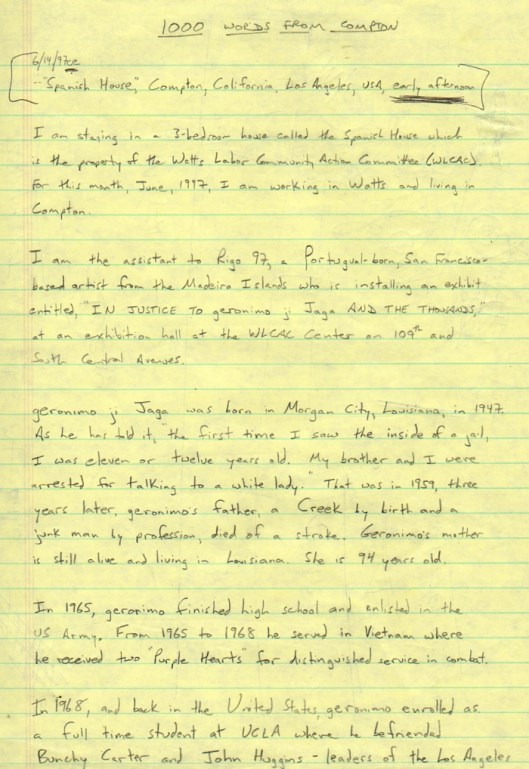
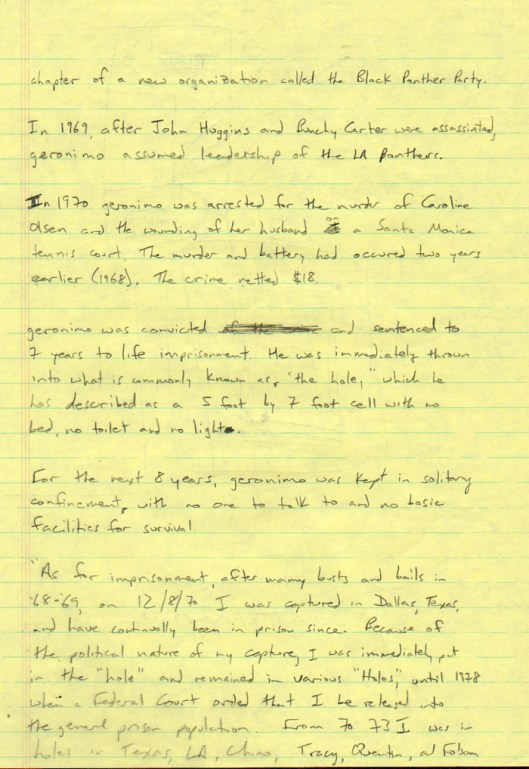
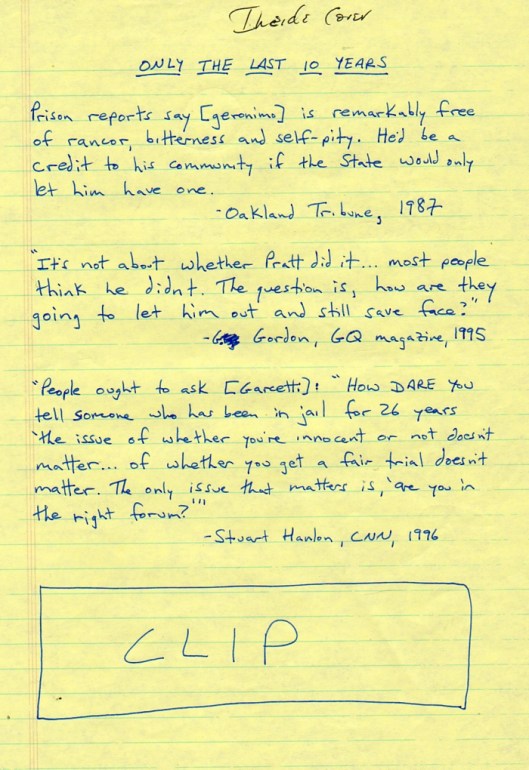
1000 Words From Compton

14 Saturday Jun 1997

Posted by mtk in installations, Los Angeles

≈ Leave a comment

Tags

1000, 1997, angeles, art, Compton, geronimo, house, installation, jaga, ji, Karthik, los, mtk, pratt, pre-release, protest, Rigo, Rigo 97, Spanish, words

1000wordsCompton001 1000wordsCompton002 1000wordsCompton003

Protected: Stab at a True Memoir

05 Wednesday Mar 1997

Posted by mtk in journal entries, S.F.

≈ Enter your password to view comments.

Tags

1997, autobiography, Karthik, memoir, mtk, san francisco, sf

This content is password-protected. To view it, please enter the password below.

Prologue to my first novel, Mood

18 Saturday Jan 1997

Posted by mtk in fiction, S.F.

≈ 1 Comment

Tags

first, Karthik, m.t., Mood, mtk, novel, prologue, san francisco

Mood

(A Fortnight of Lies & a Truth for the Profoundly Sad)

Our dreams and longings cover deeper dreams
and longings in the silence far away
All things on earth, sweet winds and shining clouds,
waters and stars and the lone moods of men,
are cool green echoes of the voice that sings
beyond the verge of Time

–Harindranath Chattopadhyaya

Once, upon a time before numbers, many things occured in harmony …

… a man sits upon a hill unaware.  He is conversating with the moon.  Get comfortable it says.  This will take as long as it takes.  Timing is everything.  And nothing at once.

Just a moment –

The sun kisses me that I should be incapable of this murmurs the moon.  Smothers me in his bright ker-shmack-a-dahs that I should be unable to share with you these whispers regarding the question you are.  (Who are you?)  My airless breath is caught in his kisses but my cold, cratered soul sings on the sly.  So take measure and begin:

Temporarily I shall have to suspend the thunderous rhythm of the train of my fates though it has built steadily in momentum toward a point at which its power nearly supersedes my own strength to arrest its churning wheels.  I am full-on the brakeman (of my own invention) and have barked at the conductor to fasten loose baggage and the hatches in every compartment.  Fortunately the only remaining passengers are fast asleep or dead or deserve whatever violent surges and upheavals which this accounting and recounting and inventorying may produce. They can handle it.  They climbed aboard of their own volition (not free will but theirs all the same – unique will)  and have had clearly pre-ordained opportunities to dismount, to unboard from this passage at station after station over the terrain of life.  The stops have been regular and timely.  Scheduling complaints have been few.  Until now.

Those who are left must have some taste for the ocean and for change or they would not be here at all.

Change is here.  Tempo rarely.

This whistle-stop panegyric will end geographically in the lap of our mother Pacific, although temporally (not rarely, temporarily) it will have begun and ended over and over in times too many to number.  Holding on tightly to its corners, edges and pages is not recommended.  They are paper thin and likely incapable of supporting even the slight weight of soulless fingers much less the blood-filled, knuckled meats of a mortal variety.

(But fast, already I am skidding.  Hold, I halt more aggressively or it will all be as it will be without the benefit of observation, without the curse of remembrance.)

Forever this will have been the American century. A has-been falsely named for a wandering Italian whose public relations skills far surpassed those of his peers. Whose marketing skills predecessed the creation of this capitalized time.

And forever stories such as mine will be contrarian.  Infinitely untold they will remain guerrilla legends of a history unknown. So listen to the invisible voice, hear the reason of the pulsing millions who live in the shadow of a great white hope perpetuating existence solely (soully) for the sake of each moment, each split-second of time; those for whom being is (and history is not) …

just a moment-

Some once-sleeping passengers have risen to the change in velocity.  They have acknowledged the alteration of tempo and have felt the impending nature of the hard-driving tone of this ride.  They must be resettled.

Sleep, sleep dear souls.  Lie down and sleep.  The time to awaken has been predetermined, but that time is not now.  This rattling about has been caused by my own unctuous wriggling. Me? Why of course, I too shall shall set to sleep.  Let me coax you into your own places first. Let me tuck you in.  Would you like a story? I am filled with stories Scheherezade herself would rub heavy-lidded eyes to hear.

Once, upon a time before numbers, many things occurred in harmony, among the first of which were the alternating cries, chortles and deep-sucking breaths of a newborn child. Prior to the child’s emersion from it mothers womb many days and nights of worry and consternation had been experienced. The child’s mother had suffered from a terrible, feverish anomaly in recent weeks due to the repositioning deep within her of an ever-hardening clot of cell activity which was fast becoming a cyst.  The cyst grew to a point at which the lives of both mother and child were jeopardized by the presence of the willful collection of necrotic cells.

Many prayers were whispered and sung.  Healers came from far and wide to the bedside of the mother who was to bear the child and- with support of neither husband, family nor friends –  whose will flickered and faded like a soft-glimmering candle, whose wax has become a mere pool of melted oil, whose wick has burned out.

It was therefore with great joy that the healthy birth of the woman’s daughter was received only to be followed by the deep sadness of its subsequent orphanage. The child was named after her mother and for the world from which she had come. The child was forever marked with foreignness.  Her name was Soleta.

Soleta entered into an orphanage from the time she was strong enough and able enough to leave the hospital where she had been born.  Years later, her earliest memories of the traversing which then occurred – for the hospital was quite a fine one and the orphanage rather not – were of a terrible trip by rough roads from a place of austere and sterile beauty – a place of solitude, to a place teeming with little lives; viruses, insects, rodents, a few adults and dozens of homeless, parentless children.

Soleta had been born and upon entering the world was thrust promptly thus into societal life. Into a society which was not even her own.

Now we must take pause to remember that many other things occurred in harmony with these events which we have chosen to follow in such a fashion.  They are merely events which occurred – nay, are occurring – while time proceeds down its umpteen paths.  Many other children were born, many other women died.  And men, too.  There were great upheavals in households throughout the world.  Arguments and love affairs took root, blossomed and bore vengeful fruit in these few subtle years.

To her credit, Soleta came during the years of this period of spiking change and flux to realize how temporary these years were. She was cognizant of the futility of an attempt – even at such a young age – to grasp for firmament which would not be forever altered within weeks, days, or hours.  She did not waste her time with names for she knew names are temporary.  She was a loner.  In her patient way, she grew observant and quiet and waitful.

Soleta’s sense of awareness had been so finely attuned that on the occasion of her 16th birthday she was possessed with a powerful assurance that the period of change had ended and it was time for her to begin. Of this she had no understanding save that a beginning was to take place which seemed to her by a process of elimination more sound than an ending and less confusing than a middling.  (Though in truth her beginning was postdated, as this middling and soon an ending, too.)

Now, it must be said that the child faced a monumental task to the point of her sweet teens.  Indeed a stranger born in a foreign land with neither parent nor guide to a culture which was not her own and under the pressure of such an intense period of flux in the course of herstory might be quick, nay would know no better than, to adopt local customs, traditions and morays if for no other reason than for the comfort and solace of companionship.

Soleta however was led by the truths of her own blood and by the ghost of an ancestor of whom she would never hear one word spoken in her lifetime and from whom the power to resist perpetually swam through her veins striking down insistent, itinerant foreign agents like a one-man army of antigens.

(yes, it was a man. And a powerful man indeed who could traverse both time and space despite the will of the child’s mother – Soleta the elder – to assert such control)

And so it came to pass that Soleta the younger learned the language of her adopted culture reluctantly.  Learned their words for things right and wrong, would establish an understanding of the names they had for things good and evil but would never for herself feel an indebtedness to any of these names.  Her linguistic skills far surpassed those of any of her cohorted orphan’s for she was unencumbered by the need to divine truth from the words she was taught.  She sailed along untethered to the concerns that other children had.  She never asked, “But … why?”

Why not?

And so empowered with a language which was not her own and knowing no truth save that truth was elsewhere (and feeling somehow an insistent pull and protection from within her spirit-filled veins) she packed a small valise and on the eve of the 16th anniversary of her birth departed from the only place she ever remembered.  And set sail for her fate.

And now she is on this train fast asleep.  Forever 16.  But we shall here more from her.  Be patient.  You see now, this is the freedom express. This is the train of what was and it barrels toward the land of what may be.

Maybe.

Or perhaps not.

The shaken passengers sleep now.  Night has fallen and we make our way at a more regular rhythm.  We are slowing and it will be only a matter of time now.   Temporal matter scatters itself throughout this trip.  The chalky dust from the crumbled remains of bones kicks up in the light of every switch flipped or matchlit spark.

I must speak of life in a colder light. For now it is night and the dead rise from within the train.  Soleta the elder (once dead, now once here risen) has come to the dining car where she pulls with full, red lips at chartreuse and absinthe in alternating sips.  She sits alone and hopes for no company though she knows it futile.  She wishes death were more solitary.  Less crowded.  “Living had its benefits,” she murmurs thinking of quiet Sunday mornings before … before …

With a click and a slide of the car door which allows in the rushing air, the doppler-shifting downward pitches of our slow-grinding halt … halt … who goes there?

‘Tis the East for whom Soleta the elder is not the sun.

“Oh.  Sorry.  I didn’t think there was anyone else here,” the East begins.  Soleta the elder smiles wanly and waves at an empty barstool, at empty tables and chairs.  She knows soon they will be full.  At least until the dawn.

The East is weary.  Etched in its moonish face (since death the sun no longer rises in it) are pockmarks of an eternity of experience.  Histories cratered and unimaginable.

The arms of the East are weak and thin.  (Some years ago its hands atrophied from lack of use; withered until they became like six stumps dangling from six, thin, unmuscled arms. It appears tentacular now, another victim of the arms race, as it takes a seat at one of the crimson, velvet booths which align walls of the dining car. It looks out at the night and sighs. El Ultimo Suspiro del Este.)

Yama the Death God rides his horse through the car.  Clattering hooves cacophonize against the slow-braking train and send plates and glasses into tinkling showers of shard.  The car is crowded with the stench of rotting bodies.  The long-ripening redolence of stale, dead aspirations fills the air.

My parents are here.  My grandparents and greats.  But none of them disturb me.  They do not even acknowledge me.  They are unsure of my blood. They do not believe from my actions that I am of them.  Some are convinced I am an impostor put here to satirize, to libel the family name.  Would they had fingers they would write the train themselves.

It brakes hard.  Momentum is fading.

Soon comes the dawn and a brief respite before my lecture.  My final oration.  And eventually, with a last toot of the blasted horn, the end of the line – la mer.  The death train ends its trip.

It is time to break fast.

Good morning gentle ladies and men, esteemed colleagues, family, friends and enemies mine.

Finish your coffee and dough knots, bagels and fruit.  I will allow for your digestion but I must finish before we come to a complete halt which by my own calculations will be within the hour.  Our mother Pacific awaits our return.

I would like to take a moment of silence first for our dearly departed conductor, who passed of old age sometime in the night, and to the brakeman who – his arms having been rent from his body – has locked the brake into position with his legs but has subsequently bled to death.  Their sacrifices have been immeasurable and I look forward to seeing them on the return trip by night.

(beat)

Champagne.  Everyone.  Please. The long, dark night has ended.  The dead are behind us and we arrive at the beginning.  Soon.

The title of my lecture today as printed upon your programmes is, “Linear Models of Time and Space in Dilated-Locomotive Physics,” and for those of you who thought you could make out or wondered over the subtitle, a confirmation:  yes, it does read, “(narrative form)”. (laughter)

I take as my fundamental assumption the fact that we speak the same language at least insomuchas everything I say – have said, will say – is comprehensible.

We are all murderers and prostitutes.

Soon this train will come to a halt and we shall face our mother with newborn eyes.  She will see within you.  She will know you for your true self.  Then, on high the sun will shine down upon the waters of the Pacific and standing here on the tall sea cliffs at the last train stop of the freedom train you shall know peace.  It shall be alit within you by the triangulated silvery sparkles of the sun on the deep blue sea.  The finger of the sun points directly at you alone in sprinkles of silvereen.

Our train comes to a halt now.  I shall sound the horn for your release.  Hear it friends, hear it blow and know that you are free at last, at last you are free.  And with this trip ended, love.  Love.  Your debts are paid.  Life awaits you.

California lays beneath the sound of the great whistle hoooooooooooooooooooooot.

Run, run, run, into the ocean.  Run to your mother Pacific and feel her cold fingers (running) in your hair.

Epilogue, poem

17 Friday Jan 1997

Posted by mtk in Coastal Cali, poetry, S.F.

≈ Leave a comment

Tags

after, entry, epilogue, finishing, first, journal, Karthik, mtk, novel, poem

January 17th, 1997ce 3:45 pm
Ocean Beach, San Francisco, California

At two o’clock p.m. on 17th January, 1997ce, I ended an experiment in documentation, exactly two years and two days from the experiment’s beginning.

I put an end to two years of work during which I spent the vast majority of my time – averaging five to seven hours a day – doing nothing but writing. The conclusion of the experiment occurred as a result of the act of putting the only existing copy of the novel I had written over the two year period into a black cardboard box and delivering it to Chronicle Books, a publisher of some size in San Francisco, at exactly two o’clock on that sunny Friday.

Then I went to the beach.

I consider the experiment in chronicling and documentation to have ended at that time.  I do not intend to revisit or change one word of the texts of the resulting documents which include the novel, many stories, poetry and a number of other notations and entries.

The following is the first entry in my journal which I wrote on Ocean Beach after ending the experiment:

You are a novelist and you have just ended your first novel.  The process in which you participate has borne a fruit.  And now, it is time to take the fruits of your labor to market.

What will the market bear?
How does your fruit compare.
to other fruits available.

Is it sweet?  Is it bitter?
Does it slake the thirst?
Does it feel cold and delicious
going down like a plum?
Is it dry and grounding, requiring
delicate effort like a banana?
or more delicate still
unseeding a pomegranate

What is the going rate for
fresh, ripe, delicious fruits
on the market which compare
to yours

Shall you ask more or less?

This is your position and
you feel you may be definitive
and yet you are afraid because
you have never sown & harvested
these seeds (brought them
to ripen) before.

Your fruit sits next to you
like a prize tomato and
just picked, plucked, fallen
and all you can think of is

how to better farm the seeds next time.
How to hoe the rows.
How to plant the seeds.
When?

And you realize there is no time.  You are beat.  The last harvest cost you everything and you are tired and hopeful for success @ the marketplace and you do not know what to do except to try to maybe relax … and take a break.

But even resting is duro … hard … difficult

This is an alone time.  And you notice your surroundings.  Sounds are amplified. The women talking at the table next to yours, the ocean, birds, music, poetry, … ART

painting

ALL     MADE

BIG!

Xmas Time and the Last Days of 1996

31 Tuesday Dec 1996

Posted by mtk in Coastal Cali, essay, journal entries, S.F.

≈ 1 Comment

Tags

airport, alicia, artist, artists, bergman, christmas, daniel, drive, east bay, freeway, Galvez, John, juana, Karthik, miranda, mtk, mural, oakland, rigo 96, san francisco, sfo, wehrle, xmas

The weather has been grey and wet.  Thick, dark, moody clouds hang over the Bay, and the water between the Golden Gate and Bay Bridge is green and grey and smoothed by high, grey skies.  There is neither fog nor mist.  Everything is different shades of grey.  Two storm fronts moved in last week.  The first came Christmas night and, the day after Christmas, the City awoke to rains.  It has been wet and damp and mucky.  And cool.

Friday morning there were sightings all up and down the Bay, of rainbows, double-rainbows and even, in the South Bay of a triple rainbow which spanned the Bay waters and ended in Oakland.  I saw the tail-end of one on Friday morning while waiting for the bus.  It stretched out over the top of the Rehab Center across the street.  A guy at the bus stop said it had been there for ten minutes.

This year, Christmas falls on a Tuesday and the New Year arrives on a Wednesday.  The work week’s are broken-up by the holidays leaving stray Fridays and Mondays to reconcile.  The Upper Management, The Owners, the Board Members, the CF and CO and CE O’s take the whole two weeks off while the workers are left to divvy up what remains of their sick days and vacation floaters from the aging year.

Offices in the financial district are composed of skeleton crews of bored staffers who find tedious, long-undone tasks to accomplish to kill the 9 to 5 on the lone Monday or Thursday they have to come in on.  “What’s the point of being here?” they ask with half frustrated, half-commiserating smiles as they pass one another in the halls, as they re-organize the files in the storage area together, and alone.

I am working as a temp.  So in this season, it’s easy to find work.  I am covering for “sick” receptionists and office service workers at a law firm in the financial district.  From this view on the 32nd floor, I can see the whole North Bay from bridge to bridge and the thick, rolling clouds and the green wavy water passing Alcatraz, Angel, and Treasure Islands.

It has been raining off and on and when it does, vertical lines slash down from black clouds like bold strokes of a charcoal nub on the sky or hard etchings on the billowy blocks of clouds.

In the financial district, people rush about prior to and after Christmas in the wet, in the rain.  They run about in slickers and galoshes.  They wear overcoats and trenchcoats and hats and carry umbrellas.  They carry packages to and fro in the rain, some grumble, some move more slowly.  The latter seem to enjoy the season.

*****

Downtown is dead. The hard pavement of the narrow streets of the financial district, usually abustle with Friday afternoon activity, pre-weekend revelry, happy hours and excitement is quiet today.  The break-up of the season leaves this Friday straggling and searching for an identity.  There are the few workers who have to stay over the holidays and put in hours to keep the offices running.  There are a few temps.  But the streets are mostly empty and those who pass one another share a silent camaraderie on the grey sidewalks.

After work I caught the bus home.  It took a good long time for the 21 to come on Market Street.  There were six 5 Fultons and at least three 38 Gearys which came before even one 21.  Not to mention the innumerable 71’s and 7’s and two 31 Balboas which passed us by as we waited.  A man commented, “I should move to Fulton … it’d be easier to get home.”  We made jokes some then.  We were the waiters for the 21, wet and miserable, huddled under the bus shelter grim but chuckling.

The bus finally came.  It was full, standing room only even that far down the line (we were between Montgomery and Powell which is maybe three or four stops from the start of the line).  There was a second 21 just behind the first, so some of us waited for it knowing we could at least sit down.

Once home, I was drained and bedraggled.  Rain takes a lot out of me in the city streets.  My shoes were soaked through at the ends giving them a black-tipped appearance.  I hopped out of my musky, wet clothes and into a hot, invigorating shower.  I washed the grime out of my hair and off my skin and afterward made a turkey sandwich and sat on my bed watching the rain.

Saturday the rain broke for an hour or so in the morning and the sun peeped through the clouds.  I didn’t see any rainbows but there must have been some.  Saturday was uneventful.  The rains kept most folks inside.  There was football to watch.  The Cowboys beat the Vikings.  The Jaguars upset the Bills.

The rain fell quietly and the air was damp and cool.  The second front came Saturday evening.  I heard it arrive.  I was having a bourbon at the Lone Palm listening to the rain outside and killing time before I had to go to the airport to pick up Rigo 96 who was returning that night from a visit to New Mexico.  The winds were picking up and the bluster became audible.  I drew a little picture about men and women while sipping my bourbon and waiting for the time to pass.  The picture is in a little sketchbook/journal I keep in my back pocket.

Rigo’s plane was supposed to come in at 9:45 but the rain and the holidays have made so many planes late I figured I’d just call in advance.  I sipped my bourbon, drawing, and listened to people trickle in on this rainy night. I checked the plane and it wasn’t to come in until 10:15.  I contemplated another bourbon but passed on it.  At around 10:00, I left the Lone Palm and headed for the airport.

I was driving Rigo’s truck.  The turn signals were acting up while he was gone (the front ones didn’t work but the back ones were fine. I guessed it was bulbs or fuses but didn’t do anything about it).  I took Guerrero down to Cesar Chavez’s Army Street and turned toward the freeway.  There was a police car on Cesar Chavez Street three cars ahead of me in the next lane.  The cop car held up traffic in his own lane and waited for me to go through the stoplight ahead of it.  I changed lanes and passed in front of the cruiser and was progressing toward the highway entrance to 101.  I was nervous.  The back turn signals were fine last time I checked. I had clearly been singled out but I didn’t know why.  Just before the highway entrance, the cops turned on their lights signaling me to pull over.

I was driving a truck with no turn signals, which had no insurance papers (nor insurance policy for that matter).  I had no drivers license.  I had just finished drinking a bourbon and a beer and not three hours earlier I had gotten stoned on some California green (marijuana) at Rigo 96’s house.  I was carrying a pipe (paraphernalia) and a small, plastic egg which contained a small amount of pot.

I couldn’t figure out why the cops had pulled me over and I didn’t have a license, so as a cop approached the driver’s side window in the rain and turned a flashlight beam on me, I said, “What’s the problem?”  I wanted to gain the cop’s trust.  Besides I hadn’t done anything wrong visibly.  I didn’t know why I was being pulled over.

A male voice came from behind the flashlight beam, “broken headlight,” he said.  The broken headlight I didn’t even know about.  I had an inkling that the lights were askew one night last week but I just thought they were aligned improperly and besides I was only just running up to the airport. There are a lot of cops on the streets during holiday time.

“License and Registration,” he said.  By this time he was close enough for me to be able to make him out.  I looked him in the eye as he turned the flashlight away from my face and into the cab of the truck.

He was young – younger than me – and he had a freshly shaved face and a short haircut.  His uniform fit snugly and was pressed and cleaned.  He is white and sees that I am not.  I felt immediately as if I had an advantage over him in age and it should be expressed in language.  I was honest.

“Well, actually,” I said, speaking confidently, “I don’t have my license on me. It was taken.  And now it’s at the Austin Police Department.  They contacted me but … I haven’t had time to …O I trailed off.  I waited and the cop didn’t say anything so I continued, “The truck isn’t even mine.  I’m just going to the airport to pick up the owner of it right now,” I said pointing to the freeway entrance ramp (It was so close the FREE way).  “I have the papers in the glove box,” I said pointing at the glove box and starting to lean over.

The cop asks to see the registration for the truck.  I lean over and pull out the fat booklet of documents Rigo has left in the glove box.  It is full of old traffic tickets, traffic court hearing papers, and other stuff.  I have no idea what the registration papers look like, so I say, “I’m not sure, I mean is it the pink thing?”  The cop doesn’t say anything.  “I mean, I don’t know what the registration papers look like,” I say as I dig.

I pull out the first pink slip of paper I come to and start to hand it to the cop.  As I do I notice it’s a traffic hearing failure-to-comply notice.  I quickly return it saying, “No that’s not it … hang on.”  The cop has turned the beam into the booklet on my lap to help me see.  Then we both see it at the same time.

“There it is,” he says as I pull the registration papers out and hand them over.  As he is looking at them I say, “That’s my friend, Rigo.”  I think momentarily that Rigo 96’s name may not be on the papers. His name changes with each passing year.  Next week he will be called Rigo 97.  I do not like calling him by his given name in public, out of respect but I am kowtowing to a cop who is younger than me, so as he looks at the papers I say, “Ricardo …” and I trail off.  As he is looking at the papers and standing in the rain and cars pass by with a swoosh of water I mutter, “I didn’t even know about the headlight.”

The truck radio is playing Joe Henderson and the lonely tenor saxophone cries through the one working speaker with a tinny creeeeeeeeee.

“What station is that?” asks the cop. “It’s ninety-one, one,” I say, “The Jazz station … KCSM.”

“I like that station,” says the kid.

He hands the registration papers back to me and says, “What’s your name?”  I tell him my first name and he asks for my last name.  I know these names are difficult for him to understand and so I say them and then I say, “it’s sort of long but I have my passport if you want to …”

He says, “I just want to make sure your license is clear and then you can be on your way.”  I hand him my passport and he holds it out in front of me and riffles through it briskly and thoroughly. He holds it upside down and riffles.  I realize he is making sure there are no visa documents lying loose within it for which he might be held responsible in a court of law.  He looks at me and says, “There are no loose documents in here, right?”  I nod.

He returns to his partner in the cruiser as I wait.  The cops turn their high-powered searchlight on and the light immediately floods the cab of the truck illuminating my face in the bright rectangular slice off the rearview mirror.

I look over at my bag sitting next to me and know the pipe and the egg with the dope in it are sitting quietly in the outside pocket.  I am warm despite the rain. Illuminated, I take off my seatbelt, and my jacket.  I dig a black, rubber hairtie out of my pocket and tie my hair up.  I know this makes me appear less threatening.

The cops are looking up my license based on my name off the passport. I sit hoping there are no violations.  I don’t think there are but nothing is for sure.  After all, the cops have just pulled me over slightly high, after drinking a bourbon and a beer, with a busted headlight and broken front turn signals.

I think about Rigo 96 waiting at the airport until his name changes because I’m in jail and I laugh to myself.

The kid comes back with my passport and hands it to me.  “All right, get that headlight taken care of,” he says, and he lets me on my way.

When I got to the airport, there were cars and people crowded in at every possible exit.  The cops were crawling all over the place making people move their cars  from the loading zone.  I parked the truck in short-term parking because circling around the airport repeatedly with a broken headlight is just asking for trouble.

By 11:00, Rigo still hadn’t turned up, though his plane had arrived.  Checking my answering machine messages at home there was no notice from him nor anyone else, that he had missed his flight.  I checked the airline register and it showed him as reserved for the flight but the guy behind the counter had no way of knowing if he had actually gotten on it.

At about 11:15 I gave up and decided to head back to the City.  (Rigo 96 had missed his connection in Albuquerque and so he wasn’t at the airport.  My roommate’s girlfriend had spoken with him when he called and then left the information on paper notes by the telephone which I didn’t get until I came home Sunday morning.)

I was nervous about the truck and so I ended up going back to Rigo’s place and dropping it off.  I took backroads.  In front of his studio, I parked the truck and leaped out and stood next to it laughing.  Free at last.

Afterward I caught the 14 and went to Cafe Babar where J. was working and had a few beers.  I wanted to wind down from the police run-in at the airport.

We hung out and played pool.  T. and I smoked out together and I helped them clean and shutdown the bar.  We had a couple of beers.  Later, I shared a cab with J. who lives in my neighborhood, and went home.

*****

Sunday, I got up and Rigo 96 called from the airport.  He told me his story about missing his flight because a man at the airport gave him wrong information regarding his connection. I told him my story about the cop and his truck.  It was still raining and we agreed it would be a bad idea to try to drive the truck out to the airport without lights.  Rigo had to catch a bus to my house because I had his keys.

Rigo 96 got to my house and we went to lunch at Art’s Barbecue.  The 49’ers were playing the Eagles in the playoffs and a television in the back of the little joint was broadcasting the game.  It was still raining and blustery.  The field at Candlestick Park was wet and muddy and the conditions for the game were terrible.  Rigo and I sat and had lunch and chatted about a number of things.

After lunch we walked in the rain down Church Street until the 22 came.  We boarded it and rode down to Mission Street where we were going to transfer to the 14 to go to his house.

Before the 14 came, I bought a December fastpass off an old guy standing at the corner there at 16th and Mission.  The guy sold me the pass for $2.  There were only two days left in the year, but the fastpass is usually good for a grace period of three days into next month and I knew I’d be traveling downtown on at least the last two days of the year to temp in the law office again so I’d save money (at least $2).

We went to Rigo’s place and he checked his messages.  Some friends of his were having a dinner get together in the evening in the East Bay. The group was comprised of artists and painters of some of the most famous and beautiful murals of the last twenty years in the Bay Area, Los Angeles and beyond.

The tradition of mural art in San Francisco is old and includes in its history the period after the turn of the century centered around the Mexican Revolution when Diego Rivera was living and painting here at places like the San Francisco Art Institute.  Rigo, a graduate of that same school, was asked to bring slides of some of his own murals to the dinner party.  The artists were planning to share perspectives on their work after eating.  Dinner was to be centered around turkey lasagna.  Rigo invited me to join him and I was happy to accept.

It was still early in the afternoon and dinner wasn’t until 7:00, so we decided we should make the pickup truck drivable because we were planning to be on the Bridge at night and it wouldn’t do to have the headlights out.  We smoked a little pinner of a joint, grabbed up a couple of screwdrivers and went to the auto parts store.  We bought new bulbs and some transparent reflective tape and were able to fix not only the headlight but the broken turn signals as well.  We did the work in the parking lot of the store.  Just as we turned the last screw in the headlight to align it, the sun was going down so we ended up needing the lights for the drive home from the auto parts store.

Before we went to the East Bay we went to see one of Rigo’s friends who was also having a party that evening.  C. has a studio in the SOMA-area called Refusalon.

C’s own studio is a narrow little job and clean and sparse with art on the walls.  We chatted with C. and his friend H.  They had a beautiful dog named Sally there.  She has enormous black eyes and a beautiful face and disposition.

We visited with C. and H. for a few minutes.  We got to see some of C.’s work and it was quite nice.  There was a carved wood piece which I particularly liked.

Rigo told me that C. had an enormous Cadillac which he had obtained from another artist some time ago. He had organized a group of students he was teaching to assist him in making an art piece of the car.  The Cadillac was covered in pennies.

C. told us he had the Caddy parked out behind the studio so on the way we drove around to the parking lot to check it out.  The Cadillac has a brown hardtop shell which comes midway over the backseat.  Other than this part of the Coupe De Ville, every inch of the vehicle is covered in copper pennies.  The pennies have been affixed to the paint job permanently. The license plate reads, “0 Cents”.

After visiting with C. we headed out to the East Bay, headlights and turn signals intact.  The party was to be held at Daniel Galvez’s house in Hayward.  The house is located on a hill just below the Mormon Temple which predominated the view.  The Mormon Temple is a huge, brightly-lit, gleaming structure, with four towers, one on each corner with reddish-orange, glowing orbs atop them.  It also has a larger tower at its center with a dome of the same coloration.

Coming over the hill to Daniel Galvez’s house, the temple is extremely well-lit due to the holiday lighting and so it looks strange and exotic.  It appears from some angles like a great, white insect with orange, bulbous projections at the end of its angled legs.  From another perspective, it looks like an alien spacecraft from a science-fiction rendering.  The building is trippy-looking.  We stare at it in the rear- and side-view mirrors as we smoke-out on Daniel’s street.

Daniel Galvez is a muralist who has recently been commissioned to do a mural at the site of the assassination of Malcolm X.  The commission was the result of a highly-prized competition and is worth some honor, prestige and money – the latter being a rare commodity for muralists or artists in general.  Daniel was chosen on the basis of a proposal he sent to the competition.

The party is already rolling when we arrive.  There is food and drink and everyone is milling about and chatting.  There are maybe a dozen of us.  Some of the best muralists in the area are here.  Besides Daniel Galvez, we have Miranda Bergman, Juana Alicia, John Werhle and Rigo 96 in the house. Ed Casal will show images of his work as will a visitor from Cambridge, Massachusetts (named J.), whose work has appeared on walls in that area of New England, USA for 15 years.  Daniel arranged this evening to allow J. to get an idea of what sort of murals are being painted on the West Coast, in the Bay Area, by local artists.

The assemblage of talent, energy and motivations in this house is historic. The work in the house itself is quite nice, also with paintings and drawings and sculptures representing a number of artists, present and absent.  Daniel has recently bought the place and it has a layout which includes a huge 20 by 20 foot studio in back of the house where he can work.  Daniel showed us a number of the computer-composite images he uses to make proposals for projects.  They included a design for a mural on the history of Chinese Immigration to California.  Daniel uses the computer to cut and paste images into a poster- or banner-sized representation of a particular mural.  Later, when the mural itself is designed, the images he has appropriated for the banner are replaced with actual people.  (friends, relatives and influences are often represented).

Dinner was a treat.  The turkey lasagna and baked ham were tasty.  There was a carrot-ginger soup which was really strong and delicious. There was salad and wines and a delicious persimmon-pudding pie for dessert.

After dinner, Daniel asked each of the artists to give him their slides to put into a carousel and we settled down to look at the work. The artists selected slides from their collections and pored and picked.  It was fun to watch them choosing works.  They seemed, despite their years of experience and their past successes, nervous to limit and choose and delineate.

The work is glorious. It spreads across bridges and under passes.  Along highways and walls. Up the sides of buildings and around corners.  Inside and outside.  There are many images and paintings I have seen before, have passed while walking through the streets of the City or cruising by on Muni.  There are many different representations of hard work and political activism.  Friends and helpers and assistants to the muralists who have worked side by side with them for years are here, too.  They call out names of faces they recognize in the works, “Hey is that your daughter? … That’s John, right there …”  The images bring back aging memories of hard work and fun times.

Miranda and Juana’s portion of the group mural project at the Women’s Building (on 18th street in the City) were shown.  The beautiful work by John Werhle in a public library in Northridge (down in L.A.)  Rigo’s big signs.  Paintings by Ed Casal.  The images were fast and furious and we looked at them for over two hours and didn’t even notice the time passing.

The discussion between the artists about techniques and materials was lyrical and beautiful to listen to, though without being a muralist it was difficult to understand (about chime and oils and cement and acrylics and panels and MDO board – all kinds of talk).

There was a feeling of camaraderie in the room and an open appreciation for the monumentality of these tasks (“the women’s building murals took thirteen months,” Juana says and silence fills the room), and for the true beauty of the works.

But there was an edge in the room of realistic cynicism.  Each of these artists struggle and fight against the continuing frustrations of their craft:  lack of funding for new projects, lack of funding for reparations and maintenance of old projects, the careless destruction of their work without their consent.  Then there is the underlying fact that the work is often ignorantly underappreciated.  Passed upon daily by blind eyes.

I feel that these people, muralists, are, have been for twenty years, more, decades, among the more courageous and beautiful of us in this area.  They endure, have endured and continue to produce work with a verity and conviction which shines of an affirmative hope.  It is overwhelming to see all of these murals, all these feet and yards and miles of painted walls and ceilings and bridges and FREEways.  It is beautiful and a little sad.

John Werhle, whose contributions to the visual landscape mean (and have meant for twenty years) so much to so many, says he cannot get commissions in San Francisco.  He is a gentle man to speak with and to be near.  He has a quiet, self-effacing demeanor and a graceful style about him.  The work he shows is alight with clouds and egrets and waters.  It is peaceful and playful work.

Miranda Bergman: what a driven energy she is.  Her words come from her lips like scuds. She speaks firmly and with conviction about the problems in Nicaragua where she has painted murals with Sandanistan children and had her work painted over with grey paint supplied by Sherwin-Williams, USA, to the Anti-Sandanistan government.  She tells of organizing and painting murals in Palestine with three other Jewish women muralists because she wanted to show the Palestinians that “all Jews aren’t Zionists.”  She jokes and laughs cynically about her frustrations and speaks openly about doing instead of talking, about achieving instead of wondering how.

Miranda’s friend and partner in representing the women’s building project tonight, Juana Alicia is the perfect foil to Miranda.  She speaks in her quietly strong voice and shows images of The Women’s Building and images of Nobel Peace Prize Laureate Rigoberta Menchu (” … my name belongs to all women.  They got my name wrong, it’s Menchu-tum because like everybody I have a mother.”) whose image graces the top of one side of the building.  Juana tells us that Menchu-tum said when she saw the women’s building that she feels “women are finally being heard.”

Juana Alicia also shows pieces based on the works of Juan Phillipe Herrera, Chicano Poet (whom she calls softly, under her breath, in the dark as she shows her slides, “Laureate as far as I’m concerned.”) and the poet Lorna Di Cervantes.

And there are so many more works and stories.  The causes and statements and purposes and representations of unheard voices are numerous. As if the only way some of these stories will be heard is by screaming in 50 foot letters on a wall.

Rigo got up and showed images of some of his works, including the three Capp Street Project-funded pieces from Rigo 95.  The famous “One Tree” brings respectful commentary but “Extinct” and “Inner City Home” are more popular with this activist crowd.  Rigo shows one of his pieces about Geronimo Ji Jaga Pratt.  (Still in prison without bail – 1997ce – ed.)

One of the purposes for this evening is for Daniel to show his friend J, the muralist from New England, what kinds of work are being done on the West Coast.  These artists represent the currency of a living tradition of West Coast mural art which dates back to the turn of the century and Diego Rivera through to Chicano and Latin American paintings of the late sixties and seventies. The representatives of this culture gathered together to show their works is impressive.

For his part, J.’s works are quite impressive, too.  They are long and tall and broad works.  He has been painting murals for fifteen years and exclusively murals for the last four.  His work is all over New England.  But it lacks the political edge of the other artists here.  It is significantly more commercial and corporate-based work.

A comparison of these methods and treatments of art and corporate advertisement brings to mind an interesting issue: the paint on the walls is hardly a few millimeters thick, but the depth of the meaning can vary so much from artist to artist.  Those few millimeters can be as deep as a river of ancient resentment or as shallow as a sideshow pitch.

After the slideshow, the artists and guests asked Daniel to show images of his own work. In particular we hoped to check out the as yet unseen Malcolm X piece.  Our host was humble and kind enough to oblige us and our curiosity gracefully.

The Malcolm X piece was glorious. Daniel showed slides of nearly the entire process of creation, including sketches and composites, from black-and-white versions through to the final colored and treated piece.  A fantastic montage of images from Malcolm’s life and times blazed across canvases.  It was an honor to witness.  The awarding of Daniel’s commission was well-deserved.

After the party we all went our separate ways.  Rigo and I headed back to the City.  (We were going to check out the Mormon Temple, but they had turned out their lights already – “I guess without caffeine they go to bed really early!” we joked)

It was a nice drive across the bridge at night.  The financial district buildings were alit with Xmas lights. I have driven this drive by daylight before and seen Rigo’s murals from the highway.  It’s good to be riding with headlights and turn signals.  We stopped back at C.’s salon on the way home for a nightcap and apple pie. Sally the dog welcomed us and I gave her some of my slice.

*****

Today is New Year’s Eve and it’s still cloudy and grey.  It’s another of these straggling Tuesdays and the office here where I am temping is empty.  “Why are we here?” some of the employees ask.  There is talk about what plans people are making to celebrate tonight.  How they will ring in 1997.  Rigo’s name will change in 12 hours.  Tomorrow is College Football Bowl Day.

I don’t tend to celebrate holidays anymore. I used to go through the motions, but along the way they have drifted out of importance. I want to spend my time well and live well, but I feel untethered to many of these clocks.

I am thinking about those muralists I met and whose work I see everyday and who continue to struggle to do what they love to do.  They are brave and strong.  Women and men with drive, energy, motivation and purpose.  They make, they do, they achieve so much so that all of our lives can be improved, so that smothered voices may be heard.

The sun came and went, rains came and went, the new years came and went.  Time passed.  The tradition of mural art progresses and time memorializes it.  We are blessed to have among us a Rigo and a Miranda Bergman, and a Juana Alicia. We are graced to have among us Daniel Galvez and John Werhle just as we were to have Diego Rivera.

The onslaught of commercial uglification may continue but silently, as continually, the struggle against it trickles along.

–M.T. Karthik, December 31st, 1996

mantra

31 Tuesday Dec 1996

Posted by mtk in poetry, S.F.

≈ Leave a comment

Tags

1996, eve, Karthik, m.t., mantra, mtk, new, poem, year, years

In the new year … shit’s gonna be different in the new year
(repeat once every 365 days)

mtk, SF, 1996

Label

10 Tuesday Dec 1996

Posted by mtk in poetry, S.F.

≈ Leave a comment

Tags

1996, goo, gunk, Karthik, label, m.t., mtk, muck, ooze, retail, sale, slop, stuff, unit


This Unit Not Labeled For Individual Retail Sale
Ingredients:  stuff, gunk, goo, slop, muck, ooze, FD&C Brown No.9, FD&C Black No.23


mtk, SF, 1996

science, language and diversity proof

27 Wednesday Nov 1996

Posted by mtk in poetry, S.F.

≈ Leave a comment

Tags

1996, diversity, Karthik, language, m.t., mtk, poem, proof, science

LANGUAGE NAMES DIVERSITY.

SCIENCE IS LANGUAGE.

SCIENCE NAMES DIVERSITY.


mtk, SF, 1996

watching and watched

10 Sunday Nov 1996

Posted by mtk in poetry, S.F.

≈ Leave a comment

Tags

1996, Karthik, m.t., mtk, poem, watched, watching


There is a feeling of being watched.
Because of course, the watcher is watching.

But the watcher is the watched.

And yet the feeling persists.
Now the watching …


mtk, SF, 1996

come, It's Fall

01 Friday Nov 1996

Posted by mtk in poetry, S.F.

≈ Leave a comment

Tags

1996, autumn, come, it's fall, Karthik, mtk, poem

I’ve come

many times

mindlessly

in the fall

when autumn has fallen

into its “n”

and october

breathed its last “errrrr”

into the lush warmth

of my woman’s insides

and it often

arrives

with

a rusty leaf

a golden crispy crackle of yellowing green

that burns well in winterous weather

in my minds stoven pipes

coming into the world

melancholic

as

november

The Storytelling is the Important Part

31 Thursday Oct 1996

Posted by mtk in poetry, S.F.

≈ Leave a comment

Tags

being, important, Karthik, m.t., mtk, poem, story, storytelling, telling


The story telling is the important part
The story is the being is the telling.  The telling is the being is the story.  The story is the telling is the being.  The being is the story is the telling. The telling is the story is the being …

the being is the telling is the story.

Not The End.


mtk, SF, 1996

my lie(f)

23 Wednesday Oct 1996

Posted by mtk in poetry, S.F.

≈ Leave a comment

Tags

1996, Karthik, lie(f), life, m.t., mtk, poem

imagine if I were to collect every single word I wrote and saved over the last fifteen years and bound them into one very fat, long book.

I have dozens of stories, poems, journal entries, drawings, notations, thoughts,

words.

Suppose I were to collect all of this and then Bind it.

I could see an ordering using language (words are lies)

of my life.

of my lie(f).

Surviving the U.$.A.

20 Sunday Oct 1996

Posted by mtk in poetry, S.F.

≈ Leave a comment

Tags

1996, capitalism, counter, Karthik, mtk, sf, States, surviving, U$A, United, usa

In the US, temperance of desire is necessary more than anywhere else because here, laxity of this temperance is observed as a vulnerability and an opportunity for commercial intervention.

This subsequently leads to the inflation of false desires and the inflation of the value of insignificant temporal things.

mtk, SF, 1996

Can it?

17 Thursday Oct 1996

Posted by mtk in poetry, S.F.

≈ Leave a comment

Tags

1996, can, it, Karthik, m.t., mtk, order, poem, word, words


Can it be some other words? In some other order?

No. It has to be exactly these words.  In exactly this order.

No.  It could be any order.

mtk, SF, 1996

me, fucked

16 Wednesday Oct 1996

Posted by mtk in poetry, S.F.

≈ Leave a comment

Tags

1996, fucked, Karthik, m.t., me, mtk, poem

If computers are a fad, I’m fucked.
(me)
If computers aren’t a fad, I’m fucked.

If the Internet’s a fad, I’m fucked.
(me)
If the Internet isn’t a fad, I’m fucked.

mtk, SF, 1996

what am I doing here?

12 Saturday Oct 1996

Posted by mtk in poetry, S.F.

≈ Leave a comment

Tags

1995, doing, here, Karthik, m.t., mtk, poem, sf, what


What on earth am I doing here?
seeking control of the wrong things.
… just seeking control

lost

in a stupid place
in a stupid, stupid place,
lost.


mtk, SF, 1996

Marconi's First Words

28 Saturday Sep 1996

Posted by mtk in poetry, S.F.

≈ Leave a comment

Tags

1996, first, Guglielmo, Karthik, m.t., Marconi, mtk, poem, words


doesn’t matter what Marconi’s first words were.

He was only the first one to put them into another wave, another packet.

There are millions of ways unheard everyday.

So why celebrate one?

mtk, SF, 1996

The Law Regarding Suicide

23 Monday Sep 1996

Posted by mtk in poetry, S.F.

≈ Leave a comment

Tags

1996, faiil, Karthik, law, m.t., mtk, poem, regarding, succeed, suicide

The law regarding suicide:

you’re allowed to succeed
you’re not allowed to fail

you’re not allowed to succeed.
you’re not allowed to try.

mtk, SF, 1996

the long ing

22 Sunday Sep 1996

Posted by mtk in poetry

≈ Leave a comment

Tags

1996, ing, Karthik, long, m.t., mtk, poem, the

the long

ing

doesn’t hurt

it’s too long

to hurt

anymore

Moving Fast

01 Sunday Sep 1996

Posted by mtk in poetry, S.F.

≈ Leave a comment

Tags

1996, fast, Karthik, m.t., Moving, mtk, poem


Moving FAST

in the wrong direction

is tantamount

to moving slower than SLOW.


mtk, SF, 1996

← Older posts
Newer posts →

M.T. Karthik

Unknown's avatar

This blog archives early work of M.T. Karthik, who took every photograph and shot all the video here unless otherwise credited.

Performances and installations are posted by date of execution.

Writing appears in whatever form it was originally or, as in the case of poems or journal entries, retyped faithfully from print.

all of it is © M.T. Karthik

a minute of rain

https://www.youtube.com/watch?v=QYLHNRS8ik4

Top Categories

2022 2024 2025 Asia baseball beliefs birds Coastal Cali elections essay fauna flora India journalism landscape Letter From MTK Los Angeles music video North Oakland NYC performance photography poetry politics reviews S.F. short film social media thoughts travel

Archives

  • March 2026
  • February 2026
  • December 2025
  • November 2025
  • September 2025
  • August 2025
  • July 2025
  • June 2025
  • May 2025
  • April 2025
  • March 2025
  • February 2025
  • December 2024
  • November 2024
  • October 2024
  • September 2024
  • August 2024
  • July 2024
  • June 2024
  • April 2024
  • March 2024
  • January 2024
  • December 2022
  • November 2022
  • October 2022
  • September 2022
  • August 2022
  • July 2022
  • June 2022
  • May 2022
  • April 2022
  • March 2022
  • January 2022
  • December 2017
  • November 2017
  • October 2017
  • September 2017
  • August 2017
  • July 2017
  • June 2017
  • May 2017
  • April 2017
  • March 2017
  • February 2017
  • January 2017
  • December 2016
  • November 2016
  • October 2016
  • September 2016
  • August 2016
  • July 2016
  • June 2016
  • May 2016
  • April 2016
  • March 2016
  • February 2016
  • November 2015
  • September 2015
  • August 2015
  • July 2015
  • June 2015
  • October 2014
  • August 2014
  • July 2014
  • June 2014
  • May 2014
  • April 2014
  • November 2013
  • September 2013
  • June 2013
  • May 2013
  • April 2013
  • December 2012
  • November 2012
  • October 2012
  • September 2012
  • August 2012
  • July 2012
  • June 2012
  • May 2012
  • April 2012
  • March 2012
  • February 2012
  • January 2012
  • December 2011
  • November 2011
  • October 2011
  • September 2011
  • August 2011
  • July 2011
  • June 2011
  • May 2011
  • April 2011
  • March 2011
  • February 2011
  • January 2011
  • December 2010
  • November 2010
  • October 2010
  • August 2010
  • July 2010
  • June 2010
  • April 2010
  • October 2009
  • July 2009
  • June 2009
  • May 2009
  • April 2009
  • November 2008
  • October 2008
  • April 2008
  • January 2008
  • November 2007
  • October 2007
  • July 2007
  • May 2007
  • April 2007
  • March 2007
  • February 2007
  • January 2007
  • December 2006
  • November 2006
  • September 2006
  • February 2006
  • January 2006
  • December 2005
  • November 2005
  • October 2005
  • September 2005
  • August 2005
  • April 2005
  • February 2005
  • January 2005
  • December 2004
  • November 2004
  • August 2004
  • June 2004
  • April 2004
  • December 2003
  • October 2003
  • September 2003
  • March 2003
  • February 2003
  • December 2002
  • November 2002
  • October 2002
  • September 2002
  • May 2002
  • April 2002
  • September 2001
  • July 2001
  • June 2001
  • February 2001
  • November 2000
  • August 2000
  • June 2000
  • March 2000
  • December 1999
  • October 1999
  • July 1999
  • June 1999
  • April 1999
  • March 1999
  • October 1998
  • July 1998
  • June 1998
  • May 1998
  • April 1998
  • February 1998
  • January 1998
  • December 1997
  • November 1997
  • October 1997
  • September 1997
  • August 1997
  • June 1997
  • March 1997
  • January 1997
  • December 1996
  • November 1996
  • October 1996
  • September 1996
  • August 1996
  • July 1996
  • May 1996
  • April 1996
  • March 1996
  • February 1996
  • December 1995
  • November 1995
  • October 1995
  • September 1995
  • August 1995
  • June 1995
  • May 1995
  • February 1995
  • January 1995
  • October 1994
  • September 1994
  • August 1994
  • May 1994
  • August 1993
  • August 1992
  • April 1992
  • November 1991
  • February 1991
  • December 1988
  • October 1984
  • May 1982
  • July 1981
  • April 1977

Blog at WordPress.com.

  • Subscribe Subscribed
    • MTK The Writist
    • Join 57 other subscribers
    • Already have a WordPress.com account? Log in now.
    • MTK The Writist
    • Subscribe Subscribed
    • Sign up
    • Log in
    • Report this content
    • View site in Reader
    • Manage subscriptions
    • Collapse this bar
 

Loading Comments...
 

    Privacy & Cookies: This site uses cookies. By continuing to use this website, you agree to their use.
    To find out more, including how to control cookies, see here: Cookie Policy