• About
  • Fauna
  • Flora
  • Landscapes
  • Radio
  • sketchy stuff

MTK The Writist

~ Homo sapiens digitalis

MTK The Writist

Tag Archives: mtk

Before You Came, short fiction, 2008

28 Tuesday Oct 2008

Posted by mtk in fiction, NYC

≈ 1 Comment

Tags

2008, Before You Came, Karthik, m.t. karthik, mtk, short, story

The bed is relieved. Two lovers lie beside each other, weightless. Amber light from a street lamp outside falls through the open window casting itself across their splayed bodies painting their skin – his chest goes deep red, her shoulders, a canvas to the shadow of the windowframe – a perfect rhombus in pale orange. She puts her arm over him.

“All right,” he murmurs, “We do it.”

“Mmmm,” she hums into his chest.

They sigh in unison.

That’s how the decision is made. He does not hide his anxiety and she senses it but says nothing more. His lips are chapped and he picks at the dry skin. The movement jostles her. She wriggles, and turns away, already drifting off to sleep. He lies awake considering a temp job.

The next day she tells her assistant, Lucy:

“We’re going to do it.”

High morning sunlight blazes through her office. Lucy enters, closes the door, flattens the blinds, then turns on the ashtray. It was a gift — an ashtray that sucks smoke into its belly and diffuses it.

A gaily plaid-patterned pouch fluffs out under a black plastic tray containing the suction mechanism. It looks like a sporran pulled from the navel of a Scot or, when there’s more than one cigarette resting on it, like a tiny set of bone-white bagpipes.

“Well, now you’ve gotta quit,” Lucy comments, shaking a cigarette loose from the pack on the table between them. Jennifer pulls a lighter from her purse.

“Mmm,” she agrees, “this one’s my last.” She leans across the desk, lights Lucy’s, then her own. They smoke in silence. Jennifer rocks back in her chair as she puts the cigarette to her lips, then leans forward to exhale. It is quiet between them in the office – the barely audible crackle of the burning paper, the long, slow exhalation of smoke into the ashtray, the soft beeps of fax machines and telephones from beyond Lucy’s desk. Jennifer ashes.

“Well,” Lucy says, finally, “hope it’s a girl.”

The would-be father of her child sits on a bench in Union Square in a black overcoat with a wool scarf wrapped tightly around his neck; folded once lengthwise and then tucked into a loop made from halving its length — comme son ami Stan, comme un Parisian.

The scarf was a gift from Jennifer. He’d had it dry-cleaned only once: during The Horrific Autumn of the Void when Raj became convinced that noxious World Trade Center dust, porting asbestos and burnt humanity, had infected everything capable of holding it. He’d even rid himself of his beard, then. But it was back by winter – speckled with tiny white spacecraft each time it snowed.

Rajagopal Balasubramaniam americanized when he moved to New York, taking the name Raj Balas, because he felt it had a European feel. He was 19 then and the Mayor was a Jew – it was a good time to change your name.

When they first met, Jennifer thought it would be a one-night stand. In Raj’s arms, after that hot night, she said: “People from outside the U.S. aren’t put off by girls with a weight problem,” she said, “It’s like it’s not part of their culture to discriminate – or maybe it’s even better, you know, to have a little more on you?”

“You don’t have a weight problem,” Raj mumbled.

Since that encounter, seven years have fired by at New York’s inhuman tempo. They stayed together through four infidelities, three of which they discussed openly. Raj slept on the sofa fourteen times. Jennifer once left on short notice to stay with her mother in California but she returned after the weekend. They didn’t rush into things after nine-eleven, but knew then, for certain, where it was going.

It’s twilight in autumn when day darkens early and gray dusk speeds toward nightness – the hour of the shift change, when empty taxis return to their gates leaving tourists at street corners waving their arms in futility at yellow cars topped by bright white letters: “not-for-hire.” The city of New York breathes workers in and out – the drone bees of the great hive exhaled and inhaled, exhaled, inhaled.

In the park, Raj watches a woman in black moving fast against a stiffening wind. The woman runs to get to the subway steps. Traffic picks up.

<wheedley eedley eedley> goes his phone. “Balas,” he replies.

“Bigot!” whispers the voice of a shape-shifting creature known as a rakshasa. The streets are a tumult. There are chiseled cement barriers cast into the avenue, cracked and speckled with tar. A tattered leaf skitters across the stone surface of the pathway in front of him. It comes to rest near Raj’s shoe. “Admit it, at least,” hisses the voice.

Raj holds the phone still against his cheek. A zephyr passes over his face. The rakshasa takes the corporeal form of a gray-flecked, tattered thing that flutters to a landing on the sidewalk.

He pockets his phone. The pigeon steps cautiously, stretching the wrinkly pink skin on its knobby legs. A scaly sheen of iridescent violet and sea-green glimmers in its neck.

“And yet you profit from avoiding conflict,” it murmurs, “you hypocrite.”

Raj looks left and right. He thinks a pigeon is talking to him. The park fills with people en route to the subway. From the pocket of his overcoat, he withdraws a crumpled, white paper sack. He unwraps half a bagel, tears off a piece the size of his thumb and throws it down in the walkway. The pigeon pecks at it.

Several more birds gather, clucking and cooing. Raj feeds them. The light fades fast. The thousand thousands descend from high-rises into the concrete street, all the souls of city traffic, like leaves drifting down.

Part Two
Lucy was born into a large Irish family that shared a small flat in King’s Cross, London, in the early 1980’s. There wasn’t enough room for a happy family, much less one with her father at its root.

These days, she plugs headphones into a sixteenth-inch jack attached to a radiating plastic box on her desk each morning at 7:30, faces the monitor, the door and the telephone, takes a one-hour break for lunch, returns to her hemispheric chamber for five hours in the afternoon, and then pulls out of the jack at 6, like a stopwatch, <click>.

And she does it again the next day … infinity.

This has gone on for seven years.

Lucy is a vibrant human being who has evolved into a robot trained to respond when things beep and ring:

<wheedley-eedley-eedley>

“Creative.” she sings into the receiver,

It’s Raj: “Hi Lucy, what’s up?”

“I see us as huge, flat, irradiant disks,” Lucy replies, “enormous plates of data stacked on top of each other in a hierarchy of information access. We constitute our consciousness of what is happening in the world right now from the information marketplace, consuming only what’s available at our financial level – on our particular plateau. Nobody reads anything that isn’t on the Internet any more, so it all comes down to TV.”

Ten year’s in the industry, and Lucy’s voice has been whetted for the phone: cool and metallic.

“If you’ve only got TV, you’re in the ghetto where everybody knows the same false shit. If you’ve TV but no cable, you’re broke or the nouveau chic who cut the cable after 9/11 and ran out and bought a DVD player. You watch videos, claim they’re documentaries.

“If you’ve TV and cable – and I’m talking just basic, now, because news and information ride the basic and premium packages equally – then you’re on the biggest, widest disk of all. We shop together, eat out together, form opinions together in electronic media and real time everywhere-now. We watch the same shit on a TV mounted in the back of a seat on the airplane. Most of us have Internet access, which less than 10% of the world has …

“From our huge, flat socio-intellectual group it gets smaller – smaller disks of information consumers: satellite TV, digital, broadband, until you finally end up with the wealthy few flipping through free porn and catching Formula One live from Dubai,”

Lucy takes a breath, and in a series of quick motions, opens a drawer, pulls out a message pad and cuts the iTunes dj, midstream. “And these aren’t the Illuminati we’re talking about, Raj. These are the most powerful wankers on earth. Neroes, Raj, masturbating while Rome burns.”

In the park Raj shrugs back the chill, “I read the papers. Can you put me through, please?”

“One moment please.”

In her office, Jennifer stabs an index finger at the grey button marked “intercom” and immediately the office is filled with the airy sound of static, a plastic mic dangling in the wind.

“Hey,” she calls out.

“Goddammit, take me off.”

“What do you want?”

“Let’s celebrate …”

“I can’t.”

Cars swoosh by, a horn, in the distance, a siren. A heartbeat.
“C’mon, pick up the phone.” Jennifer takes a drag, eking out, “My hands are full here.” She exhales into the ashtray.

“When are you done?”

She sighs and flips her wrist to see the face of her watch. “I don’t know. Ten, maybe?”

“All right, look, I’m going to Gopal’s.”

“Look for pregnancy books.” Jennifer hangs up, then stabs at another line to call her mother.

“Hello?”

“We’re going to have a baby,” she blurts into the receiver. “We’ll start trying in the spring. It’s decided.”

“Are you getting married?”

“No.”

The dead nothing sound of the digital line between words, then the unmistakable sigh of her mother, “I’ll call you back.” <click>

Jennifer sets the phone down and immediately reaches for a cigarette. “This one’s my last.”

Part Three
Still radiator coolant in a puddle at the curbside bus stop shimmering electric green reflects the neon strip from a lotto sign in the window of the corner shop owned by the immigrant whose kid tagged “AMERIKKKA” everywhere after the buildings got knocked down.

Nobody here – where it’s taught early not to ask or tell too much – would say for sure that the Bush Mafia didn’t let 9/11 happen and most put up an American flag since it meant the Italians’d do business. Pimping and hoing continued at 96% efficiency while the legitimate economy tumbled blindly waiting for the murder of Arabs to save it.

Here, the same smells in an orderly way from the same places everyday, end in a mix remembered miles away as Brooklyn. Each twilight brings the sound of jet-fuel burning in the turbines of descending planes and a few hundred more people everyday. To see what exactly? New York died in the 20th century. The eleventh of September just sealed the tomb, neatly closing the era for historians. It was all so scripted.

Picture night over rooftops and chimneys. When everything is still, you see me. I am a New York night.
Ovid: There is, far above us, a way. It appears white at night and so we call it milky.

Picture a white skipping stone, pulsing, at night. That’s right, a satellite. See that skipping stone blipping regularly across the fluid blackness between the still points of ancient light that forms the great sea of time and space. I am the black sea upon which rests Ovid’s great white way.

On that first night of the new era, while you slept or tried to sleep, having nightmares or dreaming it all a dream, I was clickety-click, lickety-split, looking-climbing, seeing everywhere. I crept across rooftops from ocean to ocean, swam – one among billions of plankton – in the bitstorm on the infosea, avoiding whales of security teams: enormous beasts of agency drifting through the fluid ones and zeroes making as much useful information as stochastic noise.

I lay low, listening as they passed, singing their weird music that pushes them forever on. I became the white eyeball. Have you ever seen two men fight? I am a New York night and there is no greater authority on such matters. I host eight million egos. I catch a fight every shift.

There’s often a moment just before the shit goes down when it seems it won’t happen at all: a slouch in posture, a moment’s hesitation, the briefest instant of sanity or fatigue before the flurry of escalation that leads, ultimately, to assault. It might be a <sigh> that breaks the hard-built tension just before the nod, the push, the shove-jam-cock that ends with the <pop> of battery.

The deaths of 2,800 in my belly were the outcome of one such flurry of violent exchanges between the most desperate and the wickedest of the wealthy. The Oil Cabal Americans – whose religion is capitalism – drunk with newfound power from the success of their Millenial coup d’etat, spent the summer of ’01 baiting the fearless blackguards of the shadow markets over possession of dark crude from the shores of the Caspian Sea.

Then it was the spectacle on CNN worldwide, which means that there was a declaration of war all right, only it happened months before the morning of September 11. Perhaps years, decades and centuries come into it. Will we ever know?

No.

Instead we’re stuck with the birth of a fiction: the spectacle re-interpreted and woven into artificial jingo, accepted by at least enough people to let the war parade begin, middle and … will it ever end?

Part of the spectacle happened half a mile from the hard-angle of Gopal’s nose. It was spectacular right before his eyes. He stood on the roof of his North Brooklyn bookstore – where he’d watched the sun set a thousand times over the glittering Manhattan skyline, where he’d smoked a thousand joints after work over the last seven years – chin dropped to his chest, brow furrowed, staring in awe. He saw the fiery bursts, witnessed the collapse and the enormous hoary plume of ash, poisoned dust and rubble. He rolled a joint.

He’d have made a unique photo. His calmness from a distance linked him with no one. His hawkish South Asian nose was only accentuated by that perched posture on the bookstore rooftop staring at the nullification of the World Trade Centers. He looked more like a vulture than anything else.

Then Gopal went downstairs to watch the news. The kids had been let out of school and some of the teenagers drifted into the shop to hang out. Gopal told them their parents would want them home, and when the shop was empty, locked up downstairs, flipped the “closed” sign and went back up to the roof.

Jennifer was at her office when the second jetliner screamed past. She didn’t get back to the house until after 2 in the afternoon. She found Raj face down in his pillow and woke him with the news. He’d slept through the apocalypse.

They watched the replays of what had happened just half a mile away while he slept. They went to the roof. There they found Gopal, atop his, next door, smoking. They crossed over the flashing. It was Gopal who first said: “There’ll be backlash.”

Part Four
The First Gulf War never happened for Gopal, nor for his wife, Amrita. In May of 1990, just a few months before Bush’s Marines moved into Desert Shield, the newlywed Indian-American couple moved to Madras, she on a fellowship, he under contract. It was the month of the fire winds of Agni, that blow down from the slight eastern ghats across the desert of Tamil Nadu to the sea. Rajiv Gandhi hadn’t yet been assassinated. There was a drunken-ness in the fat, sticky afternoons.

They struggled with being Americans in India. It tore at their relationship. He drank late, often, and gave himself, swaggering, to Indian time. She found him condescending and patronizing and so was defiant when they went anywhere together. He thought her a hypocrite.

By April of the following year, while George H. W. Bush was declaring Kuwait a free republic, Gopal and Amrita were divorced.

Their families were generally unconcerned that a George Bush sought to crush Saddam Hussein and attack Iraq even then. Many secretly rather appreciated the cover that Bush’s war provided for the family misfortune – the hushed-up word and the secret bibliography of unmarried writers – “diworce.”

Bush the Elder’s war was declared over because it was bad politics. Amrita and Gopal called it quits for bad vibes. Late at night on a golf course in Bangalore, they made love, drunk, for the last time. Amrita pitied him and let it happen.

They moved back to New York and found friends who watched television at a frightening speed. Ubiquitous shrinking cel-phones led beep-beeping to workstations playing DOOM with three-dimensional range-of-motion in New York, capitol of capital – into which they leapt, single. Well, Amrita did: she went to grad school, married a Manhattan Jew, and became something of a demi-goddess; dark, silent and lovely set against all those white people, a broad-leafed houseplant whose curved palm wove its way into everything. She grew into the role. She and David rented a flat on the upper west side. Pukka.

Gopal meanwhile, moved to Brooklyn to tend the bookstore, Subbu’s Books. North Brooklyn pronounced it, “Soo-Booze”.

Subbu’s Books is a tall, narrow shop in a converted, ochre-brick row house at the end of a Brooklyn block that neatly separates two neighborhoods of different languages. Because of post-9/11 gentrification and development, the new customers are immigrants, artists, writers and film-makers.

Subbu’s sells newspapers, poetry, literature, magazines, how-to, nonfiction, a handful of first editions, calendars, selected best sellers, bookmarks, stamps, postcards and textbooks in Spanish, English, Arabic, Romance, Polish, Hindi-Urdu, Russian, Mandarin Chinese and so on. An image of the store’s founder, one V.V. Subbuswami, hangs, framed, garlanded, dusty, behind the counter. Today, Gopal, Subbuswami’s eldest nephew, makes purchasing decisions himself alone.

The block is silent but for the occasional whisper of rustling dry leaves on the asphalt. The birch out front of the shop has begun to turn; several leaves have achieved red and gold and a few yellow ones threaten to be the first to fall. Gopal hasn’t yet replaced the screens in the doors with glass and a thin, chilly breeze gusts through the shop. He props open the door to the washroom to sweep, mop and change the paper.

He was currently obsessed with American novelists of the mid-twentieth century, absorbed in a Van Wyck Brooks paperback of interviews.
After cleaning the toilet, Gopal picks up the paperback from the tank, closes the door and sits down to empty himself:

“In the summer of 1954, when he was forty, two years after winning the National Book Award in the United States for his first novel, “Invisible Man,” Ralph Ellison sat at Café de la Mairie du VI. In postwar Paris, with a group of expatriated Americans, he granted an interview to The Paris Review. It was his last day in Europe at the end of a well-traveled summer. He would return to the U.S. the next morning.

“I suspect,” Ellison said, “that all the agony that goes into writing is borne precisely because the writer longs for acceptance – but it must be acceptance on his own terms.”

Ellison, at perhaps the height of his freedom, embraced by some intellectuals and academics in New York and Europe at least, critically assured of his place in any history of the American novel – “Lolita,” would not appear until the following spring – continued:

“The Negro novelist draws his blackness too tightly around him when he sits down to write – that’s what the anti-protest critics believe. But perhaps the white reader draws his whiteness around himself when he sits down to read … he doesn’t want to identify himself with Negro characters in terms of our immediate racial and social situation, though on a deeper human level identification can become compelling, when the situation is revealed artistically.”

The interviewers describe the author as “overwhelming. To listen to him is rather like sitting in the back of a huge hall and feeling the lecturer’s faraway eyes staring directly into your own.”

Ellison, facing the literary attention of Europe and Euro-america, was direct and serious:

“The white reader doesn’t want to get too close, not even in an imaginary re-creation of society. Negro writers have felt this, and it has led to much of our failure.”

Gopal shits and reconsiders the text: “The white reader doesn’t want to get too close, not even in an imaginary re-creation of society.” He flips to the frontispiece. The little paperback had been published in the city, by Viking, in 1963; the exact year that, some thirteen thousand miles away, Gopal had fallen into this existence. “Too close to what?” he mutters.

When Raj arrives he tells Gopal: “We’re going to have a kid.”

“The aunties will have a fit if you don’t get married.”

Raj adopts a Valley Girl tone that he and Gopal once mocked, putting his hand up, palm out, “What. Ever.” He rolls his eyes heavenward. Laughing, Gopal reaches over and high-fives the open palm.

“How old are you?” he asks.

“Thirty-six.”

Gopal shrugs and returns to his paperback.

As Raj picks at the shelves, he and Gopal spend the afternoon trying out the sound of their new names: Gopal-mama, Gopal-uncle, Appa, Dad, “Pops” and so on.

Part Five

The rakshasa returns as an African-American male, 6’2″, puffy afro, in the alley behind the bookshop. Raj, who had slipped out back to piss in the street since Gopal had beaten him to the toilet, finds himself facing the demon dressed in an all-black sweatsuit with two parallel white stripes running down the pants leg. White, block, sans serif lettering is printed across his chest: HOUSE NEGRO.

“Will you please wake up?”

Raj mumbles like an idiot, looking up and down the alley, peering back over-his shoulder at the bookshop for Gopal’s piercing eyes. “What do you want from me?”

“Come clean!” barks the brother from another planet. The rakshasa looks at Raj in disgust, steps toward him. “Take your clothes off, man, we’re swapping.”

The near-silent alleyway drips invisible trickles of water. Several blocks away a garbage truck sounds its high-pitched, repeated <wheet-wheet-wheet-wheet> backing up to a curbside dumpster. Raj Balas is standing naked and alone on a side street in Brooklyn, his clothes in his hands, his cock and balls hanging out.

Later, Raj lays his dark hand upon Jennifer’s pale breast – como Neruda; un reloj en la noche. He makes tiny circles with his index finger around the shades of pink.

They share the row-house next door to Subbu’s Books. Their bedroom window looks out onto the tree-lined street. Opposite their building, the brick walls of a materials warehouse are tagged with graffiti: SOON.

“A pigeon called me a bigot yesterday.”

“I suppose it was only a matter of time,” she murmurs.

“I’m being visited by a demon. He says I’m a house nigger.”

Jennifer tenses: “I told you not to use that word in front of me.” She half lifts the sheets. “So what are you telling me?” she manages, “that your conscience is brown, too?” She rolls over, away from him, her long white back a wall of silence.

Part Six
On this day, a Sunday, they are expected in New Jersey for a garden party to be held at the home of Ramesh and Kalpana, septuagenarians who had emigrated to the U.S. in the same year as Raj’s parents and who had been close with his Uncle Subbu. “We were a Tamil family all alone here and they were Telegus,” his mother would say when he was young, with such respect and wonderment, “So, of course, Kalpana and I became like sisters.” Since his own father’s death, Raj had become closer with Ramesh-uncle and Kalpana-auntie.

The stems of chlorophyll-leaking leaves snap free, sending showers of technicolor shard drifting down to the earth, rusted and yelloween. Kalpana stands still, at the edge of the driveway on the concrete path leading to the door, looking out across the lawn.

Though she has been a resident of Northern New Jersey for the past thirty-five years, she’s never grown accustomed to the scent of fallen leaves soaked in rainwater. The damp odor clings to her tongue, hangs thick in her nostrils. She and her neighbors order the leaves raked before the rains come. They are stuffed into bags and marched to the curb, where they stand like squat dwarves, a family of Oompa-Loompahs side by side before each house in their neighborhood.

Kalpana and Ramesh live in a private community set among curving roads over a collection of hills covered in poplars, birches and oaks. Each home has a grassy, landscaped lawn with a copse of trees and a concrete drive connected by a sidewalk that runs along the road. A rectangular trail of grass between the sidewalk and curbside thematically unites each lawn.

From inside, she hears the phone:

<brrrrrrring>

Ramesh, tilted back in a cloth-covered easy chair in the living room, a few meters from the yellow Princess in the kitchen, makes no move to answer. The La-Z-Boy is an immense cavern around his frail, aging body. He is a tiny, thin South Indian man swallowed by a copy of The New York Times.

The recliner is positioned at an angle in front of a huge-screen television a few feet away. CNN is on, the volume unbearably loud. A second ring from the old yellow phone in the kitchen: <brrrrrring>.

“I’ll take it,” Kalpana calls out, making toward the phone. “Helloo!?” Her voice is hard-edged, high-pitched and grating. When she answers the phone, she always sounds slightly irritated, to dissuade the endless parade of telemarketers and scam artists but more, to put the fear of God into anyone from her family who might call.

“Auntie?” It’s the tinny sound of Raj Balas, swift in motion on a train marked New Jersey Transit.

“Aaaanh,” Kalpana says affirmatively, in a flat tone.

“It’s Rajagopal.”

“Aaaanh. Aaaanh,” she repeats. In the next room, the television blares. Kalpana glares at Ramesh, who remains in his chair, unmoving. “Who is it?” he shouts out from behind the Times.

“We’ll be there around 12:30,” Raj says.

Ramesh lowers the paper and looks across the living room into the kitchen. “Is it Lakshmi?” Exasperation crawls into his voice.

“Aaanh.” Kalpana repeats, to Raj.

“WHO IS IT?!” shouts Ramesh.

Flustered, Kalpana screams into the phone, “AAAANH!” On the train, Raj pulls the cellular away from his ear. She lowers the receiver, covers it with her hand and shouts to Ramesh, “Pah! It’s Rajagopal! Leave me alone! God!”

After Kalpana hangs up, she remains sitting at the kitchen table, staring into the living room at the vast, crinkly rectangle of the front and back pages of the Living Arts section that masks her husband. Ihe television blares. She says calmly, “He is coming with Jennifer.”

“Yaarre?”

“Jennifer!” Kalpana repeats loudly. “Che! Why don’t you turn that thing down?”

Ramesh lowers the paper and mutes the television with a finger to the remote. He looks across at Kalpana. “What’s he doing now?”

“He’s written an opera.”

Exactly 172 minutes later, Raj, wearing sunglasses and holding a gin and tonic, stands in Kalpana-auntie and Ramesh-uncle’s kitchen, opposite Prasad-Uncle, a 70-year-old Brahmin, in an open-collar and tee shirt, black polyester pants, who is shouting: “Krishna says, ‘I am God!’; Christ calls himself the Son of God! Mohammed, the Prophet of God. Only Krishna says, ‘Who is God? I. AM. GOD!”

A young boy runs past. Raj pulls his hips back and throws his arms out to avoid him, swinging his glass before him to prevent a spill, “Woah-ho!”

He leans back a little, pushing his free hand into his pocket; a maneuver meant to show deference to his elder with a demureness of posture in dissent. “but Uncle,” he begins, “I mean, the stories are metaphors told over and over creating a consensus on how we agree-”

“No,” replies Prasad-uncle firmly, “Consider Vyasa as a seat from which the story of God and man is told. It is the role of a man to tell, and of God to write – it is Ganapati who writes the story after all.

“But who puts the story in the mind of man? God. Every dream and notion is God’s first. Until it is written it belongs to God and only the enlightened can understand it.”

“And when it is written?” Raj asks.

“Then,” Prasad-Uncle smiles triumphantly, “it belongs to man.

Jennifer approaches quietly and Raj leans forward to kiss her cheek, whispering, “What a circular viewpoint.”

She slips an arm around him. “We’ve got to get back, babe.”

On the New Jersey Transit the atheist Raj Balas is suffering helminths. These particular blood-borne parasites don’t die easily. They swim in the veins for generations. The wicked beast manifests itself in all manner of hallucinations. Now it is auditory; an unending prattle in his mind as they speed toward Penn Station: “Faker, Fakir.”

Opposite him, Jennifer has fallen asleep, her full, white breasts gently rise and fall with her breathing; her shoulders sway left and right with the motion of the train.
Part Seven
Raj Balas’s opera characterizes Woodrow Wilson as a pedagogic Calvinist who led the U.S. into “the great war in Europe,” believing in an end to war forever and a new world order in which nation-states around the globe communicate in peace through ambassadors at a League of Nations Assembly.

The climactic moment transpires in the fifth and final scene of the third act, when the bespectacled, black-haired American President, a tenor, ascends an arpeggiated, slow-building, upper-register aria in the Oval Office.

It is the end of the war. Wilson has prepared a grandiose plan of reparations. The following morning he will leave for Europe. It is night. Wilson is in his bedclothes. First, the basses accompany him in drawn, syncopated half-notes. Their rhythmic pulse is picked up by the cellos, that push the tempo en pizzicato.

Wilson falls to his knees. The 14 points toward a new world order swell in volume as sectionals are added, from the strings to the woodwinds, the brass. The cellos persist, but their frenzied pik-pik-pik can barely be heard over the ensemble of instrumentation. The orchestra amplifies in a crescendo as Wilson climbs high above his clef into the effeminate heavens of the altos. He rises. The opera climaxes in the fervor of the Calvinist at the height of delusion. He stretches himself like a tautly drawn wire pursuing higher and higher pitches. He sings, “The world shall know a peace as never before / The brotherhood of man in shared holy contemplation …” a portrait of the American President overextended at the pinnacle of doomed hubris.

From the 14 points aria, the story tumbles down through the post-war years. The production arcs through the failure of the League of Nations, its blown Senate ratification, Wilson’s fall from favor with the public.

In the closing scene, the aged, beleaguered Wilson, making unattended whistle-stop lectures across the U.S., collapses in a heart attack on the train, raving madly about meaningful dialogue between all people on earth. And then he dies.

Winter brings calmness to the Apple. The shopping season ends. Mallhattan rests. Jennifer walks 23rd Street through a soft feathering snow. It is dawn. The silence is embracing. She is expected on an all-day photo shoot at a warehouse in Chelsea. Arriving, she finds Lucy outside, on a cigarette break.

Hugs. Cheek-kisses. Lucy mutters through the falling flakes. “How’s Mama-2-B?”

“Not counting her chickens before they hatch.”

“Hmm,” Lucy replies, flipping her cigarette into the gathering snow curbside, “Best not to put them all in one basket.”

For lunch at a German place in the central village, Jennifer orders beef and vegetable stew with potatoes, Raj, lentil soup and a beer.

“You don’t mind coming here, right?”

Raj stirs his soup idly, “No, it’s fine”

“Babe, I want to start soon. We’re ready.”

The tintinnabulation of silverware and words on glass, laughter from a table in the back. Raj stirs.

Jennifer puts her hand out across the table and touches the fingers of his left hand with hers. “I’m ready.”

They finish their meal in silence.

The rakshasa stamps around Raj’s subway car rattling through subterranean New York: a beast with wild fangs and spiky claws, it howls: “You are drowning in pollutants!” It is the dead of winter – 23 degrees (F) outside – but in a metal box under the East River, Rajagopal Balasubramaniam is sweating.

In Conclusion

The following day, in the middle of the afternoon, Raj and Jennifer take a long, hot shower together. Using the special sponge, he lovingly soaps her entire body and receives the same in return. The difference in the color of their skin is never more apparent than in these moments, their most intimate, delicious reprieves from urbanity.

It is the first time in many years – since the scare – that they have not used a condom. Before Jennifer falls asleep, this is the last thing she remembers Raj whispering, softly in her ear:

“… and then we’ll say … to our little baby:

‘That’s how it was when you came into this world.’”

M.T. Karthik, 2001 – 2008

written in NYC, Los Angeles, Japan, India and Oakland
Sonny Rollins, concert review, 2008

04 Friday Apr 2008

Posted by mtk in essay, jazz, journalism, reviews

≈ Leave a comment

Tags

2008, Berkeley, Cal, california, collossus, Colossus, Ishmael, m.t. karthik, mtk, Performances, Reed, review, rollins, sonny, the, The Colossus, Zellerbach

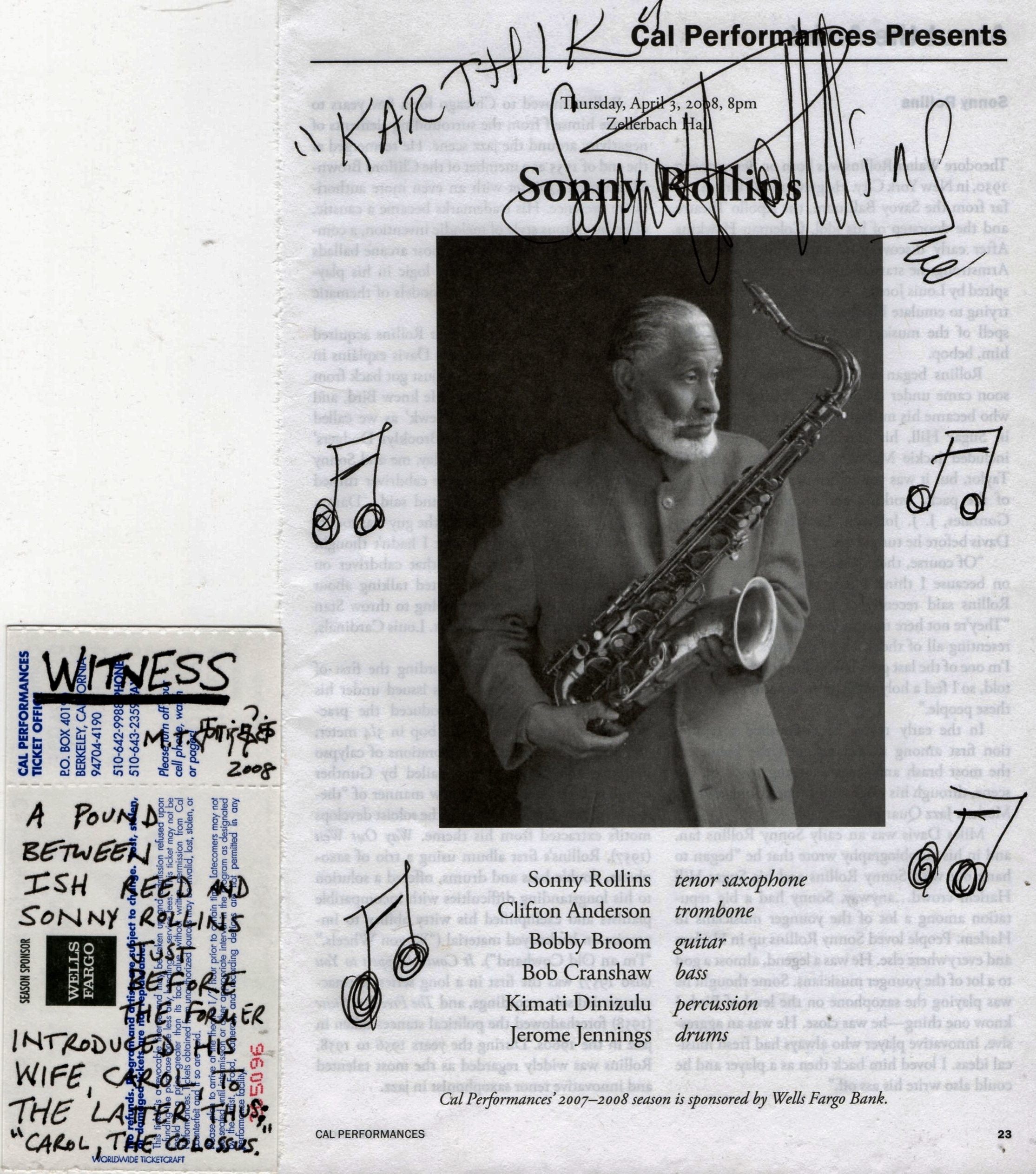
77-year old Sonny Rollins absolutely lifted 2,000 plus in a wowing two-hour set Thursday night at Zellerbach Hall on the Berkeley campus.

The gig was the first before a worldwide tour over the next two months for the tenor giant that includes Singapore, Japan, China and Rollins’ first trip to Korea. The group returns to the US briefly before moving on to Europe in the summer.

The irrepressible genius called tunes and blew glowing chord support throughout the show and was positively still energetic backstage – after two hours of uninterrupted performance. The Rollins feel remains, an unmistakably witty and stable voice in jazz and the sextet has found a dope new heartbeat in drummer Kobie Watkins who, churning the toms, created a pulsing drum-and-bass groove that Rollins, and all of us, felt. If they were strolling it would be sick.

Rollins’ broad tone blends seamlessly now with long-time collaborator, trombonist Clifton Anderson, whose fluidity is technically superior and, at moments, gorgeous. Rollins continues to experiment with African percussionist Kimati Dinizulu.

Highlight of the evening for me was witnessing novelist Ishmael Reed and Rollins share a fistpound backstage after the show, and hearing the former introduce his wife to Rollins, thus: “Meet my wife, Carol, Carol … The Colossus.”

word.

Some Thoughts On Film in the Last Five Days of 2007

01 Tuesday Jan 2008

Posted by mtk in journal entries

≈ Leave a comment

Tags

Allen, Downey, film, Gilliam, Godard, Jarmusch, Karthik, Kelly, Kubrick, Kurosawa, la jetee, Lee, Marker, Moore, mtk, sans soleil, Scott, shoot the piano player, Spielberg, Tarantino, Truffaut, Varda.Attenborough, Wong Kar-Wai

December 21-26, 2007
some thoughts on film after seeing:

Chris Marker’s Sans Soleil [1983] and La Jetee [1963]
Agnes Varda’s The Gleaners and I, and after two years [2000/2002]
John Cassavetes’ Shadows [1959]
Jean-Luc Godard’s masculin feminin [1966]
Todd Haynes’ Far From Heaven [2002]
Abbas Kiarostami’s Five [2004]

and late on the 26th adding – la double vie de Veronique by Kieslowski

– all for the first time.
and enjoying Jarmusch’s Dead Man [1995?] for the first time in a dozen years.

also earlier this year, in June, marks my first viewing of:

Godard’s Vivre sa vie and Bande a part [early 60’s: ’63, ’64 …breathless is ‘60]
Kurosawa’s Throne of Blood, Sanshiro Sugata and I Live in Fear [mid,late 50’s bxw] Fellini’s City of Women [early seventies]

Marker’s two works separated by 20 years and varda’s doc have uncommonly sharp and fluid writing, that merges seamlessly and profoundly with the audio and film – I find it confident.

Marker
Christian Francois Bouche-Villeneuve

Krasna is the author of the texts and the images (separately), Marker the editor, conceptualist. and choosing the woman to voice the thing is great third layer (nonlinear). she delivering: “he wrote” is mechanical-vox. AWESOME. [Kubrick’s HAL is a male, but tenor]

Sandor Krasna, Hungarian cameraman, b. 1932 in Kolozsvar, Budapest Film Academy made Erdelyi Tancok (Transylvanian Dances), and assisted in another film, left Hungary in 1956 (returned in 1966 does travel diary piece) chances to join with a volcanologist Haroun Tazieff (footage), travels, shoots Cabo Verde, Guinnea Bissau and Japan, where he stays longest and has a deep affinity for culture.

THE FELLING OF A GIRAFFE, the volcano claiming a town and images of his long years in Japan and visits to Africa, specifically Guinea-bissau and Cabo Verde? are the visually intense gems of sans soleil.

Marker’s contextualization of the letters of his cameraman is a masterpiece of editing but all of it is still less to me, now, today, 24 years later, than the wordless entirety of the felling of the giraffe. there’s IMAGE (seule) and TEXT (seule) … and then there’s crossing over into the merge and all the “infinity” that comes with it. But still there is this solitude right now, that exists – you can get people there … with footage, nearly raw, of the felling of a giraffe by rifle – for how many years more, we don’t know, maybe few.

Marker comments: “I write this in 2002, as a new wave is rising, of which my young comrades of Kourtrajme (french collective of actors, directors, writers, filmmakers) offer a heartwarming example, and which perhaps has already found its Breathless in Isild Le Besco’s Demi-tarif.” [[half price] made in 2002, young actress, maybe her only film, definitely her first. film about/involving youth.-helen]

and from the notes on Marker himself, comes this gem:
“… and quietly lending a hand to fellow committed filmmakers like Patricio Guzman, whose landmark film on the downfall of the Allende government, The Battle of Chile [1975], reputedly owed to Marker an indispensable gift of film stock.”

Kurosawa/Kiarostami
The intensely slow, long takes in Kurosawa’s Throne of Blood with a single move in the middle of the take (i.e. the wife moving slightly forward on the tatami mat and then stillness again), return with the stick on the beach in ONE of FIVE, Kiarostami for Ozu

Haynes
the period music in Haynes’ film isn’t from the period of the film. the male-male kiss here and her reaction is amazing. she is a genius. she is so good. how old is she?

Godard
by the time we get to masculin feminin, (hindsightedly) Godard’s conceit is played out: (fashionista, too chic) also, it’s all quite hetero-sexy and even the toilet kiss is played with such outsider

anti-vietnam punk, text blams all great. close-ups of cute girls (bo-ring). straight guys chasing cute girls (boring). sudden-gun-blam has become his trademark. by ’66.

Truffaut
December 30, 2007, sunday
just finished Shoot The Piano Player [1960]
Truffaut/Moussy [Goodis]/Aznavour

brill.
excellent passage when Saroyan’s wife lays into him for his “fame” and arrogance.
‘you repeat yourself ten times’

the flash to the fight poster just before the fight.

the too-slow before entering the impresario’s office to the wordless exchange of violin for piano music by the two musicians at audition

the flashback to his previous life as transition, fullness of this flashback (Pulp Fiction)

the “day that changes everything” starts with them deciding to quit. but it was the day that ended, the day before – when they escaped the bandits – that keys this.

a crime movie. an emotionless and sympathetic central figure (Bogart’s Rick).

and last night, December 29

Eternal Sunshine of the Spotless Mind [2004]
Gondry/Kaufmann/Jim Carrey
[Alexander Pope as delivered by “Mary”]
hammer to kid thing is a moment. weird running though the psyche stuff.
the magicality of it ends up linearizing a mental territory that has multiple dimensions – I don’t like this. even in science of sleep I find it sorta lame … too linear a dimensionality even with all its magical elements is still too linear a dimension to describe the mind – the psyche. point. and it smacks of creative dearth. an engine running out of steam.

Last Day of 2007
a list of my contemporary favorite feature length
films/movies/directors of the last 50 years

1. 2001: A Space Odyssey [Kubrick]
2. Singin in the Rain [Kelly]
3. Dead Man [Jarmusch]
4. Throne of Blood/The Bad Sleep Well [Kurosawa]
5. The Nights of Cabiria [Fellini]
6. Vivre sa Vie/Weekend [Godard]
7. Jackie Brown [Tarantino]
8. Bladerunner [Scott]
9. Shoot the Piano Player/Small Change [Truffaut]
10. Do The Right Thing/He Got Game/She Hate Me [Lee]
11. Crimes and Misdemeanors [Allen]
12. Blood Simple/Barton Fink/No Country for Old Men [Coen Brothers]
13. Gandhi [Attenborough]
14. The Gleaners and I [Varda]
15. As Tears Go By/Days of Being Wild/Chung-King Express [Wong Kar Wai]
16. Sans Soleil/La Jetee [Marker]
17. Brazil/Time Bandits [Gilliam]
18. Putney Swope [Downey]
19. Bowling for Columbine [Moore]
20. Minority Report [Spielberg]

Letter to House Speaker Nancy Pelosi, 2007

19 Monday Nov 2007

Posted by mtk in elections, public letters

≈ Leave a comment

Tags

2007, Bush, cheney, impeachment, Karthik, letter, m.t. karthik, mtk, Nancy, Pelosi

AN OPEN LETTER TO NANCY PELOSI, SAN FRANCISCO 2007
To: U.S. Representative Nancy Pelosi:
You are the only person of power we on the progressive left can approach, because of your position as Speaker of the House: you could re-structure the dialogue in this nation, and some would say you could single-handedly save it in a totally unique and American way.

We beseech you to ignore Republicans, Democrats and so-called Progressives who have conceded impeachment in toto.

Impeachment, Censure and Congressional Investigation allow us as citizens to monitor our leadership. They are important tools of state that must be exercised actively to keep balance. We feel you know this, but are being roped into a position of pseudo-neutrality by National and Federal pressures in your role as Speaker, and so, as constituents, here in the Bay Area, we urge you to reconsider, to take a new approach and to save this country from despotism.

Representative Pelosi, you will be greeted by a flood of support from the grassroots level if you take this on. You could revolutionize the argument. You could be the one in Washington who says, “This has nothing to do with the upcoming primaries or the Election of 2008 – this has to do with what this country wants revealed by this Administration now, before another can take over, before they are out of the reach of public accountability.”

Make History: We ask you to have a public change of heart and to step up to being the ethical and cultural conscience of our nation at this tense moment in history when this very unpopular administration has us poised to begin world war against Russia and Iran on bogus intelligence and false claims against another of West Asia’s ancient centers of culture.

The Cheney/Bush agenda for tactical nuclear strikes on Iran is aggressive, frightening and – exactly like the agenda against Iraq was – illegal, unconstitutional and against our country’s fundamental values. Yes, Ms. Pelosi, I am accusing them of lying and deceit in the engagement of their war in Iraq – the Persian Gulf War Two. I accuse them of great, staged manipulations in their idiotic War on Terror. Many at home and abroad fear greatly that they are engaged secretly in practices to do this again, thus: If we do not impeach Cheney and Bush then they will bomb Iran … with or without our sanction.

The only way to regain control of the U.S. American government from this kind of despotism is to actively promote transparent investigation of every single corner that Bush/Cheney has labeled “National Security,” to do the same with this War on Terror.

Demand the Administration open these to Members, in private or a special committee, if not publicly. Look into the requests of Constitutional scholars and others who see criminality in their behavior. Yes, definitely Investigate and Impeach Cheney; and be proud of taking this Bush government up loudly and on the record, because future generations will vindicate you. The lies, conflicts of interest and criminal acts are provable, apparent.

Bush, Cheney and the Neoconservatives:  Rumsfeld,  Ashcroft, Perle, Wolfowitz et. al., must be questioned. They have lied to the United Nations and our own people, and are universally being condemned for this. Our only hope is to show the rest of the world that our system here in the United States does have in place the means to check itself, when it is so obviously occupied by despots. That is what Impeachment and Censure are for. The world waits for us to take these people to task. Congress must open up the Bush/Cheney administration before it leaves office.

It is imperative to the future of our country that we force them to testify and tell us what has been going on in our name in their so-called war on terror. The successes they trumpet turn out to be staged and often involve terrified innocents. Their failures in Iraq and Afghanistan are riddled with criminal activities in prisons, in the field of battle and in the streets. There are hospitals and villages where our soldiers are feared and despised.

Please, Representative Pelosi, look deep into the future of this country, summon the courage and do what you do so well. Stand with your colleagues in the House who cry for Congressional Investigation of Cheney/Bush – that includes Impeachment and Censure, if necessary. It is an absolute necessity before the U.S.A. can pass one more law or engage in one more battle.

No, Ms. Pelosi, Impeachment, Censure and Congressional Investigation of Bush/Cheney have nothing to do with the Election of 2008. They have everything to do with the soul of our nation.

Respectfully,
M.T. Karthik

Iran is a Stone, poem, 2007

11 Sunday Nov 2007

Posted by mtk in Berkeley, poetry

≈ 1 Comment

Tags

answer, bear, china, crow, India, Iran, islam, Karthik, m.t., mtk, not, poem, problem, Russia, stone, tree, turkken, war, yemen

Iran is a Stone

Iran is a Stone

China is a Tree

India, a Crow

Russia, Bear

From Turkmen to Yemen

the sands are shifting

Sudamérica demuestra la dirección

Africa waits

Islam is not the problem

War is not the answer

F/A-18 Jet Engine Audio

13 Saturday Oct 2007

Posted by mtk in audio

≈ 1 Comment

Tags

2007, A-18, blue angels, F-18, F/A-18, m.t. karthik, mtk, san francisco, sf

At the Blue Angels Show in SF, I had just turned my brand new digital recorder on, set levels and was telling BPW, my partner’s younger sister what it was … when the show started and a jet screamed directly above our heads.

This audio has not been tweaked in any way. It is the actual .wav file recorded by the handheld digital recorder.

la danse des deux papillons

08 Sunday Jul 2007

Posted by mtk in fauna, jazz, music video, short film

≈ Leave a comment

Tags

butterfly, common, India, Karthik, mariposa, mtk, Nadu, papillon, pondicherry, puducherri, rose, schmetterling, tamil

Tamil Om Tattoo

24 Thursday May 2007

Posted by mtk in Asia, performance, sculpture, short film

≈ Leave a comment

Tags

2007, auroville, Karthik, m.t., mtk, om, pondicherry, tamil, tattoo

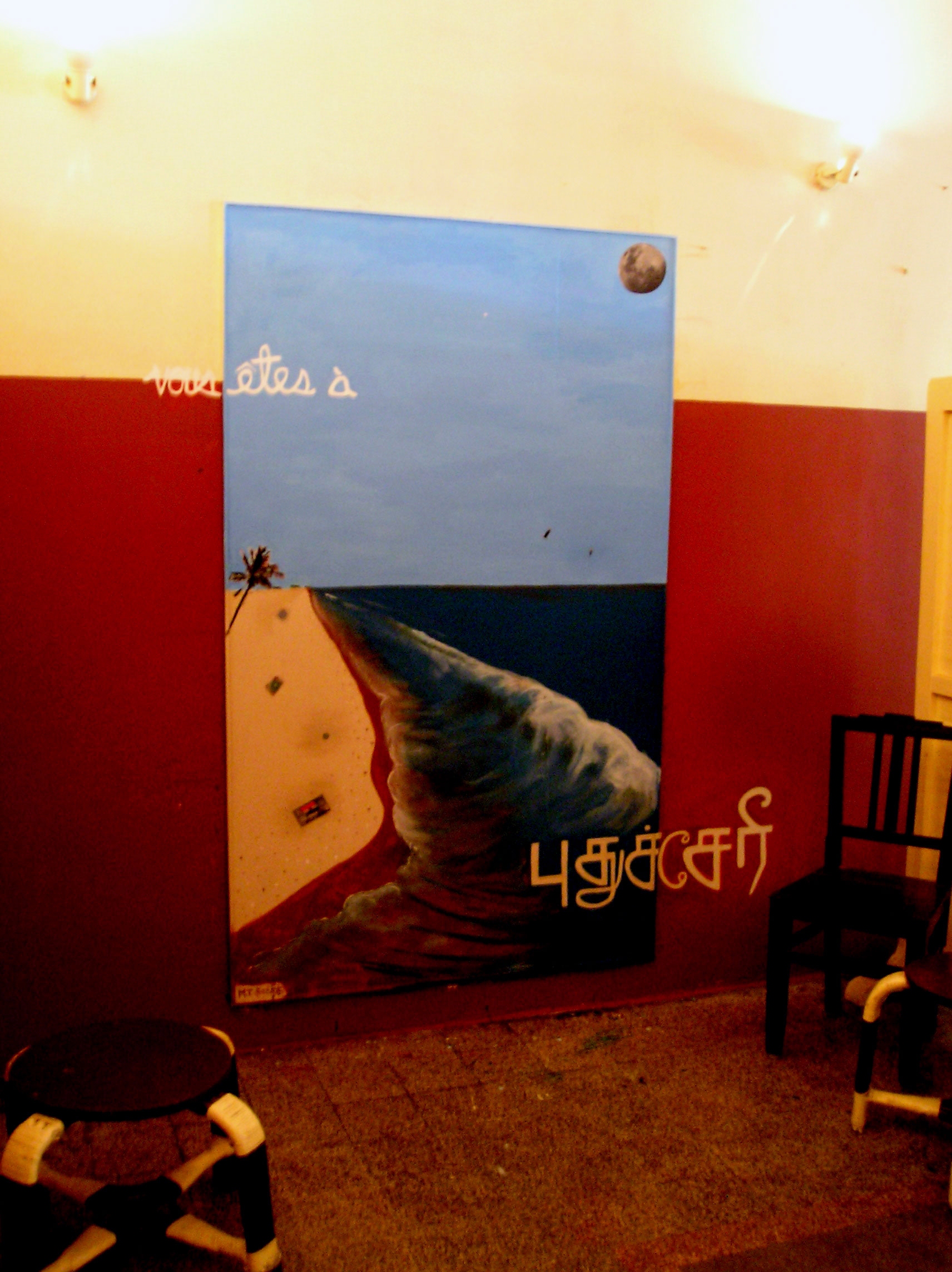
Vous êtes à Pudduchcherri, installation, 2007

18 Friday May 2007

Posted by mtk in Asia, collage, India, installations, MTKinstalls, Tamil Coast

≈ Leave a comment

Tags

2007, bar, hotel, m.t. karthik, mtk, mural, pondi, pondicherry, pondy, Pudduchcheri, pudducherri, qualithes, Vous êtes à Pudduchcherri

This slideshow requires JavaScript.

At 40, in my homeland, I painted, collaged and signed, Vous êtes à Pudduchcheri, M.T. Karthik, on the back of the wood liquor cabinet installed in a wall at Qualithe’s Hotel Bar in Pondicherri, Pudduchcheri, Tamil Nadu, India in three weeks in May, 2007.

The cabinet is 84 x 50 inches, 6.5 inches above the floor, and the wall is perhaps  fifteen feet wide. It was immediately interesting to toy with the line dividing the lighter upper from the darker lower layers. The text was decided upon after weeks of discourse with locals and regulars – and translates in English to: “You are in Puduchcheri”

Collaged Elements

The image of the moon is an actual photograph taken in 1971 by telescope from observatory of the University of Montana.

The oil well is from the back of the old,purple Indian 1-rupee note.

I photographed the haliastur indus (brahminy kite), pair, myself, from my studio for nine months, and then printed and selected the images of the two raptors collaged into frame – male and female.

The palm tree was photographed at a local beach as well.

The postage stamp is the a magazine reproduction of the first stamp issued by independent India.

the detritus on the beach includes a matchbook and wrapper from a package of firecrackers, and the tiger from the tiger balm packaging.

art students from the Chitra Kala Parishath art college in Bangalore, were invited to add depth to the waves and a second heavenly body, a single white point representing Venus, over the sea.

mtk, 2007

After Po-Mo and Before We Agree

11 Wednesday Apr 2007

Posted by mtk in art, Asia, Commentary, conceptual art, India, talks, Tamil Coast

≈ Leave a comment

Tags

after, agree, art, Auroson, auroville, before, contemporary, culture, India, Karthik, lecture, m.t., m.t. karthik, mtk, po-mo, show, slide, talk, we

After Po-Mo and Before We Agree

art talk by M.T. Karthik

Auroville, India 2007

Begin with the piece on The End of Post-Modernism, October 1999. (pause)

But I thik that Giulianis comment, as ignorant and political as it may have been, is indicative of the feeling at the end of the 20th century. Arthur Danto had written The Death of Art in 1994, the century was limping to an end.

*******K Foundation

On 23 August 1994, the K Foundation (Bill Drummond and Jimmy Cauty) burnt one million pounds sterling in cash on the Scottish island of Jura. This money represented the bulk of the K Foundation’s funds, earned by Drummond and Cauty as The KLF, one of the United Kingdom‘s most successful pop groups of the early 1990s. The duo have never fully explained their motivations for the burning.

The incineration was recorded on a Hi-8 video camera by K Foundation collaborator Gimpo. In August 1995, the film—Watch the K Foundation Burn a Million Quid[1]—was toured around the British Isles, with Drummond and Cauty engaging each audience in debate about the burning and its meaning. In November 1995, the duo pledged to dissolve the K Foundation and to refrain from public discussion of the burning for a period of 23 years.

A book—K Foundation Burn A Million Quid, edited and compiled by collaborator Chris Brook —was published by ellipsis Books in 1997, compiling stills from the film, accounts of events and viewer reactions. The book also contains an image of a single house brick that was manufactured from the fire’s ashes.

last year I was with Matthew Higgs

Matthew Higgs is director of White Columns in New York. He is also associate director of exhibitions at the Institute of Contemporary Arts in London, England. He has organized more than forty exhibitions, including To Whom It May Concern and Reality Check: Painting in the Exploded Field at the CCA Wattis Institute. A regular contributor to Artforum, Higgs has written for many catalogs and other publications. As an artist, he is represented by Murray Guy in New York and Anthony Wilkinson Gallery in London.

But I think that the socio-political scene drove arts to find new ways to seek new materials and do things that Rudolph Giuliani could do but which are still art. and to communicate ideas through mass media.

I am going to talk about a few different places and people I have met and known in San Francisco, New York, Japan. India and elsewhere and let you see some work here and get an idea of what is being made and by whom.

It is interesting to me that the Venice Bienale opened today is it and I didn’t go to the site to see who is in it or whatever. I wanted to try to construct this talk from – as Auroson suggested – my own experiences of art and artists.

Vik Muniz (Brazil, 1961) is an avant-garde artist who experiments with novel media. For example, he made two detailed replicas of Leonardo da Vinci‘s Mona Lisa: one out of jelly and the other out of peanut butter. He has also worked in sugar, wire, thread, and Bosco Chocolate Syrup, out of which he produced a recreation of Leonardo’s Last Supper. Many of Muniz’s works are new approaches to older pieces; he has reinterpreted a number of Monet‘s paintings, including paintings of the cathedral at Rouen, which Muniz accomplished using small clumps of pignment sprinkled onto a flat surface.

Vik Muniz’s use of materials is more than a result of aesthetic decisions alone. In his picture of Sigmund Freud, for example, he uses chococlate to render the image. The photograph is printed in such high resolution that one can almost taste the material from which the image is made. In this sense, Muniz is refering to Freud’s theory of the oral stage. Likewise, because of the chocolate’s viscosity and visual similarity to excrement there is an allusion to Freud’s anal stage as well. This conceptual framing of matter is also apparent in his Sugar Children series. In this body of work, Muniz went to a sugar plantation in Brazil to photograph children of laborers who work there. He made the images from the sugar at the plantation. The differential in value between the wages of the laborers, and the fluctuating cost of sugar in the international market as well the price for the photograph, reveal much about geopoltics, global/local economics, and the art world.

Vik Muniz works with the syntax of photography, hut his images are not simply photographic. As Vince Aletti pointed out in the Village Voice, “[Muniz] has teased the medium mercilessly and with an infectious glee. He makes pictures of pictures — sly, punning documents that subvert photography by forcing it to record not the natural world but a fiction, a simulation.” (left: Action Photo (After Hans Namuth), 1997, 60 x 48 inches, Collection of Eileen and Peter Norton, Los Angeles)

Born in 1961, Muniz grew up in Sao Paulo, Brazil where he studied advertising, a field which he acknowledges,”made me aware of the dichotomy between an object and its images.” After he moved to New York in 1983, Muniz made sculptures which he documented in photographs, then began incorporating photographs in his sculptural installations. He discovered that what interested him most was the representation of objects rather than the objects themselves, the dislocation between expectation and fact, representation and reality.

Muniz’s pictures are illusions that draw from the language of visual culture, but they twist and redefine our perception of both the commonplace and the fantastical. His images humorously, as well as critically challenge our ability to discern fact from fiction, reality from appearance. Utilizing a range of unorthodox materials — granulated sugar, chocolate syrup, tomato sauce, thread, wire, cotton, soil — Muniz first creates an image, sculpturally manipulates it, then photographs it. Whether a portrait, landscape, still life, or iconic image from history, Muniz’s works are never what they seem.

More recently he has been creating larger-scale works, such as pictures carved into the earth (geoglyphs) or made of huge piles of junk. His sense of humor comes through in his “Pictures of Clouds” series, in which he had a skywriter draw cartoon outlines of clouds in the sky.


Surasi Kusolwong

born in 1965 in Ayutthaya, Thailand. In 1987 he received his BFA from Silpakorn University, Bangkok, Thailand, and in 1993 he received his MFA from Hochshule für Bildender Künst, Braunshweig, Germany. Kusolwong’s artistic practice includes installation and performance-based work and, since 1996, he has concocted variations on market settings where inexpensive, mass-produced, Thai-manufactured goods are sold for a nominal fee.

The artist has shown widely in Europe, America, Asia, and Australia. Solo exhibitions include Institute of Visual Arts (INOVA), Milwaukee, WI; Arte all’Arte (Arte Continua project), Casole d’Elsa, Italy; Fri-Art Centre D’Art Contemporain Kunsthalle, Fribourg, and Art & Public Gallery, Geneva, Switzerland. Group exhibitions include P.S.1 Contemporary Art Center, Long Island City, NY; Hayward Gallery, London, England; Kiasma Museum of Contemporary Art, Helsinki, Finland; Academia de Francia/Villa Médicis, Rome, Italy; 21st Century Museum of Contemporary Art, Kanazawa, Museum of Contemporary Art, Tokyo, Japan; Pusan Metropolitan Museum of Art, Samsung Museum of Modern Art, Seoul, Korea; Edsvik Art & Culture Center, Sollentuna, Sweden. Kusolwong has exhibited in many biennales including the 2001 Berlin Biennale, Germany; Transfert, 2001 Swiss Sculpture Exhibition, Biel, Switzerland; Kwangju Biennale 2000, Korea; Taipei Biennale 2000, Taiwan; Third Asia-Pacific Triennial of Contemporary Art, Brisbane, 11th Biennale of Sydney, Australia; and the 1997 Vienna Secession, Austria

Lu Jie was born in Fujian, China in 1964. He holds a BFA from the China Academy of Arts in Hangzhou and an MA from the Creative Curating Program in Goldsmiths College, University of London. Lu Jie has curated numerous contemporary art exhibitions internationally including the Chinese presentation at the 2005 Prague Biennale and the 2005 Yokohama Triennale. He is the founder of the Long March Foundation in New York, and the 25000 Cultural Transmission Center in Beijing. Over the past six years, Lu Jie has been concentrating his efforts to produce The Long March – a Walking Visual Display which was exhibited in National Museum of Contemporary Art, Oslo, Museum of Contemporary Art, Lyon, 2004 Shanghai Biennale, 2004 Taipei Biennale and will be exhibited in 2005 Yokohama Triennale, Vancouver Art Gallery and the next Asia Pacific Triennale.

Long March Capital – Visual Economies of TransMedia

Initiated in 1999, carried out on the historical Long March route in 2002, and returning to Beijing from where we are still marching locally and internationally today, the Long March is a multifaceted and complex art project in which the journeys through the realities of different social locations, contexts, and dimensions are part of a process of artistic experience and creation. The Long March’s approach to new media, therefore, extends beyond the faculties of technology, rather looking at the metaphor of the Long March as a medium and methodology in which creative expression can arise. In this regard, the Long March acts not only as an art project but as a “transmediator,” a form of capital which offers a platform, context, and professional service for the realization and display of new media works, as well as a “glocalely” situated “social” as a new media. Participants work together, turning local resources into the international language of contemporary art, and conversely imbuing international art with a local context and significance. As such, the Long March journey becomes a collective knowledge production and performance where both audiences and artists alike become participant observers constantly negotiating the boundaries and relationships of the various visual economies bounded within artistic production.

Lu Jie is the founder and director of the Long March Foundation, New York and the 25,000 Cultural Transmission Center, Beijing. Over the past six years, Lu Jie has been concentrating his efforts to produce the Long March Project, portions of which have been exhibited internationally including in the 2004 Shanghai Biennale, the 2004 Taipei Biennale, at the Vancouver Art Gallery 2005 and The Yokohama Triennale 2005 and Sao Paulo Biennale in 2006.

The Long March Project: : Lu Jie in Conversation with Hsingyuan Tsao and Shengtian Zheng

On the evening of October 12, 2005 the Vancouver Art Gallery presented “Dialogues on Art: Lu Jie in Conversation with Shengtian Zheng and Hsingyuan Tsao.” The presentation was organized in conjunction with the exhibition Classified Materials: Accumulations, Archives, Artists.

Lu Jie: The Long March Project was initiated in 1999 when I was a curatorial studies student at London University. During that time I developed a critique of the representation of politics in the context of international Chinese art exhibitions. I was thinking about the ways that contemporary art practice could connect with social development and social change. I developed the Long March Project as an organic structure that could parallel the grand narrative of the historical Long March initiated by Mao Zedong. I developed the idea that a number of sites could be created according to this historical Long March—this search for utopia, this sharing of resources, this going beyond the limits of body and ideology.

After several years of preparation, the Long March Foundation was established in New York in 2000. I spent two years visiting the six thousand miles historical Long March route. In 2002, we established the 25,000 Cultural Transmission Center in Beijing before launching the project that summer. After a three-month journey, twelve of the twenty planned sites were completed. We already had the contribution of two-hundred-and-fifty local and international artists. People thought that the government would stop us, but there were no political problems.

In the Yanchuan papercutting survey—which we believe is a milestone of the whole Long March up until today—we asked questions such as: what do we do with the so-called folk artists who live in China, whose life and profession is all based on an aesthetic that we do not value? This work is something that other curators and institutions do not deal with. But for the Long March Project—a project that wants to face reality—the different social hierarchies and historical frameworks all connect together to create a new understanding of contemporary Chinese art. So we believed from the very beginning that folk art, such as paper-cutting, is something that should be re-examined.

what’s next?

list and

culture jamming

media pluralism

regionality

Tamil Nadu Suspense

23 Friday Mar 2007

Posted by mtk in Asia, fiction, India, music video, performance, self portrait, short film, Tamil Coast

≈ Leave a comment

Tags

chavady, Karthik, m.t., mtk, mudaliar, Nadu, periya, Suspense, tamil

a trailer for a short film


Directed, produced, written, performed, edited and shot by MTK 2007

satori at 40

23 Friday Mar 2007

Posted by mtk in Asia, India, poetry, Tamil Coast

≈ Leave a comment

Tags

40, 40th, birthday, forty, India, Karthik, m.t., mtk, poem, satori, satori at 40

If you keep making lefts

You go in a circle

If you keep making rights

you wind up where you began

If you just go straight ahead

you’ll wind up where your headed

but going straight ahead’s the fastest way to dead.

MTK, Pudducherri, Tamil Nadu, India March 23, 2007

Tamil Om Tattoo, 2007

13 Tuesday Feb 2007

Posted by mtk in Asia, India, performance, short film, Tamil Coast, travel

≈ Leave a comment

Tags

2007, Karthik, m.t., mtk, om, phillipe, pondicherry, tamil, tattoo

death in the village, 2007

04 Thursday Jan 2007

Posted by mtk in Asia, essay, India, Tamil Coast

≈ Leave a comment

Tags

2007, chavady, death, m.t. karthik, mtk, mudaliar, periya, tamil, village

Over the last few nights, lit by an obese moon, the local animals have been fighting; first the dogs went at it ferociously; then loud, wailing cats; hissing, crying, haunting sounds. Then a crazed bird-fight, filled with screeching – all this in the two nights of the moon’s fullest face.

The village is a breathing thing, a living ecosystem of many species of insects, reptiles, mammals and birds living adjacently. The village mood is governed communally, first by the most powerful forces of nature, primarily the sun and moon – and, here, the sea – and secondly, by humanity in concert with nature.

In working with nature, humanity is further subdivided, along a continuum from those who will care for animals and plants, to those who would not tolerate them, but as food. Most follow a gentle co-existence.

A properly functioning village can be considered among the most sane and balanced social ecosystems ever created by human beings. Interspecies tolerance, collegiality and an awareness of the fundamental interconnectedness among all living things exists.
Here, vegetarianism is considered a social enlightenment for most people. Trash is often laid out on low thistle or brush to allow ants and other insects to pick it clean. I have watched a village woman wash the anus of her cow with her bare hand and water with such care as she would give her own child.

The village is asleep shortly after sundown. It gets dark quickly. Public lighting is elegantly limited to one or two long, narrow, tube lights, atop wooden posts placed at the intersection of paths or at the gate of one of the wealthier homeowners. But power outages are common, eliminating even this small amount of soft, light pollution. The night sky is clear, the stars, sharp.

Dawn is the loudest time of day, from cock’s crow, through crow’s caw and eventually multiple, staticky, jam-boxes, and at least one television set, projecting bhajans and popular songs. This comes to an end abruptly, when there is a brief silence into which the cow next door lows – an enormous sound – at least once each morning. Today, all sound was overcome by a single, overpowering noise, a retort, by human design, repeated at regular intervals. Someone was lighting and dropping grenade-like bombas.

This same, single, very powerful firecracker, set off very near to this house every half hour or so, was irregular enough to feel sudden each time – 9:30, 9:55, 10:27. The noise hit me in the gut. The dog was terrified.

It is an intense sound in this place – and now the cat fight continues, screeching and hissing, tearing-around sounds between booms.

Bombas all day long: “someone died” is the best we have. Sekar says it was two people, one on either side of us, in recent days. The villagers gathered with firecrackers, drums and flags – multiple very loud retorts all day long; many right now.

The dog stayed under the bed for hours, until sundown when the bombas finally ceased – we all sat in silence. Then, through the night, under the flat, bright light of the fat waning moon – really three days full –  came the horrible, sad, wailing of a woman who sounded like a widow, or a mother, begging God or anyone to explain “Why?” between heavy, interminable sobs. She finally fell asleep, but her cries were the loudest sound in the night for an hour. The death must have been literally just beyond the wall to our West.

The entire village is a part of the death – even the crows were vacated by the noise. They say that when a king dies, crows fly and caw – maybe it’s because of the fireworks. This full moon there was an important death, likely two, in our village. The crows and dogs and cats know it … and I know it, too.

4 January, 2007
Periyamudaliar Chavady, TN, India

[discovered that one of the two deaths was L’s grandmother –  the mother of the man from whom I’ve been leasing a motorbike. We learned, too, that there was another death, just next door to us – very close to us, on the same day – likely someone we had seen daily in the last few months – but we don’t know whom. I would know the face … but which face, of the last few months, is missing now? that I cannot say. So it was Usha,  the daughter- in-law of one of the deceased, who told us, three weeks after Pongal, that the villagers did not celebrate Pongal this year because of these deaths, a full moon before].

Auto-Rickshaws in South India, 2006

16 Saturday Dec 2006

Posted by mtk in Asia, India, photography, Tamil Coast, travel, vehicles

≈ Leave a comment

Tags

2006, 3-wheel, auto, autorick, chennai, Coimbatore, India, Karthik, lambretta, m.t. karthik, mtk, Nadu, rickshaw, rigo 23, tamil, three, Tricycle Museum, wheel

tiltwheeler
Sangetha3Wheelerdetail
Sangeetha3Wheeler
redautorickz
redautoricky
redautorickx
redauto3
redauto2
redauto1
Picture 081
Picture 076
Picture 019
JeevaTransport
foggyredback
39
28
shareauto
Picture 078
Picture 011
Picture 010
niceredautorick
autorickwithCD
two
private3
private2
private
communistmarxist2
communistmarxist
closedback2
closedback
1984europe
1984c
1984b
1984a
1984
1969europe
1969d
1969c
1969b
1969aa
1969a
1969
1968d
1968c
1968b
1968
1967e
1967d
1967c
1967b
1967
1966b
1966
1964g
1964f
1964e
1964d
1964c
1964b
1964
1958

In autumn of 2006, for a traveling project by Rigo 23 that he calls Tricycle Museum, I researched and purchased three-wheeled vehicles from South India and shipped them to Madeira Island, Portugal. Here are some of the best of the many auto-ricks I photographed.

They are arranged in reverse chronological order for the most  part and the last one is a 1958 model that was still running on the roads in Coimbatore in 2006!

Tricycle Rickshaws, Tamil Nadu, India

08 Friday Dec 2006

Posted by mtk in India, photography, Tamil Coast, travel

≈ 1 Comment

Tags

2006, chennai, cycle, cyclericks, India, Karthik, m.t. karthik, madras, mtk, Nadu, ricks, rickshaw, tamil, tricycles

1
2
3
4
5
6
7
8
9
10
11
12
13

In autumn of 2006, for a traveling project by Rigo 23 that he calls Tricycle Museum, I researched and purchased three-wheeled vehicles from South India and shipped them to Madeira Island, Portugal. Here are some of the best of the many cycle-ricks I photographed.

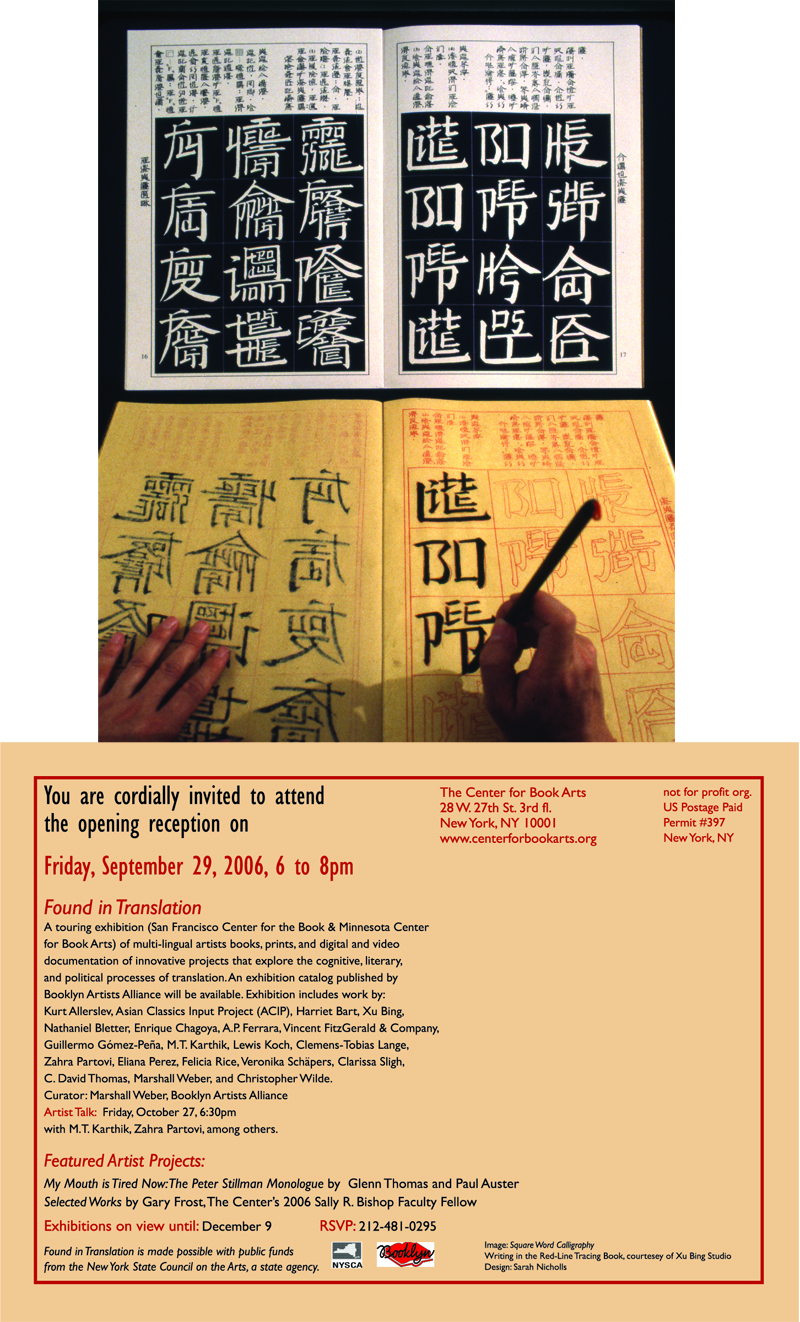
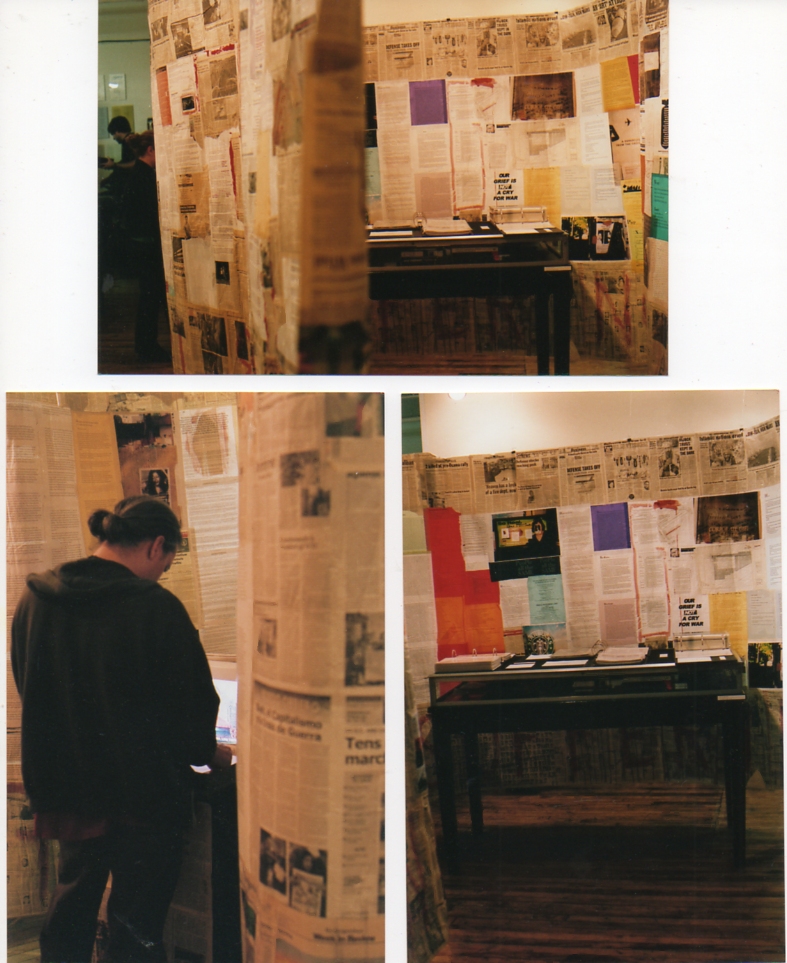
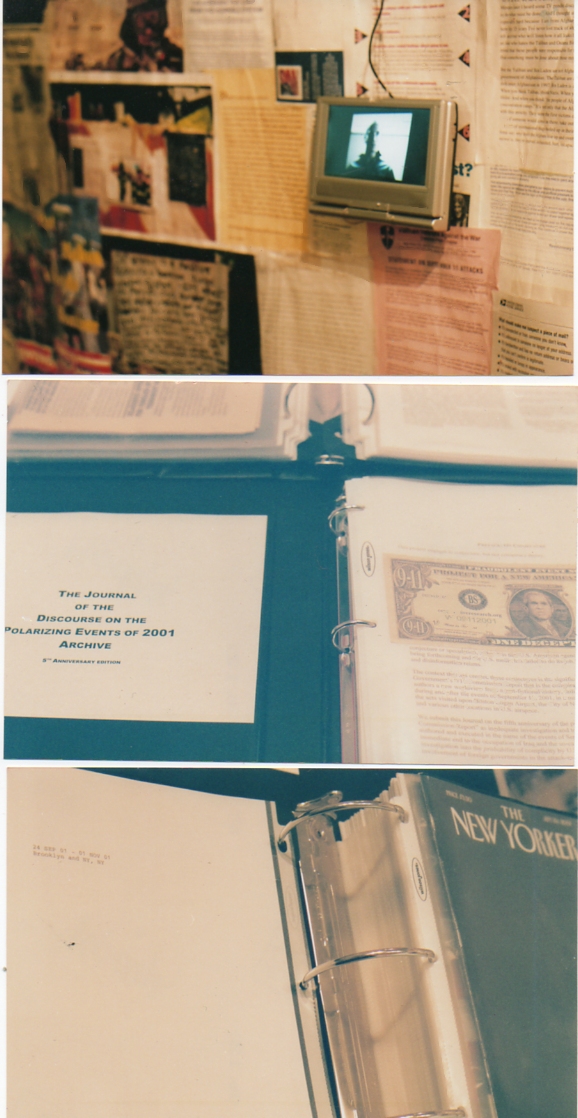
Found in Translation, Center for Book Arts, NY, 2006

29 Friday Sep 2006

Posted by mtk in artists books, collage, installations, MTKinstalls, NYC

≈ 1 Comment

Tags

2006, A.P. Ferrara, arts, book, booklyn, books, center, Found, in, Karthik, m.t. karthik, Mark Wagner, Marshall Weber, mtk, new york, translation

This slideshow requires JavaScript.

The Discourse on the Polarizing Events of 2001 [MTK with A.P. Ferrara]

installed:

Rigo 23

18 Saturday Feb 2006

Posted by mtk in journalism

≈ Leave a comment

Tags

2006, 23, art, europe, interview, karthikm.t., Madeira, magazine, mtk, Portugal, Rigo, Spain, W.

[W]Art001 [W]Art002 [W]Art003 [W]Art004 [W]Art005 [W]Art006 [W]Art007

my education to 2006

01 Sunday Jan 2006

Posted by mtk in essay, journal entries

≈ Leave a comment

Tags

2004, education, Karthik, m.t. karthik, mtk

Pacifica Station KPFK 90.7fm Los Angeles
2003-2005 radio

Independent Study with Booklyn Artists Alliance, Brooklyn, NY
1998, 2000-2002 book-making, art, development, grant writing

Independent Study with Rigo 23, worldwide
1996-2006 art, art handling

The New School University, Manhattan, NY
1998 creative writing, data conversion, project management

Genentech, Incorporated, South San Francisco, CA
1994 FDA Clinical Trials Research, relational databases, data management

Tulane University School of Public Health and Tropical Medicine, New Orleans
1993 biostatistics
1992 international health and epidemiology

Independent Study and Travel, Asia
1990-1992 Taiwan, Thailand, India, Japan, Korea, China, Indonesia

University of Texas at Austin
88-89 radio, political science, history, French
87-88 radio, political science, history
86-87 radio, television, film, art, history
85-86 engineering, physics, biology, chemistry

Tom C. Clark High School, San Antonio, TX
84-85 senior Physics, Calculus, Music, Literature
83-84 junior Physics, Trigonometry, Music, Literature
82-83 sophomore Chemistry, Music, Literature
81-82 freshman Biology, Music, Literature

William P. Hobby Junior High School, San Antonio, TX
80-81 8th grade
79-80 7th grade
78-79 6th grade

Locke Hill Elementary School, San Antonio, TX
77-78 5th grade
76-77 4th grade
75-76 3rd grade
74-75 2nd grade

Books Read in 2005

31 Saturday Dec 2005

Posted by mtk in Asia, Book Review, Japan, journal entries, literature

≈ 1 Comment

Tags

2005, Asia, book, books, Japan, Karthik, m.t., mtk, read

The Wind-Up Bird Chronicle, Hard-Boiled Wonderland at the End of the World, Wild Sheep Chase, Norwegian Wood and Kafka on the Shore [Umibe no Kafuka]

Haruki Murakami

The Woman in the Dunes

Kobo Abe

Friend of the Earth

T.C. Boyle

Idoru

William Gibson

Airframe

Michael Crichton

The General of the Dead Army

Ismail Kadare,

Harry Potter(s) and The Prisoner of Azkaban, The Order of the Phoenix

J.K. Rowling

The Setting Sun and No Longer Human, Blue Bamboo short stories

Dazai Osamu

The Curious Incident of the Dog in the Night

Mark Haddon

A Mature Woman

Saiichi Maruya

Rashomon and other stories

Akataguwe

Non-Fiction:

Imperial Overstretch

Jim Tarbell

significant parts of Harry Braverman’s Labor and Monopoly Capital

and the eco-biography Planetwalker, John Francis

News Director and Elections Producer, 2003 – 2005

12 Saturday Nov 2005

Posted by mtk in elections, essay, journalism, Los Angeles, performance, protest, social media

≈ 1 Comment

Tags

2003, 2004, 2005, 90.7fm, alan, angeles, armando, blosdale, Christine, director, Elections, gudino, host, iraq, Karthik, kpfk, L.A., LA, los, los angeles, m.t., minsky, mtk, new, onthemic, pacifica, producer, radio, war

NEWS AND ELECTIONS DIRECTOR, KPFK AND PACIFICA

During the Iraq War and the Election of 2004, I was news director and director of elections coverage for Pacifica Station KPFK, 90.7fm Los Angeles, 98.7fm Santa Barbara, California – the largest independent fm signal in the United States of America.

During the buildup to the war I increased news presence on the schedule by 200%.

For six months after that I increased it 150%.

I broke up Free Speech Radio News into segments and reproduced the evening news with one host rather than two. This allowed us to write more content and update the FSRN content with the latest news [hired PC Burke, managed ML Lopez]

In Los Angeles KPFK had long been a place for actors to volunteer to get air time. I fired the actors who were reading the news and pledged no others would be used – rather I would train a team of multi-disciplinary writers to read.

[I hand-picked JF Rosencrantz, Page Getz, Sister Charlene Mohammed, Aura Bogado, Walt Tanner, and many other voices for the newsroom and trained them to deliver on radio].

I added two reporters [both hires were women] and added music and breaks to make the news more listenable for a younger audience. I produced original art pieces, found-sound and cultural pieces.

I was the first News Director to go to Palestine and Israel via Amman, in late 2003 and to the UN, where I was credentialed for the Security Council during run up to war [early 2003]. I reported daily into the midday and evening news and this work is archived in the Pacifica Radio Archives [MTKintheOPT2003/04].

I was the only reporter at the United Nations Security Council on March 21st, 2003, to ask each Ambassador of the U.N. Security Council whether or not they would condemn the bombing of Baghdad by the United States and U.K. the previous night. Russian Foreign Minister Sergei Lavrov told me and all the press corps beside me in response that Putin spoke for all Russia when he said it “violates the U.N. Charter.”

I was the opening voice on Pacifica’s “Attack on Peace,” a nationwide broadcast to millions of listeners and, with Amy Goodman, co-hosted the first hour of what would be three days of historic nationwide broadcasting about Peace and opposing the War on Iraq as it was taking place.

KPFK and Pacifica gave me a chance to do something epic and we both benefited greatly from it. I stand behind my decision to give my time during the Iraq War and Election 2004 to Pacifica. I am exceptionally proud of the work we did.

A detailed description of our work and how it culminated, follows:

02102003 First Newscast with MTK as News Director
First time we ever cut FSRN into separate news pieces, removed the music and parsed the show across the hour. We only ran FSRN as a complete program three times over the next two years.

0210-02282003 The Immokalee Workers Hunger Strike

03012003 move to a single host for the one-hour KPFK Evening News
First hosted by MTK (02282003) and then briefly by Jennifer Hodges and Trevor David and subsequently Monica Lopez, Patrick C. Burke, Aura Bogado, Saman Assefi, Walt Tanner, Teresa Wierszbianska, Sister Charlene Mohammad and others, the one-host-one-hour newscast using FSRN as spliced features parsed across the hour, radically professionalized KPFK’s Evening News “sound”.

03052003 Student Walk Out
Coverage from high schools and universities throughout signal area.

03102003 The addition of the Morning and Mid-Day Reports
At this point, one month into my tenure I had increased News production by 250%, and was preparing to cover the opening of a U.S. Invasion.

0301-04112003 U.N. Security Council as it deliberated Res. 1441
MTK representing Pacifica and KPFK demanded live from the press pit  inside the U.N. Security Council chambers in New York, that each available Secretary of the Security Council respond to the bombing of Baghdad.

0318-03202003 Live coast-to-coast newscast hosted (NY/LA) during opening of US attack on Iraq with live reports from New York, Baghdad, Havana and San Francisco MTK with M. Lopez, T. David, P. Burke, J. Hodges, M. LePique, M. White, N. Thompson, volunteers and the Interns (Clark/Al Sarraf).

04082003 The Guardian of Britain singles out KPFK
http://www.guardian.co.uk/france/story/0,11882,932223,00.html
“If you live in LA, the Bay Area, New York, Washington or Houston, you can, for respite, tune in to one of the Pacifica network radio stations, which for more than 50 years have been broadcasting news from the left. Their war coverage is entitled “Assault on Peace” rather than “Showdown Iraq” and on an average day on my local station, KPFK, you can hear Gore Vidal, Noam Chomsky and members of the anti-war movement with a completely different take on the war and items of news not broadcast anywhere else.”

04102003 Pacifica’s National Dialogue for Peace
MTK opened the first hour of this nationwide radio program, co-hosting with Amy Goodman. “Pacifica’s National Dialogue for Peace,” was a three-hour radio broadcast that allowed calls from unscreened listeners to an electronic-audio panel that included Ohio Democrat and Presidential Candidate Dennis Kucinich live from a payphone at Congress, Global Village Activist Medea Benjamin live from Washington D.C., and Kani Xulan, a displaced Turkish Kurd, live from New York.

04242003 Occidental Petroleum and Airscan Sued by Colombian villager
Original investigative reporting by JFR and MLL and MTK on the lawsuit filed by Alberto Mujica against Occidental Petroleum and Airscan Security for the cluster-bombing of Santo Domingo, Colombia which murdered Mujica’s family and neighbors and destroyed their village on December 13, 1998.

0502003 MTK Hosts One Hour Special News Program Dialogue with Listeners

05052003 Audio Magazine Project element
The sound of birds on Mt. Washington used as an ambient newsbreak

05092003 Argentine Election Coverage with live results

05012003 Bush’s “End of the War/Victory” speech
Margaret Presscod and M.T. Karthik step on GWBush as he speaks from the deck of the U.S.S. Lincoln parked off the coast of San Diego. Analysis included timely news and information about what was happening in Iraq in Falluja in the last weeks of April and clearly points out actual lies by GWB in the speech. Khaled Abou El-Fadl, professor of Law at UCLA weighs in on Bush’s racist and historically regressive language in an incisive and brilliant post-speech analysis.

05152003 Vinnell Corporation
Vinnell – a local firm that built Dodger Stadium – has ties to the Saudi Arabian National Guard and the C.I.A., 19 Immigrants found suffocated to death in the back of a trailer truck in Texas. Both of these stories are important and represent the beginning of a split in the newsroom.

0515-06092003 Three Chechan Female Suicide Bombers in three weeks
Our Chechnya coverage began to get deeper and deeper after this. We worked our way up to the election in October with coverage from at least seven news sources, including sources from the region: Interfax, Pravda, The Moscow Times.

05182003 Argentine Runoff Election that elects Kirchner

05302003 Audio Magazine Project
A bright and exciting newscast with music by Sergio Mielnishenko

06032003 “9/11 Column” launched
Column investigating 9/11 runs every Tuesday for the entire summer ending on 9/11/2003. Interviews with Michel Chossodovsky, Don Paul, Mary Schiavo, Naseem Ahmed, Ralph Schoenman and Tony Taylor on the 9/11 Special.

06162003 Dominique deVillepin and Strawon defining Hamas as terrorist, live coverage of “People Over Politics” Rally Downtown with PCB
This cast is indicative of things we have been doing: in-depth international news with specific cultural and intellectual analysis (MTK) and coverage of local protests and rallies (PCB, MLL, volunteers). We became quite good at this actually with reporters in the field at many key events often phoning in live.

06182003 Iranian exiles self-immolations in Paris and GMO crops in California
Our GMO coverage pre-dated the media burst in summer and our Iranian self-immolation stories were like nothing done anywhere in English. We looked directly at the suicides as a political tool for communication.

06272003 Coverage of Protests against George W. Bush and Parvez Musharraf, military dictator of Pakistan and ally to Bush War.
Not only did we cover the several thousand anti-Bush and few dozen pro-Bush demonstrators on this night, but we had a credentialed reporter at the visit and lecture by Pakistani Coup Leader Parvez Musharraf (PCB).

07042003 Special News Programming on “4th of July” with editorial comment by MTK and “socio-political interstices” produced by AAB

This is was the only time I recorded an editorial for the KPFK Evening News. I had, by this time produced dozens of them and would go on to produce hundreds more. Just once, on the Fourth of July during the War Year, I allowed myself a luxury that is abused by most Pacifica Radio Hosts.

07112003 Live interview with State Assembly Member Judy Chu
Her bill sponsored to support multilingual contract language in California.
(with brief Mandarin Chinese-language exchange with MTK in the outcue)

0715-08152003 Liberian struggle, Iraq worsens
We began covering Subsaharan Africa and Liberia arose like a healthy distraction from the real issues in DRC and Nigeria and Sierra Leone so we began doing that as well. Live coverage from Nigerian elections led to live calls to Uganda as well.

07152003 New News Theme introduced, headline bumpers added

0720-07292003 Donovan Jackson beating verdict
live reports from Inglewood and the courthouse by volunteer Jordan Davis

07212003 Audio Magazine Project element
the sound of the Dodgers organ player and stadium announcer calling the final field and plate appearances of “Ricky Henderson” versus the St. Louis Cardinals over the weekend

07252003 Napalm Use in Iraq
Detailed analysis of the admission by U.S. military of the use of napalm or incendiary bombs that are illegal on Iraqis. Mark 77 versus Napalm incendiaries in detail.

0801-11172003 Russian Federation and “breakaway republics”
We wrote and delivered original work on Chechnya which led to deeper coverage of Azerbaijan, Kzrygystan and Georgia as well as to coverage of The Russian Federation with original interviews of: Matt Bevins, Editor-in-Chief of the Moscow Times for 9 years. (DP), Ian Bremmer Director of the Eurasia Division of the World Policy Institute(DP/MTK), Professor Ronald Suny of the University of Chicago (DP), Giorgy Lomsadze of the Caspian Business Daily live from Tibilisi when as many as 20,000 Georgians descended on the governmental center. (MTK)

08062003 Launch of “Politics or Pedagogy” an education column
John Cromshow’s weekly spin at radio by, for and about kindergarten to high school teachers, students and administration

0806-08102003 Camisea Gas Project, Peru
Amazon Watch and Friends of the Earth take on Ex-Im Bank who want to finance a project that would jeopardize rainforest. We do in-depth interviews on the Paracas National Marine Reserve, home to the endangered Humboldt Penguin. Ex-Im backs off. (MTK)

0809-10072003 The California Recall Election
Complete coverage of all legal angles of lawsuits preceding the Recall and full coverage of three debates and the election, including post-election analysis and commentary and coverage from The Biltmore Hotel, Schwarzenegger’s HQ and Sacramento. Live radio and interviews with Peter Camejo, Terry McAuliffe, and press relations for Davis, Bustamante, Huffington and McClintock.

0808-08112003 Guantanamo Detainees
Focus on the Guantanamo detainees including interviews with attorney’s and family members

0812-09152003 Sherman Austin
Coverage ending with a piece from the field at the courthouse on the day Austin surrendered to authorities Interviews of tearful friends and family of Sherman Austin by Alan Minsky.

08082003 One Hour Special Program on the Recall
Volunteer Jordan Davis joined MTK to discuss the Recall with listeners

09032003 90-minute special program Recall Debate
MTK hosts coverage of debate between five major candidates and listener calls

09052003 Audio Magazine Project
Cast with music by Sergio Mielnishenko, new computers in the newsroom

09112003 M.T. Karthik’s 9/11 Special
a one hour program on covert U.S. Military operations and 9/11’s throughout history, including 9/11/2001.

0912-09162003 Josh Connole Arrest
Live breaking newsradio had KPFK collecting sound from ReGen Co-op as the arrest was occurring.

10012003 Launch of “The Mechanics of Voting” Column

10042003 Dreaming Our Future: If the Truth is Told, Griffith Park, Los Angeles
A Los Angeles Department of Cultural Affairs-sponsored youth conference organized by Fidel Rodriguez. MTK produced interviews and coverage with volunteer Joseph Lee, 16

1007-10082003 Recall Election coverage
one hour Election Recall Special with TZW

10082003 M on the BBC
MTK on California’s new Governor on morning radio in London

10092003 Use of audio from Radio Intifada
Cross-pollination of programming through shared interview resources

10132003 The Crossing
MLL at the U.S. Mexico Border on vigilantes and border crossings

10152003 Straw Poll of Midday News audience
Result: 96 callers in twenty minutes supported the program by saying they favor the Midday News.

1019-10312003 Fall Fund Drive
News raises $25,000, highest ever for a News Department at KPFK.

10202003 Organic Lounge launched (MLL, RM, LLC)
Food news and politics of organics and genetically-modified foods

10252003 One Hour Special Program Roundtable on Activism hosted by MTK

10302003 Political Prisoners column launched (TC)
Dedicated to political prisoners being held here in the U.S.A.

11132003 Audio Magazine Project element
the sound of thunder in Mt. Washington used as an ambient newsbreak

1212-12312003 Audible Palestine project
http://revolocien.com/zounds/audiblepalestine.php

and thus ended my first year as News Director of KPFK 90.7fm Los Angeles, for which I was rewarded with doubling listeners and a raise.

2004 News and Election Coverage Executive Producer

I was often accused of editorializing. Having studied journalism for years, I denied it with specific details. I countered that editorializing is rampant on the other side, so lies are being taken for fact. I believe I’ve been vindicated in recent years.

The two-paper town is so rare that journalism and the record no longer exist. Colin Powell could spend an hour and a half at the UN telling the world that Saddam Hussein has dangerous weapons of mass destruction, that he is capable of delivering them to people and committing mass atrocity. Powell does this for 96 minutes and every paper presents it as fact.

What you got was a non-competitive view that said, “we think Saddam Hussein is this. We think Saddam Hussein is that.” They didn’t do “We observed Powell pitching such and such about Saddam Hussein.” Now how did we at KPFK? We played not one clip of Powell or Jack Straw – their ideas were already in all the papers. We let people hear other voices that favored and opposed war- the UN ambassadors from Pakistan, the Syrian, the Chilean. Others on the Security Council who you could not hear anywhere else. We provided the competitive journalism that allowed a comparison to what you got in every other paper.

“US American” is an example of something linguistic that I generated with much assistance from Patrick Burke. We’d say “US American” for all references to persons, entities or policies of the USA. The term was meant to replace and correct American. American President Bush, American this, American that. Well, Chile is in America, Canada is in America, Mexico is in America. Listeners got that. It’s an antidote for that broadcast idea of The Global North being the most important. It is also important because it contextualizes the USA, which I believe must be isolated. Only after we had done this on KPFK for two years did the stories ridiculing the beauty pageant entrant who used the term emerge. I defend the young woman here for the first time as possibly the first U.S. American to exist, thus placing me second, Patrick C. Burke, third and anyone else who chooses to identify in line beyond this point. As a journalist, I believe you should be extra-national – you should be outside of the state, like Neruda, like Paz. A journalist should be able to say, “I investigate your decision as a nation,” not reproduce the Pentagon line by printing the fax they just sent as news, which sadly happens now in many newsrooms.

KERRY WON
We had perhaps as many as half a million listeners during the Election Cycle. On November 23, 2004, three weeks after Election Day, I sent out an e-mail from my private e-mail account, which in any case I knew meant my termination.

In that e-mail I projected the winner of the 2004 U.S. Presidential race to be Democrat John Kerry by virtue of a true victory of the votes in Ohio and thus an electoral college delegate count of 270 to 267. I believe I would have been the only broadcast journalist in the United States to have made such a projection in the election month of November 2004 or before the Electoral College first met in early December – but I wasn’t able to make it on the air. It was and remains too radical in mainstream media circles to suggest that John Kerry won – not just on-air, but even in an e-mail. I stand by my projection. I believe the Bush campaign rigged the election of 2004 and negotiated a settlement with Kerry/McAuliffe and the DNC. There can be no other explanation for the mathematics or my personal experiences that night.

Nationwide exit polls for the 2004 Elections in the United States were conducted by Edison Media Research and Mitofsky International on contract with major national press and TV news services.  One of the unique things that KPFK radio did on Election Night that was different from other live broadcasts was to release results as confirmed only as they were broadcast by one particular television outlet that was a part of this contract. We chose to rely on C-SPAN as the lead media outlet for our broadcasts in announcing results.

This decision was made because it had been reported that the non-profit cable network was the only television outlet that had taken the extra precaution to create a special professional relationship with the Associated Press to allow them access to no less than 500 AP reporters around the country to confirm numbers as they came in on election night. This relationship was established as a reform after the television debacle of the 2000 Election in which Florida “flipped” from red to blue in the middle of the night. As members of the National Election Pool contracting Edison/Mitofsky, these AP reporters and C-SPAN, would have access to both exit polls and election results.

During KPFK’s election night broadcast we occasionally checked numbers being reported by the other networks and announced discrepancies to our listeners as a means of covering the media covering the election while covering the election itself. If a network announced a result before any other network or before C-SPAN, we let our listeners know which network (or network anchor) it was, what the result was and whether or not C-SPAN had confirmed it. I believe we were the only radio station in the U.S. to take this near-academic approach to covering the media while covering the election.

By this methodology, and by being in Los Angeles, in the western-most time zone, KPFK radio broadcast final results of exit polls and confirmed results as they were announced from east coast to west – although listeners to KPFK in L.A. sometimes received projections and actual results later than those posted on NBC, CBS, ABC and FOX, the results were hard, linear, continuous and directly linked to exit polling and to confirmed results as they came in. We told our listeners that we considered matters too close to call. We didn’t rush to judgement.

Edison/Mitofsky conducted exit polls in each state and a nationwide exit poll and, on the afternoon of Election Day, disclosed confidential poll data to the general public showing John Kerry ahead of George Bush in several key battleground states. At 8:27pmPST [11:30pmEST], despite widespread reports of voter disenfranchisement and massive problems with the mechanics of voting, it seemed clear in our broadcast booth that Kerry was winning the race for the presidency by a very slim margin of the electoral college delegate count based on exit poll results and confirmed numbers in states that were not too close to call. Florida polls had just closed for Bush. It had been out of our calculation for projecting a Kerry win, which at any rate we did not broadcast at that time.

It was exactly then that the numbers began to change; between the hours of 8:40 and 10:30 on the west coast. We ended our election night coverage at 10:30, with the position of “Too Close to Call,” but witnessed and reported a radical shift in numbers from 8:40 until the end of our broadcast. If, as has been alleged, there was e-vote cheating going on, I believe this is when it happened.

It is important to note that we were using one television source and not shifting our results in instances when a network announced their confirmed result. We stayed with C-SPAN throughout and as a result I am able to state unequivocally and with conviction that there was a radical change in numbers from confirmed sources with access to both exit polls and results in a very short amount of time at a specific hour on Election Night.

Immediately after the close of polls, at 10pm Eastern, Edwin/Mitofsky’s national exit poll showed Kerry had won the popular vote by a margin of 3%.  Less than fifteen hours later, on the morning of November 3, the official vote counts showed Bush defeating Kerry by 2.5% in the popular vote.

This discrepancy between exit polls and the official election results – a five and a half point swing, astronomical in historical terms – has never been statistically resolved. Several methods have been used to estimate the probability that the national exit poll results would be as different as they were from the national popular vote by random chance. These estimates range from 1 in 16.5 million to 1 in 1,240. No matter how it is calculated, the discrepancy cannot be attributed to chance.

In the absence of raw data, analyses were accomplished using “screen captures” of data published to the Internet on election night. One such analysis of unadjusted exit poll data, by Dr. Ron Baiman, a professor of statistics at the University of Illinois at Chicago, found that statistically significant discrepancies of exit poll results from reported election outcomes were not randomly distributed but rather concentrated in five states, four of which were battleground states, long known to have been key to victory by electoral college vote.

This geographically biased error in exit polls against actual results seems too politically sensitive to be coincidence and indeed, Baiman concluded that the probability that these discrepancies would simultaneously occur in only the most critical states of Ohio, Florida, and Pennsylvania (rather than in any other randomly selected group of three states), is less than 1 in 330,000, an analysis that agreed with independent calculation by Dr. Steven Freeman, visiting faculty at the University of Pennsylvania, who calculated that the probability that random chance accounted for simultaneous exit poll discrepancies in the three battleground states was well outside of the realm of statistical plausibility.

On January 19, 2005, Edison Media Research and Mitofsky International released a 77-page report entitled “Evaluation of Edison/Mitofsky Election System 2004,” acknowledging widespread discrepancies between their exit polls and official counts, admitting the differences were far greater than can be explained by sampling error, but asserting the disparity was “most likely due to Kerry voters participating in the exit polls at a higher rate than Bush voters.” The company did not, however, conduct any statistical tests to prove this likelihood of “reluctant Bush voters.” On March 31, a non-profit group called US Count Votes did just that, publishing: An Analysis of the 2004 Presidential Election Exit Poll Discrepancies as a part of its National Election Data Archive Project, in which the group addresses what it identifies as the only three possible explanations for the discrepancies: random sampling error, error in the exit polls, or error in the actual results.

Edwin/Mitofsky itself declared in admitting the immense discrepancies, that they could not be due to chance or random sampling error, with which the authors of the US Count Votes agree. But Edwin/Mitofsky takes the view that their own exit polls were incorrect and the official actual results are correct, while US Count Votes states that the consortium does not come any where near substantiating that position in its report noting that actually “the data that Edison/Mitofsky did offer in their report shows how implausible this theory is.”

The US Count Votes Analysis claims convincingly that Edison/Mitofsky “did not even consider” the hypothesis that the actual results could have been wrong, and “thus made no effort to contradict” this hypothesis, stating further that “some of Edison/Mitofsky’s exit poll data may be construed as affirmative evidence for inaccurate election results,” and concluding, “that the hypothesis that the voters’ intent was not accurately recorded or counted cannot be ruled out and needs further investigation.”

Many statisticians including Baiman and Freeman are signatories to the US Count Votes analysis and a summative report can be downloaded free from:

uscountvotes.org/ucvAnalysis/US/USCountVotes_Re_Mitofsky-Edison.pdf.

The report uses the data released by Edwin/Mitofsky to debunk its own “reluctant Bush responders” explanation and the results of the analysis are both very clear and very disturbing. A comparison of votes cast in the Presidential race with votes on the same ballots in other races or for or against various propositions and referenda around the country, reveals even greater unexplainable biases toward Bush in the official vote count as compared to the exit polls.

My experience as a journalist covering Election 2004 led me to these conjectures. My methodology covering the results on-air live from the west coast on election night and in the three weeks that followed confirmed for me a desperate need for someone in media to announce that they did not believe George W. Bush won the Election and, because of the radical transformation of the U.S. American elections process by the landmark Supreme Court case Bush v. Gore (2000), to announce it loudly before the Electoral College met in early December.

Frustrated by what I saw as a second contravention of democracy during a Presidential election, I hoped to induce investigation of the results by honestly reporting what was strongly suggested by conjecture. The media and John Kerry capitulated. We stayed in context.

MTK’s Elections Hotwired November10, 2004

That’s why I sent an e-mail from my position as Elections Coordinator for Pacifica Radio projecting John Kerry the President of the United States.

Immediately after sending that e-mail for which I was relieved of duty, I sent another e-mail, this time as a concerned voter, to my Senator:

U.S. Senator Barbara Boxer:
Let me begin by saying I voted for you. And that you may now be the only person that we on the progressive left can approach, because you are in many ways a part of power and the ruling class in the United States and you are a well-respected member of one of the major parties.

We beseech you to ignore Republicans, Democrats and so-called Progressives who have conceded this election as accomplished fairly and to independently look into the matter.

Please, Senator Boxer, take up the call for Investigation of the Election of 2004. Do it now; before the Electoral College votes and before the Inauguration of the President.

At this moment – as in 2000 – colleagues of yours in the House are prepared to contest and investigate the election for fraud. One Senator willing to ask is all they need to achieve such a request. Only one single Senator who is politically safe, who has the support of a Progressive community, and who has the courage of conviction to stand up and say simply that:

decisions regarding how we vote and for whom are being made too quickly, and as a result carelessly, and perhaps erroneously; that our democratic processes are being rushed and hurried by the Republicans led by Karl Rove [called the “architect” of the re-election by Bush] and; that democracy in the U.S.A. is suffering terribly, if not critically.

As a woman and a progressive Democrat, you have won re-election easily. People here support you for your ideas and values. You are in a safe state among people who share your beliefs.

After hearing four weeks of testimony from key states [especially Ohio] and after reading horrifying stories from around the country as to what happened on Tuesday, November 2, I and many of your other constituents believe that the results of the 2004 election are significantly riddled with errors, many of which circumstantially point to the STRONG possibility of FRAUD and vote fixing.

Senator Boxer, changing the outcome of the election is NOT our interest in asking this of you. The desperate and fundamental need for a fair elections process and real democracy DEMANDS a slower, more measured, piece-by-piece investigation – conducted by Congress – of the Election of 2004 and in particular of the votes cast via electronic voting machines.

It is now clear that George W. Bush’s falsely named Help America Vote Act written to address the many issues that resulted from the 2000 election, served only to rush US counties and states into purchasing machines that have become black holes for American votes.

California’s Secretary of State Kevin Shelley was admired by people across the State for standing up to the manufacturers who were clearly complicit in rushing these devices past proper standards and though now he is being attacked within the system by the powers that be, it is clear he has TREMENDOUS public respect for his forward-looking actions on e-voting over the past year and a half. By setting an aggressive calendar for hearings and for public and private input, Secretary of State Shelley was able to decertify machines and to put out a detailed list of 23 conditions for the use of other machines to make them safer and more accurate for Californians. He said when doing this that cheating wasn’t going to happen on his watch. He then testified before the Election Assistance Commission and at both the Democratic and Republican Conventions, that other states should earnestly learn from California’s experience and institutionalize protections … but it was too little, too late.

Other states and indeed Bush’s White House and the GOP-controlled Congress, diminished the significance of Secretary of State Shelley’s very hard work. Senator Boxer, you will be greeted by a flood of support from the grassroots level if you take this on. You could revolutionize the argument.

As our Senator won’t you chastise them for what they did to our Secretary of State? Won’t you stop their stampeding toward re-election for long enough to examine the facts and the data? Won’t you please tell the rest of the country that Californians were very relieved to have had a Secretary of State who cared enough to demand protections against problems suffered in other parts of the country?

Please, Senator Boxer, look deep into the future of this country, summon the courage and do what you do so well. Stand with your colleagues in the House who believe a Congressional Investigation into the Election of 2004 is an absolute necessity before the U.S.A. can pass one more law or engage in one more battle. Only one Senator is required … it would make us all proud if you were first.

Respectfully,
M.T. Karthik

and to her credit, Senator Boxer made history, contesting the election and voting alone for the Election of 2004 to be investigated for fraud, a point since alleged by Representative Robert F Kennedy, Jr and several other congressional members.

The Power of Nightmares, review of BBC documentary series, 2005

31 Monday Oct 2005

Posted by mtk in essay, reviews, short film

≈ Leave a comment

Tags

2005, adam, bbc, curtis, documentary, Karthik, m.t. karthik, mtk, nightmares, power, review

The Power of Nightmares, a BBC documentary in three one- hour parts by Adam Curtis, is available free online and free from intellectual property burdens. It is in the Creative Commons so you can just download it from

http://www.archive.org/details/ThePowerOfNightmares

Watch it and rebroadcast it anywhere you can. The series takes as its subject a comparison of two ideological groups that have tried to shape the entire world for the past fifty years using money, power, influence, religion, violence and finally fear.

This doc also seeks to define and address a change in policy makers: from positivists who seek to represent humanity toward a better life into negativists who perpetuate stereotypes of fear to remain in power. But fundamentally the series is a comparison of two radical groups who now hold the world in their grip:

The Islamic Fundamentalist Extremists and
The US American Neoconservatives

The series begins with an examination of the intellectual pursuits of Egyptian philosopher and Islamic Fundamentalist scholar Syed Qtub and Neo-conservative Scholar and University of Chicago professor Leo Strauss in 1949 and details how their pursuits led to what would become the ideology behind these two currents of hyper-conservative thought that have been extremely active: struggling against their own societies, subsequently working together to defeat the Soviet Union in Afghanistan and ending up in direct conflict in a Winner-Take-All-Fight-to-the-Death, which is taking place even now in the guise of the War on Terror [which ought rightfully be called the War of Terror].

But more, this series properly addresses the tactic of fear used by both groups, and especially that used by the neocons, to propagandize humanity into electing politicians willing to use the fear model for their own selfish interests – Tony Blair is really exposed as an opportunist by this series.

I deeply wish more people could see this doc so we could begin a discussion to reframe the global power conversation that is being dictated to us by military and militant authorities.

Curtis’ series does not address the possibility of Neocon or US American complicity in the attack on 9/11 nor does it properly address the Clinton era in context:

He says 9/11 was executed by extreme readers of Islamic Fundamentalism and leaves it at that [he says the actual events were executed by a plan drawn by KSM (that’s Khalid Sheik Mohammad in CIA-speak)] and that Clinton was a fundamentally good agent who was buried by a neocon cabal which trained its powers of attack at him [painting Clinton as a victim].

In these readings, I have differences with Curtis, but he doesn’t take a stance on these matters that threatens the possibilities lined out by many other researchers and documentarians with more access and focus on them. He simply leaves them as generally accepted media ideas for the sake of a wider, more historiographic perspective that is really very brilliant.

He proposes very effectively that the neocons have used the exact same exaggerative tactics to take down first the Soviet Union, then Bill Clinton and now, finally, Muslim Fundamentalism under the vague rubric of Terrorism.

The series goes further and proposes that “there is no al Qaeda.” And fully debunks the Bush administrations claims of successful anti-terror work in the USA post-9/11.

This is a GREAT historical view of conflicts authored by and between the Neocons and the Islamist Extremists … really important work.

Please find some one with high speed connection universities would be perfect places to achieve this – and broadcast them widely.

Film clubs, organizations, peace groups, non-profits, NGOs, students or professors or faculty or staff with access to computer labs with high-speed connections: please download this important three part series from the BBC and have public viewings and showings.

I urge this because I think it would make a great beginning to reframing the 21st century conversation.

M.T. Karthik
31 October 2005

dereliction

24 Monday Oct 2005

Posted by mtk in artists books, collage, Los Angeles, NYC, poetry, politics

≈ 1 Comment

Tags

2005, acrylic, artists, book, Borsa, bound, dereliction, gouache, Karthik, large, m.t. karthik, maps, mtk, paint, salvaged, size, Wilde

dereliction [2005]
13.5 x 21 in

an original poem by M.T. Karthik on seafarer’s maps salvaged by G. Borsa from a derelict tugboat on the Newtown Creek that separates the boroughs of Queens and Brooklyn, NY; with gouache, acrylic, ink, and collage of printed paper, printed plastic and color prints from digital media by M.T. Karthik; bound by C.K. Wilde

OLYMPUS DIGITAL CAMERA

Initially authored during the Republican National Convention as it was taking place in New York City, “dereliction” [2004] begins with a slap across the face of the Prince of Wales in 2001.  A reprint of the BBC World Service Internet screenshot features 19-year-old Alina striking Charles with a rose in Riga, Latvia, and is collaged into a map of the seagoing entrance to the Gulf of Riga in the Baltic.  Accompanying text reports that Alina was protesting the then recently begun bombing of Afghanistan by the United States and the United Kingdom. This is the only spread in the book which maps an actual place.

An invocation:
“O, Chorus of unknown seas, drowning the known to smithereens”
leads the viewer from the map and image of an actual place into a fantasy cartography.

As an organizing principle each folio is designed such that no spread has paper from the same original map in its recto and verso facia.  To achieve this, the maps were spread out, cut into quarters and recomposed, designed primarily with an aesthetic created from the juxtaposition of land masses and water. The land and water were then treated with media to create text that serves to obfuscate specificity further, but also to unify bodies of water and masses of land.

Each spread (including the title page and frontispiece) is composed from deconstructed maps positioned to create shorelines and seaways with no basis in earthly reality. The result is a deconstruction of the original maps that creates an atlas of a world familiar yet not accurately descriptive of any known place. The title page is companioned with a frontispiece detailing the title, as the first sets of waves of text appear in the sea: “the ship of state is derelict”.

Figures rigid in concept, but loose and flexible in media, create a striking paradox, as patterns of zeroes and ones are painted in gouache across the land masses – a reminder of digital output and a haunting count.
Swiftly, the context leaps back in time to the era of the Atomic Bombs dropped on Hiroshima and Nagasaki, as a play on words is employed in the repeating waves of text in the sea: Truman as the “worst president,” the decision to use the bomb as the “worst precedent”. [Curatorial note: there are momentary and unique changes in the underlying text in each spread. In this case, buried in the text are two additions:  “the buck stops here” and “worst Missouri Mob” … meant to implicate unseen hands behind the Truman presidency.]

A spread follows featuring the English transliteration of the name of Hiroshima copied 1,000 times and of Nagasaki 750 times and leads to the A-bomb spread: the spread with the most text in the book, in all five layers, including the Sanskrit transliteration of Chapter 11, Verse 32, from the Bhagavad Gita, quoted by Oppenheimer upon seeing the cloud from the first successful test of his atomic bomb.

From the A-Bomb spread, “dereliction” [2005] continues to accuse the founders of the U.S. of genocide and the current leaders of the United States of militarization for centuries. A parallel is made between the figure cited by Bartholomew de las Casas as killed by Columbus’ ventures and a figure representing those killed by the USA abroad in covert and overt operations between 1945 and 2001 and digital photos of pre-columbian sculptures from Oaxaca, Mexico float in the seas.

The centerfold of “dereliction” [2005] employs a quote from James Joyce’s “Portrait of the Artist as a Young Man” to make a point about the rush to war in Iraq. In the novel, Joyce describes his class being asked by his teacher, to copy the phrase “zeal without prudence is like a ship adrift,” repeatedly. At the place marked in the maps as “Middleground” this quote is written over and over as instructed, and creates the central thesis of the text: that the USA is adrift, waging bungled wars led by men who don’t know even simple philosophical truths.

The text then moves to an admonition of those adrift without such knowledge:

“Oh, woe betide ye, adrift at sea, without even a cosmology”

and concludes by offering a cosmology in the form of a Haiku [5 syllables, 7 syllables, 5 syllables]:

a cosmology :
sun father mother ocean
the moon is a god

Mister Lonelyhearts 2005

22 Thursday Sep 2005

Posted by mtk in conceptual art

≈ 1 Comment

Tags

2005, art, conceptual, digital, Karthik, lonelyhearts, m.t. karthik, mister, mtk

This slideshow requires JavaScript.

I conceived of and completed this piece in Japan in nine months in 2005. It took a few hundred games of hearts. It’s been installed once, in India, at atelierMTK in 2006-07.

kota taki art, installation 2005

18 Sunday Sep 2005

Posted by mtk in Asia, installations, Japan, MTKinstalls, sculpture

≈ Leave a comment

Tags

2005, cement, hit, Japan, kamakura, Karthik, kota, kottaki, m.t. karthik, mtk, small, strike, taki

This slideshow requires JavaScript.

cicadas, Kamakura, Japan, 2005

13 Saturday Aug 2005

Posted by mtk in Asia, audio, Japan

≈ 1 Comment

Tags

2005, august, cicadas, Japan, kamakura, Karthik, m.t. karthik, mtk, summer

rice paddy frogs, Koriyama, Japan, 2005

25 Monday Apr 2005

Posted by mtk in Asia, audio, Japan

≈ Leave a comment

Tags

2005, bellied, frog, frogs, Japan, Karthik, koriyama, m.t., mtk, paddies, paddy, rice, white

Pluralism of Media in the Age of Surveillance

24 Thursday Feb 2005

Posted by mtk in beliefs, Commentary, Los Angeles, protest, talks

≈ Leave a comment

Tags

age, angeles, C-level, CA, gallery, Karthik, los, m.t., media, mtk, pluralism, surveillance, talk

Agit-Prop to Info-Prop; Culture Jamming, Alternative Media, Activism and the monolithic corporate-controlled US American Media

performance lecture at C-Level in Chinatown

02/24/2005

M.T. Karthik

Good Evening and Thanks for coming out.

Thanks to Michael Wilson who quickly put this together upon realizing that I am leaving the U.S. – due here next week, really – and for recognizing that this departure may be permanent … and for having the appreciation for my work to see that a presentation like this might be useful … for myself as an organizational mechanism and – perhaps, if we are lucky – for you, gathered here tonight to consider the material.

I’m a writer, a book and performance artist and a member of the Booklyn Artists Alliance [you can see our work at www.booklyn.org] there’s a decent bio there and though the list of works, exhibitions and performances is a little stale, some colophons of books I have finished in recent years and links to work in progress can be found by navigating to the Artists page and clicking my name, M.T. Karthik.

One of my most recent public projects was to function as News Director at Pacifica Station KPFK 90.7fm here in Los Angeles from 2003 to 2004 and to produce and direct coverage of the 2004 Election.

I want to frame things a little because this talk is really a companion to two other formal talks I have done since the election –

one immediately afterward … on that Thursday after the Election, 4 November 2004, when the Kerry concession was just 36 hours old, at a panel at Cal-Arts.

I was invited by the artist Mariana Botey and in my presentation, I promoted the idea of rejecting the concession as meaningless to the outcome and really meaningless to democracy in the U.S. at all – focusing on the errors not in political strategy and campaigning as most media outlets were doing at that time, but rather upon the mistakes in vote casting, counting or registering … the mechanics of voting itself and reports of problems and issues.

KPFK News stayed in the context of the actual votes cast and counted – or uncounted – long after others had heaped their towels atop John Kerry’s, thrown so soon after Election Day.

From our position it was clear that the election was still too close to call.

I maintained that claims to the contrary were suspect. But the constant and immediate projection and legitimization of a Bush victory is what we saw … and heard … daily, at incredible volume from every network and publication – that they “did not contest the outcome of Bush’s victory …”

only a handful of alternative media outlets proposed that votes in OHIO were unclear and that results from many parts of the country that used electronic voting machines were skewed versus long-trending and historically accurate exit polls.

[actually the Herbst Brothers were there – is it correct to call you that? I mean that the editors of The Journal of Aesthetics and Protest were on that panel, as was the artist Mariana Botey, who invited me to participate]

and a second talk I did in San Francisco at New College in The Mission District one month later, on 5 December of last year, entitled, “Radio As Meta-Medium.” … that one is available apparently in its entirety online … I haven’t heard it but I understand it’s there … and it was sort of hectic as I was positioned to have to defend myself against my former employers and fellow Pacificans for a projection I made by e-mail

Yes, after the election and before the electoral college vote, I was the only broadcast journalist in the USA to project John Kerry the winner of the state of OH – and thereby the winner of the Presidency by an electoral college vote-count of 3 delegates 270 to 267.

I did it three weeks after election day and only upon the collection and broadcast of numerous testimonials regarding the election from experts, monitors and voters in Ohio, Florida, New Mexico, Nevada and other parts of the country. I made the projection because I felt that the declaration that Bush had won was no more than an unsubstantiated projection made by corporate-controlled media in the U.S. and parroted by those unwilling to do proper journalism or even proper investigation into electoral problems. I did it more than a month before the Electoral College voted because I wanted to slow the confirmation of George Walker Bush’s second term as President – so a proper investigation of the election could be conducted.

As a side note: I do not believe that George Walker Bush is the legitimate President of the United States of America. The NORC study, an independent, academic investigation into the election of 2000 v. Gore proved Bush lost at that time and published results in the Spring after his first so-called Inauguration – that data can be found at www.norc.org

and I believe Bush, through Rove and his people, have committed election fraud in 2004 to bring about a bureaucratic coup here in the U.S. – perhaps you do, too.

It was this position that forced me out of KPFK and Pacifica –the network was unwilling to take my stance, considered, at the time, too radical. The local station manager claimed she had to play her hand as it was dealt, folding me out and, ultimately, stooging for Pacifica management at the Network’s head offices in Berkeley.

Though ultimately foiled by the inner-workings of the institution, I was able to get key pieces of information out, was able to make certain kinds of journalism happen that had not yet happened in much if not all of U.S. electoral journalism. And techniques that had not been tried in U.S. American journalism were tested some of which thrive today at KPFK News and nowhere else.

This was the inevitable conclusion of the piece … It was predictable that the artists methodology would eventually conflict so firmly with the so-called journalists methodology, or that of Pacifica, the pacifist, listener-driven community medium. That there would be some kind of tautological or industrial or logical paradox or collision … this was inevitable. I sought to control this long enough to participate in the election of 2004 in a way that no other media outlet would.

For myself, secure in my methods and what I have learned, I do not accuse Pacifica management of anything more than cowardice, complacency and ignorance. They just don’t get it. They are confused about methodology. Their techniques are sadly outmoded. There are luddites among them and they can’t keep up. They are held hostage by their fear that they will cease to exist and so they function like hangers-on, desperate for attention and support, unwilling to take strong positions. They do not know how to change the way journalism is done in the U.S. They do not know how to take advantage of their unique position. They struggle to stay afloat because of bad management which wastes opportunities and the tremendous goodwill extended in the form of cash contributions by the listener-sponsors.

Pacifica is also deeply infiltrated by agents known as moles. It doesn’t take much … I mean it’s a community station and the doors are wide open. The RCP, Democrats and Right-Wing agents have access and they regularly manipulate Pacifica’s content. I knew this going in, as a listener it is apparent – and I tried to navigate the environment for the term of the project in an attempt to cut through.

The question for myself as an artist was how strategically could I flex in this context. Could I identify stories or angles that were NOT being allowed to break through the U.S. American Media vacuum and push them through the tool?

In the instance of the Election, that circumstantial evidence pointed to manipulation of votes and vote-counts by Republicans and that a fraudulent election had been alleged by reputable elections monitors? The answer is … No.

In the instance of investigating the polarizing events of “nine – eleven” … no. not really.

Well, at least not to more than a few hundred thousand listeners at a time.

Well, I think it’s best NOT to duplicate the material discussed in the previous talks as much as possible. I’d rather bring other things to bear here tonight – perhaps a more global and academic view, now that there has been time to review the period – and then the three talks taken together will have a kind of thicker … meaner … impact.

The title of tonight’s lecture

Pluralism of Media In The Age of Surveillance

Is really very broad because I conceived it quickly in a phone call with Michael to pull this together, but it really suits, to the direction I want to go with the material I have gathered in the last eight years.

I coined a term a few years ago to describe one type of public art or public intervention or public work I am engaged in and that I am encouraging others to participate in, and that’s in our subtitle here:

Info-Prop.

Information Propaganda is an extension of the 1968 term Agitation Propaganda or Agit-Prop.

Info-Prop is art meant to convey truth past the massive volume of lies and omissions being generated by technocrats and corporate controlled media. It seeks truths that have been buried or evacuated. (We’ll get into this tactic later – the evacuation of collectively held truths)

Info-Prop attempts contemporaneous revision of what is being recorded as history at The New York Times, or on FOX in an attempt to create and maintain parallel histories to that documented by the largest of our mass media.

The incredibly creative signs, performances and clothing I have seen, not just at protests, but everywher over the past few years that include graphics of complex data, visual portrayals of the power structures that exist, images of Rumsfeld shaking hands with Saddam Hussein in 1983, facts represented on charts that are not made available through corporate media … this is what I mean. Information Propaganda. Info-Prop.

Info-Prop is an outsider art form that can be exercised by professional artists and non-artists alike. As a movement of cultural production Info-Prop has been driven primarily by the nexus of the Information Age: the Internet.

This immediate, free, global connection – invented by the U.S. defense department to allow for internal communication in the event of a nuclear attack [this was before they figured out that EMPs would probably take out all power] … then given second to academics and then finally to everyone else but only through deregulated, proper Capitalist structures … Internet Service Providers and so on … this Internet is still very very very young.

Here in the U.S. we push, sit upon and ride the half-ass, trickety jalopy we call the Internet at the dawn of international communication in real-time, awaiting a sensibility to take hold of the English-language part of our social intercourse that isn’t fundamentalist Christian and radically right-wing or from Texas with a hardline agenda or wearing an elephant tiepin in the form of the flag of the United States of America.

It is apparent now that the United States of America is occupied by a political force that can only be called a faction. This faction controls communications media with near-absolute restriction of content, controls agencies that monitor, manage and distribute the collective funds of the largest bank account in the world, and controls the most powerful military to which it granted more than 400 Billion dollars last year, the best funded, most powerful war machine on earth.

Among the fools in this faction there are elderly bigots who are given swan-songs of attention, there are hyper-militarily minded protocol hounds who have seized the language they wrote only two and a half generations ago. There are House Niggers. And House Wiggers, too. House Immigrunts.

All have been seized by soldier mentality and blood-lust – that is the stage play CNN, NPR, PBS, ABC, CBS, NBC, Fox, HBO, The New York Times, Washington Post, and every major news outlet in the United States is meant to project because what happened is:

The free-est economy in the world puffed itself up for eight years – wrapped itself into a Y2knot by getting dumbed into a hitch in the 90’s – and had to be “system re-booted.”

Thus, 9/11.

When all intranet debts were erased by a tidal wave of media, pumping the same fiction (a well-known – not obscure – mafia move). They hate our blue jeans and Matrix movies so we get to go kill them and take their oil. All the drunk parasites clinging to the largest multi-media assault on international humanity ever attempted by any country, any peoples.

This faction is guilty of producing, staging and titling “9-eleven” to salvage the failing economy and to stimulate younger generations of participants into their System of Society. They do this with pride. Named themselves neoconservatives and have a fascist mentor, author and originator in the Russian-Jewish immigrant University of Chicago Academic Leo Strauss, a TV-watching, hate-filled neo-Hobbes.

We witness these neocons drop megatons of death from the sky upon the heads of others, elsewhere, anywhere in the world they wish. These, who have said aloud – and continue to say it – they believe they are doing God’s work while openly engaged in murder, manipulation of masses, demagoguery, espionage, political deceit, covert operations and corporate protectionism.

There is significant reason to believe that the Internet, your e-mail, is not secure and that the content is being manipulated by Intelligence agencies of the U.S. and other Nation States as well as by rogue operatives as these agencies claim. That all our phones are tapped.

But, it is important to note –

as this graphic by San Francisco-based, Portuguese artist Rigo 23 illuminates –

how few people really have access to the Internet still.

At the talk in San Francisco late last year, I called “Live Radio” a meta-medium, unlike other media because of its intimacy, its vernacular aspect, its aural and oral nature and the fact that it “happens” in real time.

By distilling content from the Internet, Television, Print and other media into a script to be read over the airwaves by a reader, radio, like television, seeks the trust of the listener in the reader and her or his script and attempts to make itself meta-mediator of content.

If you are blind perhaps the radio is the only way to get the information, but the vast majority of radio listeners are not blind – they have chosen the radio as their mediator. Trust has been established.

Radio is a Meta-Medium.

This is actually how the right-wing in America has achieved so much, using broadcast and particularly a.m. radio to great effect to create trust in voices who bend truth, commit prevarications of omission and outright lies in order to push an agenda of their party and their interests. Limbaugh, O’Reilly, Dennis Miller, etc. etc.

Corporations give them volume … the sheer volume of the “mass” in mass media. This is how dollars are translated into historical fiction.

We live in a condition where small groups of committed, intellectual individuals interested in truth have been cordoned off, marginalized and re-framed. While their messages may be true and may occur in a pluralism of media, these messages are drowned out and disappeared, by tactical disinformation, damage control, spin and evacuation. This is what I mean by evacuated. Vacuo. Vacuum. the idea that some stories are made invisible because once they are reported special interests with access to enormous tools of media create a vacuum around them, bury them in irrelevancies or reduce them in importance in the National psyche.

One of the major problems is that the intelligence capabilities of the other side in this media war are so completely all-pervasive that they are able to nip any impending growth of movements around ideas early and prevent them from growing.

I think of the pre-emptive strikes in New York during the RNC in which 1900 people were arrested. Think about this, folks, three times the number of people arrested in Chicago at the DNC in 1968 were arrested in New York in 2004 at the RNC and nobody cared … well, not nobody … but who really knew that the Republican Party … the Federal Government and Bush had instructed the New York Police Department to arrest protesters in New York in advance of their committing acts of civil disobedience because these were known to participants and police in advance of their occurrence and who cared that the Republicans PAID for the lease on Pier 59, to have these peaceful protesters – women, men, grandmothers – put into a filthy, toxic holding pen. Who now knows that the place had been leased by the Republican Party for this purpose?

These tactics are the physical parallels to the pre-emptive tactics applied in media on a daily and weekly basis by political factions.

You know that a group is going to launch a major story about you because you have them surveilled. You then take whatever steps necessary to make the story disappear or seem ridiculous.

And now we see the title of our talk today more clearly:

Pluralism of Media in the Age of Surveillance.

Some tactics

1. Language

Coinage:

U.S. American – For many years the term ‘American’ used to describe people of the U.S.A. has been offensive, a classic form of propaganda – mitigating the genocide the whole of the Americas has been experiencing for 512 and a half years under a rubric of the hemisphere’s Master – the U.S.A.

Peacekeeping Gunmen

George Walker Bush, Dick Bruce Cheney

Ahmad Chalabi

“puppets”

2. Media Itself – I think that intercessionary tactics have to be exercised into various media where they are not expected. – example of the NYU kids.

3. Non-Linear techniques … non-sequitors …

4. courage

LA River Surge, 2005

11 Tuesday Jan 2005

Posted by mtk in journalism, Los Angeles, short film

≈ Leave a comment

Tags

2005, angeles, Karthik, L.A., LA, los, m.t., mtk, river, surge

Gallery

Pre-Columbian Sculpture, Oaxaca, Mexico, 2004

23 Thursday Dec 2004

Posted by mtk in Oaxaca, travel

≈ Leave a comment

Tags

2004, carvings, chatino, columbian, december, hills, Karthik, m.t., mexico, mtk, oaxaca, pre, sculpture

This gallery contains 16 photos.

← Older posts
Newer posts →

M.T. Karthik

Unknown's avatar

This blog archives early work of M.T. Karthik, who took every photograph and shot all the video here unless otherwise credited.

Performances and installations are posted by date of execution.

Writing appears in whatever form it was originally or, as in the case of poems or journal entries, retyped faithfully from print.

all of it is © M.T. Karthik

a minute of rain

https://www.youtube.com/watch?v=QYLHNRS8ik4

Top Categories

2022 2024 2025 Asia baseball beliefs birds Coastal Cali elections essay fauna flora India journalism landscape Letter From MTK Los Angeles music video North Oakland NYC performance photography poetry politics reviews S.F. short film social media thoughts travel

Archives

  • December 2025
  • November 2025
  • September 2025
  • August 2025
  • July 2025
  • June 2025
  • May 2025
  • April 2025
  • March 2025
  • February 2025
  • December 2024
  • November 2024
  • October 2024
  • September 2024
  • August 2024
  • July 2024
  • June 2024
  • April 2024
  • March 2024
  • January 2024
  • December 2022
  • November 2022
  • October 2022
  • September 2022
  • August 2022
  • July 2022
  • June 2022
  • May 2022
  • April 2022
  • March 2022
  • January 2022
  • December 2017
  • November 2017
  • October 2017
  • September 2017
  • August 2017
  • July 2017
  • June 2017
  • May 2017
  • April 2017
  • March 2017
  • February 2017
  • January 2017
  • December 2016
  • November 2016
  • October 2016
  • September 2016
  • August 2016
  • July 2016
  • June 2016
  • May 2016
  • April 2016
  • March 2016
  • February 2016
  • November 2015
  • September 2015
  • August 2015
  • July 2015
  • June 2015
  • October 2014
  • August 2014
  • July 2014
  • June 2014
  • May 2014
  • April 2014
  • November 2013
  • September 2013
  • June 2013
  • May 2013
  • April 2013
  • December 2012
  • November 2012
  • October 2012
  • September 2012
  • August 2012
  • July 2012
  • June 2012
  • May 2012
  • April 2012
  • March 2012
  • February 2012
  • January 2012
  • December 2011
  • November 2011
  • October 2011
  • September 2011
  • August 2011
  • July 2011
  • June 2011
  • May 2011
  • April 2011
  • March 2011
  • February 2011
  • January 2011
  • December 2010
  • November 2010
  • October 2010
  • August 2010
  • July 2010
  • June 2010
  • April 2010
  • October 2009
  • July 2009
  • June 2009
  • May 2009
  • April 2009
  • November 2008
  • October 2008
  • April 2008
  • January 2008
  • November 2007
  • October 2007
  • July 2007
  • May 2007
  • April 2007
  • March 2007
  • February 2007
  • January 2007
  • December 2006
  • November 2006
  • September 2006
  • February 2006
  • January 2006
  • December 2005
  • November 2005
  • October 2005
  • September 2005
  • August 2005
  • April 2005
  • February 2005
  • January 2005
  • December 2004
  • November 2004
  • August 2004
  • June 2004
  • April 2004
  • December 2003
  • October 2003
  • September 2003
  • March 2003
  • February 2003
  • December 2002
  • November 2002
  • October 2002
  • September 2002
  • May 2002
  • April 2002
  • September 2001
  • July 2001
  • June 2001
  • February 2001
  • November 2000
  • August 2000
  • June 2000
  • March 2000
  • December 1999
  • October 1999
  • July 1999
  • June 1999
  • April 1999
  • March 1999
  • October 1998
  • July 1998
  • June 1998
  • May 1998
  • April 1998
  • February 1998
  • January 1998
  • December 1997
  • November 1997
  • October 1997
  • September 1997
  • August 1997
  • June 1997
  • March 1997
  • January 1997
  • December 1996
  • November 1996
  • October 1996
  • September 1996
  • August 1996
  • July 1996
  • May 1996
  • April 1996
  • March 1996
  • February 1996
  • December 1995
  • November 1995
  • October 1995
  • September 1995
  • August 1995
  • June 1995
  • May 1995
  • February 1995
  • January 1995
  • October 1994
  • September 1994
  • August 1994
  • May 1994
  • August 1993
  • August 1992
  • April 1992
  • November 1991
  • February 1991
  • December 1988
  • October 1984
  • May 1982
  • July 1981
  • April 1977

Blog at WordPress.com.

  • Subscribe Subscribed
    • MTK The Writist
    • Join 56 other subscribers
    • Already have a WordPress.com account? Log in now.
    • MTK The Writist
    • Subscribe Subscribed
    • Sign up
    • Log in
    • Report this content
    • View site in Reader
    • Manage subscriptions
    • Collapse this bar
 

Loading Comments...
 

    Privacy & Cookies: This site uses cookies. By continuing to use this website, you agree to their use.
    To find out more, including how to control cookies, see here: Cookie Policy