I quit socials in 2021. I was on Twitter for exactly ten years: as MTKsf from April.4, 2011 to April 4, 2021.
I have started BlueSky as of November 24, 2024.

24 Sunday Nov 2024
Posted in 2024, journal entries, journalism, Letter From MTK, literature, social media, thoughts
28 Monday Oct 2024
Posted in 2024, art, artists books, conceptual art, literature, self portrait, thoughts
Tags
2024, book, m.t. karthik, Writist, zine
The Writist by M. T. Karthik is a 16-page book. It is described during production in the videos below:
05 Friday Jul 2024
Posted in 2024, essay, Letter From MTK, literature, religio, thoughts
Every night and every morn
Some to misery are born
Every morn and every night
Some are born to sweet delight
Some are born to sweet delight
Some are born to endless night
from “Auguries of Innocence,” William Blake, 1806
Some people get to do whatever the fuck they want. That is just how life is. We see moments of fairness or justness or equality, but in truth there is little of that.
Most people are under the weight of existence, and some people get to do whatever they want.
I have met those people, been with them, in some cases inside of them. And then I have traveled alone and have emulated those who can do whatever the fuck they want for short periods of time, have enjoyed richly.
I achieve this by control of my desires and by moving more deliberately than others. I rarely sign up for things. I go off-season, off-hours, weekdays. I collaborate less and less. I control my expenses and take on no responsibilities.
Reading is good.
Read read read read read rare breed.
Being under the weight of existence is managed in innumerable ways to greater and lesser degrees of success by all people. But there are clear biases, prejudices and inequalities without reason – save corruption.
Religions are suspect. Governments are increasingly fascist – using technology and media to program and control societies rather than serve them.
Authoritarian oligarchies seek not to unite and improve the lot of all, but now instead to arm themselves for impending conflict.
Resources are dwindling. The globe itself now relies solely on us, humanity, and our management sensibility – the Anthropocene rolls onward.
Nature is exquisite in its mutability. The tumbling, sidelong evolution of everything explodes in all directions seeking paths that succeed, but the entirety is unknowable.
13 Saturday Apr 2024
Posted in 2024, fiction, literature
Tags
#mtkforever, Asia, asian, fiction, m.t. karthik, Mindswimming, tamil
(4500 words)
© M.T. Karthik 2024
It was as if the ocean herself took a gulp. The wave was instantly far above him. The riptide churned and he tumbled in the suck.
Kiran let himself roll until struck by the terror he had not taken a deep enough breath. He unrolled parallel with the wave and opened his eyes but saw only pulses of light.
At last the pull lessened. He strained to the surface, broke through into the bright sunshine and gasped, swallowing air. He breast-stroked to the shallows, crawled up on the sand, and collapsed, exhausted.
A wrinkled old man wrapped in cotton squatted on the sand a few feet away. He remained unmoved. Kiran lay face down, beached, sputtering. The man spoke.
“Good. You did not panic.”
The old man shifted slowly. His eyes narrowed. He returned to staring out to the distant horizon.
Kiran lay in the sand, breathing hard. The waves lapped up the legs of his trunks, chilling him. His cheek was pressed into the speckled sand. His open eye focused on the tiny grains.
When he was younger, most likely stoned, he’d have concentrated on the microverse of color and texture, aimlessly. Instead, at 45, he found himself reminded of the article he’d just read about this beach. He propped himself up with both arms, peered at the sand.
“Is this monazite,” he thought, “What color is monazite?” He seemed to remember it was a reddish-brown.
It wasn’t the first time he’d misjudged the tide. The last time was years before, but the feeling was discretely precise: the grip in his chest and his mind screaming, “I’m out of breath!”
But instantaneous to the panic was a knowledge not to. His rational mind took charge.
His heart was pounding. He shuddered and felt older. Kiran gathered himself and stood. The Indian Ocean licked his ankles. A brahminy kite, Haliastur indus, screeched. He turned to see it dive into the tide. It emerged with a fish. It hunted in the sea, on land, in the air, a masterful omnipresence. The mated pair that nested in a palm tree near his hut were apex predators. He watched the male fly off toward home with his catch.

Kiran was master of little, apex of nowhere. He had come back to his birthplace to resurrect himself, but thus far all he had resurrected were memories that burdened him. He swam twice a day and stayed fit but his spirit flagged. He was shiftless. Soon, he’d have to leave.
“But not yet,” he thought.
He stumbled to his towel, grabbed his novel and sunglasses and headed back to the hut he called home the past three months.
Kiran plodded up the beach warily, avoiding the shits of the villagers and pied-dogs. His mind twisted in the blistering heat. Summer on this coast culminated in hot winds; Agni Natchathiram, the hottest period of the year on the Tamil calendar. It was way-offseason, which was why he could afford to return to India at all. Now, he was broke.
Kiran stopped at the gate to the gravel road that led back to the village. He shook the sand off his chappals and dusted his feet. Children ran about. No one paid him attention. He had almost drowned. He wondered if the old man would have let him.
There was a narrow pathway between the beach and the village, fenced off by wind-bent bamboo. He turned the corner to the path and the tintamarre of the beach dropped dramatically. It was the mid-morning calm.
Dawn was the loudest time of day, from cock’s crow, through crow’s caw, multiple staticky jam-boxes and at least one television set every hundred feet projecting bhajans and popular songs. Through it all, Kiran lay awake in bed or sat at his desk with coffee. The clatter came to an end abruptly – when there was a brief silence into which the cow next door lowed – an enormous sound.
Kiran had seen his neighbor wash the ass of that cow with her bare hands and water with as much care as she gave her own child.
It did not go unnoticed in the village that Kiran bought fish from Ambika, and at least once a week went into town and had a steak at the French restaurant, or a burger or a chicken sandwich.
Despite being born a local Brahmin, he wasn’t a vegetarian – yet another count chalked up to his Americanism, like the western accent he had when speaking Tamil.
He’d traveled on a U.S. passport, a citizen for decades, but here in his birthplace, unemployed and divorced, he was untethered. That was why he had returned: to see if he still belonged, or to discover for certain he no longer belonged, here.
Within days he knew it was moronic to think he could answer such a question, in three months, ten years or a lifetime.
The trouble was, with the changes in the U.S., he no longer felt he belonged there either.
A respite from the war on terror seemed to emerge with the election of a well-educated and earnest black Democrat – who had voted against the Iraq War.
He and the First Black First Lady breathed fresh air into the nation for nine months, when <wham> slammed the financial crisis of 2008, plunging the country into deep recess.
Bad economic times dispensed by a personable and intelligent President numbed everybody Kiran knew further. They began to ignore the drone strikes and Iraq and Guantanamo and the incessant war.
Suddenly the pressure to buy-in was real. They succumbed to the insistent crush of the seductive digital economy – joined Facebook and Twitter and put increasingly complicated phones in their pockets and then in their homes, devices that spied on them freely.
As Kiran’s friend Siva, a professor of culture and media studies put it, in his book on Facebook: “It isn’t Orwell, it’s Huxley.”
When he decided to return to India, Kiran felt on the cusp of something. He was desperate for direction but earnest no one else should author it.
He wanted to know what he was supposed to have learned by now. What was life supposed to have taught him?
He walked through the village quickly and swept through his gate. He rinsed off his feet with the hose on the cement patio and wondered if the reddish water swirling down the drain was monazite.
Months before, a stone carver he’d invited over had pointed out the mineral’s value, but Kiran had done nothing to investigate. He didn’t act on the possibilities right beneath his own feet until it was too late.
“Shit or get off the pot,” Phillipe had said, but with his accent, it was hilarious.
Kiran cursed his sloth as he showered. The hut and its small yard were surrounded by an eight foot wall which allowed Kiran to live unobserved by the villagers. This contributed to their speculatory gossip about him.
He took advantage of the privacy to walk around naked after a shower. He liked drying off openly in the hot Tamil air. It was something he would never do anywhere else. It felt so natural and normal here. Everything felt more base here.
He felt more like the animal he was. Yet he was no longer that animal. Knowing it was like a sting. Had he loved at all?
The sting and that question were immediately followed by a flood of images – Jim Carrey smiling like a tool in The Truman Show. He wondered if his entire American life was a simulacrum.
If he felt more connected to the animal he really was here, then what had he been there?
Who had played hoops and spun records?
Who had loved Sara, and planned with her and fathered Dash?
He wondered if his whole personality to this point was merely a projection he’d created to function in the U.S.
The thought that emerged these past three months in his birthplace, where he felt like a foreigner in practical society and profoundly himself when alone, never progressed. It only was.
He walked in circles around the small hut and yard, naked.
India was exploding with possibilities as the U. S. downspiralled.
For two and a half months he’d been walking in this circle, going swimming twice a day, and walking in this circle.
Because he knew nothing ends he had no answer.
He stopped walking and snorted aloud, “Yeah, right, I’m going to start mining thorium from the sand.”
Kiran drew the curtains and lay down on the mat. He was still. The fans turned. Then nothing moved. The power was intermittent.
With the power cut it was too hot to sleep or work and when he heard a high-pitched, “eeeeeeeeeeeee!” – the whine of the first mosquito – he leapt up.
Lying naked in a still hut by the beach mid-morning was asking for months of nasty joint pain: the blood-suckers carried chikungunya. He’d have to go into town.
Kiran wrapped himself in a cotton lungi and took a long-sleeve jibba from the second drawer of his dresser. As he pulled it over his head, he heard the call of Ambika, the fishmonger: “Meee-eeeeen!”
The woman sat patiently awaiting him on the dusty patio outside his gate. She had a wide, shallow, stainless steel dish on her lap. There was usually little left to choose from by the time she got to his hut because Kiran woke later than everyone else in the village and went swimming with the sun well up
Ambika woke with her husband long before dawn. She made him capi and saw him off to the sea. She received him back after sunrise. The men divided the day’s catch and she cleaned and prepared her dish with the wives of the other fishermen. They each walked a separate route through the village to sell their share of the ocean’s bounty.
Ambika wore a sea-green and midnight-blue sari with thin, gold lining that matched her nose ring and the gold chain that hung around her neck signifying she was wed. She had dark skin and deep blue tattoos on both arms in the style of the older tribes. She was just two years older than Kiran, but years in the sun in this beach village, gave her a wizened look.
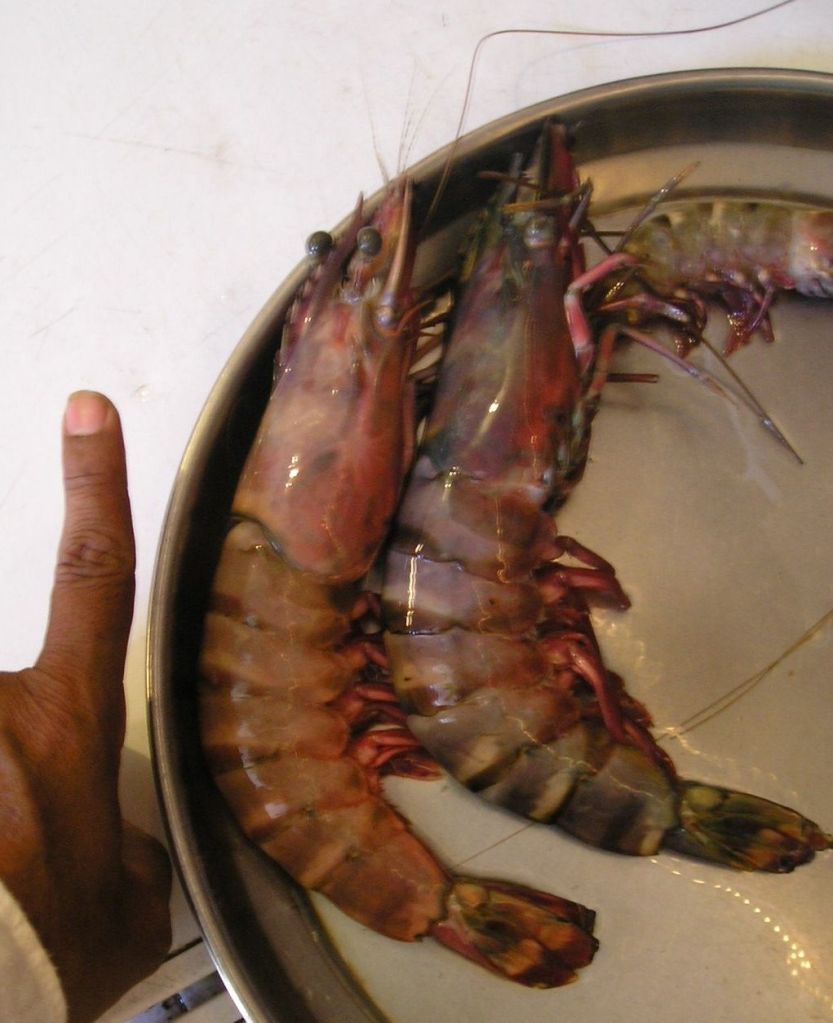
Today she had a single white perch and two giant tiger prawns. The mid-morning sun glistened and flashed brightly off the stainless steel dish as she swiveled it to show him. He bought the perch but then asked if he could take a picture of the prawns.
Ambika loved when he did this. Despite the ubiquity of phones in the village nowadays, no one used them to take pictures of food. It was something foreigners did. This time she posed, which was a first.
Kiran had eight pictures of Ambika in his phone, documenting seven different species on her dish. In the initial snaps she looked wary and stoic – on occasion suspicious. Now she took time to position herself. She turned the dish to prevent glare. She drew the top of her sari from her shoulder up and over her head to shade her face.
Suddenly, Kiran realized that she, and therefore all the villagers, must think he was leaving. He imagined her saying to the fishermen’s wives that next time he asked to take a picture of her fish, she would pose – because ‘who knew where sir was going and who all then would see her?’
He bent down and zoomed in on the dish, eliminating her from frame. The prawns were huge, at least ten inches long. Green and dark gray at the tips of their tails, their color grew lighter along the fat crustaceans’ bodies over the swimming legs, and pink toward the fore. The walking legs were striped a cartoonish pink-and-white beneath the dull, gray-pink carapaces.
Two round black eyes sat like little black caviar roe placed atop the rostrum above the wiry, red antennae that swept out before them. “Decapods,” Kiran thought, as he set his left hand beside the dish and stuck his index finger out for scale. He had never seen prawns this size before – not in the U.S. He suddenly felt he couldn’t think of anything better about the USA at all.
He stood up, and thanked and paid Ambika. Then he took the perch back inside. He had leftover rice from last night’s meal. He warmed it in the pan as he fried the fish. He stirred in some diced green onion and ginger, finally adding some cut spinach and chili paste. A squeeze of lemon brought out the flavor of the whitefish. It cut flaky and tasted delicious.
As he ate, Kiran thought again about Ambika. She saw much more clearly than he did despite all his travels and his western education. She and the other villagers were lighting-quick-witted. Their connection through daily process to thousands of years of Tamil made it so.
His mind was filled with the ceaseless noise of his Facebook, Twitter and IG scrolls.
When he arrived he never said when he’d depart. They knew before he knew himself. They were reading him as they read every tourist who came to stay.
The villagers’ lives were unchanged for centuries. They’d seen many come and go, among whom he was no more or less unique – to them he was a simpleton.
Kiran finished eating, washed up and changed into trousers, replacing his chappals with closed-toed black loafers. He had to go to the bank.
He wheeled the bike out, locked the gate and pushed off. He took the main road only as far as the first circle road. He did not want to pass the cafe on the way in. He wasn’t ready to face the gossip pit of expats and regulars yet. Cutting east, he headed down back alleys to the bank.
Emerging from one of these alleys into the round that diverted lorries and buses to the highway, he crossed but got caught between lights at the auto-rickshaw stand.
“Dey! Merica-sir!” a voice yelled at him. He turned to see the autorick driver he’d been buying ganja from standing among a cadre of his fellow drivers. He called him “Merica-sir” because he knew he hated it. It was both respect-building for his local familiarity with Kiran, a foreigner, and it was a dismissive dig.
The driver waggled his hand in a combination hang-loose and call-me sign. His head swiveled in the back-and-forth bobbling unique to South Indians that asks, implies and gestures, at once.
Kiran shook his head and waved him off as the light changed. If he hustled, he could make the light at the next round while all the lights between were green.
He drew a gulp of dusty, earthen air, the grit and residue of thousands of souls, and pushed hard. The auto-rick driver squeezed his rubber air-horn in a honkedy-honk-goodbye which Kiran was surprised he could pick out from the tumultuous roar of the busy street.
He made the lights, swung into the next roundabout and shot out into the bank parking lot. He pulled onto the front patio and chained his bike to the end of the crowded stand. There was a mall adjacent to the bank. The bike rack was always crowded.
Kiran loved coming to the bank. It had an entrance way – mirror-tinted double glass doors let you in to a small foyer and another set of glass doors that led inside. It was a glass air lock – an area to shake oneself of the dust and heat before entering the cool A/C and the clean confines of the bank.
There was a water fountain in the foyer and even a small, single-stall restroom with a sink. Kiran went in and rinsed off, wiping the sweat and dust from his arms and face. He dried his hands by pushing back his hair, took a deep breath and looked at himself in the mirror. He was older.
His temples were flecked with gray that contrasted sharply with his long black hair. His scruffy beard was equally salty. He knew he’d have to shave it all before going back to the U.S. He pulled down the skin under his eyes and stared into himself. When he let go he pored over the extent of the bags.
Kiran had opened the bank account from California over the net. They overnighted him a card international express. When he arrived at the airport in Chennai, he withdrew 120,000 rupees. He used it to get situated. Only then did he use the card to buy sundries in town.
He knew the e-trail of his purchases was being closely observed by the bank. If he spent money at Western fast food chains and checked into a 5-star hotel it meant one thing. If he bought groceries and supplies from local shops, it meant something else. He paid for the hut in cash.
After a few days in the village, he made his way to the bank on a bicycle, covered in cotton. On a Tuesday, a week after he had been in town, Kiran made a showy first appearance at the bank to “meet the manager” and be seen by those who had been watching his purchases as a non-resident Indian.
It was standard practice: make it seem you have plenty of money in the U.S. and are here to share it with family and explore business opportunities. Behave as local as you can. He used the card to buy his bicycle. He used cash when he rented a moto.
He never used the card at local bars. It was the first arrangement he made with Phillipe. He left a deposit, ran a tab till an agreed upon limit and then paid in full in rupee notes. Keeping currency fluid was an invaluable skill of travel.
Mr. Srinivasan was a prototypical South Indian money manager: balding on top and clean shaven, with a round face and baby cheeks. He wore thin wire spectacles that could have been a decade old. He wore a brown suit. It was 42 degrees C outside and this guy was in a suit.
“It is vonderful to see young men doing well in America and coming home to invest,” Srinivasan had remarked as they signed the paperwork. There was an old wooden abacus at the edge of his desk. In the corner, unused, sat a typewriter. Kiran gave him a thumb impression for the bank’s records. “Will you require transfer account?” Srinivasan had asked.
“Not at the moment,” Kiran had replied, “We’ll see.”
The manager bobbled his head at him, “India is booming, sir. You will do very well here now. And your vife, sir?”
“We’re divorced,” Kiran had murmured, signing and initialing paperwork. It was another tight, efficient lie, that pegged him as American.
Srinivasan immediately fired off the excessive tsks that were so common here, “Tsk, tsk, tsk, tsk, tsk, tsk, tsk, tsk, tsk” – a rapid-fire nine tsks was considered more empathetic – “terrible,” he had concluded.
Now, as the interior glass doors slid open before him, Kiran realized he looked forward to seeing the old man again. Srinivasan would testify to his goodness if called upon to do so while he was away. Kiran was confident he’d left an impressive e-trail of purchases and relationships.
There was a podium placed beside the doors as he entered. This was new. A tall, thin, mustachioed young boy in uniform stood at the podium and greeted him. Kiran asked to see Srinivasan. The boy furrowed his brow and looked down at a nonexistent list. “There is no one here working by that name, sir.”
Kiran then asked after the manager and was told he would have to make an appointment. He told the young man to go and ask the manager if he would see him now. Being pushy at the bank exhibited the confidence of both a wealthy American and a local Brahmin. It couldn’t hurt to try.
“Madam is a madam, sir.” the boy replied.
“Fine,” Kiran threw on the frustrated voice, “ask her.”
The young man dropped his head to his chest and ran to the back offices. “The new India, “ Kiran thought, “where turnover is high and smart women make moves to gain control of their lives.”
Now one of them appeared. She was young. “Maybe not 30,” Kiran thought. She was 28: “I’m Urmila.”
Like the bank manager before her, Urmila dressed in western attire, though considerably more sensibly. She wore a thin, black, linen jacket over a light white blouse and a medium-length, business-cut, black skirt. She wore a string of silvery-white pearls. Her gold name tag read: “Urmila Narayan, Manager”.
She extended her hand. Her hair was tied up in a tight bun. She had a sharp but elegant nose over which she now assessed him with searching, dark-brown eyes. All business. They shook and he noticed she looked him-up-and-down before saying, “Come on back to my office.”
Urmila spun around quickly and strode off to the back. Kiran hop-stepped to catch up. He called out after her, “Hey, listen, I didn’t realize I needed an appointment-”
“It’s no trouble,” she called out over her shoulder, not breaking stride.
Her office was small, but one wall was a window treated with the same mirror-tint on the front of the building and when she closed the door the space was cool, well-lit and humming. There were two wall-mounted monitors overhead which ran livestreams of BTVI and Bloomberg Global and two monitors on a desk crowded with a keyboard, mouse and documents. She sat behind the desk and indicated a chair opposite.
There was unopened mail on the chair. He handed it to her and she glanced at the envelopes as she set them atop all the documents on her desk, put her hands together, looked at him and asked, “What can I do for you?”
“I’m headed back to the States briefly and want to maintain my account. I just wanted to touch base with the bank about that. Clarify dates, if there’s a minimum balance or …” he trailed off.
She looked up his account on one of the monitors before her and said, “I see you opened this just a few months ago. How long do you expect to be gone? Because we have some options.”
Kiran was not prepared for this. It was a long way from balding Srinivasan and his abacus and typewriter of a few months ago. “Uh, I don’t know for sure. I have to go back to take care of a few things. Of course I’ll be in touch from there and I can still conduct operations with my account through transfers and the net, right?”
“Right,” Urmila replied, curtly, as if suddenly realizing exactly whom she was dealing with.
She sat back and spoke quickly: “You’ve taken our most basic account, which you opened with a principal balance you deposited as a lump sum from your account in California before you arrived. The monthly fee for the card and other services has been taken out of this principal. So if you continued with this basic account, you’d have to keep paying the monthly fee and maintain a balance,” she paused, scanning the monitor, “I think it’s like 100,000 rupees. There would of course be penalties if you didn’t manage this.”
“Sure, I understand,” Kiran replied.
“Alternatively,” Urmila continued, swiveling in her chair to a shelf behind her, “I would encourage you to consider investing with us.” She pulled down a glossy folder from the shelf and passed it to him. It was filled with printed pages and charts. “Here’s a simple explanation of some of the opportunities we have. You could leave as little as 5,000 US here and it would be working for you.”
Kiran tried to look cool. “Oh, I see,” he took the folder and pretended to flip through it. His ignorance wasn’t lost on her. “But I guess there would be tax implications …” he trailed off again.
Urmila sighed and grabbed a business card, flipped it and deftly wrote her number on the back. “This is my mobile. It’ll be easier than trying to use the appointment line. Call me direct to discuss and we can do the needful.” She handed the card across the desk to him and sat back.
He realized this was all the time she had and stood. He thanked her as they shook hands and he left. It was all cold, swift, mechanical and delivered exactly as it might have been in Modesto. “The new India,” he thought.
He put the folder in his backpack and headed out of the bank. The second doors opened and the heat hit him like a wall. He craved a drink, but knew he had to visit the Internet cafe first. He had to look up flights and let Sara and Dash know he was headed back. He unchained the bike and set off.
He pulled up to the cafe and was pleased to see there weren’t that many bikes out front. School hadn’t let out yet. In the afternoons the place was swamped with teenagers. There were only 15 cubicles, stalls really, so groups of kids hung around each, spilling over.
Kiran checked in and slid into a stall. He ran a Kayak search on tickets and checked every box: Cheap-O air and ijustfly and orbitz and priceline and whatever Indian options they added. There were nearly a dozen windows to sift through to get an idea of a price range. He would use the range to negotiate with a local travel agent for a lower price or a better flight. After a half hour of collecting data, his mind swimming with flight numbers, fares and connections, he shut down all the sites and put away his notes.
He wrote Sara first. Short sentences. Their relationship had decayed to where only the most pertinent info was exchanged. It was like writing a telegram in the last century: “Home next month. When can I see him? – K.”
He thought about writing to Dash to tell him as well, but realized he didn’t have concrete dates to share. Instead, he sent him a few snaps of the beach and of an elephant he saw on the road. “Wish you were here. How are the A’s doing?” he wrote. Kiran wondered if Dash even kept up with baseball.
He spent a few minutes looking for articles about thorium in the sands of Tamil Nadu. He stared at images of monazite-laden sand. He couldn’t tell anything from comparing the images. They all looked different from each other and the sand by his hut.
The tiny bell on the front door of the Internet cafe began ringing periodically and insistently, as teenagers and their posses kicked it open and filed in. Many of them were Dash’s age.
It was time to go.
27 Wednesday Mar 2024
Posted in fiction, literature, North Oakland, Oakland, S.F., SF Bay
Tags
Area, Bay, changing, chrysopylae, ever, ever-changing, fiction, Francisco, Karthik, m.t., m.t. karthik, oakland, San, short, story, writing
by M.T. Karthik, 2024
(6060 words)
To this Gate I gave the name of Chrysopylae, or Golden Gate; for the same reasons that the harbor of Byzantium was called Chrysoceras, or Golden Horn.
John C. Frémont, July 1, 1846

——–
On a half empty flight returning to SFO from Costa Rica, in seats 17B and C, Freddy Pico held hands with a stranger. She was in her mid-30’s and trying to get back to Vegas. She approached him at Juan Santamaria International and quietly asked if she could sit beside him on the half-empty, wide-bodied jet, confessing hapless fear during takeoffs and landings.
Her name was Elizabeth and she waited till he was alone. Freddy stood off apart from the others in front of a floor to ceiling window pane.
The harsh tube bulbs overhead were oddly made more stark by the rectangular plastic covers meant to serve as flat sconces. The ultimate effect was that everyone waiting to board, latinos y gringos alike, appeared undead.
Freddy was twisting his body around in front of the window, trying to position himself to actually see – to avoid the harsh glare and make out the fiery volcanic glow of the Poás in the distance – when Elizabeth approached and stammered her request.
Now, twenty years later and 3,000 miles away, standing on Ocean Beach, Freddy suddenly remembered what Elizabeth said during that takeoff, when she death-gripped his hand while their 747 banked slowly out to sea, leaving the ribbon of coastal Nicaragua behind.
She murmured, “I live in the desert because I don’t like change. People who like change need the ocean.”
Freddy remembered her looking up and away awkwardly to avoid any open blinds and the thousands of feet between them and mother earth. Her dishwater brown hair was tied up in a small bun. Her pale hazel eyes jumped to the no-smoking and fasten-seat-belt signs, the personal fan and light, the dull gray of the plastic stowaway bins – anywhere but the windows.
People always asked Freddy to do things like that: hold their hands during takeoff, or mind their stuff while they ran outside to feed the meter. He was easy-going. He wasn’t short or tall. He had a round, welcoming face, warm eyes. His paunch appeared and disappeared, a tide of the seasons, not the hustle of jogging.
The marine layer sat thick overhead. It made everything dark; the sea, the sky, the stone outcroppings in the gate. This contrast gave the sand a clean, beige hue. Freddy saw the boys running around on the sand and tried to implicate them in his flight mate’s analysis of what different people need, from so long ago.
Marcus, the eldest, liked change. Ricky was in constant change. Really, all the kids were.
“Kids,” Freddy thought, “need the ocean.”
“C’mon! Let’s go,” Freddy yelled at the sinewy black shadows running against the gray wall of sky and surf down the beach. He raised his hand when he saw Ricky looking back at him and swirled his finger in a wide circle in the air, reeling them back in. Ricky waved, turned away and chased down the others. Today there were four of them.
Two flying forms blew past Freddy tearing up the long beachhead. He didn’t get their names. Earlier, Marcus showed up at Freddy’s place with these two – brothers, maybe three years apart – easing in behind him. “Oye, Mr. Pico, I told these guys they could come along.” Freddy realized Marcus liked being the gatekeeper – bringing kids from the neighborhood around to his place.
It had started with one of Marcus’s classmates three years before, and today Freddy didn’t know these two brother’s names, but he knew their mother and had seen them around the neighborhood. As long as he knew the kids’ parents, Freddy never asked questions. He just gave as many as fit in his Gran Torino a ride to the beach and back, some fruit, a couple of bottled waters.
“You got towels?” the elder brother asked.
“Uh, yeah, sure.”
Ricky strolled up with his shoes in his hand, eyes sparkling and blurted, “Man, the sand’s actually cold!” Freddy turned and looked back for Marcus, whose shadowy form he made out slowly trudging toward them. The fog and swirling sand intermittently swathed him in mist.
Marcus looked up the windy beach and made sure Mr. Pico turned back around before taking out the joint. He had been unable to light it on the beach without it being obvious. He spent a frustrating twenty minutes trying to get it lit before finally giving up.
It was the first time he had ever sneaked a joint on a beach trip and he’d brought matches, which he got free from the goldfish bowl at the hostess stand next to a dish of individually-wrapped, red-and-white peppermints in the foyer of Aldo’s, the Italian restaurant in his neighborhood.
He hadn’t thought about the wind at the beach and only now realized he should have bought a lighter. As a result, he never managed to get an actual hit. He brushed the charred, crumbly bits off the end of the pinner, pinched it and twisted it closed. He slipped it back into his shirt pocket under his hoodie and shell jacket.
As he approached the cement ramp that eased up out of the sand to the car and the others, Marcus felt a sharp spasm of guilt. If he had been successful, he realized, he’d have felt worse. As he approached the big Ford, he feared Mr. Pico would smell it.
Unlocking the doors, Freddy called out ,”Hey guys, dust the sand off before getting in.” Ricky sat on a bench beside the old sedan, swatting the bottoms of his feet with his socks.
“So what’d you think?” Freddy asked the two new boys.
“It’s hecka cold, man!” the younger brother erupted, grinning. The elder boy shrugged. Freddy could see the kid was carrying something heavy all day. “So where am I taking you guys … to your mom’s?
Marcus walked up and interrupted before they could answer: “Just take us all back to your place. We’re gonna walk down to GameStop on the way home.”
The younger boys careened into the backseat, falling on top of each other. They fell asleep before the long, low Ford even hit the panhandle. In the passenger seat, Marcus had his ear buds in, his hood up and his face turned to the window.
Freddy noticed a recent change in Marcus’ demeanor, a posture of urban defiance. Marcus wanted people in the city to see him as East Bay: low-slung and closed-off. But Freddy knew he was drinking everything in, peripherally – Oakland style.
A guy in his mid-20’s with thick, black, designer glasses, wearing a gray scarf around his neck and a long, black overcoat that hung to the knees of his cuffed designer jeans, was standing on the corner texting someone, ignorant that he had the light. He stood just at the edge of the curb, tantalizingly close to stepping off, and yet … not doing it.
An Indian cabbie trying to make a right at the corner, was left hanging. Was the guy going to walk?
The Gran Torino was in the middle lane, paused at the light for traffic, so Marcus’ passenger window was immediately beside the cab and he could hear the woman in the back seat barking in rage at the cabbie to get a move on – unaware he could go nowhere until the guy on the corner either moved or looked up from his I-phone.
The full-bearded Sikh, who filled out the driver’s seat like a massive blue tuber, puffed his cheeks and let out a sigh that emptied his breast and crumpled his shoulders. His turban sank. Marcus sighed sympathetically.
“What’s up?” Freddy asked.
“Nothing,” Marcus murmured, “Just fools in the city.”
The marine layer lay thick across San Francisco as the big sedan slowly edged forward through traffic toward the bridge. The skyline was waist deep in it. The Pyramid, BofA and Salesforce were all masked in gray.
But as they came up on the 101, the gray evaporated. Halfway across the water, the fingers of the marine layer were melted away. Skies were clear over the East Bay and it was sunny; windows with views of the ever-changing chrysopylae reflected the sunlight, peppering the Oakland hills with white dots and shimmering lights.
Freddy reflected on how little the boys knew about the hills, or the city. Their world was the flats of Oakland, and only a few block radius. That was what had inspired him to take these trips to the beach; how it came to pass that Federico Ignacio Pico was the first person to introduce Marcus, Ricky and a half dozen other local kids to the Pacific Ocean.
He enjoyed watching them the first time, approaching the sea boldly, then as they got nearer the waves, more cautiously, until at last they put their toes in the water, yelped with frozen joy and leaped backward.
As his big Ford crept up the onramp to finally enter the bridge, Freddy noticed a man behind the wheel of a little gray sedan in the lane beside him, with an intense look of stress on his face.
“Driven near-blind chasing the cost of living.” Freddy thought.
It’s the same anywhere there’s hills and flats, cities and burbs; where there are people overlooking the overlooked. The hills have treasured views, and the flats get unaffordable rents. But here there’s a treasure in the flats – a glittering gem of silver and gray, blue, brown and green: the San Francisco Bay.
As the crazy, bastard pathfinder noted, at sunset from the Oakland hills: it’s golden at times, too.
The Pacific pours through this ever-changing chrysopylae under Our Lady of Perpetual Suicides. It breathes up the delta and down the South Bay, brackish. There’s continuity. If you stick your toe in Lake Merritt or Corte Madera Creek; San Pablo Bay or the Carquinez Straits, you always feel connected to the Pacific.
Freddy glanced at the boys in the rear view mirror, then tapped Marcus and spoke up to get through his music. “They don’t need to go to GameStop – they’re all crashed out. I’m taking ’em home.”
Marcus didn’t turn to face him, “Yeah, all right.” The bay rolled by.
“What’s the tide doing?”
Marcus sat up, pulled out his earbuds and leaned to look: “hustlin’ out.”
“How’s the chop?” Freddy could see the water, but he feigned focus on driving. Marcus had learned a lot in three years.
“Hella caps … gotta be 20 … well, 15.”
Changing lanes across the wide, gray asphalt of the maze to the 580, and easing into Oakland, the white of the bridge, the cranes and the road stripes shone brightly – it was warm.
“Yo, man, just let me out on Telegraph,” Marcus added.
Freddy nodded and eased the GT through the criss-crossing traffic of the thousands homeward bound.
*******
Barbara Carter rented one side of a duplex in the middle of a typical East Oakland block. At one end there was an empty warehouse building. The other end of the street crossed a busy avenue. The corner had a pizza delivery spot, a bodega, a coin laundromat, a gas station and an eight story, glass and concrete condominium rising above them all.
The units in the condo were mostly 700-square foot studios. The tenants were all unmarried singles who either didn’t have much patience for kids, or feared them. They walked city-fast, headphones in, head down to their phones tapping apps on the way to BART to the City.
The kids had no place to be. The pizza spot had no tables. It was just a stand for delivery drivers, that served $5 gourmet slices to the condo residents. The corner store owner was fascist against kids hanging around his shop. The bodega and laundromat were no loitering zones and the gas station … well, it was a gas station.
The playground for the kids was the empty end of the block with its decrepit warehouse wrapped entirely in barbed-wire fencing. Realtors signs were tied to the woven metal with metal twist-ties every thirty feet, but none of the signs were legible as each had been tagged “Paloma” in sweet, lyrical, Belton Molotow Premium Azure Blue.
Barbara’s duplex was halfway up the block. The houses on either side were all single family homes. She had a housemate, Michelle, who was obliged to pass through a small common space, a foyer, to come and go. Michelle had closed the front door to the foyer and spun to face the street just as Freddy pulled up. Her pony tail whipped around and hit the screen door as it closed.
Seeing it was the boys, she turned, opened the screen door, unlocked the front door, and then, ponytail whipping back-and forth, turned and walked back purposefully in front of Freddy’s car to his window. She leaned in and lowered her sunglasses, shaking her head: “You don’t want to go in there.”
She saw the two sleeping brothers in the backseat. “Aw, look at that! That is so sweet what you do for these kids.”
Freddy smiled, “Whose Volvo ?” He nodded to the black EX-30 parked in the driveway they shared.
“PTA,” Michelle whispered, “They’re saying Eric stole something.”
“Which one’s Eric?” Freddy asked, as he emerged to let the kids out. Michelle helped rustle them to the sidewalk. “This,” she patted his head as she gently nudged him to the curb, “is Michael, he’s eleven. And that,” she said, nodding at the elder brother, “is Eric, he’s thirteen. What did you do?”
“I didn’t do anything,” Eric murmured, half asleep, half-defiant. Freddy wondered if the kids’ sullen attitude all day had something to do with whatever was going on inside.
“Did you have fun at the beach?” Michelle asked the boys as they slipped out of the big back seat.
Michael turned and smiled weakly, giving a thumbs-up, then continued after the slinking figure of his brother toward the front door. Michelle gently patted Freddy on the back, “Good to see you Freddy, I’m telling you: Stay out of it.”
She crossed the street to her Honda and Freddy watched her start up and pull out, before turning to the duplex. He had already dropped Ricky off and, since Marcus had gotten out at Telegraph, this was his last stop.
The door to the foyer was ajar, and he could see Barbara inside as he walked up and heard her: “Oh, good. Come in,” as he waved through the screen door before swinging it open.
“Have you got a few minutes, Freddy?”
Michael and Eric’s mother was a formidable woman. She stood nearly six feet in heels and was thus slightly taller than Freddy. She had dark skin which gave her form broad, statuesque features. She stood in the entrance to the kitchen and didn’t move nearer the door as Freddy entered.
Eric was standing at the front of the living room, between them, head down, staring at his shoes. There was no sign of his little brother. A man and woman were seated on the couch. Freddy did not recognize them. Both rose when he entered.
Barbara quickly added: “How was the beach? Were they good?”
Freddy glanced about. Michael had dragged himself off someplace.
“They were great. We had fun.”
Eric stood in front of a big, flat, wall-mounted monitor. When on, it dominated the small, neat living room. Off and silent, the monitor created an immense black backdrop for Eric, who looked even more isolated as he faced the interrogation taking place.
Barbara walked across the room to Eric’s side: “Well, I’d love to hear all about your first trip to the beach, but unfortunately, we’ve got to address a problem.” She took her place behind him, supportively, and put her arms on his shoulders before turning to the others.
“This is Mr. Pico. He took the kids to the beach today,” and, turning to Freddy: “This is Lynn Chen and Paul Wallace, with the PTA.”
There was a low, round table in front of the couch, and the two stepped out and around to greet Freddy. The Asian woman seemed to be Chinese, but Freddy couldn’t tell her direct heritage. She wore a simple black dress, with white shoes and a simple medium length string of pearls. She put her hand out confidently, “Nice to meet you, I’m Lynn. Are you the boy’s guardian?”
“The boy,” Freddy thought, as he shook her hand before replying, “Oh, no-” but Barbara interrupted:
“No. He’s a neighbor.” She stopped full then added, “and a friend.” There was tension for a half second before Barbara turned to Freddy, “But I may need you in a professional capacity.” and then to the others, “Mr. Pico is a police officer.”
Freddy let go of Lynn’s hand, shaking his head, “No,” he demurred, as he turned to the tall man with thinning brown hair and glasses beside her. Middle-aged, in brown slacks and a beige blazer over a rumpled but clean, white-collared shirt, he looked a little lost.
Freddy continued, “I’m a graduate of the Oakland police academy, but I’ve never served as an officer.”
“Ah.” the tall, clumsy man said, noncommittally. “I’m Paul. Paul Wallace.”
Freddy explained, “They needed bilingual candidates and I signed up, but I was in the graduating class after the budget cuts. There were limited positions, so I deferred.”
As they shook hands, Paul nodded vigorously, approving, “I see, I see, well …” He was the type that trailed off. Freddy wondered if it was because Wallace was often in rooms filled with opinionated parents. Freddy imagined he’d grown accustomed to being deferential at the PTA.
There was dead air as they continued shaking hands and staring at each other. Seeing Wallace wasn‘t about to say anything else, he continued: “Please, call me Freddy.” He turned to find a place to sit. Barbara took Freddy’s arm, “What I meant was we may need your services as an investigator.”
There was an empty armchair to the right of the couch and Freddy took it as Paul and Lynn returned to the sofa.
“Yeah, they needed either Chinese or Hmong or Tagalog speakers so I gave up my spot.”
The tone in the room, unreeled carefully by Eric’s mother, had shifted with Freddy’s arrival. She now asked, “Would anyone like coffee?” and to the general lifting of mood and nods all around, “Great, just give me a second. Eric, honey, why don’t you come help me?”
“Terrible business, this … ” Paul muttered, trailing off.
Lynn looked to Paul but was obviously used to him, because she waited only a brief, perfunctory moment – it was like she was staring at him counting to some number in her head; a limit – before she shook her shoulder length hair and turned to Freddy to take charge of the situation.
“I think the boy’s involved with whoever has taken a valuable sculpture from the grounds. They melt them down and make good money – it’s happened before.”
“They,” Freddy thought.
“Now, Lynn,” Paul was used to this role, already back-tracking, “Slow down. Until there’s some clear-cut evidence, we shouldn’t go accusing …”
“Until,” Freddy thought.
Not knowing what else to say and eager to turn to someone else, Paul looked to Freddy, “Honestly I didn’t want to come …”
Lynn stopped short and looked at him, wounded, as he continued, “The police came when we reported it of course, but they have no leads or …,” his voice disappeared again into thin air. Then he started fresh, “The District will be conducting our own investigation,” and then he paused again, before muttering, “but perhaps you could be … of some … “
He was like an engine that just won’t turn over. “Well, I’m happy to do whatever I can for Barbara and Eric,” Freddy replied, “But I’d be working on their behalf. We’re neighbors.” He paused and looked at Lynn, “And friends.”
Lynn, visibly exasperated by the sudden appearance of someone even less allied to her views than Paul, realized she had to be diplomatic, “Well, it’s just we need to act fast because whoever’s got it is going to melt it down and turn it into cash as fast as they can. They’ve got to get rid of the evidence. And I think that boy,” she said, pointing at the kitchen, “knows where our Cooper’s Hawk is at this very moment.”
“Hmm, well,” Freddy said. “I can tell you I spent the day with Eric and his little brother, Michael, and they were great on our outing.
“I began giving kids from this neighborhood monthly rides to the beach a few years ago-”
“Oh wait-” Lynn said, “I’ve heard of that.”
“of that,” Freddy thought, before continuing, “Different kids, and if there’s room, some kids come back.”
Lynn smiled and sat back. Paul nodded vigorously, incapable of an appropriate response. Freddy let them off the hook:
“So this is one of the bronzes in that series the school commissioned last year? The Cooper’s Hawk is just one, right? of several that depict native flora and fauna reproduced in bronze?”
“That’s right,” Lynn responded, “I was on the selection committee. It’s an important work. We can’t have elements of it just walking away-”
The need for increased security for the remaining statues hadn’t struck her yet and she interrupted herself, trailing off, “The other statues …”
Barbara returned with a coffee pot and a tray with cups, which she set on the low table. There was creamer in a small, cylindrical metal pitcher with a hinged lid and spout and brown sugar in a crystal bowl with a spoon, rather than lumps. She poured Freddy a cup, handed it to him, then poured coffee into the remaining three cups on the tray and took one for herself. She gently added a dash of creamer. Paul and Lynn quickly and mindlessly did the same, as Freddy continued:
“Those statues are installed along the creek, I believe. But I’ve noticed the Cooper’s Hawk has a vulnerability in its design. At the point where the legs meet the branch, the metal’s quite thin. It has delicate talons.”
Freddy’s crisp, direct investigative approach silenced the room. The quiet unassuming fellow who strolled in like the driver or sitter was gone. In his place, a shrewd and observant local emerged. He took their silence for agreement and pressed on.
“So that’s the weak point. But it’s installed at some height, I believe.”
“Yes, that’s right,” answered Paul, “It’s meant to be seen from the ground at rest on a branch, perhaps like it’s hunting for mice. It’s probably fifteen feet up there.”
“So how did the thief get up there unseen?” Freddy continued.
“That said, it would’ve been pretty easy to break the sculpture off the branch at the thin point near the talons,” he paused, “Once you were up there – you wouldn’t need a torch.” Freddy looked directly at Lynn, “A child could do it.”
Lynn sat back smugly and listened to see where this was going.
“When was it taken? Who first noticed it missing?”
Paul replied, “It was discovered missing by a student and his father who bike the creek to school together. They noticed it on Saturday, on their way to the farmers market. The father called me to report it. So …”
Lynn interrupted more quickly this time, “So it was taken sometime Friday night.”
“Or early Saturday morning,” Freddy concluded.
Since his mother had taken her coffee cup to the other armchair opposite Freddy, Eric looked even more isolated, standing, awkwardly, staring at his shoes.
Freddy turned to him, “Eric, do you know anything about this?”
“No.”
Lynn sat up straight with alarm, “There are a group of kids who hang out together every afternoon. They hang around the campus and they … they …” she sighed, constrained by language, “they get into a lot of who knows what?
“I’ve been told for seven years now as my kids grow up in this neighborhood that we don’t use the word, ‘gang,’ because it’s inappropriate and stigmatizing, and in fact, ” she quickly turned to Barbara before continuing, “I agree with that, I do. But we need to admit we have at least one group of kids that hang around only with each other and roam about doing mischief.”
Barbara looked as though she might explode in reaction had she not immediately stood, taken a large deep breath and returned to her son’s side. Instead, she asked simply and slowly, “Do you have some specific evidence against my son? Or are you singling him out for hanging around campus after school with his friends?”
“We’re not singling him out,” Paul countered, “We’ve sent parent/teacher pairs to each of the other parents, too. So we’re not … ”
Lynn again jumped in, “On Friday afternoon, Eric and his friends were seen not just hanging around, but standing under the Cooper’s and throwing rocks at it. There were a whole lot of kids who saw them. They said they probably knocked it off the branch with a rock and took it. We’re following-up on what the eyewitnesses-”
“Eyewitnesses?” Barbara retorted, “To what?”
Freddy spoke up, “Eric, were you and your friends throwing rocks at the Cooper‘s Hawk statue?”
Eric shifted weight and looked at Freddy, “Yeah, we were trying to hit it.”
“See?” Lynn spat triumphantly.
Freddy put his palms out, face down, and patted the air between them, saying gently, “Hang on, now.” He turned back to Eric, “You didn’t knock it down?”
Eric sniffed, “No way,” he shook his head, “It’s bronze. I mean we were just throwing tiny little rocks …”
Barbara turned to Lynn sternly: “So you interviewed a bunch of little kids who wouldn’t know a bronze like that can’t be knocked off a branch by a pebble and that’s why you’re here?”
“Do you know how bronze statues like that are made, Eric?” Freddy asked, in part to ease the tension.
“Um, no.”
“Well, the metal is liquefied and poured into a form, a mold. The mold is made out of a material that’s sustainable.”
Eric listened and shrugged.
Freddy turned to Lynn, “Which means the artist can reproduce the work, right? I mean, they still have the forms for each of the pieces.”
Lynn Chen was not pleased with the direction this was going. “That’s not the point-”
Freddy continued, “I’m not sure on what criteria you made your decision on this project … delicate bronzes in public space? and he paused, “but I guess it’s a good thing you can secure a replacement.”
Lynn stared at him coolly. “That’s true.”
“And maybe the artist can strengthen the point of contact,” Freddy continued, “or make the work more secure somehow,” Then he shook his head, “But I just don‘t think Eric here would have any idea what to do with a bronze to make money off it. Can’t speak for his friends …”
He turned to Paul: “Can I get a list of the other parents whose kids are involved?”
Paul shifted uncomfortably, “Oh. Well, see. You understand, Mr. Pico- I mean, you’re not even a parent. It’s just not something …”
This time it was Barbara who seized the empty space of Paul’s indeterminacy. “I’m going to get on the phone tonight and find out what’s going on.” She turned to Eric and said, “Honey, I know you must be tired and sandy. Why don’t you go up and take a shower and get ready for dinner?”
The gratefulness in Eric’s eyes belied no trace of guilt. He turned and ran. “Make sure Michael gets cleaned up too!” Barbara shouted at the shrinking form of her eldest son.
Lynn sat back on the couch as if to fix herself there and crossed her arms. “We need to ask him what he was doing with those kids on Friday afternoon. Did he go back to the campus later that night? Where was he Friday night, Mrs. Carter?”
Freddy interrupted, “I’ll talk to Eric. I’ll ask him about it.”
“Right.” Lynn was skeptical, “and you’ll tell us if he and his friends did it?”
Freddy replied, “It doesn’t serve my business reputation to cover up crimes. If there’s more to discover, Barbara and I will let you know.”
Barbara stood to imply the meeting was over. Wallace stood immediately thereafter. Freddy slowly rose and gestured, and finally, begrudgingly, Lynn stood to shake his hand.
As they left, Freddy remarked, “I think you’ll find kids’re more forthcoming to their own families. You really ought to let the parents of the other kids talk to them first. I’ll be happy to help.”
Lynn softened, “If it wasn’t Eric, I’m sorry. I just feel we have to hold the kids responsible for their campus.”
Barbara spoke more gently as she walked them out, “I don’t want to believe he’s involved in this, but if he is somehow, I promise you, we’ll get to the bottom of it and Eric will take responsibility.” She shook hands with Paul and Lynn once again on the porch, a considerably more amicable air between them.
*****
Freddy pulled into the driveway and noticed his housemate wasn’t home. Raj had a separate entrance and the porch light over his door was on. His bicycle, usually locked up on the side of the house, was gone. Freddy went in and turned on the radio. The evening news had just begun.
Before they left for the beach, Freddy had left a filet of wild caught salmon to thaw in the refrigerator. He pulled it out and a shallow dish, which he sprinkled with salt. He squeezed half a lemon into the dish and laid the fish in it, flipping it so both sides absorbed the marinade. He let it sit covered as he filled and set the rice cooker.
He pulled a head of broccoli out of the refrigerator, cut and washed some florets and tossed them into the inner vessel of a range top steamer. He found two carrots in the crisper and diced them in.
Then Freddy pulled down a pan, set it on the range and drizzled it with avocado oil. He turned on the burner, and when the pan was sufficiently hot, set the fish inside, pouring the excess marinade from the plate on top. In a few minutes the aroma of the salmon filled his flat. He flipped on the fan in the hood and turned to peel and dice a chunk of fresh ginger which he tossed in with the fish.
Freddy drew a bottle of white wine from his makeshift stores: a cool, dry cupboard under the stairs that led up to Raj’s flat. It was a 2011 gewürztraminer from Navarro he’d bought the previous month, when he passed through Anderson Valley on the way home from a fishing trip to the North Coast. He uncorked the wine, poured a glass, then flipped the cork, reinserted it into the bottle and put it in the door of the fridge.
Sipping the gewertz, Freddy turned the fish and peeled back the skin, stir frying it separately in the edge of the pan. He diced a serrano pepper and tossed it in with the bits of skin at the edge of the pan. In the end he’d add the spicy, crispy, fried skin to the cooked rice. Freddy poured a shallow amount of water into the outer vessel of the steamer, put it on another burner and waited for it to boil. Then he gently set the inner vessel into the steamer and closed it.
Freddy’s cel rang. It was Raj. He answered: “Hey man, I‘m making fish and rice if you’re hungry.”
“I’m good,” Raj replied, “Meet me for a drink after.” Freddy agreed and stabbed at the face of his phone with his little finger to hang up.
The rice was finished. He removed the lid from the cooker and flipped the salmon skin up into the rice with the spatula. He broke up the filet in the pan to reveal the bones, then plated the rice, vegetables and half the fish. He turned off the burners, put a lid on the remaining salmon, refilled his wine glass and took his plate to the bar in the living room to eat and listen to Minds Over Matter, the radio quiz show.
He called in to answer but his guess was wrong. It was Margaret, queen consort of Malcolm III who was “first to cross the firth at Forth.”
*****
The lights of the logos for Walgreens at the corner of Telegraph and 51st had the ‘W’ of the scripted neon blown out for years. So it said “Al Green’s” for so long that’s how people liked it. The Ethiopian manager was down, so he let it be. Tricked out strip mall lighting and rolling graffiti are often misread as blight rather than culture.
Marcus strolled in under the watchful gaze of the security guard by the door. The older African recognized him as one of the neighborhood kids, knew he didn’t steal and gave him a head nod and a big smile. He wanted kids like Marcus to like him.
Marcus went straight to the counter and asked for a black Bic. He tested it with a flick, like he’d been taught to do by the kid who gave him the joint. He paid for the lighter and took it outside where he peeled off the white adhesive warning label and tossed it in the trash can on the corner. He fingered the joint in his pocket and looked down the block.
He walked to Bushrod park and found a stand of trees set off away from the playground. He stood under an oak, alertly looking around for cops or nosy adults as he lit the joint. This was only the third time in his life that Marcus had ever smoked weed, and it was the first time he was doing it alone. He coughed and struggled to hit the joint. A thin, twisting line of whitish smoke drifted upward from the tip. After just a few tokes, his mind went blank. He stubbed the joint out against the trunk of an oak, twisted the end closed again and dropped it back into his pocket. In the waning glow of twilight he wandered out of the park toward home.
*****
Barbara could see the boys were exhausted. After nodding slowly over the course of dinner, little Michael finally just fell asleep in front of his plate. His chin rose and fell on his chest as he snored lightly. Beside him, Eric was just staring into his remaining food, stirring what was left of the vegetables.
During dinner Barbara had exchanged texts with most of the other parents. Sunday evening was precious relaxation time for all the families. They collectively agreed – through a quick series of texts – to put the kids to bed and discuss the missing Cooper’s Hawk by email, or when convenient on a call, within a day or two.
“You guys must have had fun,” Barbara said quietly. “Go ahead and take your brother to bed, Eric. I‘ll come and tuck you in after I clean up.”
Eric woke Michael up with a nudge and the boys headed off to the room they shared. Barbara cleared the table, brushed the leftovers into the organics, rinsed the plates and loaded them into the dishwasher. She wiped down the table and countertops and put her smaller kettle on for tea.
Checking the time, she calculated so she could program the television. She started a Netflix show she’d saved, then paused it. Then she scheduled a new episode of her favorite show on HBO to interrupt when it was due to begin later that evening.
She went to tuck the boys in, but found them both passed out on their beds with the desk lamp on. Percy Jackson’s Battle of the Labyrinth lay splayed open across Michael’s chest. Barbara picked up the novel gently, grabbed a baseball card from the bedside table and used it as a bookmark. She set the book on the table and gave Michael a kiss. Then she drew the blankets across her two beautiful sons, turned off the lamp and left them to their dreams.
The End
Chapter One of
The Ever-Changing Chrysopylae
a Freddy Pico Mystery
17 Monday Jan 2022
Posted in 2022, Commentary, conceptual art, essay, literature
January 17, 2020
The machines subtly took control of time from humanity and almost no one noticed.
This base-ten cult of decades, centuries and millennia seized all of culture in the space of five score years and became the first salvo of the machines, culminating in the agreement among them known as 2000.
I was born into a continuous and ancient culture, untethered to such limitations, which soared to intellectual, philosophical, cultural and artistic heights. We invented chess and a concept of zero and many other philosophies that spread from the bosom of our land outward across the continents in your (retroactively named) first millennium.
Until we were brutally interrupted by the Europeans in their savage centuries – of using ships to travel everywhere and subjugate everyone else in the name of a ‘civilization’ we found and still find invasive, crass, physical, brutish, short-sighted, arrogant and ignorant.
They learned what they wanted to learn, what profited them, quickly though … and were great at taking credit for others’ thoughts and ideas by dehumanizing them (for, among other things, the unwillingness to debase oneself to damaging another for one’s own gain).
So yeah, suddenly, in the exact middle of their second millennium, for five centuries, they administered this vicious, dehumanizing, racist projection upon the world, culminating in continental-sized land grabs that attempted to genocide hundreds of nations of millions of people, whom they mistakenly called Indians and Blacks.
We watched all this from the other side of the world where we too were forced to absorb the Europeans’ assault, – mostly the British. We, too, then experienced the God-complex and scheming manipulations they used to elevate themselves and bend us into submission.
Thus, just as their second millennium came to a close, and a so-called Post-Colonial Era was granted by their philosophy, we are also among the hundreds of millions that shook off the yoke of their subjugation.
My existence straddles millennia.
And I don’t know when you’re living, but we now awake daily to contemplate the possibility of our complete and total eradication, not necessarily at the hands of the violent, but perhaps as a result of what the Europeans’ half-millennium has wrought, for better or worse. They build, protect and insure their clubhouse built of racist social truths for the 1%.
Their defensiveness and insecurity in the slow realization of their failings, cripples us, as we try to do the slow, age-old work … of pacifying, indeed tranquilizing the bellicose nature so quick to emerge in the grunts.
It awakens flash anger and violent explosions that have devastating effects upon hundreds of thousands of families and innocents.
It maintains white-supremacy and racial dominance. It continues and worsens insidiously by promoting loudly and at huge international volume, those who continuously relate their narrative, culminating in the ugly raw capitalist burp that is Trump – a P.T. Barnum in the White House who thinks he’s God.
(beats)
It quietly silences those telling parallel history – by eliminating them from the formal base-ten digital record in the Internet amongst the saved data. And makes them unpopular by drowning them out and by any other means necessary. Facebook is the perfect machine for this.
This means, in some cases, making the truth unpopular by any means necessary and substituting a social truth for the real truth by any means necessary.
They have not yet fully seen how what they have done was wrong nor apologized nor shown remorse nor asked genuine forgiveness nor sought to restore what was.
Instead they have created their own history that labels these millennia, establishes the calendar and when the day begins and ends and uses globalist terms for engagements that are ferociously capitalist, in which money is the almighty and war for resources is perpetual. They declare themselves the victors of these continental land grabs and centuries of slave-ownership.
On the clock we live under at the dawn of their third millennium, they drive the engine of our world madly forward at an increasingly unsustainable pace.
My name is Karthik and I am a human born in Tamil Nadu, India, and raised in the United States of America for the past 50 years. I am well-educated and read daily a large amount of contemporaneous information and data about our times. I am unemployed and divorced from all ideology.
I am not selling anything and I am not looking for a job.
I am merely trying to communicate how sickened and embarrassed I am by the USA. And to beg you to Stop. Unplug. Slow down. Get back to who you really are. You are lost and running at a breakneck pace.
When you’re lost, don’t run at a breakneck pace.
Stop.
Calm down.
Collect data and evaluate the current situation, what is actually in front of you.
Organize and Re-order your priorities to the immediate.
Immediately, a quarter of a million and rising to a third of a million Americans are dying, actively, of an unprecedented viral pandemic because we, as towns, cities, states and a nation have failed so completely to organize consistent, universal policy to control spread.
Stop.
Think about what YOU are doing. Each day. To prevent spread of the Covid-19 coronavirus and monkeypox.
31 Saturday Dec 2005
Posted in Asia, Book Review, Japan, journal entries, literature
The Wind-Up Bird Chronicle, Hard-Boiled Wonderland at the End of the World, Wild Sheep Chase, Norwegian Wood and Kafka on the Shore [Umibe no Kafuka]
Haruki Murakami
The Woman in the Dunes
Kobo Abe
Friend of the Earth
T.C. Boyle
Idoru
William Gibson
Airframe
Michael Crichton
The General of the Dead Army
Ismail Kadare,
Harry Potter(s) and The Prisoner of Azkaban, The Order of the Phoenix
J.K. Rowling
The Setting Sun and No Longer Human, Blue Bamboo short stories
Dazai Osamu
The Curious Incident of the Dog in the Night
Mark Haddon
A Mature Woman
Saiichi Maruya
Rashomon and other stories
Akataguwe
Non-Fiction:
Imperial Overstretch
Jim Tarbell
significant parts of Harry Braverman’s Labor and Monopoly Capital
and the eco-biography Planetwalker, John Francis
04 Sunday Oct 1998
Posted in artists books, bats, conceptual art, fiction, literature, novel, NYC, performance, philosophy, politics, thoughts
Tags
1998, 3day, book, brooklyn, City, conflict, day, fiction, greenpoint, Kantuscha, Karna, Karna's, Karthik, mtk, new, novel, NYC, second, Spetzo, three, typewriter, typewritten, york
Karna’s Conflict
a novel
©1998 Karthik
Karna’s Conflict was typewritten between midnight, Friday, September 4, 1998 and midnight, Monday, September 7, 1998, in Greenpoint, Brooklyn, as an entry in the 1998 Anvil Press Three-Day Novel Writing Contest.
It was retyped into Microsoft Word ’98, edited by T.R. Watson, and completed in this form on October 4, 1998.
It is dedicated with much respect to my editor and friend Tiffany Rhae, to Natty-Dread Michael Burns, and to my colleagues at 70 Commercial Street. The last page is dedicated, in memoriam, to The New School for Social Research, Manhattan, 1917–1997. R.I.P
Chapter One
“Nothing is amazing. Everyone is lying.” That’s the beginning of the novel that closed the millennium. It continues, “I am Kantuscha, citoyen du monde.”
That’s what they said when he wrote it: “the novel that closed the millennium.” I’ve read the words so many times that they now lose their meaning for me. He is a writer and I am his echo, a latent force awaiting my moment to act. I am his student and my actions are presaged.
I’m a writing student at The New University of Social Studies. It was founded 60 years ago by a pack of radical angry white men, an experiment, a school unlike any other. The founders were trying to create the first institution to honestly deal with the lies and rationalizations of the dominant culture in the U.S. Men like Charles Beard, the first academic in America to publish criticism of the country’s founding fathers. The New University was begun on a dream that the United States would wake up to the falsity of its politic through the education of its adults.
But now it’s a joke and Kantuscha, my professor, knows it. I am learning from him to be critical, wary and resistant. I am learning to write. He is 63 years old and has been tenured for 25 of those years. His girlfriend is fucking me. I am fucking his girlfriend, Anita.
My fate is sealed.
This is a story about changes and power and freedom. It is our story and, telling it, I strengthen my resolve to act.
This is the story of a school of thought. Primarily it’s about thinking but it’s also about the netherworld of feeling. It’s our story: Kantuscha’s, Anita’s and mine. Its end has been written already. My actions, his words are forever together sealed. We have brought everything onto ourselves and I am sure of my actions now. There is no one else to blame. This is a work of protest. It is the only way.
I am lucky. I will be a part of the end of history. I am a critical component of the transition from the past into an unpast, unfuture. Our story is post-historic, just like the USA.
It takes place in New York City. Among the thousand thousands. I am high above Manhattan with a bird’s eye view, from the vantage point of the Empire State’s most famous ambition. From here the island is busy.
The end won’t be all good. There will be deaths. It is inevitable. The first death is the death of Democratic Socialism. It has already passed, we are designated to mourn. We watch documentary films about Allende, read books about the struggle. We have filed Marxism away in the history sections of our libraries. We are talking about a revolution. We cannot even be bothered to act.
And that is how I come to be here, up high and poised. I am armed.
I am armed with this machine with which I intend to tell our story. It’s a laptop with a built-in modem and my cell-phone will get these words where they need to go. I’m staying up here until the end. Getting here was easy—security was half-asleep when I snuck by. The elevators are turned off now and the guards have made their last pass. It’s just me, high and alone above the twinkling lights of New York City.
This story starts 20 blocks south of here, at the University. I was with Kantuscha. We were in his office on the third floor of the graduate studies building on Fifth Avenue. He was pissed off. Kantuscha was on the University renaming committee. It was a token gesture, since the President had already decided on the new name (I heard he had an identity team create the new logo as early as last year).
Kantuscha resisted. He still thinks his fight makes a difference. None of his students ever say it out loud but we all know he lost years ago.
The new name is more directly related to the primary focus of the University curricula. It reflects the prevailing attitude of the times. “The University of Arts and Social Studies” is to be inaugurated next spring with a new class of students.
They can have their U-ASS.
It’s not the name change alone. Kantuscha is, has been, fighting a losing battle for fifteen years. I am his only research student now. We are two males of a kind, a dying breed. Dodos. The times are passing us. That’s why I can’t go down quietly. I owe it to him to make some noise.
If you were an Anti-Capitalist and you found yourself in New York without a job, where would you turn? I answered that question by sending a resume to The New University of Social Studies. They promised me free tuition in exchange for 30 hours a week in the Computer Science department—simple stuff, database management.
I knew Kantuscha was there. I had been reading his stuff for years. I was naïve enough to take the deal because I actually believed that Kantuscha’s work was making a difference. I thought the revolution was still on! You know, “the struggle continues ….” I was pathetic.
Kantuscha and I worked it out so I clock hours assisting him and get paid to do it. The conveniences I take—free copies, Internet access—my friends who work downtown call it corporate swashbuckling. We feed the underground—give graff writers slap-tags and glue stick. Some catalogs and comics get made that wouldn’t otherwise see the light of day. Some pseudo-revolutionary e-mails get sent. That’s how we have to behave these days. Like jackals.
If you ask my friend Fingers, he’ll tell you this is a worker’s story. The one about the worker who sings on the chain-gang. But I disagree. How deep can I sell out? How deep? I was looking for a Masters of Fine Arts so I could maybe get tenure somewhere. It was either that or become a wage-slave making just enough money to keep my mouth shut.
But now I realize what I have to do and so now, now I get this rare prize for a minute. I get a minute free of the Capitalists. Just long enough to make some sense of it. To express as loudly and clearly as possible. You see, I have come here to seize the microphone, to wrestle it from the locus of power.
But enough of introductions, we must turn to the story itself —the amazing true story of our times! …
Nothing is amazing, everyone is lying.
Chapter Two
“Wake up, wake up,” she whispers, “the enduring aspect of this argument is feminine.”
It is early on a Sunday morning in Brooklyn. Anita rises from bed as Kantuscha wakes and slowly turns into the cool. She is naked. Her bare feet pat the soft wood floor as she crosses from her bed to the bathroom sink, stretching her long brown arms as she walks.
He opens his eyes briefly, watches her walk away from him through one eye, through a triangular lump in the blankets. When she’s out of sight, he closes his eyes and rolls over. His legs rub together, wrapped tight in the sheets and, waking, he remembers the meat of their conversation the night before. The low grrrrr of boxfan blades turning in the window brings a dull, gentle unquiet of thudded air as he opens his eyelids into the pillow. Briefly he thinks, “the masculine is impatient,” before forgetting the thought entirely in the awareness that comes with waking up. He is naked.
He rolls his shoulders back once, twice, and does soft half-push-ups into the pillow. He turns over and allows himself to fall backward into the bed.
She does not like commitment but enjoys Sunday mornings with him. In the bathroom, she looks into the mirror. Her eyes are clear and bright. She puts her hair up, fastening it with a pin. She turns the faucet on, runs her hands under the streaming, then splashes her face with cool water.
“I love your bed,” he calls out.
“It’s the biggest bed in New York City,” she replies matter-of-factly. They have an easy rhythm on the weekend, which often includes Saturday night in the city and breakfast together on Sunday. Kantuscha gets up and puts on a shirt.
Anita’s studio is in Brooklyn, in a renovated warehouse building. There are two large windows on the southwest—the light crawls in through arcs of rectangles that splay across the floor and walls. The space is not big, but it is the first place she has ever lived in alone, and she’s happy to call it her own.
Anita is a graphic design student whose background is in painting. She has been a student at the New University for a little more than a year. She turns off the water. “What shall we have for breakfast?”
Kantuscha crawls out of bed and walks into the bathroom behind her. They have been lovers for three months now and he feels comfortable in her place. “God,” he says, kissing her neck, “it’s too hot for food.”
It has been a summer fling. It began at the end of the Spring semester and now, in late August, it lingers wondering what the autumn will bring. Anita was taking a course in Media Studies for which she had to conduct a video interview. She chose Kantuscha as her subject because she had been attracted to his work. After the project he began calling her up and asking her out. They’ve been together since.
The school is going through a change and the years are filled with contradictions. One is the dialectic between the 30-something multimedia student and the 60-something Marxist literature professor.
The old man is pissed off because everybody is getting stupid on technology that was created to expand the mind; the younger woman has lately been getting a rise out of him by calling him a Luddite, while emphasizing the strengths of being stupid. The school runs the rope between them.
The school is transitioning from its role as one of the great institutions of the radical left into something … else. It is a sign of the times. It’s just how things are in the era of the free market, the new century.
“I am not a Luddite,” he intones. They are laying across her bed with the newspaper in the early afternoon light. “I just think the computing curriculum is something of a scam.”
“I am here to take advantage of the gear,” she says. “It costs a bit, sure, but you can’t get access to that kind of gear just anywhere.”
“The gear is not the point,” he replies, “it’s the problem … how much of what it does is of any value?”
“Value is subjective …” she counters.
“But we agree there’s tremendous inequity in the new world, right? Waste is rampant and value is placed on image and production value instead of content. Besides, what good is a website to a sick and starving person?”
Beckett, Anita’s small black-and-white calico, comes creeping up onto the bed. He stretches, pawing the Home section on his way across Living Arts, finally finding himself a patch of sunlight between Sports and Anita’s knee.
The University has turned to computing as a means of attracting more students. At one time the school had been fiercely independently minded, designed as a resource for adult education, the first such institution in the USA. Now, there are development administrators, human resources personnel and vice presidents. There are living trustees for whom buildings and theaters are named, who want their names on the school’s new computer facilities and want those facilities filled with top-of-the-line hardware and software. It is the nature of the times.
“The whole computing revolution is just a mini-revolution of the rich,” says Kantuscha, “It tills the soil of the wealthy to keep the bourgeois from looking too fat, by creating a false middle class that spends more on stupid unnecessary things.”
Anita leans back against the headboard. “What. Ever,” she says. She rolls her eyes. “The University has the best gear in Manhattan and I have access to it to do as I please. That costs money and I am willing to pay for it.” She picks up the Business section, murmuring, “… if they didn’t have it, I’d go wherever they did.”
“But for the price of one class you could pay for your own computer,” Kantuscha replies. “For the price of two you could get software and books and teach yourself.”
She is silent.
“So admit it,” he continues, “you want a multimedia degree because you’ll get mileage out of saying you have it.”
“Well, yes,” she replies, “I’ll be more marketable.”
“But not from the gear,” Kantuscha presses. “You’re investing in something else … you’re joining a club.”
Anita is exasperated. “Look,” she says, “the pace of the world is not slowing down. I am not getting younger. I am totally at the mercy of the marketplace for a job. Computing skills I can rely on for the next twenty years.”
It is an ongoing dispute. The professor is trying to explain to Anita his philosophy, the philosophy of the most recent past. He sees the image-orientation of the Media Studies department as a bone thrown to the students by the rich. Kantuscha cannot convince Anita that the control the wealthy have over the poor is formed by a complex system of buy-and-sell created to distract the people from the real locus of power in society.
And Anita cannot get the old man to see that he has lost touch with the rate of speed at which the world is moving, to acknowledge the value of new tools and occupations, and to understand the amount of disposable income they can bring to people who have never had choices. She can’t get Kantuscha to see these choices as empowering.
It is an argument of the times and the old man is losing. Socialism is laying down and dying before the promise of Capitalism. Ads carrying images of the rewards of the free-market are jettisoned at light speed around the planet. Socialism is all but dead. And that’s how things are at the University these days: bells, whistles, and, somewhere in the distance, the fading gong of a death knell.
“You have to adapt,” she says. “The world is capitalized, complexified, technologized, interconnected by computers, for better or worse—to speed up the rate of exchange.”
“Yes, yes,” he replies, “but it’s not for the exchange of ideas … it’s for the exchange of money.”
Chapter Three
Manhattan is a mall. It has gone from marking place to meeting place to marketplace. Made its way through Modernists and is shuffling off Post-Modernism as it marches to the much-hyped end of its millennium. We are all just waiting now. Makers are a dime a dozen. Artists are a dime a dozen. I’m a dime a dozen.
We are trying to find a way out of our barbaric past to a better future, struggling all the while to release ourselves from the slow-weakening grip of time. Time, the central preoccupation of our existence, an echo of language. We absorb ourselves in rhythmic acts in a sweet search for harmonics, meaning.
And occasionally we find a groove, banging out a rap from a complex mesh of noises. We have a lot of gear. We struggle with the microphone. Microphone check one two one two. There are artists among the rebels. Madness, madness art.
But mostly we’re surrounded by adverts and fashion that is totalitarian in its attempts at dictatorship. Massive propaganda and hardly anyone free enough to resist to any effect. The air is dulled with banality. We are past the hand-wringing but haven’t yet found a movement. Teachers are hard to find and most everyone is waiting, waiting, waiting.
If you favor the underdog, then you know it is the time of the lone juggernaut against the uncaring machine. In the streets, graffiti artists are bombing every day, begging for eyes to unblind themselves, to learn how to reject billboards and corporate culture. In the record shops and warehouses breakbeat scientists are bringing a mad melange of multicultural sounds … music and noise and words are being broken down and wrecked and checked as hip-hop verses the world in the roots and the essence of urban culture. In the clubs and schools, black kids, white kids, brown kids and yellow kids are setting aside their differences to remember a time when they were more alike than different, a time from before they were indoctrinated. The street is rising up in tiny crests and swells.
I hooked up with Kantuscha. It was only a few years ago that we realized that the Academy had fallen behind. Worse, it’s becoming the agency for separating the Capitalists from the People. The only hope left is the writers and that’s why I connected with Kantuscha. He’s got legs. He’s pumping pretty hard for a guy his age. I’m trying to bring more from the street. The gulf between the school and the people—la gente, I mean, the real people and the real school of the revolution—hasn’t been wider since the revolution began. I figured Kantuscha could teach me to translate, could show me how to get my words in-between the street and the Capitalists.
There are two aggressive Populist movements at play in the concrete fields of the mall. The pseudo-Satirists are pushing thin irony (candy meant to bide the time) and the Systems Organists are complexifying with machines, under the illusion that some infinite net on the horizon will incorporate us all and still support freedom and individual thought.
And these two movements have joined the everpresent zealots for the umpteen causes and the victims of eras past. The times are thus deep with possibility but rife with fear and depression. People are taking every kind of dope available, in concert and alone.
In the streets, we are lucky to find a groove once in a while. If it has drive it lasts a fortnight. That’s our clock since we got hip to rejecting the 9 to 5. We struggle to return to Indian Time, to measure by the turning of the moon. Pseudo-Satirists, Systems Organists, Social Democrats and Capitalists alike find peace in the face of the moon. From here she sets over New Jersey and the whole stolen land beyond.
I can see all of Manhattan from up here, and on out to Queens, Brooklyn, the Bronx. I can nearly see my place across the East River. I live in Greenpoint, Brooklyn, at the mouth of the New Town Creek, once home of the five black arts, now the site of New York’s largest dumpsite and landfill. Rent’s cheap and there is a fulfillment of dharma in reclaiming dead buildings. From my place I can see the cityscape of Manhattan, from the 59th Street Bridge to the World Trade Centers. The sun sets on the Empire.
I always have to remind visitors that my view is a convenience and not a luxury. Because when the garbage barges come by and we get a whiff of the waste of 12 million shit-producing motherfuckers, we all stop to think. We are beyond shock. We are just trying to figure out how to deal.
I’m a permagrant. We are members of the permanently immigrant class. We’re always from somewhere else. Some of us are members of the Club of No Places, whose motto is “No flag, no country, can re-place the placeless.” They have a stubborn mind among them. Their work is imperative—I must say, some progress is being made. But the markets are making it tough.
It is summer. The humidity sticks to our skin. We await the cool breezes of autumn and fall. School will start again and the students are wandering around town with their parents, colliding with the other tourists and pickpockets. It’s best just to stay out of the streets. Especially tonight.
Here I sit, high atop the Empire State Building, lamenting the death of intellectualism and the radical left. Fashion dictates that I be more entertaining. What will we do to become famous and dandy, just like Amos and Andy? The answers hang on banners draped all over Times Square, Disneyfied. It’s an ugly time, a time of commercial uglification.
So occasionally, to relieve the tension, we make jokes.
“The year 2000’s coming, yo, you know somebody’s gonna blow some shit up!”
That’s what Fingers says. He’s a composer and bassist in the jazz program. I hang out with him between sets. We trade fours. He’s got a regular Sunday night gig at a new spot downtown.
“I’m not saying I’m asking for it,” he said. “I just know human nature too well, man, not to plan it’s gonna happen.” We were at the club late on a Sunday night at the end of last semester.
I was nonplussed. I was intoxicated. It was late and Fingers had been plucking four thick ropy strings wound taut across a wooden board. The infinite universe had buzzed into perfect harmony at moments.
New York City, yo, players got chops. Straight ahead. There is no edge thicker with talent than NYC. Some as thick maybe, but everybody here is throwing down with respect.
Fingers is cool. He sits with his own thing when he gets the microphone. That’s respect: Practice at home and bring what you’ve got at the appropriate time. There are too many of us here trying to represent ourselves; some etiquette is required.
Looking for a tempo in New York City, a tempo to groove to, to find some peace of mind, we come across harmonies, and for a moment we can chill out with someone else who’s lonesome, too. Together alone together alone. It’s a comfort and not a renaissance. It’s just moment by moment. Fingers does his part and so we inform each other.
“What do you think’ll be left, Fingers?”
“I don’t know man, but shit’s gonna be noisy! They’re going to blow some shit up!”
That seems so long ago now, back at the beginning of the summer, I guess. What’s cool about Fingers is that he freed himself, he didn’t waste time waiting for somebody to come along and do it for him.
This is about waking up. The terror of the new millennium for those that don’t recognize it, is that it brings with it the fear that the old is out and the new is in. That means all the great resistors are at risk of being swept under the carpet, while the Capitalists replace History with their own Disney re-makes, you dig?
Like take for example Octavio Paz, a literary giant of the 20th century, who passed on in 1998. If we turn the clock and leave him behind then we leave behind someone who was wise enough to wake us up to this:
“In the North American system, men and women are subjected from childhood to an exorable process. Certain principles contained in brief formulas are endlessly repeated by the press, radio, television, churches and especially schools. A person imprisoned by these schemes is like a plant in a flower pot too small for it. He cannot grow or mature. This sort of conspiracy cannot help but provoke violent individual rebellions.”
But Fingers was hip to it before I was. Seeking the microphone in order to make a niche for our rebellions we unearth the need for an instrument. We fashion the instrument from what we have available. Like this word processor, like Fingers’ bass. What we seek is an opportunity to provide the content to the machine that inspires and equalizes. We are working toward Post-Colonialism. It’s slow coming.
When Kantuscha first came to the University things were different. The school was a hotbed for Communists and Marxists. The year was 1965 and Greenwich Village was alive with uncontained exuberance, exploding into jazz at the Blue Note and the Vanguard.
Kantuscha was tenured in 1971, a year after the University absorbed the oldest design school on the island of Manhattan—the beginning of the end of Social Research in favor of fashion. Parsons School of Design brought with it the watered down arts ethic of the monied. The artsnake began its long, slow swallowing of social consciousness. The playful intellectualism of pop art gave way to pseudo-intellectual claptrap and the School became less and less political and more a tool of the monied few.
By 1979, the Capitalists were on a roll, making sure we would all remember their 80’s.
And now we have this.
The school is now comprised of seven “divisions” and 65% of its revenue comes from what is called “arts education.” The only progressive thing about the Social Sciences at the University now is that they have dwindled in importance progressively since 1980. Worst of all there is little or no communication between divisions. There are no creative expressions about significant issues that aren’t funded by corporate interests because a body politic separates the divisions, divides them more completely than walls. And technology seals the hallways.
The aging intellectuals are retiring, the Socialist institution is limping, and the century is winding down. In the next century the tradition of radical thought will be a cute memory, a nostalgia.
Lately I’ve been pissing people off. They have been talking about my attitude. I have been sort of loose, but what the fuck? When did this place get so tight? It’s sad. I’m 33 years old and a hyphenated-American Communist at the end of the American century, watching the money slip through my fingers.
Gotta perk up. Fortunately, Fingers has finished his bourbon and he’s back onstage. With a low-bellied grumble he smacks out a mean jungly line and his horns come screaming in with a wicked screech. Resurrecting grooves of times past and spinning them into a sampled sound from the turntables as the engineer cross-fades in a rider.
Mean, man, real mean this group. Electronic and live drum and bass kicking through downtempo—maybe 95, 100 bpm’s—and looping way late wide backbeats underneath. What? I found this groove maybe a month ago. It might last a month.
Chapter Four
Anita’s studio is colorful and filled with light from late morning to sunset. She is at peace here and finds it easy to create. She can write, or paint … but there is no computer. It has been her practice to use computers at work or at school but to keep her studio free of the machines.
She believes in managing machines. Has a pager but no cell-phone, message center but not call-waiting. She has a VCR connected to a television set that doesn’t work except with the video, which she feels is the perfect kind of set-up to have, and has in fact wondered for years why they don’t sell such a product in this land of variety in the marketplace.
By keeping her studio free of machines she moves more freely through the space. She finds she is more active and manages her time better. She is preparing now a paper on managing machines—but she only works on that at school.
Here, the pace is more even, mellower. The light is great: Brooklyn light. The kind of light that is best appreciated after having been shadowed by the towers of concrete and metal in Manhattan.
Anita’s favorite summertime event is the Charlie Parker birthday celebration in Tompkins Square Park. She goes every year—finds herself a patch in the madding crowd and settles with a book and listens. The festival is a celebration of Parker’s music and his relationship to New York.
An ardent fan of Bird Flight, every morning on the Columbia Radio Station, her silk-screen project for art school was a T-shirt that read jesus, phil, drop the needle! in large sans serif letters, a reference to the DJ who hosts Bird Flight and the Parker Festival, the DJ who has a tendency to ramble on. Who’d rather talk about Bird than hear him some mornings.
The festival is set to begin. The telephone rings. Anita makes a date to meet a friend later and leaves. Behind her the light of sunset remains gold on her sunflower-yellow-painted walls.
It’s a lovely sunset enjoyed only by her cat, Beckett. Late in the afternoon light Beckett awakens and stretches his paws, rolls over onto his back, and opens his mouth with a wide, white yawn. The sun sets while Anita enjoys the high flying sounds of Ornithology, sweeping through the trees in the park.
The drunks pass out. Music—Bird’s music—is heard at Charlie Parker Corner in New York City.
Afterwards, Anita finds herself walking through the East Village casually with nowhere to be. This is how life has been lately. She feels free to do what she pleases. It wasn’t always like that; it has taken sweet time to get things this clean. Empowering herself to take what she wants from this life has been an education.
Anita’s life has become a rich, diverse pleasure. On the regular, she has healthy sex with two men who appreciate her and give her space. She’s been freelancing as a graphic designer, creating business cards and flyers for friends. The school makes it easy; free access to the gear is making her rent. Anita’s got shit wired.
She meets friends at a bar in the Lower East Side. The neighborhood that used to be home to heads, addicts, is now home to frat boys who come on the weekends to drink themselves stupid. At least Sunday evening is mellow. Anita and her friends find a table against the wall and order a round.
The City is feeling it. Summer’s ending, school starts soon. There’s a nice vibe in the air. Anita sees a friend who teaches uptown. “Yo, Michael,” she calls out. He joins her. Michael teaches high school in Washington Heights. Anita met him three years before at a party, and they’ve stayed in touch, at least through voice mail—a sign of friendship in New York, just staying in touch by answering machine.
“Yo, Anita, how you livin’?” He hugs her and takes a seat.
“Good,” she replies, “are you ready to go back?” She is referring to teaching 13 year-olds.
Michael breaks into a big smile. “Ready, yo, I’m crazy ready!”
Chapter Five
So let’s be clear about one thing: Anita and I are Indian. I mean Kantuscha is citoyen du monde, you know? But Anita and I are Indian-Americans. She is from Kerala originally, on the Southwest coast, and I am from the opposite coast in the South. That’s what really got us started.
I mean, I suppose I should tell it right.
I had gone home for a few weeks—back to Jersey, I mean—to be with family, my mother’s family. They live in Middlesex County amongst the largest community of Indians living in the US. It was cool. I ate good food and got a break from the City.
When I got back Kantuscha was with her. I mean just together all the time. I was kind of weirded out that Anita was Indian and fucking my mentor, but I don’t really know how else to name what I felt. Then a few weeks later, Kantuscha went out of town for a lecture, I think to Budapest—yes, and London on the way home.
So Anita and I got to hang out alone for the first time. Together alone together. It didn’t take long for us to figure out how rare a combination we were, without having been arranged, and so … free of cultural hang-ups, we got it on. Man, we got is so on!
So I guess it has been a month now. Kantuscha got back a few weeks ago. We haven’t totally worked it out yet, but whatever. Anita can decide what to do about that. I’m cool.
I dig the way she communicates. We have an understanding that this thing can stay on the DL and the back burner for a minute, but occasionally I’ll get a page…dare I say it? Booty call. It’s cool. We’re not making any decisions or promises.
And the old man? He’s cool, I suppose. I leave it alone.
So there’s the set-up. Oh, except about my job. It’s a long, crazy story. I am manipulating one of Manhattan’s institutions to my own ends. No big deal. It’s already done.
I just have to wrap it up and then I’m out. They’re happy about that at the University. They’ve been wanting me gone, I think, gone or more committed to helping it along.
Kantuscha says my attitude is tighter with the founders’ than the President’s. The President makes a cool $200,000 a year, with a free place to live. So I figure I’m costing the place a lot less than he is. Except, of course—I kind of got my fingers all into his fundraising activities.
It’s a long story. It’s the story of the death of socialism at one of Manhattan’s oldest left-leaning institutions. I’m just passing through. Found myself a mirror.
Well, now you’re all up in it, I suppose—may as well lay it out straight so you don’t end up hearing rumors after it’s all gone down. Maybe my actions—no matter how noisy—won’t even make a splash. Maybe they’ll call me a fanatic, a liar, and just roll on … but I’d rather be sure than have a bad rep kicking around.
None of it’s my fault. I know how that sounds, but when you lay everything out and look at the facts, I argue that I am an innocent. Innocent like a jackal or a hyena or a vulture is innocent, because this is how I have to behave to get mine.
But I’ll let you judge for yourself.
It begins ten months ago in the middle of winter when this mule needed a stable. And sought the warmth of an Inn.
Chapter Six
“Je suis Kantuscha, citoyen du monde,” he writes. “There you are,” he says, smiling as he passes the book across the table. A young woman with dark, profound eyes accepts the text from him; “Thank you, sir,” she whispers in reply. There is a nervous moment between them and he lowers his eyes briefly as he caps his pen. Then before she walks away and the next person in line walks up, he looks back at her. “Thank you,” he says, and nods quickly.
The book signing is the fourth this month; numbers of attendees have dropped significantly since he began this tour. There will be a new book is about the Media Crisis—Lying, Ignorant Dacoits: Propaganda by the Children of the American Media Corps. Today, though, he is signing a reissue of his first text.
“Je suis Kantuscha, citoyen du monde,” he writes. Kantuscha’s readers prefer he signs books with the opening to his first great work, the work which garnered him an audience in the USA. It has been thirty years since their publication. Kantuscha, citoyen du monde, is becoming a has-been before death.
“I feel like Elvis,” he told his student recently. “It’s better to burn out, than to fade away,” Karna had replied.
Kantuscha is suffering from a crisis of identity. At this point in his career, there are powerful forces who want him “just to go away.” Worse: these forces were once his allies in a war of ethics. He is being turned out.
The Bibliography of Kantuscha texts over the last thirty years reads like a eulogy: The School and Society (1968), The Reflex Arc Concept of Education (1971), Ethics (1975), Democracy and Education (1976), What is Man? Twain as Marxist (1978), Human Nature and Conduct (1981), The New Right, Threat to the True Intellectual (1982), The Reagan Revolution: Fact and Fiction in the Era of Lies (1983), New Media As Power Tools: Propaganda in the Year of Orwell (1984), Numb: The United Somnambulant States of America (1986), Valid Fiction Versus Political Propaganda, Pamphlet #23 (1988), The Death of the Age of Greed and Madness (novel, 1989), and Revolutions: A Literary and Political Primer for the ’90s (1990).
The texts that have followed have been collaborations with students, barring two memoirs and the reissue that he has been autographing for the last month. The new book hasn’t even been picked up yet, though his agent assures him it is only a matter of time, a technicality.
Kantuscha, one-time super-revolutionary, faces extinction resulting from an inability to compete with new media, and the beast that plagues intellect: the dwindling of the global attention span.
In 1968, Kantuscha wrote:
“The Academy is set back from the street up a long, winding drive through its campus. From this position academicians seek to represent the people, though they cannot be bothered to meet them casually in their environment, in the street. Economics, the new Capitalists pseudo-science demands their attention.
The people in the meantime seek avenues. Roads by which they can reach the academy. They wonder about the service entrance, ask questions of the postman who makes daily deliveries to the Institution.
When a member of the people is courageous enough to set aside his or her life for long enough to find an avenue from the street to the Academy – carrying with them in all earnestness an expression of life on the outside – they are met with derision and told to go back to the street. This is the function of the Academy in its current state: to enforce the divisions created by the intellectual elite, and reinforce an irrational history based on fictions and political propaganda.”
In those days The New University of Social Studies was wild about the fight for egalitarianism. Baby, the struggle was on! The Black Panther Party for Self-Defense had a standing invitation to lecture in NYC. For a minute there, Kantuscha actually believed the revolution was happening NOW!
And now it seems he is the only one left.
After the signing, Kantuscha went for a walk along the wide sidewalks of Broadway uptown near Columbia. He stopped for a coffee and read the ads outside the coffee shop door. School will begin soon and the Upper West Side is filled with students and their parents, checking out what they perceive of as “New York City,” the sensible ones trying to get their business done and stay out of the way, the more careless or ignorant doing otherwise.
It is good, supposes Kantuscha, that Columbia is up high and out of the way. Nowadays, the Village is a boutique, a bar or a Barnes and Noble. McDonalds has long lines and tourists wander in herds looking for bohemian life. Columbia can retain its attitude up here on the upper west.
Kantuscha smiles at the thought. He remembers that a colleague has moved back to Manhattan very near to where he is walking. “Where was it? —ah yes, here at 105th Street.” He comes to the buzzer of Dr. Nicholas Butler, Professor Emeritus of History, Columbia University, now semi-retired, teaching adjunct anyway just occasionally so his pension fattens for retirement. That was his joke; no one else got away with saying it.
Kantuscha gave the little yellowy button ringed in shiny brass a firm Bzzzzzzzzzzzzzzzzzzzzt.
“Uh…Yes?” came a voice from the past.
“Nick? Halloo Nick? It’s me, Kantuscha—”
“Hey, Kantuscha—Bzzzzzzzz” came the sound from the intercom and he made his way upstairs to Dr. Butler’s flat.
Chapter Seven – Anita and Amber
Saturday afternoon and Anita is lying sprawled across her bed with Beckett in warm afternoon light. Her sunflower-yellow walls are bright and the air is warm and sticky. She is completely casual, her long, brown arms splay across the covers, lazy. They are flecked with yellow and brown spots of paint.
She told Kantuscha she might come to his book signing in Manhattan, but she flaked on him when she saw the sun creeping across the hard wood of her studio. The sun fell in rectangles across the far wall of her studio and a corner of a canvas that she had stretched several months ago was suddenly awash in light. The light radiated a triangle of bright white that caught her eye.
She spent the morning setting up her easel and dusting off the paints that had been in storage under her big bed. The paint containers had collected a thin layer of dust that manifest itself in wispy collections of lint around that stuck to the excess paint around lips of tubes of acrylic and cans of oil. She cleaned her brushes in hot water and then alcohol and then water again. She spread an old soft canvas as drop cloth. She then set to painting for the better part of the morning.
The work was a dense melange of yellows and browns, simultaneously bright and sunny and dense and profound and earthen. It was good, relaxing time in studio for Anita on a Saturday morning. But then it was time to go to work.
She has been working on a web page for a friend/client and promised it would be up and running by Labor Day. She also has a set of business cards that she has been commissioned to make for a friend who is opening a camera shop in the East Village.
Anita is content without a computer in her studio. She finds a joy from being with her paints and brushes and away from machines. She has grown confident that she paints more, draws more and writes more when she doesn’t have a computer at home.
But having to get up and drag herself into Manhattan from Brooklyn is a bit of a pain in the ass, especially on the weekend when the light is so perfect in her space. These were the days it was tough to manage her relationship to machines.
“C’mon Beckett, you want to go into Manhattan with me?” Beckett yawns in reply. That’s a negative.
She takes the L from Williamsburg into Manhattan and walks to the school from Union Square. By the time she gets into the computer lab and gets her stuff set up, she only has a few hours of lab time left. She must be efficient.
Anita is focused. She is somewhat older than the other students, mostly young kids in the undergraduate schools. They can be distracting. As she works, two kids careen into the seat at the Macintosh next to hers, dropping their backpacks noisily and chattering.
“Yo, that’s just bullshit, man,” says one, “I take loans up the ass to pay for this place and I get no access to computers?”
“It’s intercession,” replies his friend, “the regular hours start back up after Labor Day.”
“Yo, I’m paying $2000 for a computer class, I better get 24 friggin 7, access bra’.”
“Whatever, man,” replies his friend, “We’re lucky to have any kind of access to this kind of gear.”
The first kid stops staring into the monitor and turns to face the second, “You are an idiot.”
“What? What?”
“I could buy my own machine and have 24-hour access for the price of one class, but the student loan office won’t allow me to spend tuition on it. The place is a BIZness, man.”
Anita turns back to her own work, as the second kid fades from her peripheral hearing, “why I gotta be an idiot?”
Anita is practical. It has taken her a long time to get back into school and she does not want to waste her time. She settles in for a long afternoon of computing. The lab is windowless, painted white and lit by strips of fluorescent lighting overhead. The whole of the room is made dull and white. The only color in the room erupts from the flashing internet ads, screen savers and software apps on the plastic big-screened monitors. The school has good gear. It is easy to get immersed in it on a sunny Saturday afternoon.
Back at home, Beckett takes a minute to stretch his paws and move from one side of Anita’s sprawling covers to the other to find a new patch of sunlight on the biggest bed in New York City.
Anita is in the continuing education department. She has been a student for four years. She is taking a long, even-handed path to a Master’s in Design. She began by taking night classes after her day job as an administrative assistant in midtown. She used to work for an advertising firm. That was back when she was married.
Anita had an arranged marriage. It was settled by her parents and she hadn’t resisted. It turned into a six year struggle for freedom that got ugly and abusive before her final success, diworce.
“Diworce,” that was the whispered name she wore now across the state line. She didn’t even bother to visit her family in New Jersey these days.
But for now she has things set up better than they have ever been. Her own place in Brooklyn, rent paid from doing graphic design work, and just two more semesters until she graduates, with honors. It has been a long road to her education. She is earning it.
And lately she has begun to feel something long since lost. Lately, after the dialectics and the conversation and the long, slow groovy nights of some seriously comfortable and conversant sex, Anita has begun to feel beautiful.
It was a terrible thing her ex-husband had taken from her. Once a person loses the ability to feel beautiful, they lose too, the ability to see beauty in the world. And this is a terrible and lonesome way to live.
For Anita, every move she has made in the last few years has been a step toward freedom from her past. She was earning her own way now, was making it on her own. Things were moving. And two men had taken an interest at the same time.
Anita found herself in a completely new moral territory. He was no longer burdened with the hypocritical sensibility of her native culture about sexuality or about marriage. The diworce had burned all of that out of her. She just wanted to feel.
At first it had been hard. She felt alone in New York. She felt continually as if she were missing the point. She went on a few dates with guys who just sort of walked into her life.
Practically blind dates.
But she wanted more freedom, her taste for choice and freedom was voracious, she waned to move easily at her own pace, but wanted to be free to experiment and try new things. She had wanted to find that magical part of life in New York that allows a soul to wander unencumbered. It was hard.
It was a realization that came slow, that the kind of New York life she wanted comes from staying in the city for a long time and becoming a part of the fiber of the place. She had to become a New Yorker if she was to ever feel comfortable in the place. And that meant freeing herself even more than ever before.
The sexuality issue came down to communication. He had never learned how to communicate intimately. Her parents would never speak of such things and without a model of how to do so before she married, she took her husbands view as “normal.’ But it became clear after only a few years that her husband was a boor. She longed to be free to make her own choices about sexuality. She wanted to learn how to communicate sexually.
In the University environment she had found what she was seeking. Her first year she dated a man six years her junior who was more experienced than she was. He was sensitive to her. By the third year she had developed a language with which she could participate as a sexually active urban adult to her satisfaction without compromising her sense of freedom.
She found that she was able to communicate her needs and desires from sexual partners with greater ease. Kantuscha was expressive and easy to talk about any topic, had explored a wide range of territories and Karna, his student, he was as open as a New York night.
For the first time in a decade Anita was feeling pretty cool. There were no latent conflicts sneaking around the corner like Mack the Knife, she didn’t owe anyone any money. Her friends had stopped treating her like an invalid. A few of them even seemed a little jealous of her success. Playfully of course, her friend Amber would tease her, but still and all, it felt good to be wanted. It felt good to be desired. It felt really damn good to get it on!
She finished the website and was almost through pressing the layers of the business card for a final save. She had created a trickety card for the camera shop. First she pulled an image of an old camera from the internet and then, using Photoshop (she morphed it into a logo. All she had left to do was add some color to the outlined text below the image. She had left the color for last as she couldn’t decide. She had been fascinated by yellows and browns lately, but couldn’t quite get the hue right.
Before tackling the problem, she went to pull some research material from the internet. She closed down Photoshop (and opened her internet browser software. Surfing through the newspapers and e-mail she had left for Monday morning, she came across an article in the Times that gave her pause. It related to the work she had been doing.
The article was tied to a story from CNN, referred to it anyway and she was curious. It had direct bearing on theories of her own about managing time in front of machines. A few clicks of the mouse had her at the CNN site and she found the piece she sought.
Anita had proposed a collaborative piece to Kantuscha about managing one’s use of computers and the Internet a few months before. It was how they had met. As a student in the Multi-Media program, Anita had to take a video production class. For her final project she did a piece on Kantuscha and the recent re-issue of his seminal work.
She sent one copy of the CNN piece to HYPERLINK mailto:Kantuscha@newussocstud.edu Kantuscha@newussocstud.edu and hard copied one for herself. Then she logged off and left the lab.
On the way out, she got a sweet smile and a friendly wink from the security guard, a big Jamaican with beautiful skin. He had been making remarks to her occasionally, little niceties. He did it with all the women in the lab, but for Anita, it represented just a little more of the what-she-needed to feel really good.
“What are you talking about girl?” said her friend Amber.
They are at the coffeeshop on Union Square having a drink in the evening light.
“C’mon, Amber … it feels good.”
Amber replies: “Men in New York are barbaric. They hoot and whistle in the street – as if I am supposed to be turned on by that? Girl, I am so sure- they don’t even know what they are yelling about half the time. I’ve seen these guys. If it’s got tits and high heels, they go looking at it like-”
She tilts her sunglasses down on her nose and stares over the top of them at Anita. “They don’t even know what they’re looking at! They aren’t even close enough … they’re too poor to pay attention to what they’re even looking at.”
Anita and Amber break up laughing. “What. Ever.” Replies Anita. “I am just walking down the street minding my own business and if they want to make a fuss and I enjoy it, I am not going to deny I enjoy that- maybe I’ll even wink back-”
“The women look at each other and then say in concert, “… if he’s cute.” They both say it at the same time and collapse into themselves with laughter, a harmonious sound in the sidewalk of Union Square West. “And that’s what it all comes down to,” continues Amber.
Anita is enjoying being practical about finding her sexual identity. It is long overdue. “Baby, you are on fire,” continues Amber, “What you need to do is have a party.”
Anita is taken by the idea.
“Mhmm,” Amber whispers across the table between them, “you need to spread some of that around.”
It has not occurred to Anita to throw a party in a long long time. “Summer’s about to end,” murmurs Amber, “Have a Labor day party. Potluck. Up on the roof over at your place.”
Amber and Anita have become close in the last few months. They met in an Advanced Photoshop class and worked on a project together. Amber reaches out across the table and pats Anita on the back of her wrist.
“C’mon, baby, it’ll be fun.”
Chapter Eight
Dr. Butler’s flat on the Upper West Side is modest but well-appointed. The hardwood floors are of soft yellow pine, and across them lay a varied collection of colorful, serene and even narrative rugs. Intricate patterns are woven into the coverings. They come from India and Pakistan and Israel and Egypt.
The rug in the study is a marvelously intricate weaving. It was a gift from Kantuscha a dozen years before when they worked together to produce a book on Marxist writings from Post-Independence South Asia. It was Butler who had titled that work Labor, Intellect and Dharma.
Kantuscha hated the title. It symbolized all of the problems they had working together. “Dharma” is an intolerably difficult word to translate and the term has already taken the false meaning of “duty” in the West, and besides, “the text was about so much more than Hindu or even Indian points of view.” These were Kantuscha’s thoughts at the time. But the Columbia contract was integral to the process by which he was able to fund his next three book projects. He had bought the rug for Butler not as a symbol of the love he had for the project they worked on together, but as a penance for the damning things he had thought about Butler, while Butler was seeing to his paycheck.
Seeing the rug, Kantuscha said, “It’s good to see you again, Nick.”
“Kantuscha, I am thrilled to be back in the City, I tell you.”
Butler was absolutely beaming. They were in his study now and he had taken his customary position behind his desk. The expansive, swiveling, dark black behemoth of a chair he sat in was positioned such that he could swivel from facing the small chairs he kept for visitors to the desktop with large, sweeping movements.
This was what he needed to do his work. Kantuscha didn’t judge Butler for it, just observed it too up-close-and-personal for comfort. He hoped this time, with no work to talk about, they could actually spend some time together chatting and behaving as friends do, so he wouldn’t have to feel he was lying for calling Butler a friend.
Dr. Nicholas Butler is a very busy man.
“I say the City is just ALIVE with the energy of young blood,” he said, waving his hands across the top of his desk and casting attraction to a wide and dense perspective that, from his window, looked out onto the tops of the trees on his street, and then down to the West Side Highway from where the sunset could be seen, dropping off past Jersey.
“You think so?” Kantuscha mumbled, while shifting his weight in the settee he’d settled into—it had seemed more appropriate than the Director’s chair in the corner.
“God, yes—can’t you feel it?” replied Butler. He turned to his desktop with an almost comical whirl of the chair, reaching out with both arms for the top of the empty desk upon which he slapped his open palms with a [Smack!].
“Now. Let me see,” he said, “I believe I have,” and he put his hand thoughtfully to his nose while staring at his desk drawers, “in the—” and as he reached for it, “bottom drawer!” he concluded with a grin, and in one swift movement, he whipped out a large brown bottle of whiskey that he held up to Kantuscha for his inspection.
“Man, Nick, you are beautiful,” Kantuscha said as he looked at the bottle in complete incomprehension. He had long ago trusted that Butler’s taste was questionable in matters like booze or music. He was sure he wouldn’t have heard of the Scotch anyway as he never drank the stuff himself.
He watched as Butler poured him a small glass and added just a drop of water. Butler passed it across the space between them with flair and offered a toast to “older times than these,” with a smile that wished it was enigmatic. They drank.
And Kantuscha had a moment to reflect on the times as they pass.
They spoke for some time about simple things and it was actually pretty comfortable. Kantuscha remembered why he had first been attracted to this professor from Columbia with the dramatic sensibilities. Butler was always quite positive when he was with others, enjoyed reducing negative things to little jokes or imitations he would pull off to alleviate tensions with some effect of physical comedy associated with them. He’d mimic the Dean of some school or another, or would capture the spirit of a movement with a turn of phrase, with such ease. He always gave the effect of speaking freely. Kantuscha began to feel free as a result.
“Well, I may as well tell you,” said Kantuscha finally, “before you find out yourself and I get a phone call making fun.”
Dr. Butler became very serious. “Well,” he began, “whatever could this be about? Certainly not about the proposed name change for your institution, no.” He shook his head gravely, “It couldn’t be about such a thing, for this sort of thing is very serious indeed. It’s the sort of thing that leads to trouble…change, I mean.” And in the end he smiled that elfin smile for which he was so famous.
“I should’ve known you’d know,” said Kantuscha. He sat back and sipped his whiskey with a sigh.
This is a moment that Nicholas Butler, Ph.D., will cherish. He will bring to fore every theatrical aspect of himself he can summon. This is the sort of moment a man like Nicholas Murray Butler slows way, way down.
It is the conversation Butler has not had with Kantuscha, that he has long awaited. He has been deprived of this great joy for some thirty years, as he has watched from uptown while Kantuscha published powerful texts that made a difference. It is a moment he has expected. He has written the story of this conversation so many times that he is hyper-prepared to have it, to have it slow, and to remember how it goes so he can record it in his memoirs, tell it to others faithfully.
He said it all in one go, just like that. Leaned forward at first, then slowly leaned back as he unwound the sentences that followed. He finished tilting way back in his huge black chair with his elbows on the armrests and his hands in a position that posed as sympathetic, but belied smugness.
“The experiment is over. The New University of Social Studies had legs, Kantuscha, made a serious run at change. But the social research experiment is done. Now just the place is left … and it’s just like every other little-town-college in the country, save that it’s in Manhattan and endowed to the gills by rich, living trustees.”
“It will never attract the intellect the Ivy League does and will be forced to compete for progressively worse faculty, or worse, “star faculty,’ whose work is always sub-par by the time they become “stars,’ and who cost more to maintain.
“Its revenue already comes predominantly from what poses as Arts education but which is in fact Fashion and Advertising in a thin disguise.”
Butler was on a roll now, swiveling in his chair and waving his arms across the vast expanse of air over his empty desktop. He was obviously enjoying himself.
“It has already happened. The place is dead. Intellectually, it is a sinking ship,” he said, and then, leaning forward, he murmured, “and you’re the only rat left.”
Chapter Nine – Karna
I have taken the name Karna and I will tell you why. In the great epic Mahabharata, Karna is a prince born to Kunti who abandons him. He is found and raised by a wainwright, and Karna re-enters our story only as an adult when he challenges Arjuna of the Pandavas in a contest of skill in archery. Karna bests Arjuna in fact, but is deemed unworthy of the act due to his low-caste. His mother, Kunti, looks on and says nothing, knowing all.
The Pandavas and the Kauravas, the two warring family factions in the Mahabharata must play out their story infinitely with each telling, each character has his or her given role to fulfill, their dharma. The extremes, the poles of emotion are dealt with over the course of a thousand thousand retellings. And so characters and situations became both good and evil at once.
Karna is rejected by the Pandavas, who, in the most general interpretation of the tale, represent good. He is claimed by the Kauravas and he is put into action against his own brother Pandavas. He is forced at one point in the great battle of the Mahabharata to choose between staying with the Kauravas and leaving their encampment by cover of night. His mother Kunti has at last revealed herself to him and she begs him to come with her to safety. It is a poignant moment.
But Karna does not go with Kunti to the Pandavas camp. He takes for his duty the assignment of fighting with the Kauravas, who accepted him regardless of caste or status. The Kauravas, who represent in their most general interpretation, evil, are fated to die.
Karna is killed in the battle of the Mahabharata by Arjuna whom he bested the first time they met so many years before, by whom he was rejected for being of low caste.
The way in which Arjuna kills his brother Karna is significant. On the battlefield, Karna has wreaked havoc upon the Pandava armies. His skill as a warrior is matchless. He is responsible, in part, for the death of Abhimanyu, Arjuna’s son. Karna shoots an arrow from behind Abhimanyu, breaking his bow, disarming him to be killed.
Abhimanyu, perhaps the most “Western-style” hero in the Mahabharata, is a teenager who is called into action to lead the Pandava army into battle and to break a complex wheel-shaped formation into which the Kaurava armies have formed. But he becomes trapped behind enemy lines and embroiled in hand-to-hand combat, surrounded by enemy forces, whirling a chariot wheel and standing on a heap of Kauravas dead and dying from his hand. Abhimanyu is finally killed by a blow to the head. It is this death, the death of his son, which Arjuna seeks to avenge when he bears down on Karna.
In the fierce battle that ensues, Karna’s chariot wheel becomes stuck in mud.
As Karna, biological son of Kunti, raised by a charioteer, leaps from his chariot to unstick the wheel, he sees Arjuna advancing upon him. Karna accuses Arjuna of unfair tactics, but Arjuna presses on filled with the driving principle of his dharma – so given to him by Krishna in the Bhagavad Gita before the battle begins – and he beheads the great warrior Karna as he struggles with a wagon wheel.
The story of Karna is the story of Arjuna is the story of the Batman is the story of the Joker is the story of me is a story a thousand thousand years older than the first European novel. But it is richening out these days. It is getting more profound because of immigration, emigration, and movements from nation to nation.
I have taken the name Karna because India is my Kunti, my original mother, and the United States is my adopted Kaurava family. I abandon my given name for a name that suits my condition, placeless.
I am Karna, heir to the last great Marxist at The New University of Social Studies.
Only thing is, the school is changing its name, the century is coming to an end, the Christians have put a new reference point on things, social democracy is dead, and the Capitalists are very much in charge.
I am a permagrant, a member of the permanently immigrant class. And for now I live in New York. I’m an Indian-American with an emphasis on the hyphen and I have set up shop with a teacher.
Now that teacher has gone and started something up with one of my country-sisters. And we’re all mixed up together. She, like me, rejects her mother, our mother ñ though she does so for different reasons, with a different style.
She and I have found something in common and we have gotten it on. Man, have we gotten it so on! I like it and I am about ready to quit my job, which means I’ll have to quit school.
Oh yes, my job, I said I’d tell you the real story. Well, it goes a little something like this. I skated into New York on next to nothing and needed to find some kind of work, “cause as everybody knows, if you live in New York you gotta work.
So I surfed the job website of The New University of Social Studies, figured I’d get a job teaching or something. But there were only jobs in the administrative offices. So I took one I could do.
Now to understand what kind of job I have, you need to know a little about computing. And seeing as how so many people lie about how much they know about computers and computing, I’m going to try to break it down from the shallow end to the deep end. Please don’t become offended if your knowledge of computing is more profound, just be patient, I beg it.
The University has been having trouble collecting the money people promise to her. The pledge and financial records are a mess.
This once radical institution has never before had a complex method for keeping track of endowment – it was founded on quite opposite principles after all – or of graduates from the institution who could be pressed to give back endowment.
Seeing as how the place is in the middle of a Capital campaign to raise $200,000,000 over the last ten years, there’s money to be thrown at the job of development and fundraising. There may not be room for Marxists, but there is definitely room in the budget for new ways to collect money.
I suppose now you are getting an idea about this gig of mine. It isn’t brain surgery. But it has got a twisty logic to it. And that’s part of the mix in our masala of a story, the story of our triangle and our school.
I am a database administrator. I am responsible for keeping track of the money. With computers. The software package is a popular one. It is used by all the people who use computers for fundraising, most non-profits anyway. And that is a point of some significance, that one company should make the software that governs the databases of money raising at most major institutions. They must have access to that data at some point, must know who has the money anyway. And the big question in the USA is always the same: who’s got the money?
The database resides on a LAN, which is a local area network, of computers, at the University. The data is stored in an Oracle( database product that resides on a Windows NT( server.
The application stores reports and files to a network drive that is not on the server or local drive. (At this point I may begin to lose some of you, please bear with me while I bring the remainder of this complex environment to the others who may have an interest.) The whole of the data comes to something like 63,500 records. The budget of the University is around 130 million dollars, 77% of the working budget comes from tuition paid, and the President makes $200,000 a year with a free place to live.
So my position is key to the fund-raising that this President is doing – this 200,000 dollar Yale man, of whom everyone is so afraid. Only I didn’t know all this when I started, so as I have said before, “none of this is my fault. I’m as innocent as a hyena or a jackal or a vulture.’ I’m an American now, I have learned how to do what I gotta do to get mine.
And for my services, I receive free tuition and a paycheck. And with that I am studying under the great Spetzo Kantuscha, citoyen du monde. So I took the job. Only it has been ten months and the blinders burned off eight months ago. Kantuscha and the University are as impotent as the President’s pre-Viagra nights.
But that’s yet another story. This story is ours and there is something we’ve left out: it has to do with that devil of a word, love. I have yet to understand it, but its aspect owns me now. I am seeing Anita and she is seeing me. We are feeling something new.
And that is why this thing is happening. Not that I am in love with her, I am not, but we are intimate. I have found sweet cool places in her skin, have tasted them. My whole life I have been separate from my mother India, so all the sex I’ve been having has been with people from other places, with other mothers. But for the first time I am tasting milk chocolate. Anita is showing me several important things:
First and most obvious, I have learned it is possible for me, despite this era of placelessness to find someone to groove with, the mix-up hasn’t gotten so deep a body can’t find some-other-body once a body knows itself. But the trick is coming to know oneself.
Second, I have found that communication is the key to quality intimacy. Getting what you want means knowing what you want and how to ask for it. It’s a delicate and slow thing that takes time to learn. Nice.
And last, I have learned that there is some kind of hope. “Cause with all the wack-ass shit she’s been through, for Anita to be this cool and basically with a good sense of humor and kind and not bitter, proves it.
<wheedley-eedley-eedley>
Well speak of the devil. Excuse me, I have to make a call. I’ve have been paged.
I’m back. It wasn’t a booty call. I mean, it was Anita, but she was calling to get Fingers’ number. She’s having a Labor Day Barbecue, and wants him to play. She says we’re all invited … well, she invited me and I asked if I could bring a few friends so I am sure it’s cool.
Hope Fingers isn’t gigging already. Boy’s got chops, yo. Hip-ass chops. Right on, man! Livin’ in New York City, working at the New University and about to check out some sweet-hot rhythm and jazz. I guess shit’s going my way.
So how come I feel like quitting?
I guess I got the wrong job.
Chapter Ten – Frank
Dr. Frank Lessman was a 20-year IBM man which means for 20 years of his life he worked at a place where he had to be told to “Think.”
He is 53 years old, white, Anglo-Saxon and Protestant, earnestly so, but it shouldn’t be held against him. It is meant only as a description that comes with certain stereotypical baggage. This is intended, because most of the stereotypes hold. In this case.
And today, Dr. Lessman is having difficulty thinking about how to solve his current problem. Lessman is Vice President of Information Technology at The New University of Social Studies, a position that has existed for exactly two and a half years, that was launched by the Board of Trustees with the oft-intoned mantra, “to take the University into the next millennium.” Frank makes six figures. Most of the eight Vice Presidents do. It comes out of the budget.
When he had seen the employment ad three years ago, it gave him a thrill. It was exactly what he was looking for, an opportunity at an Academic setting, with a serious salary and hours he could handle. After IBM, he figured, the University would be a cakewalk. It was meant to be a retirement gig.
But somehow things have gone awry. There are major problems with turnover. He can’t seem to keep anybody at the place for long and since he arrived, three long-term employees have taken it upon themselves to leave for the private sector some thirty blocks south, where they are clocking big dollars in the financial district.
Dr. Lessman keeps hoping the problems will go away. He wants to spend time enjoying. He takes Fridays off in the summer and has been doing so for the last month happily. He loves hanging out with the students in the multi-media center and in the computer labs. He likes watching the students “chilling,” – he has learned the vernacular term – with the instructors.
Yes, being a Vice President at the University is supposed to be like that: cooling with the students, basking in the glory of having spent 12 millions on equipment with the highest numbered versions of hard- and software. Walking through the system solving problems with a wave of the hand.
But lately it hasn’t quite been like that.
It seems the e-mail keeps going down and the LAN administrator who was so good at keeping it running has quit. E-mail is important. “It is critical to the student’s research,” he tells the new LAN admin guy, “It is a free way for the professors and students to share important information.” But the new kid just looks bored. The problem persists. Lessman avoids it lately. He takes steps to be absent when the system goes down. It’s better not to think too much about it, he figures.
Things were going so well before the Director of Computer Services quit. He was a capable fellow, had been at the University for the last eight years, had stewarded the creation of all the computing labs, had been the transitionary, go to guy. But somehow, Lessman found himself staring at the Director’s Resignation letter a few months back and he still hadn’t found a suitable replacement. Then two more employees left in quick succession. Things were sort of falling apart. In a rash act, he had made a blunder and he knew it now. But how to rectify it? He was stumped.
He had to think.
It was all that Kantuscha’s fault. Well, mostly, Frank figured, because he continually goaded Karna, the troublemaker, into resistance. This Karna, a graduate student with an interest in computing and literature was bungling up the whole transition to the new database system. And why? All because Kantuscha was filling his head with arcane socialist drivel.
Karna had been hired ten months before on the basis of strong interviewing techniques and a stronger list of references. He had said during his interview that he had only sent out one resume, to the school. It was remarkable, in that moment, Karna had taken away all his leverage in the negotiation process with a dismissing shrug and a declaration of his love for the founding principles of the University and the work of one of its faculty.
When Frank had heard from the Director – the former Director now – that he had filled the database administrator position with the candidate named Karna, Frank had presumed everything was settled. But somehow things had gotten quite muddled.
Apparently, the previous Director had made some promises to Karna that Frank couldn’t keep. He had told Karna he would pay a relocation fee for his move to New York, had promised him an office and an administrative assistant. At the time, the Director had been under Frank’s orders to “hire someone, anyone … before the shit hits the fan.” And so when Karna had made requests, the Director had agreed to them.
But Frank had no plan of fulfilling the promises he’d made. He figured he’d just say whatever was necessary to get Karna aboard. “There is no way a person so engaged by the University’s founding principles as this Karna is walking away from a job here over a few broken promises,” Frank told the Director, “Just deny him off-handedly, say “we’re a non-profit, the money didn’t come through.’”
And he had been right. Karna took the position, found that he had been lied to about so many things during his interviews and still he stuck to his job.
But now, the plan was backfiring, and Karna was clearly jeopardizing the project. He had called his own six-month review to discuss the communication problems at the University and the resignation of so many colleagues. Frank avoided him.
He had taken to sending e-mails, making demands that the promises made when he was interviewed be kept. Frank did not reply. Karna was trying to summon leverage from the as yet unfinished database project knowing the President was breathing down everyone’s neck for it to get finished. Yes, Karna was getting noisy and Frank wanted to fire him. Except, there was the problem of the blunder.
Two months earlier, Frank had given Karna a raise.
It was a moment of panic. Karna had called his own six-month review on the heels of the most recent resignation of one of his colleagues. He had scheduled it for a Wednesday morning a couple of months back. Frank was nervous. He had quickly worked out a 6% increase and thrown it out at the beginning of the meeting.
But Karna wasn’t after money. It turned out he just wanted to talk. Lessman grew wary and avoided him. The result now was that Karna was pissed off, had a raise and was slacking the shit out of his job. There was nothing left to do but wait for Karna to decide on his next move.
And that made Lessman very nervous.
Lessman feared that Karna would hold the database project hostage by controlling the future of the new system. But there was nothing he could do now to stop it. “Oh fie,” he thought, “I have got to think.” And as the last 25 million dollars of a 200 million dollar Capital Campaign hung in the balance, Dr. Frank Lessman 20-year IBM man, turned University VP, tried to think.
Chapter Eleven
It was a lot of money. It was a serious amount of money to be making ethical decisions about.
But the money and the philosophy behind it flew in the face of everything the founders had believed in. It represents to me the end of socialized thought at the New University. May as well call it the Same Old University, now. Surrounded by a highly capitalized institution that claims socialist roots while forcing students into thousands of dollars in debt to take classes in fashion and advertising under the guise of art, I am totally spun. How does a “non-profit” make 154 million dollars in 8 years?
One of the founders of the University was an educational philosopher who had written about the relationship between Labor and Education and Corporate Interests. Recently, Professor Noam Chomsky had mentioned him in a lecture.
“Fact is,” Chomsky said, “to an extraordinary extent by comparative standards, the United States is a business-run society, which means that human rights are subordinated to the overwhelming, over-riding need of profit by investors. Decisions are placed in the hands of unaccountable, private tyrannies, which means that even if formal democratic practices exist, as they do, they are of peripheral significance. The government, in fact, is, as John Dewey called it 50 or 60 years ago, “the shadow cast by business over society,’ so that modifications in the shadow are not going to change the substance. These are truisms throughout most of American history including American working class history until quite recently, until the 1950’s in fact, and it also means that social policy is geared to the transfer of wealth and power to those who already have it and deliberately so.”
Attending the lecture, employed by the development office of the school, under a 20-year IBM man, I felt my stomach turn. I saw Kantuscha onstage at the lecture and felt a twinge of anger.
The University is as bad as any of it—a cabal of wealthy trustees meet behind closed doors and invest in this institution to make true what they want to be true. They invest in the operation of the University through their friend the President who herds them like sheep through the computer labs and names buildings and theatres after them.
They talk about freedom of intellect, but they have a say in what gets taught. There are no students on the board, and so “social policy’ around these parts nowadays, is made by rich, old-school, Jewish New Yorkers and their liberal-WASP Capitalist counterparts.
I shrank in my seat. Voicing such opinions at the University would be tantamount to political suicide, or in my case homicide, since it would reflect back on Kantuscha. But what am I supposed to do? Deny it? The place is a joke. It’s wholly capitalized. There’s no resistance left.
And while every word Kantuscha teaches is contradictory to this kind of activity, they let him teach, because he’s tenured, and he’s old now, and benign. His work is relegated to the archives of the library, to become part of the continuing celebration of the school’s history. A celebration that left the possibility of change in the past.
And I am alone in my disgust. Nearly all my peers and colleagues gave up years ago. The revolution is dead in their eyes. Kantuscha has his tenure, has his friends who remember his fiery days. He wears his past with pride. But I haven’t yet been enough to be a has-been. I am a never-was before even becoming an am. And there’s no rut lower than that one.
The world, fast free-marketizing and soon wholly capitalized, is leaving us behind, and Kantuscha and I are just watching it burn. Lost. Shell-shocked and having sex with the same woman who disagrees with the position that things are so grave.
The day after the Chomsky lecture, hardly a month ago now, Kantuscha called me into his office and he laid it down. He had friends at Columbia who still respected him for his thoughts and his work. He offered to give me strong references and to get me a position in the Literature Department uptown.
It was a low point in our relationship, lower even than the day when I feared for a brief moment that my involvement with Anita had something to do with my feelings for Kantuscha, my perception of him.
That was a bad day.
Everything was stupid. It seemed the grace of old New York was a lie and worse, even the romance was dead forever. The island of Manhattan never looked more like a mall.
But now of course, there’s work to do.
Where the hell am I? Oh yeah, Brooklyn. And what day is today? Shit it’s Sunday night, Fingers is back at the ballroom and I am missing out to stare at the moon and remember what I already know.
Fingers baby. Fingers is bringing the juice. Once you have heard his big, old bass, your beats get right in the groove.
The ballroom is a new night spot. I have been making the rounds and settling in for a late night sip with Fingers. He is always on. That’s as regular as la bella luna, you see. We have among us somehow these ones. They pop out of the womb under different stars or at a crazy new angle or by the light of a different moon. They are our musicians, and thankfully, they keep on coming.
By the time I get there the crowd is swinging. There are Shivs and Interiors, a group of Pseudo-Satirists at the table in the back always gives me a nod; they’re down with the parametric constructivism movement. There’s urbanites, neo-situationists, namers, ravers and glams. A table of finely dressed Loofs keep a chill low-profile at the bar. This is the one place I am sure to be free of Systems Organists. Aaaah, to have a place to go. I am free. I am free. C’mon and bring it my partners, “cause we are all free.
But wait. What’s that light…?
What light from over Queens and Brooklyn leaks in radiant fingers through the cloud cover on a dark dark night?
Wait. I have to get my bearings. Urban hunter-gatherers find their bearings. Where’re the World Trade Centers? The Woolworth building beside them there … Yes! The East!
It is the East and the rise of the pale full moon at last.
The moon, the glorious radiant moon absorbs the sadness and the grief, the sorrows and struggles of the thousand thousands in her pale face. The full moon comes rising over Queens like a long, slow stretch. At last, the moon has come to absorb our songs.
One by one, New Yorkers come out to share her light. Anita crawls out her fire escape to the roof. Kantuscha walking eastward on 10th street slowly stumbles into the middle of the road, staring at that great golden orb. A cab driver swerves to miss him and then comes to a halt and stares at the moon himself. Aaah yes. The healing moon. Still visible in the sky over New York City, a lunatic place. Brings peace to the thousand thousands and resolution to the lonely heart of Karna, who hesitates too much.
It will arc across the sky tonight free, but eventually it, too, will be severed by the sharp crags of the edges of buildings. The cityscape will cut it into angled shreds – shards. The wholeness of the moon will be chopped-cut by the sky scrapers of Manhattan and the ambitions of the Modernists, but still her radiant light illuminates a million souls.
Thank you pale moon, for the reliable resource of your absolution. By your light we remember that the self-importance, the arrogant sense of self that beguiles us into egoistic depressions is but maya. Nothing matters so much that cannot be resolved.
The fantastic odds against the probability of our own existence are revealed by your light. We see but a slice, a moment of it all, in our times of deepest and most profound contemplation.
Everything is everything is everything and we are inestimably lucky.
Fingers is throwing down a mean riff. A golden rummy light fills the place from the warmth of breaths exhaled and the passing of bodies in motion between tables, along aisles.
The laughter is infectious, starting sometimes on stage with Fingers who gives a bark and a smile when he slaps out a new groove he has discovered.
It’s a New York night at the end of the Christian’s millennium. We are all managing to have a laugh.
Anita strolls in with a posse of friends. She spots Karna up front but has the sense to leave him alone on a moon-filled night. “Moody bastard,” she says, not unaffectionately, to Amber, who asks why she doesn’t make a move toward him.
They find a place in the back and order a round. Amber strings the strap of her purse across the back of her chair and then turns to Anita with a crazed, mischievous look. “This guy is on fire!” she cries, and for a minute everyone in the place turns to watch Fingers, his bass surrounded in a golden glow as he rips through a riff that Mingus couldn’t have cut.
The conversation turns to matters of the heart. “Why are you even with him? Asks Amber, “he seems a little wic-wic-wickedy-wack,”. She is talking about Karna now. They have been discussing his attitude.
Anita considers this answer carefully. “It has something to do with us,” she says, “I mean, our people.” Problems with her people, problems with her men, these are things Amber understands too well. “Bring it, baby, “cause I am listening to learn.”
“O.K., yo, after my divorce, I was pissed!” Anita looks across the table at Amber, “PISSED, yo! I mean I didn’t want to have anything to do with my so-called people. The hypocrites turned their backs on me faster than you can chant Om Namo Narayanayas,” she laughs, “faster than I can anyway.”
Anita pauses. Fingers fills the gaps with groove. Then she says: “I don’t know where they are getting it from, maybe nowhere … but they have lost their minds.”
She takes a sip of her drink before continuing. “We’re rationalizers most of all,” she says, “We are the world’s most complex, hyper-rationalizing culture. Our Brahmins have all this spare time to think and overthink how shit is going to be, how shit is supposed to be. We have made all these crazy walls that prevent us from seeing how shit really is … I mean right now.”
Anita is trying to explain her sense of Indian thought, but it is difficult. “I guess being with Karna has given me a kind of hope. I mean here’s a guy, I mean a pretty cute, intelligent, cool guy, from my culture, who isn’t all fucked in the head with how things ought to be.
“He’s got all kinds of other problems, sure, but when it comes to communicating what’s going to happen next, he is all here, all now. And that my cousin-sister, is something Indian men sorely lack.”
Anita concludes and reaches out for some love, receives four fingers and a thumb that pull against hers and pop back creating a lovely, crisp sharp <snap>.
Fingers is getting it on. The place is filled with love and a great groove. You may take the barstools of the dance floor or find a quiet corner for conversing, but what this Big Old Man and his ax will do to you, is WAKE YOU UP!
At the set break, Fingers and Karna turn a high-five into a cupped hand grip and pull one another to the chest for a hug. “What’s happening, man,” whispers Fingers in Karna’s ear, “How you living?”
“Cool, cool, “ Karna replies.
“I see your woman in here-”
“She ain’t mine man … just a little something that happens time to time.”
“Word.”
Watching his eyes, Fingers asks, “You want to join me? I’m headed outside.” The two men make their way out to do what musicians do on set break, namely, light a “j’ and look at the moon. “That Old Devil Moon,” hollers Fingers as they creep into the alley.
Chapter Twelve – Labor Day
“Hey Mister Music … You sure sound good to me.”
Begins with Marley. “Feel like dancin’ … dance “cause we all free.
Feel like dancin’ … come dance with me. Play I some music … listen reggae music. Play I some music … listen reggae music. Roots Rock Reggae,” from the beat box sitting on the hardwood floor. The early rays of light haven’t yet entered Anita’s space and the morning is stretching way way way back to get real wide and slow and holiday.
Today, the worker’s rest.
They can’t ever take this day away from us. It is a day to relax. Brothers and sisters, today we get a whole day, a work day, a Monday, with which to lay our burdens down. Rest our weary selves. Today is an extra Sunday, a chill-day.
And what do the Laborers want to do today? Barbecue. Make a fire outdoors and cook food. In Anita’s neighborhood in Brooklyn, many folks start early. There are barbecue pits set up on the sidewalks, groups of neighbors gather with lawn chairs and coolers around a coal-fired grill.
Some start around eleven in the a.m. They are led by folks who love holidays so much they want to get started early and be at it all day. These parties are being held by people from all walks of life with one thing in common: they have labored for a long time. Yes, these Laborers are practiced at the enjoyment of Labor Day.
There is always enough food and never more than enough for everyone to take exactly as much as they want home. There is always exactly the right kind of booze available, whether its cold canned beer in a tub filled with ice, or gins and tonics with a lime wedge or “a Cosmopolitan for the ladies.” There’s usually somebody with a little grass or somebody’s “on the way.”
Folks are drunk or going to be on the government-approved intoxicants and more and the food will be cooked by someone who thinks they know what they are doing and when you eat it and it’s so damn good right then, at that moment in time and space, who the fuck are you to argue? There is no talk of politics.
Now that is how Laborers get it on. In Brooklyn, anyway.
There are parties that start early in the day and later in the afternoon and fetes that don’t begin until night. Our story continues at a particular kind of Labor Day party, but it’s cool, everyone is welcome. It’s the kind of a party that takes place late on a Labor Day. Labor Night really, when the drunks have already passed out, and all the food that had been out in sunlight has been wrapped up.
It’s a party for the schemers and planners, for revolutionaries and resistors, for people grooving to a desire for change change change. This kind of Labor Night party has been held by the greats. Allende and Araya Peters and presumably Dorfman if he was really down, Lenin and Trotsky and the boys in red, Gandhi, Jawaharlal, and their gang back home while Karna’s pops was studying Chemistry in Madras, all the greats.
This one will take place under a just barely waning moon. It’s the kind of a party that is for all the people who have been at parties all day long and aren’t quite finished celebrating their freedom and the power of the working class, of the true workers on their day. It is for politicians. And writers and intellectuals.
It is for people who want to sleep really late on their Labor day, those who want to get up late, be alone, not bathe until late in the day, and see no one until the sun sets. It is for Laborers who never get to see the outside of a Monday alone and so go wandering through the financial district like a ghost in the cemetery fields.
It will be the kind of a Labor Night party where there are several cold bottles of champagne in the refrigerator, and tons of leftovers from Labor Day celebrations around town. It will be a Labor Night party by Anita, and she hasn’t thrown a party in a long long time.
She gets up and makes her way to the toilet turning off the Marley on the way. There are few details to deal with, it’s the kind of a party that pretty much takes care of itself, everybody is responsible, will bring something or other. Labor Night.
But she has agreed to go to Jersey to see an old friend during the Labor day. She washes her face and slips out of her towel as she gets into the shower. (Here we go).
There was a terrific thunderstorm early in the afternoon. It broke the Labor Day in two.
The early revelers had to deal with the blast, set pots and pans across the floor. They braced themselves for a hard rain and a Labor Day to tell stories about in the years to come. They remembered wild ones. Had seen the big one back in ‘76 or the crazy tornado-vibing skies of that one summer’s end, in ‘84.
The Laborers who set their parties for the afternoon had a stressful Labor morning despite their desires for rest. They were nervous, at least during the storm. Nails were chewed for fear the rain might not break and that people on their way to the party were trapped in that never never land between parties. These afternoon partiers hovered by the telephone asking everyone around, “should we cancel? should we cancel?”
Everyone waited to see what would happen next.
The storm was a blast. It was fantastic. It swept into town on the dead vibe of a vicious increase in humidity. The sky went gray and green. The air became numb and dull for a half an hour.
Then it hit. Ga—Dash! The wind whipped the panes and the screens, frantic arms were thrown at the windows, mad attempts were made to cover the barbecue pit, food was hustled inside.
The rain cleaned out the City. It knew nothing of Labor Day or of parties. It was cleaning houses. Summer was ending, autumn arriving and the house needed to be swept out.
Then at 3:00, in the middle of everything, it stopped. The rain came to a halt, the wind died down, and slowly, the clouds began to break up. It was a marvelous effect. Everyone was rejuvenated by it.
The day was spent enjoying good food and company. Men and women laughed at one another, at themselves, and had a good time. In New Jersey a group of Indian-Americans welcomed Anita as one of their own, “Aaaarrrree, ma? Got all kinds of New York style now, eh?” said the aunties as they looked her up and down.
They ate vegetarian South Indian cooking – in a barbecue setting out of respect for the day. Two of the aunties were scheming to set Anita up with an engineer who worked at a local research facility. Anita was kind enough to go for a walk with him. He turned out to be a guy she had seen in the city at a Talvin Singh show and they laughed about that and about what they had been told about each other by the aunties. It was a good time, a healing time. Anita made the first step toward dealing with her past. The step toward Jersey.
But soon, by late afternoon, she was ready to get back to the City, to her loft, and to Beckett, named for the only white writer she ever really liked. Anita was in love. She was in love with her studio space. She was enamored by her own life. Her place. It represented the grounding environment of her newfound freedom. There was never anybody in her bed that didn’t belong there and it was only empty when she wanted it that way. It felt good.
She had a glass of Kahlua and cream and, in the fridge, ten tiffins of delicious South Indian treats: Saambar, idlis, masala dosais, oorgha, samosas and gulab jamuns.
Everything was ready by 7:30.
Kantuscha awoke late and alone. It was the first time he had slept past nine o’clock since … he couldn’t recall when. It felt good. It felt very good just to lay in bed.
Kantuscha’s pad is pretty cool. It’s an old brownstone in Harlem. Labor Day and Kantuscha’s just laying in bed chillin’. He was planning to go downtown to the nineties for a party at a colleague’s place. Many of his friends and colleagues were moving back to the City at the turn of the century. That’s how he told it, away from New York anyway. He’d say, “I do wonder if the Christian’s calendar has something to do with it. I find so many people moving to the City, to all the cities I suppose, for a decade now.”
For their part, Kantuscha’s friends were coming back because the City is as safe as it has ever been. It has been made into a mall and has hyper-tight security.
Kantuscha felt a disconnection from the calendar, the times. When he had come to New York, he did so because it was an opportunity for him to push his work. He sought more freedom. He sought amplification for his voice. But he had watched the times change.
People were coming for the idea of Manhattan now. It was wrapped up and sold like a bonbon. The capitalization of this idea was at the heart of getting people to work harder for less, pay more to live and claim they were free. The rigors of marketization affected everything and especially the sense of time.
Somewhere along the way, it didn’t matter when, the Christian’s working calendar had come to reign supreme. With computing, with the nine to five, five day work week, somehow it had become entrenched into the lives of the people. The people, la gente, the poor people sometimes became so confused by the institutional perspective of time, now they didn’t know if being late on rent was worse than missing the sales at Macy’s.
The Labor Day was the holiday Kantuscha liked best. It brought shape to his own year, his own sense of time. It was the fulcrum between the lazy days of summer and autumn months of action.
With Labor Day came a new school year and the sense of rebirth of ideas. Perhaps a new student who would take an interest in putting legs under theory and taking shit a little further than it had been taken last year.
Kantuscha, for all the complications of life at The New University of Social Studies these days, was happy that the new season was starting, that the full moon had passed with its lunacy, and that the endless New York summer was shaking of its hype and, in a word, ending.
Soon autumn and that rich, cool feeling of breezes on the sidewalk sweeping circles of rusted leaves, of sweet evenings out with students and faculty to the tune of change, of possibility.
Kantuscha awaited Labor Day. It pulled him out of the doubting summer, into the faithful months of the harvest. His regular calendar, if it could be called that, was related more to the seasons than anything else.
His most productive month was the month of the eleventh moon of the year, his season for editing was the late winter months, and in spring he brought his thoughts to publication. He was well-prepared for the amping up. It was time to go to work. The new school year had officially begun.
It’s the same for all teachers, all real teachers anyway, who have the endurance and the patience to stick it out and make an effort and who try to make a difference in another persons life over the course of seasons.
“It is a rare and special privilege to be a real teacher,” wrote Kantuscha in a text once, “and there is no political frame of reference that can take the joy away from Labor Day, because it means the beginning of a new season and a new chance for change.”
That’s the Kantuscha groove. It was time for him to rise.
By noon, Kantuscha was out of the house and headed downtown with a bottle of Sancerre ‘96. The clouds were gathering and he thought for a moment about how he would get to Anita’s place later, in a storm. But as soon as the thought came he let it ride – “best on holidays to just let things solve themselves,” he thought, “best to try to enjoy oneself, easily and slowly despite the noise and terrible weight of all the work there is to be done all the time.”
The party was at the apartment of a colleague in the Graduate Faculty. She was a new professor and not yet tenured. But the marvelous thing about her invitation and her manner was that it felt unencumbered by the politic of her tenure process. She was sincere and kind, wanted to have a little get-together at her place.
It was just getting going when Kantuscha arrived. As he stood on the doorstep awaiting the buzzer, the rain began to pour from the sky. While the storm blasted the cars and trees outside, inside, the conversation turned to the meaning of the day.
“Professor Kantuscha,” a voice called out. But before the voice uttered even another word the room silenced of conversation. The guests knew that a voice so loud was going to ask Spetzo Kantuscha, citoyen du monde, to issue forth on Labor Day.
Kantuscha stepped on the voice. “It is Labor Day,” he began, before the voice could finish. “Before whoever you are, “ and at this point he feigned to seek out the owner of the voice, deliberately looked another direction, in fact, to prevent any embarrassment. “Before you,” he continued, “ask me anything in such a loud voice … let me just say this.”
And everyone broke up laughing.
“The left is not dead. The struggle is on. And this is our day and no one can take it from us.”
And the party rolled on with a rich, heady aplomb. They argued and cajoled and scrapped for money and played politics and laughed and had, in general, a marvelous time. And Kantuscha took the opportunity to remind everyone in the place that there was still a fight happening, and everyone, even Nick Butler, who called everyone Nick, was forced to smile, Nicky?
By 7:00 Kantuscha was ready to make his leave. He went in search of his host to thank her. She was bearing forth on a topic of some import when he entered the room. Kantuscha found a place against the back wall of the room and listened.
“Everybody is complaining about content,” she began, “but I am here to get past the hand-wringing.”
There was a nice vibe in the room and the new professor had command of attention.
“The empowerment of women is working, but way too slow. Every minute spent empowering women will feed back to every society in the world. That is how it is.”
She stared around the room and sought dissenters or anyone who never came out of a mother’s womb and finding neither continued, “now the issue,” and she smiled as she said it, “is tempo.”
The discussion rolled on. The conversation breathed. Eventually the new professor caught Kantuscha’s eye. “What’s this, Dr. Kantuscha? You’re not leaving? … so soon?”
Kantuscha made his way across the room and made his goodbyes. He wandered out of the new professor’s place and made his way to a Liquor shop to pick up a bottle of champagne for Anita’s party.
Yo. Fingers be chillin’.
He’s got a gig in a few.
Chillin’.
Workin’ out bass lines in his head while lying on the sofa,
Chillin’.
Thinkin’ about how he is going to have a tea and then set to tuning his ax, about pulling out a bow and hearing the strings resonate,
Chillin’.
Trying to figure out what kind of magic he has in his quiver of possible arrows with which he can throw down in the crib of his new friend Anita and thinking just for a second about how he wishes she wasn’t so busy with the main characters to pay attention to where the profundity of his bass and sweet positive vibration is at,
Chillin’.
When a storm came up on his window pane. Slowly, very very slowly, Fingers turned his head toward the windows. The rain began to drip in. The wind slapped at his screens. He got up and pulled down some pots and pans and set them across the floor. He lay down and set back to Chillin’.
He moved one of the bowls, a metal one for sautéing in, with his foot so it caught the rain with a ting!
Chillin’.
Then it was time to go to the gig.
Anita’s place is in Williamsburg which is just down the way from my place in Greenpoint. I live at the mouth of the New Town Creek, a tributary of the (so-called) East River to my West, the river that runs from the Harlem River to the ocean, well, what we call the Atlantic Ocean these days.
The Atlantic is a hole. The Pacific, what we call the Pacific now, that’s our mother, from whose womb-belly we swam to shore. But the Atlantic is the gap between the selves we are now and the us of an older time. For me, the “diworce’ is more recent, but hardly any of us are on motherland.
That’s why I’m a permagrant. For now, I live on the New Town Creek in New York City and I look at Manhattan everyday and am drained by what I see. It’s Labor Day and my lover or my temporary lover is having a party tonight at her place in Williamsburg. I can take the G to the L.
But I think I will just walk. It is a cool and pleasant evening. Earlier today there was this crazy storm. It lasted about an hour and shook up my whole building.
The downstairs neighbors, who are having a Labor Day party, came running up to my place because water was leaking through the floorboards of my place into theirs. We have had problems because sometimes I leave the windows open and the rain drips down through our floors to the flat below.
But my windows were already closed and water was coming from my roof down through the building. My upstairs neighbors didn’t answer to knocks on their door, were away, perhaps at a Labor Day party of their own. So we, my neighbors and I, put out pots and pans and now there’re a whole load of pots and pans to be washed, but I’ll get to them later.
We have a laugh. It’s cool, but everything we do, everything we are is encumbered by what we are seeing at the University, a shift to the capitalized right. She is somewhat older than me and has been at the University for a dozen years. She’s seen the whole thing go down, from the institutionalizing of the Board, to the yearly increases in tuition to the six-figure paychecks of the Presidents and VP’s, to the new-style of business management. She has had the same underpaying job for those twelve years.
She said I wouldn’t last, told me I’d be out of there before too long, and I joked, “Hell, yes!” I said, “I got a life to live, sister!” And we laughed. But I had forgotten about what it would feel like to leave her behind when the time came.
I guess that time is now. And I hate that place. Because I can get out of there and go do something else. But she’ll still be there putting up with all the bullshit. Working her fingers to the bone for more than a dozen years for a belief she can’t let go, and for health care she needs. And that’s why I hate that place.
I hate it for what it is doing to the good people who came to it with an idealistic heart and a sense of purpose. The institution is changing with the times – fighting the capitalists is a fight-already-lost. But the University is folding over the socialist dream without care for the hearts and souls of good people. People who came because they believed. They worked hard because they believed. And they are tired because it is harder to believe.
I haven’t done much today. Got up late. Made breakfast. I have been listening to Lee Morgan’s “Live at the Lighthouse.” There are wicked licks kicking through it. I have been trying to avoid looking at work, but invariably I will have to. Tomorrow, I have to get the database engine up and test it. It has been frustrating me for weeks.
I hate my job. I really hate it. I am assigned a stupid task in an insipid office filled with idiotic reiterative processes designed to enrichen the institution and its administration monetarily but which does nothing for it intellectually. There is a wonderful woman at my workplace. She is a riot and we laugh when we meet at the copy or fax machines. I cannot get over how easily we laugh. There have been a lot of going away parties this year, as my colleagues have resigned their way out from under Lessman’s rule – she’s the one I always end up with, sipping champagne, making fun of the place.
It began with high ideals, a social experiment started by rebel professors. It was meant to be a place where any serious adult pursuit could be considered. It was meant to be inexpensive and collective learning. It was meant to serve the people, la gente. Now it serves the sons and daughters of the rich who want to live in Woody Allen’s Manhattan.
But the rest of the City is worse. If I can’t bring myself to work for The New University of Social Studies because of my socialist ethic where can I work? Maybe I should go downtown like my friends and get a job in the financial district. At least if I’m going to whore myself away, I should get what I’m worth. For what? A fat paycheck so I can become more engrossed in the consumption of entertaining refinements that keep me tied to the social structure of the spending class, a wage-slave?
If you were an anti-Capitalist and found yourself in New York City without a job where would you turn?
The air is much cooler. I don’t think it’ll rain again, at least it doesn’t look as though it will. I’ll walk to Anita’s place. It should be a good party. There is sure to be a lot of food. Anita told me she was going to Jersey today which means there may even be home-cooked Indian food, which is at this point like some kind of holistic medicine to me, a memory of my past and the taste of my own blood. Can’t miss that. Fingers is going to play. So that’s cool. Maybe Michael will be there. He’s a teacher at I.S.90 in Washington Heights. He told me once he had information about how to become a teacher in the New York School system. I could teach. They say the pay for substitute teaching is 50 bucks a day and you can refuse the work if you don’t feel like going in. There’s a cool gig. I could go in when I want. Freedom.
Part Three – The Party
So we’ve the set up. The night is beautiful on Anita’s roof. The cityscape is aglow. The lights of Manhattan shimmer in the late summer evening, breezes on the East River to the west. Autumn is on its way. The rain has cleared the air. Our cast assembles for a late night gathering and discussion. Anything seems possible on a night so pregnant. The cool air, the promise of autumn leaves. There are plans to be elucidated, revolutions to begin.
Anita welcomes her friends. She is comfortable, content. She is excited to be sharing herself again. She is happy to be free of the fear, the terror of not knowing where life is going next. It has been a hard year or two, filled with tests from the great complexity of life. And now she feels free. Free enough to have a party and welcome her friends. Labor Night. Life has brought her to a good place.
When she left her husband, time had seemed to her to slow to an inexorably slow rate of speed. She couldn’t think, couldn’t reason. She had gone to stay with her auntie in New Jersey, but felt lost and alone, separate from the old-country values. She admired her auntie. The auntie was a 70-year old widow who had moved to the US 40 years before. She was still so active, worked as an administrator at a local hospital. At the age of 70, a remarkable woman.
But Anita felt only the heaviness of her diworce and the subsequent weight of her aloneness in the eyes of the Indian community in New Jersey. She couldn’t free herself from the terrible feelings of emptiness.
Now, here in New York, she felt full of life and possibility. It had been a long road through tough times. And at last she felt independent.
The guests began to arrive around 8:00. Fingers turned up with a drummer and a horn-player from his regular gig at the Ballroom.
“What’s happening, Anita,” he asks, “where do you want us to set up?”
They are downstairs at the front door of her building. They assess the skies that are overcast and gray, but that seem to be letting thin violet lines of twilight through.
“I think the storm’s pretty much broken up,” she replies, “why don’t we set up on the roof?”
The decision is made quickly and the first guests help set up a little stage on the rooftop. It takes no time at all. Everyone chips in. By 8:30, Fingers is bringing his bow slowly across the four phat strings of his bass and a deep, long low hummmmmmm fills the night air.
“Yo, Michael!” calls out Anita when the teacher arrives. He is dressed to the nines, in a black zoot with thin silver pin-stripes. Anita gives him a hug. “Hey Anita,” he says in her ear as the music surround them, “I brought a bottle of wine.” Anita directs him to the kitchen and the party gets kicking.
Things are starting to cook. The bass thuds through the roof coming at the guests with a grounding groove. It is turning into a nice little affair. The party takes on a few small groups of conversation and one of these is a group of intellectuals who have gathered in the kitchen over Anita’s salsa. They are absent-minded about what they eat and very clear about what they are saying, but unsure of what it means.
“We are in a crisis,” says one, “Nobody knows what to do.”
“There are no more leaders,” says another, “I feel totally lost.”
“I cannot wait for this Christian millennium to go ahead and happen,” says a third.
The first is reminded of some good news for leftists seeking hope at the wane. “Have you heard about Rigo’s new piece in San Francisco?” All three of the intellectuals are familiar with the work of the San Francisco-based Portugee whose work stands Giant across the cityscapes of the world. Word of his work is encouraging to any free-minded thinker. Rigo pulls hope out of ass as well any artist alive. “It’s a pretty cool piece, man,” continues the first of the intellectuals, “It’s just big as letters on a wall that read, “Twentieth Century Never Again”
The three men laugh and stand in awe of the beauty of such work when the second says, “Yeah, you know I talked to him last week. I was doing a piece on art and advertising and needed some history.”
The first fellow points at his own head, “He’s got a great library man.”
“True, true. You know what he said about that piece, yo? He said he was just going to sit back and wait for it to prove him right.”
Upstairs things are seriously cooking. Fingers has his group burning wide crazy licks and basslines so phat the rooftop nearly lifts off its supports. It’s a funny mix of people. Most of the guests are coming from other parties and are dressed and intoxicated accordingly. Most everyone has that late-night dreamy Sunday feel for staying up, though it’s a Monday and the end of a long weekend. A buzzy sweet hope-it-never-ends kind of vibe is what Anita’s party has. Most everyone has come to find a quiet place to chill, don’t want to think about the fact they have to work tomorrow. Anita has put together a really nice chillzone.
Amber arrives. She gets a moment alone with Anita. “How are you doing baby?” she asks. She knows that Anita spent the day in Jersey for the first time since her divorce papers finally went through.
Anita smiles and hugs her. “You know what, Amber? I am really good. Today was a really cool Labor Day. I think things are coming out pretty cool after all.” She feels the importance of having spent the day with Indian-Americans in Jersey, with her people. She knows that she is managing at last to find a space for herself between her two cultural aspects, she has found a way to surf her hyphen. “I’ll have a lot to be thankful for on Thanksgiving this year.”
Amber smiles, “Well two men on your plate’s a whole lot to celebrate now isn’t it?”
Ah yes, Anita’s two men.
Karna is here. Kantuscha has yet to arrive.
Karna has found a place for himself by the little stage setup. Anita drifts by to see him while he grooves to the solo Fingers is laying down. It is deep and smooth. There is a really marvelous moment when Fingers, his massive bass beside him, plucks and beats on his ax, stares at Anita, looks to Karna as he slides into a walking groove and then breaks into a big, wide, sweet-sounding riff. He smiles as he crosses the long lyrical melody at the head. It’s a real mean groove.
Karna is convinced he will have something of the problems he has had as an immigrant for every day of his life, that he will suffer for the move that his parents made to the United States until his last breath. And while Anita shares his views with regard to her failed attempt at an arranged marriage, somehow she has found comfort in the fact that it gets easier each year to deal. That she has embraced her American self now.
It is a strange position, in-between India and New York. The two cultures are so different. To look at the two places instantly, in a moment is to see the two poles of the era of man, ancient and modern civilization. But India and Indian thought is a subset of what New York is now. New York shows more promise of change. Desires and hopes and dreams of change for the people, la gente, lay openly reflected in the architecture and art and thought, the makings of the immigrant citizens of New York City.
What can be said about life in the USA that hasn’t already been lied? It is a wealthy, obscene society that has established itself on stolen land and post-historically reinvented its aspect as a land of the free while propagandistically shoveling its capitalistic ethic on the world with a complex set of tools.
India is a once-island that smashed into its continent forcing up the tallest mountain on earth in a violent event. Its people are the first emigrants, having torn themselves from mother Africa and floated out to sea seeking freedom freedom freedom (the pursuit of all refugees.) But it didn’t get far. It ran aground. And its people began rationalizing. It remains a complex system of hyper-rationalizing culture that erases past present and future – a place where nothing and everything makes perfect sense, can be rationalized if not named.
And Little India in New York? North Central New Jersey? These places are by their definition contemporary phenomena. Territory yet to be defined. Anita, through her actions, is teaching Karna that there is hope for the part of himself that remains Indian. That he can maintain it with neither shame nor fear through effort and communication.
It has been a happy accident, their little affair. The things that it has brought them has been long overdue. This affair has brought to the heaviness of their immigration the most important of things. It has brought casualness.
“I don’t want to tell him,” she said. “It’s not really his business. It’s between you and me, this thing. Let’s just let it roll.”
“That’s cool,” Karna replies.
“But, I am still going to be seeing him,” Anita says, “Are you cool?”
“Yeah,” replies Karna, “but just stay in touch.”
“I will,” murmurs Anita, “I like what we have.”
Me, too,” he responds, “I t feels like there’s some healing in it.”
“Word.” She says.
As they listen to Fingers set, Michael approaches them. Anita leans toward Michael to introduce Karna, but Michael stops her with a wave of his hand, “I know this dude.” He reaches out an arm and hugs Karna, “yeah, man, how you livin’?”
Anita is surprised but says, “I should have known you two would know each other, you troublemakers probably hang out at the same spots.”
“Why we gotta be troublemakers,” says Karna feigning offense, “It’s this guy, yo,” and he points at Michael, “you can’t walk anywhere with this motherfucker, yo-”
“Whatever,” Michael interrupts.
“Cat’s cooler than Mariano Rivera, yo,” continues Karna, “Da Real Mayor of New York, right here.” They all have a laugh and Anita leaves off to play host, leaving Michael and Karna with a moment alone.
The groove is cool. “Hey,” asks Karna, “do you remember Alexi?”
Alexi was one of the LAN administrators who had recently resigned from the University. Alexi had introduced Michael and Karna at a party a couple of years back and the two had stayed in touch independent of him ñ an uncommon thing in New York. Michael and Karna had found common ground.
“Yeah, yeah man, I used to teach with that dude,” replies Michael, “how’s he doing?”
Alexi had been a teacher at a school uptown before coming to be a computer guy at the New University. He had given up teaching high school to learn computing at the University.
“Yo, man, I guess he’s pretty good,” says Karna, “I don’t see him so much any more.”
Michael is surprised, “Are you still at New U.?”
“Yeah, yeah, man,” replies Karna, “yeah I am. But he left. He got a job downtown.” He pauses briefly before saying, “yeah, I hear he works for Solomon Smith Barney now.”
Michael looks over at Karna. It is something of a heavy moment between friends, equals at a party in Brooklyn on a Labor Night.” Perhaps the only way to understand it is to feel the practical aspects, the capitalized aspects of what has been said. Yes, in the US it all comes down to money sooner later. Sooner or later you hit the bottom line. $hit. The bottom line.
Michael, Karna and Alexi are the same age. They are all college graduates, have hung out together time to time. They met as equals in the social circles of NYC at the end of the Christian’s millennium, bringing what strengths they each had as tools with which to make their way. Alexi and Michael had worked together as bike messengers when they first arrived. They had entered teaching together.
Alexi had been thrown into a particularly hairy teaching environment in a shittily run school in the Bronx. The teachers were held captive by bad administration and a terribly political parents association. The politics and the bullshit had gotten burned him and Alexi found himself teaching less, enjoying it less and being depressed. The New York School system has beaten the joy of teaching out of him. He had moved on to the New University in an attempt to find a place he believed in, a non-profit where he could make a difference.
At the New University things for Alexi became even more complicated and depressing. The place was a sham. He learned about computing but saw no value in what the students learned and taught. He didn’t understand the way this so-called non-profit University did business. He witnessed the capitalization. For Alexi it was the second blow to his idealism in New York.
The last straw was the hiring of Frank Lessman as Alexi and Karna’s superior. Alexi began interviewing downtown and eventually quit. And so now, Alexi, once a somewhat strong and idealistic teacher at an intermediate school in New York working with children, then a LAN administrator at the New University, was on his way to a salaried position pulling 75 grand a year for a major financial player on Wall Street.
It had been for Alexi, a hard decision to make. He had met Karna for lunch and told him about it before he had done it. The two young men sat together at Bar Six and had a grim laugh. But by the end of that lunch Karna’s eyes were wet with tears for the loss of his friend and confidant, a competent who was selling out for lack of better treatment. It was the last time they had spoken. Alexi had left just a few months ago. And he left Karna to deal with the same decision he had faced.
“I guess he’s pulling like 75,” Karna continues. Michael knows Karna makes $50,000 a year. As a public teacher in New York, Michael makes less than 30. It’s a heavy minute, this story of scale, and of ethics in a capitalized time. Karna looks at Michael.
“I’m thinking about walking, too, man,” he pauses before turning back to the face the band, “what makes me crazy is how many money-making choices there are that aren’t worth a shit.”
Michael looks at him and shakes his head, “Each one teach one, yo, each one try to reach one.” And the set ends. Fingers hops down off the stage set and gives Michael and Karna the high sign. They make a quiet exit to the fire escape. Labor Night groove.
Kantuscha shows up late. Karna and he have some words.
“Dr. Lessman came to see me,” Kantuscha begins. Karna looks down at his shoes for a moment and kicks at the black tar sticking up off Anita’s roof.
“I guess he thinks you are sort of flaking on your gig over in the Development Office,” continues Kantuscha. Karna looks Kantuscha in the eye and smiles, “Yeah, I suppose so,” he replies.
Kantuscha looks away briefly, at the band and then at the partiers scattered in little gatherings about the roof. He turns back to Karna and murmurs, “That guy’s so uptight, man, how can you stand working for him?” and the two men laugh.
Kantuscha is a little drunk. It has been a good day to relax, Labor Day. He feels good. Karna looks him in the eye and sees the old man’s youth burning like a long-enduring ember in the recesses of his mind.
Karna knows Kantuscha now. They have worked together for some time. He is comfortable with him. It is one of the perks of the job, to hang out with Spetzo Kantuscha, citoyen du monde.
Kantuscha leans toward him now. “Karna,” he whispers, “I never really asked you about Anita.”
They are separate from the others by some distance. The band has begun a mellow ballad that hums through the crowds of tiny conversations. “I mean, I just wanted you to know,” Kantuscha continues, “I thought for a minute about you when we started this thing. We have talked about you and your ties to your culture and I didn’t really think-”
Karna is confused by what Kantuscha is saying. Did he know? What was he saying?
“I dig her, you know. It just kind of happened.” He is a little drunk and leans forward as he speaks resting a hand on Karna’s shoulder. Karna leans into him, “Kid’s cool, man,” he whispers.
Kantuscha leans back, looking at him. “Yeah.” He smiles and then sighs, “Shit, I’m just a transitionary guy, you know. She needs a little freedom. That’s all I am.”
Karna smiles, “Yeah.”
Kantuscha nearly laughs, “I’m getting old, man. I guess I’m really just a transitionary guy for you, too.”
And in an instant, Karna knows what he has to do.
“I’m leaving,” he says.
“I figured,” says Kantuscha, “is there anything I can do?”
Karna shakes his head, “Nah. I think I’m going to teach for a while. High School. I want to work on a book … maybe about the school, or you know, schools in general.”
“That’s cool,” Kantuscha says, “Let me know if you want to come back. I am sure we can work something out. If you’re going to take a swing at the school you’re going to have to be careful. I’ll try to have your back on the inside.”
Kantuscha puts an arm out and takes Karna’s hand. He gives it a shake. “Rock that shit, kid,” he says, “It needs someone with legs.”
They rejoin the party in time to hear Michael bringing it at Anita. The debate is about how much there is to be done. “You are too a hypocrite,” says Michael to Anita, “and you’re using feminism as a justification.”
“Whatever,” replies Anita, “I am getting mine for the first time, yo. That is all I am doing. I am not pushing anything on anybody else.”
Michael shakes his head, “Yo,” he says, looking at Kantuscha and Karna as they step forward, “If you are truly free, Anita, you should be helping others to get free. That’s your only gig.”
It’s a strong-ass dialectic from the high school teacher from uptown, maybe the only one present with the credentials to bring it. It perks up the ears of Kantuscha who joins the thread of the conversation now.
“Why is that Michael?”
Michael, knowing Kantuscha is witnessing, says, “Well, sir … “cause no one’s free until everybody’s free.”
There is a general groan from the group assembled as the teacher from uptown breaks it down. The groan breaks up into a dozen separate conversations as Kantuscha, Karna, Anita and Michael make their own ring.
“Look, man,” defends Anita, “I make money … make rent and bills, and I keep my house. I give, too. I give to charity.”
“Oooooooh,” howls Karna, “whatever, yo, you sound so bourgeois!” They laugh. There is a silence then. The time settles into an ending groove. Kantuscha, breaks the silence.
“But we aren’t doing enough are we? I know I’m not.” He looks at the people assembled and takes a minute to break it down.
“Take your break Anita, get healed. But the war is going on with or without you. The issue isn’t nearly settled. The inequity grows absurdly out of proportion. The rich are commercially uglifying, public awareness of the inequality is at an all time low and apathy at an all time high. Though we have the tools and the technology we’re not making life better fast enough for everyone, just the wealthy few. We’ve got a lot of work to do.”
It is getting late. Fingers closes out his last set and packs up his gear. Livery cars are called to deliver the Manhattanites home. Cars are shared to the 7, to the G, the L.
Kantuscha makes his way downstairs – by invitation. He and Anita will stay together tonight. “Good night,” he says to Karna, “I’ll see you in the office tomorrow.” And Karna and Anita, the last of the Laborers to celebrate their day watch as Spetzo Kantuscha, citoyen du monde, makes his way across the roof and down the fire escape to the comfort of the biggest bed in New York City.
Epilogue
So here I am on 34th street with a bird’s eye, poised. And that’s our story, Kantuscha’s, his girlfriend’s and mine. There’s only the legs left and what I gotta do, what a man’s gotta do.
It’s a mall. From here everyone looks so tiny. The yellow cabs will be in flight one day. I can’t imagine the traffic then.
I’m poised and ready. I have been awaiting my moment to act. Fingers is right. It’s New York City and the turn of the century. They’ll count it down as I make my mark on the mall. I have this thermonuclear device attached to my chest. I’ll drop off the Empire here in a minute. The sun will no longer set on the Empire. I am working toward post-colonialism.
I have a few ends to tie up of course. The first is the plutonium. I found it. It was in a cardboard box under the Brooklyn bridge, had been kept there warm and dry by a fellow who was using it as a pillow. It was just enough really. The rest I got from the Internet I’ll include the notes in the appendices. I’m trying to put legs under Kantuscha, you know. Trying to close the millennium.
That’s what they said when he wrote it, “the novel that closed a millennium.’ He is a writer and I am his echo, a latent force awaiting my moment to act. My actions are presaged.
Here’s my resignation letter.
And the last thing to do is leave my notes behind.
You can do anything you want and some times that’s the problem. Can go anywhere you like, be anyone you want, have any kind of food. The place where you live invented many kinds of feelings you take for granted until you leave but we welcome you to the club of no places. We want to help you make it easier. To let go.
First you have to get wider. It helps to slow down – makes it easier to widen the frame – but I’ve known people who can widen and keep the pace up, too. Find your own tempo. Nothing can be grasped and held. Relativism is the fact of being and having an attitude – not a perspective from which to observe. Enjoy. Feel. Trust your feelings. They are worth more than statistics.
History is an invention of the fearful and we must smash this one quickly. Events occur, have occurred and are occurring and your knowledge of them is relative even if you participate(d). That is not the point. It is not the point that your perspective defines facts, that you have an image of truth. Identifying such concepts is a distraction from the act of participation itself.
All borders are power lines. Sometimes a border is created to empower oneself over oneself. Monocausality is useful only in deduction.
We maintain a level of participation and breathing. Have been alive for thousands of years. Have considered the value of objects and released them of their worth. Totems are temporary. Fetishes are disposable. Organic creation is meaningful. Outcomes and products are arbitrary endpoints.
Usefulness of an object is dependent on your understanding (definition) of its borders. Any object is most useful when you free it of definition. Any rule made existed as its opposite and itself before its creation. Freedom for your brother, freedom for your sister, freedom for your mama and daddy, but no freedom for me, say Mingus say.
Death is the meaning of life. Games are pastimes. Language is word play.
Play.
Participate.
Breathe.
go about the happy business of dying with grace and pleasure. Share your self with others. Feel them share with you. Seek harmony.
Be not lonesome. Free your mind of its burdens. Listen.
Listen
Listen
Listen
Listen ….
Om Shanti Om, it is the sound of one hand
Again we welcome you to placelessness. It is comfortable. Movement can be achieved with relative ease. The mind is the only barrier to motion. Possessions are of no value. All belongs to all. Attachment to material things is fear – all value may be placed on the senses and feelings, but loss, absence and dearth are necessary to sustain balance. Rationale is pretty and unnecessary – movement is always advised and justifiable. Motion and change are natural constants. Revolution is natural. Do not question the inspiration to move.
There have been, are and will be many efforts by members of the community to invoke sustained acts of creation to achieve a kind of symbiotic stillness from the harmony between participants. These acts are occurring all around you. Participation feeds and nourishes the actor and the acted upon.
The earth is not shrinking. It retains a near constant mass and volume. It is not getting smaller. Do not mistake new media applied to old distances for bridges. New media are often improperly metaphorized by the fearful, deceitful or careless. Our numbers are increasing and the earth remains the same size. We must govern and manage ourselves. Understand carefully your responsibility to give when possible and take as little as possible.
The value of anything given returns to the giver and bounces back to the receiver in repeating cycles based upon a need beyond the comprehension of either. Many members of the club of no places have tested this to significant trustworthiness.
No flag, no country can replace the placeless. All borders are power lines.
The creator within the self is the guide to inspired movement. In the moment of absolute harmony – perceived as stillness – the creator within expresses most clearly. It is difficult to hear the sound of the creator within you due to the distracting cacophony of disharmonious noise. This noise is a necessary part of the whole. Deep breaths and patience allow one to extract from the terrific ocean of static and stochastic noise a single particular note comprised of harmonic parts.
Any seemingly single particular note selected from within the greater noise is subjectively selected according to the borders of one’s own senses, no more or less important than any other. From any given note selected, new harmonies are relative. The creation of harmony within the greater noise is the act of loving creation. Trust the senses, the creator, perceive, choose and express.
The appeal of harmonies is a function of time, space and attitude. Senses must be open to be receptive.
Elegance is always open.
Open …
Open ….
Open your self to change and motion.
Change and motion are the natural methods by which the creator within you alters your environment toward a more harmonious act of expression.
The question is the means by which the creator motivates. The question mark is the mark of the creator in pursuit of harmony. The question is more important than its answer. Answers are temporary feelings of stillness from a momentary harmonic instance. Questions are open.
?????????????????????????????????????????????????????????????????????????????????????????????????????????????????????????????
I am Karna. My actions are presaged. I have a thermonuclear device tied to my chest and I am poised high atop the Empire State building in New York City. I am protesting the celebration of the victory of Capitalism and of the free markets and of commercial uglification. I protest the act of history-making by the winners. I protest the Western world redefining history in its own terms. I take this weapon by which all of time and space are rent and I tear a vast hole in that history. I demand an unfuture, unpast free from the lies and deceptions of the Western world in the last five hundred years.
We must move toward post-colonialism.
You reap what you sow, so give what you owe, y’all. Pay attention to the poor and help the downtrodden. Later. I’m out.
Kaaaaaaaaaaaaaaaaaaaaaaaaaaaaaaaaaaaaaaaaaaaaaaaaaaaaaaaaaaaaaaaaaaaaaaaaaaaaaa!
 MTK The Writist