The weather has been grey and wet. Thick, dark, moody clouds hang over the Bay, and the water between the Golden Gate and Bay Bridge is green and grey and smoothed by high, grey skies. There is neither fog nor mist. Everything is different shades of grey. Two storm fronts moved in last week. The first came Christmas night and, the day after Christmas, the City awoke to rains. It has been wet and damp and mucky. And cool.
Friday morning there were sightings all up and down the Bay, of rainbows, double-rainbows and even, in the South Bay of a triple rainbow which spanned the Bay waters and ended in Oakland. I saw the tail-end of one on Friday morning while waiting for the bus. It stretched out over the top of the Rehab Center across the street. A guy at the bus stop said it had been there for ten minutes.
This year, Christmas falls on a Tuesday and the New Year arrives on a Wednesday. The work week’s are broken-up by the holidays leaving stray Fridays and Mondays to reconcile. The Upper Management, The Owners, the Board Members, the CF and CO and CE O’s take the whole two weeks off while the workers are left to divvy up what remains of their sick days and vacation floaters from the aging year.
Offices in the financial district are composed of skeleton crews of bored staffers who find tedious, long-undone tasks to accomplish to kill the 9 to 5 on the lone Monday or Thursday they have to come in on. “What’s the point of being here?” they ask with half frustrated, half-commiserating smiles as they pass one another in the halls, as they re-organize the files in the storage area together, and alone.
I am working as a temp. So in this season, it’s easy to find work. I am covering for “sick” receptionists and office service workers at a law firm in the financial district. From this view on the 32nd floor, I can see the whole North Bay from bridge to bridge and the thick, rolling clouds and the green wavy water passing Alcatraz, Angel, and Treasure Islands.
It has been raining off and on and when it does, vertical lines slash down from black clouds like bold strokes of a charcoal nub on the sky or hard etchings on the billowy blocks of clouds.
In the financial district, people rush about prior to and after Christmas in the wet, in the rain. They run about in slickers and galoshes. They wear overcoats and trenchcoats and hats and carry umbrellas. They carry packages to and fro in the rain, some grumble, some move more slowly. The latter seem to enjoy the season.
*****
Downtown is dead. The hard pavement of the narrow streets of the financial district, usually abustle with Friday afternoon activity, pre-weekend revelry, happy hours and excitement is quiet today. The break-up of the season leaves this Friday straggling and searching for an identity. There are the few workers who have to stay over the holidays and put in hours to keep the offices running. There are a few temps. But the streets are mostly empty and those who pass one another share a silent camaraderie on the grey sidewalks.
After work I caught the bus home. It took a good long time for the 21 to come on Market Street. There were six 5 Fultons and at least three 38 Gearys which came before even one 21. Not to mention the innumerable 71’s and 7’s and two 31 Balboas which passed us by as we waited. A man commented, “I should move to Fulton … it’d be easier to get home.” We made jokes some then. We were the waiters for the 21, wet and miserable, huddled under the bus shelter grim but chuckling.
The bus finally came. It was full, standing room only even that far down the line (we were between Montgomery and Powell which is maybe three or four stops from the start of the line). There was a second 21 just behind the first, so some of us waited for it knowing we could at least sit down.
Once home, I was drained and bedraggled. Rain takes a lot out of me in the city streets. My shoes were soaked through at the ends giving them a black-tipped appearance. I hopped out of my musky, wet clothes and into a hot, invigorating shower. I washed the grime out of my hair and off my skin and afterward made a turkey sandwich and sat on my bed watching the rain.
Saturday the rain broke for an hour or so in the morning and the sun peeped through the clouds. I didn’t see any rainbows but there must have been some. Saturday was uneventful. The rains kept most folks inside. There was football to watch. The Cowboys beat the Vikings. The Jaguars upset the Bills.
The rain fell quietly and the air was damp and cool. The second front came Saturday evening. I heard it arrive. I was having a bourbon at the Lone Palm listening to the rain outside and killing time before I had to go to the airport to pick up Rigo 96 who was returning that night from a visit to New Mexico. The winds were picking up and the bluster became audible. I drew a little picture about men and women while sipping my bourbon and waiting for the time to pass. The picture is in a little sketchbook/journal I keep in my back pocket.
Rigo’s plane was supposed to come in at 9:45 but the rain and the holidays have made so many planes late I figured I’d just call in advance. I sipped my bourbon, drawing, and listened to people trickle in on this rainy night. I checked the plane and it wasn’t to come in until 10:15. I contemplated another bourbon but passed on it. At around 10:00, I left the Lone Palm and headed for the airport.
I was driving Rigo’s truck. The turn signals were acting up while he was gone (the front ones didn’t work but the back ones were fine. I guessed it was bulbs or fuses but didn’t do anything about it). I took Guerrero down to Cesar Chavez’s Army Street and turned toward the freeway. There was a police car on Cesar Chavez Street three cars ahead of me in the next lane. The cop car held up traffic in his own lane and waited for me to go through the stoplight ahead of it. I changed lanes and passed in front of the cruiser and was progressing toward the highway entrance to 101. I was nervous. The back turn signals were fine last time I checked. I had clearly been singled out but I didn’t know why. Just before the highway entrance, the cops turned on their lights signaling me to pull over.
I was driving a truck with no turn signals, which had no insurance papers (nor insurance policy for that matter). I had no drivers license. I had just finished drinking a bourbon and a beer and not three hours earlier I had gotten stoned on some California green (marijuana) at Rigo 96’s house. I was carrying a pipe (paraphernalia) and a small, plastic egg which contained a small amount of pot.
I couldn’t figure out why the cops had pulled me over and I didn’t have a license, so as a cop approached the driver’s side window in the rain and turned a flashlight beam on me, I said, “What’s the problem?” I wanted to gain the cop’s trust. Besides I hadn’t done anything wrong visibly. I didn’t know why I was being pulled over.
A male voice came from behind the flashlight beam, “broken headlight,” he said. The broken headlight I didn’t even know about. I had an inkling that the lights were askew one night last week but I just thought they were aligned improperly and besides I was only just running up to the airport. There are a lot of cops on the streets during holiday time.
“License and Registration,” he said. By this time he was close enough for me to be able to make him out. I looked him in the eye as he turned the flashlight away from my face and into the cab of the truck.
He was young – younger than me – and he had a freshly shaved face and a short haircut. His uniform fit snugly and was pressed and cleaned. He is white and sees that I am not. I felt immediately as if I had an advantage over him in age and it should be expressed in language. I was honest.
“Well, actually,” I said, speaking confidently, “I don’t have my license on me. It was taken. And now it’s at the Austin Police Department. They contacted me but … I haven’t had time to …O I trailed off. I waited and the cop didn’t say anything so I continued, “The truck isn’t even mine. I’m just going to the airport to pick up the owner of it right now,” I said pointing to the freeway entrance ramp (It was so close the FREE way). “I have the papers in the glove box,” I said pointing at the glove box and starting to lean over.
The cop asks to see the registration for the truck. I lean over and pull out the fat booklet of documents Rigo has left in the glove box. It is full of old traffic tickets, traffic court hearing papers, and other stuff. I have no idea what the registration papers look like, so I say, “I’m not sure, I mean is it the pink thing?” The cop doesn’t say anything. “I mean, I don’t know what the registration papers look like,” I say as I dig.
I pull out the first pink slip of paper I come to and start to hand it to the cop. As I do I notice it’s a traffic hearing failure-to-comply notice. I quickly return it saying, “No that’s not it … hang on.” The cop has turned the beam into the booklet on my lap to help me see. Then we both see it at the same time.
“There it is,” he says as I pull the registration papers out and hand them over. As he is looking at them I say, “That’s my friend, Rigo.” I think momentarily that Rigo 96’s name may not be on the papers. His name changes with each passing year. Next week he will be called Rigo 97. I do not like calling him by his given name in public, out of respect but I am kowtowing to a cop who is younger than me, so as he looks at the papers I say, “Ricardo …” and I trail off. As he is looking at the papers and standing in the rain and cars pass by with a swoosh of water I mutter, “I didn’t even know about the headlight.”
The truck radio is playing Joe Henderson and the lonely tenor saxophone cries through the one working speaker with a tinny creeeeeeeeee.
“What station is that?” asks the cop. “It’s ninety-one, one,” I say, “The Jazz station … KCSM.”
“I like that station,” says the kid.
He hands the registration papers back to me and says, “What’s your name?” I tell him my first name and he asks for my last name. I know these names are difficult for him to understand and so I say them and then I say, “it’s sort of long but I have my passport if you want to …”
He says, “I just want to make sure your license is clear and then you can be on your way.” I hand him my passport and he holds it out in front of me and riffles through it briskly and thoroughly. He holds it upside down and riffles. I realize he is making sure there are no visa documents lying loose within it for which he might be held responsible in a court of law. He looks at me and says, “There are no loose documents in here, right?” I nod.
He returns to his partner in the cruiser as I wait. The cops turn their high-powered searchlight on and the light immediately floods the cab of the truck illuminating my face in the bright rectangular slice off the rearview mirror.
I look over at my bag sitting next to me and know the pipe and the egg with the dope in it are sitting quietly in the outside pocket. I am warm despite the rain. Illuminated, I take off my seatbelt, and my jacket. I dig a black, rubber hairtie out of my pocket and tie my hair up. I know this makes me appear less threatening.
The cops are looking up my license based on my name off the passport. I sit hoping there are no violations. I don’t think there are but nothing is for sure. After all, the cops have just pulled me over slightly high, after drinking a bourbon and a beer, with a busted headlight and broken front turn signals.
I think about Rigo 96 waiting at the airport until his name changes because I’m in jail and I laugh to myself.
The kid comes back with my passport and hands it to me. “All right, get that headlight taken care of,” he says, and he lets me on my way.
When I got to the airport, there were cars and people crowded in at every possible exit. The cops were crawling all over the place making people move their cars from the loading zone. I parked the truck in short-term parking because circling around the airport repeatedly with a broken headlight is just asking for trouble.
By 11:00, Rigo still hadn’t turned up, though his plane had arrived. Checking my answering machine messages at home there was no notice from him nor anyone else, that he had missed his flight. I checked the airline register and it showed him as reserved for the flight but the guy behind the counter had no way of knowing if he had actually gotten on it.
At about 11:15 I gave up and decided to head back to the City. (Rigo 96 had missed his connection in Albuquerque and so he wasn’t at the airport. My roommate’s girlfriend had spoken with him when he called and then left the information on paper notes by the telephone which I didn’t get until I came home Sunday morning.)
I was nervous about the truck and so I ended up going back to Rigo’s place and dropping it off. I took backroads. In front of his studio, I parked the truck and leaped out and stood next to it laughing. Free at last.
Afterward I caught the 14 and went to Cafe Babar where J. was working and had a few beers. I wanted to wind down from the police run-in at the airport.
We hung out and played pool. T. and I smoked out together and I helped them clean and shutdown the bar. We had a couple of beers. Later, I shared a cab with J. who lives in my neighborhood, and went home.
*****
Sunday, I got up and Rigo 96 called from the airport. He told me his story about missing his flight because a man at the airport gave him wrong information regarding his connection. I told him my story about the cop and his truck. It was still raining and we agreed it would be a bad idea to try to drive the truck out to the airport without lights. Rigo had to catch a bus to my house because I had his keys.
Rigo 96 got to my house and we went to lunch at Art’s Barbecue. The 49’ers were playing the Eagles in the playoffs and a television in the back of the little joint was broadcasting the game. It was still raining and blustery. The field at Candlestick Park was wet and muddy and the conditions for the game were terrible. Rigo and I sat and had lunch and chatted about a number of things.
After lunch we walked in the rain down Church Street until the 22 came. We boarded it and rode down to Mission Street where we were going to transfer to the 14 to go to his house.
Before the 14 came, I bought a December fastpass off an old guy standing at the corner there at 16th and Mission. The guy sold me the pass for $2. There were only two days left in the year, but the fastpass is usually good for a grace period of three days into next month and I knew I’d be traveling downtown on at least the last two days of the year to temp in the law office again so I’d save money (at least $2).
We went to Rigo’s place and he checked his messages. Some friends of his were having a dinner get together in the evening in the East Bay. The group was comprised of artists and painters of some of the most famous and beautiful murals of the last twenty years in the Bay Area, Los Angeles and beyond.
The tradition of mural art in San Francisco is old and includes in its history the period after the turn of the century centered around the Mexican Revolution when Diego Rivera was living and painting here at places like the San Francisco Art Institute. Rigo, a graduate of that same school, was asked to bring slides of some of his own murals to the dinner party. The artists were planning to share perspectives on their work after eating. Dinner was to be centered around turkey lasagna. Rigo invited me to join him and I was happy to accept.
It was still early in the afternoon and dinner wasn’t until 7:00, so we decided we should make the pickup truck drivable because we were planning to be on the Bridge at night and it wouldn’t do to have the headlights out. We smoked a little pinner of a joint, grabbed up a couple of screwdrivers and went to the auto parts store. We bought new bulbs and some transparent reflective tape and were able to fix not only the headlight but the broken turn signals as well. We did the work in the parking lot of the store. Just as we turned the last screw in the headlight to align it, the sun was going down so we ended up needing the lights for the drive home from the auto parts store.
Before we went to the East Bay we went to see one of Rigo’s friends who was also having a party that evening. C. has a studio in the SOMA-area called Refusalon.
C’s own studio is a narrow little job and clean and sparse with art on the walls. We chatted with C. and his friend H. They had a beautiful dog named Sally there. She has enormous black eyes and a beautiful face and disposition.
We visited with C. and H. for a few minutes. We got to see some of C.’s work and it was quite nice. There was a carved wood piece which I particularly liked.
Rigo told me that C. had an enormous Cadillac which he had obtained from another artist some time ago. He had organized a group of students he was teaching to assist him in making an art piece of the car. The Cadillac was covered in pennies.
C. told us he had the Caddy parked out behind the studio so on the way we drove around to the parking lot to check it out. The Cadillac has a brown hardtop shell which comes midway over the backseat. Other than this part of the Coupe De Ville, every inch of the vehicle is covered in copper pennies. The pennies have been affixed to the paint job permanently. The license plate reads, “0 Cents”.
After visiting with C. we headed out to the East Bay, headlights and turn signals intact. The party was to be held at Daniel Galvez’s house in Hayward. The house is located on a hill just below the Mormon Temple which predominated the view. The Mormon Temple is a huge, brightly-lit, gleaming structure, with four towers, one on each corner with reddish-orange, glowing orbs atop them. It also has a larger tower at its center with a dome of the same coloration.
Coming over the hill to Daniel Galvez’s house, the temple is extremely well-lit due to the holiday lighting and so it looks strange and exotic. It appears from some angles like a great, white insect with orange, bulbous projections at the end of its angled legs. From another perspective, it looks like an alien spacecraft from a science-fiction rendering. The building is trippy-looking. We stare at it in the rear- and side-view mirrors as we smoke-out on Daniel’s street.
Daniel Galvez is a muralist who has recently been commissioned to do a mural at the site of the assassination of Malcolm X. The commission was the result of a highly-prized competition and is worth some honor, prestige and money – the latter being a rare commodity for muralists or artists in general. Daniel was chosen on the basis of a proposal he sent to the competition.
The party is already rolling when we arrive. There is food and drink and everyone is milling about and chatting. There are maybe a dozen of us. Some of the best muralists in the area are here. Besides Daniel Galvez, we have Miranda Bergman, Juana Alicia, John Werhle and Rigo 96 in the house. Ed Casal will show images of his work as will a visitor from Cambridge, Massachusetts (named J.), whose work has appeared on walls in that area of New England, USA for 15 years. Daniel arranged this evening to allow J. to get an idea of what sort of murals are being painted on the West Coast, in the Bay Area, by local artists.
The assemblage of talent, energy and motivations in this house is historic. The work in the house itself is quite nice, also with paintings and drawings and sculptures representing a number of artists, present and absent. Daniel has recently bought the place and it has a layout which includes a huge 20 by 20 foot studio in back of the house where he can work. Daniel showed us a number of the computer-composite images he uses to make proposals for projects. They included a design for a mural on the history of Chinese Immigration to California. Daniel uses the computer to cut and paste images into a poster- or banner-sized representation of a particular mural. Later, when the mural itself is designed, the images he has appropriated for the banner are replaced with actual people. (friends, relatives and influences are often represented).
Dinner was a treat. The turkey lasagna and baked ham were tasty. There was a carrot-ginger soup which was really strong and delicious. There was salad and wines and a delicious persimmon-pudding pie for dessert.
After dinner, Daniel asked each of the artists to give him their slides to put into a carousel and we settled down to look at the work. The artists selected slides from their collections and pored and picked. It was fun to watch them choosing works. They seemed, despite their years of experience and their past successes, nervous to limit and choose and delineate.
The work is glorious. It spreads across bridges and under passes. Along highways and walls. Up the sides of buildings and around corners. Inside and outside. There are many images and paintings I have seen before, have passed while walking through the streets of the City or cruising by on Muni. There are many different representations of hard work and political activism. Friends and helpers and assistants to the muralists who have worked side by side with them for years are here, too. They call out names of faces they recognize in the works, “Hey is that your daughter? … That’s John, right there …” The images bring back aging memories of hard work and fun times.
Miranda and Juana’s portion of the group mural project at the Women’s Building (on 18th street in the City) were shown. The beautiful work by John Werhle in a public library in Northridge (down in L.A.) Rigo’s big signs. Paintings by Ed Casal. The images were fast and furious and we looked at them for over two hours and didn’t even notice the time passing.
The discussion between the artists about techniques and materials was lyrical and beautiful to listen to, though without being a muralist it was difficult to understand (about chime and oils and cement and acrylics and panels and MDO board – all kinds of talk).
There was a feeling of camaraderie in the room and an open appreciation for the monumentality of these tasks (“the women’s building murals took thirteen months,” Juana says and silence fills the room), and for the true beauty of the works.
But there was an edge in the room of realistic cynicism. Each of these artists struggle and fight against the continuing frustrations of their craft: lack of funding for new projects, lack of funding for reparations and maintenance of old projects, the careless destruction of their work without their consent. Then there is the underlying fact that the work is often ignorantly underappreciated. Passed upon daily by blind eyes.
I feel that these people, muralists, are, have been for twenty years, more, decades, among the more courageous and beautiful of us in this area. They endure, have endured and continue to produce work with a verity and conviction which shines of an affirmative hope. It is overwhelming to see all of these murals, all these feet and yards and miles of painted walls and ceilings and bridges and FREEways. It is beautiful and a little sad.
John Werhle, whose contributions to the visual landscape mean (and have meant for twenty years) so much to so many, says he cannot get commissions in San Francisco. He is a gentle man to speak with and to be near. He has a quiet, self-effacing demeanor and a graceful style about him. The work he shows is alight with clouds and egrets and waters. It is peaceful and playful work.
Miranda Bergman: what a driven energy she is. Her words come from her lips like scuds. She speaks firmly and with conviction about the problems in Nicaragua where she has painted murals with Sandanistan children and had her work painted over with grey paint supplied by Sherwin-Williams, USA, to the Anti-Sandanistan government. She tells of organizing and painting murals in Palestine with three other Jewish women muralists because she wanted to show the Palestinians that “all Jews aren’t Zionists.” She jokes and laughs cynically about her frustrations and speaks openly about doing instead of talking, about achieving instead of wondering how.
Miranda’s friend and partner in representing the women’s building project tonight, Juana Alicia is the perfect foil to Miranda. She speaks in her quietly strong voice and shows images of The Women’s Building and images of Nobel Peace Prize Laureate Rigoberta Menchu (” … my name belongs to all women. They got my name wrong, it’s Menchu-tum because like everybody I have a mother.”) whose image graces the top of one side of the building. Juana tells us that Menchu-tum said when she saw the women’s building that she feels “women are finally being heard.”
Juana Alicia also shows pieces based on the works of Juan Phillipe Herrera, Chicano Poet (whom she calls softly, under her breath, in the dark as she shows her slides, “Laureate as far as I’m concerned.”) and the poet Lorna Di Cervantes.
And there are so many more works and stories. The causes and statements and purposes and representations of unheard voices are numerous. As if the only way some of these stories will be heard is by screaming in 50 foot letters on a wall.
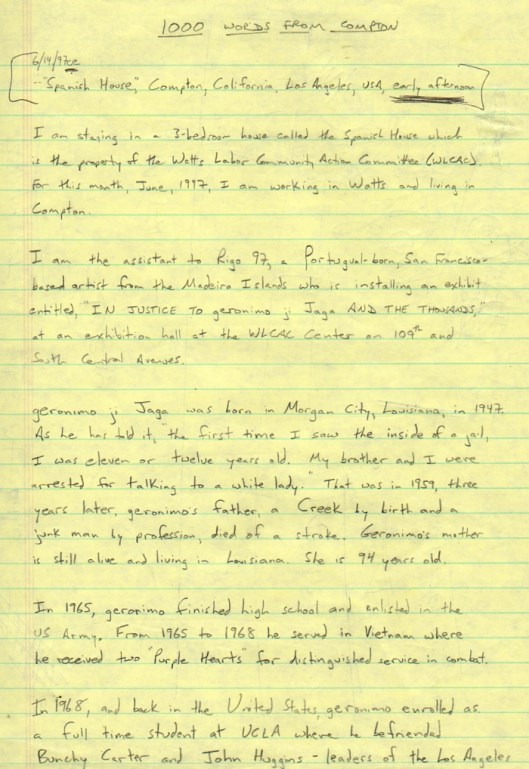
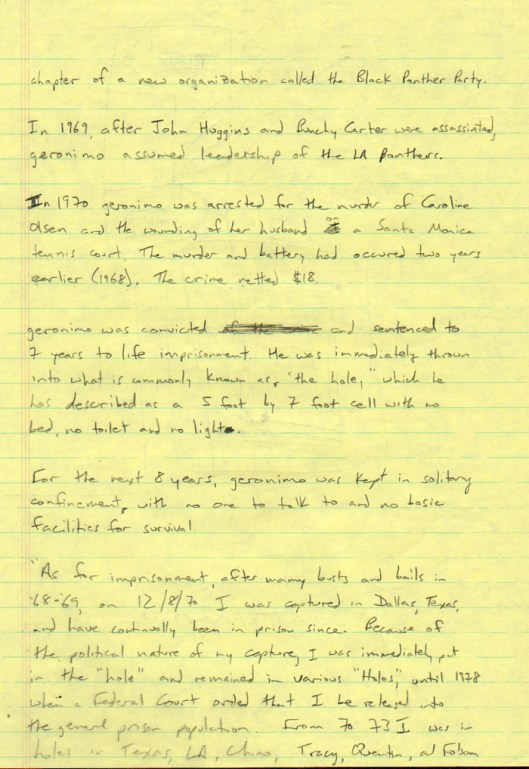
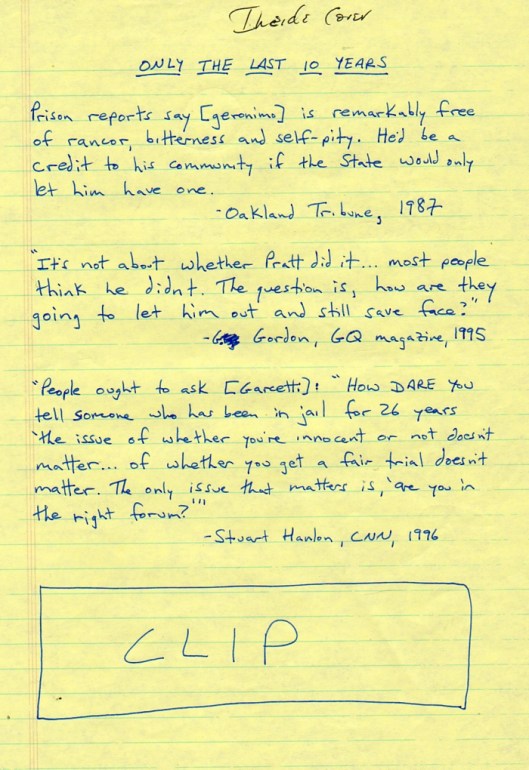
Rigo got up and showed images of some of his works, including the three Capp Street Project-funded pieces from Rigo 95. The famous “One Tree” brings respectful commentary but “Extinct” and “Inner City Home” are more popular with this activist crowd. Rigo shows one of his pieces about Geronimo Ji Jaga Pratt. (Still in prison without bail – 1997ce – ed.)
One of the purposes for this evening is for Daniel to show his friend J, the muralist from New England, what kinds of work are being done on the West Coast. These artists represent the currency of a living tradition of West Coast mural art which dates back to the turn of the century and Diego Rivera through to Chicano and Latin American paintings of the late sixties and seventies. The representatives of this culture gathered together to show their works is impressive.
For his part, J.’s works are quite impressive, too. They are long and tall and broad works. He has been painting murals for fifteen years and exclusively murals for the last four. His work is all over New England. But it lacks the political edge of the other artists here. It is significantly more commercial and corporate-based work.
A comparison of these methods and treatments of art and corporate advertisement brings to mind an interesting issue: the paint on the walls is hardly a few millimeters thick, but the depth of the meaning can vary so much from artist to artist. Those few millimeters can be as deep as a river of ancient resentment or as shallow as a sideshow pitch.
After the slideshow, the artists and guests asked Daniel to show images of his own work. In particular we hoped to check out the as yet unseen Malcolm X piece. Our host was humble and kind enough to oblige us and our curiosity gracefully.
The Malcolm X piece was glorious. Daniel showed slides of nearly the entire process of creation, including sketches and composites, from black-and-white versions through to the final colored and treated piece. A fantastic montage of images from Malcolm’s life and times blazed across canvases. It was an honor to witness. The awarding of Daniel’s commission was well-deserved.
After the party we all went our separate ways. Rigo and I headed back to the City. (We were going to check out the Mormon Temple, but they had turned out their lights already – “I guess without caffeine they go to bed really early!” we joked)
It was a nice drive across the bridge at night. The financial district buildings were alit with Xmas lights. I have driven this drive by daylight before and seen Rigo’s murals from the highway. It’s good to be riding with headlights and turn signals. We stopped back at C.’s salon on the way home for a nightcap and apple pie. Sally the dog welcomed us and I gave her some of my slice.
*****
Today is New Year’s Eve and it’s still cloudy and grey. It’s another of these straggling Tuesdays and the office here where I am temping is empty. “Why are we here?” some of the employees ask. There is talk about what plans people are making to celebrate tonight. How they will ring in 1997. Rigo’s name will change in 12 hours. Tomorrow is College Football Bowl Day.
I don’t tend to celebrate holidays anymore. I used to go through the motions, but along the way they have drifted out of importance. I want to spend my time well and live well, but I feel untethered to many of these clocks.
I am thinking about those muralists I met and whose work I see everyday and who continue to struggle to do what they love to do. They are brave and strong. Women and men with drive, energy, motivation and purpose. They make, they do, they achieve so much so that all of our lives can be improved, so that smothered voices may be heard.
The sun came and went, rains came and went, the new years came and went. Time passed. The tradition of mural art progresses and time memorializes it. We are blessed to have among us a Rigo and a Miranda Bergman, and a Juana Alicia. We are graced to have among us Daniel Galvez and John Werhle just as we were to have Diego Rivera.
The onslaught of commercial uglification may continue but silently, as continually, the struggle against it trickles along.
–M.T. Karthik, December 31st, 1996
 MTK The Writist