This story begins lying on its back in a small, one- bedroom hole in a creaking, dripping, grey, 18-story building in Tsim Sha Tsui, Hong Kong.
There, on a morning that would turn into a beautiful spring day, I wake up and hear the sound of rats scurrying around in the dark, and the sounds of wheels turning and gears clicking. I hear unnamed sounds.
I get up, pack my stuff, throw it on my back and go down to the first floor of the Chung King Mansions. This volatile, multicultural conglomeration of dirt, sweat and international odors stands just off Nathan Road in Kowloon surrounded by rows of pricy hotels: The Peninsula, The Hilton, The Hong Kong Empire.
The Chung King hostels have been the cheap place to stay for the shoestring traveler since the 1970’s. Other than brief alterations due to fires that have erupted in its corridors over the years, it hasn’t changed.
Out front, there are Indians and Iranians, bearded and red-eyed, sitting on the street railing. Foreigners from every corner of the globe are walking by. The little Chinese guy with the $8.00 USA Todays and Penthouses and Time and Newsweek and Rolling Stone, is unrolling his papers and magazines.
At dawn, the crowd are all hanging around wrapped in cotton, ear-ringed, nose-ringed, tattoed, goateed. They are either leaving for work or just getting in from play. Several of the turbaned Sikhs are asking me if I want a good place to stay or great Indian food or to go to the best restaurant in Chung King. The rest of them hover around the moneychangers offering black market rates. A German couple is buying watches, a Canadian is buying Nikes, a Frenchman is selling perfume. It’s early and a lot of people are just getting going.
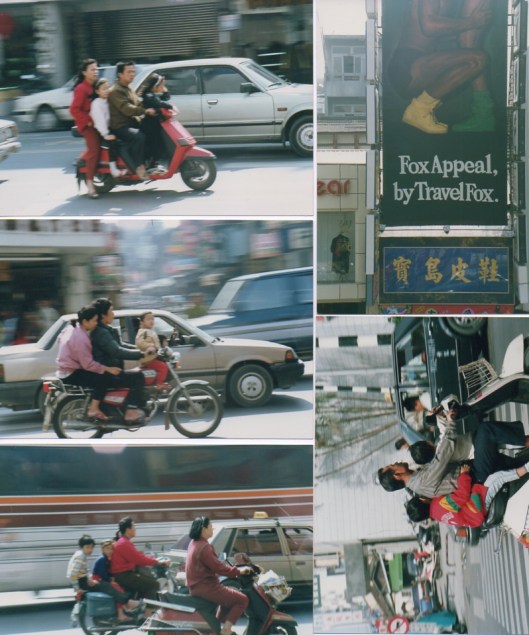
Traffic is still light. Light for here. The sidewalks are peppered with people. Bright red doubledecker buses and taxis glide by. There are light, low-lying clouds over the bay. It is a bit dewy, but you can smell the sun behind those drops, burning the clouds away. The blue sky is already cracking through. By 10:00 it will be 30 degrees.
And on this morning, as I look across the street at the Hilton, I see an anachronism. He’s an elderly Chinese man with greying temples under a flat, grey, Maoist cap. His rope buttons are worn and his ancient Chinese clothes are from a time before all of this.
The free port of Hong Kong rises around him. Six major hotels. More foreigners than Chinese. So many shops. Everybody here is either buying or selling. And he, clearly, is not.
He stands in the middle of all this looking completely foreign, and he begins to fight it.
Standing on the corner of Nathan road in front of the Hilton, he is screaming at the top of his lungs probably the only two English words he knows. Probably the two words he learned expressly for this purpose. He is standing on the street corner screaming and throwing his hands up, hitting the sky with his fists and begging:
“Go Back! Go Back! Gooooo Baaaaack! Go Back!”
His voice is cracking now. He cannot keep this up. These two words are booming down the street in the quiet morning calm; kicking back and forth off The Peninsula, off Chung King Mansions, through the corridors and dripping alleyways:
“Go Back! Gooooo Baaaaaack!”
His voice is coarse and harsh now breaking and cracking. And still he screams. It’s been about five minutes and now I’m standing beside him.
He isn’t looking at me. He isn’t looking at anyone. Unfocused, his eyes open and close with the jerking of his head and hands as he puts every ounce of energy into his request.
I stay put and now I am looking at everyone else.
They stare at him, they smile and they continue to walk. Another Chinese man is standing a few feet away clicking in Cantonese and laughing at the old man. A young couple respond to him and they all laugh. A group of white businessmen walks, uninterested. Another man videotapes from across the street.
In front of Chung King, the Indians, Iranians and other foreigners look over for a time and then go about their business. Now they are looking at me. They look long and hard. My pack is slipping. I hitch it up and turn and walk away.








 MTK The Writist