• About
  • Fauna
  • Flora
  • Landscapes
  • Radio
  • sketchy stuff

MTK The Writist

~ my blog and journal

MTK The Writist

Tag Archives: beach

Locals Summer on Long Island; Djokovic at the U.S. Open; Trips to Fenway and New Hampshire

18 Wednesday Sep 2024

Posted by mtk in 2024, baseball, NYC, Road Trips, sport, sports, travel

≈ Leave a comment

Tags

autumn, baseball, beach, Boston, boston-red-sox, Fenway, Flushing, friendship, Hampshire, island, Lido, long, Massachusetts, mlb, new, open, park, queens, sports, summer, tennis, tom, travel, trees, U.S., USTA, woods, york

I’m out on Long Island, NY, where I’ve spent a couple of weeks visiting my friend, Tom, who was my neighbor in Williamsburg, Brooklyn, 25 years ago, when we were both childless, unmarried and young.

Well, I was in my early-30’s. Tom and his roommates were recent college grads, starting their careers in the biggest city in the world. NYC was spectacular and singularly massive at the turn of the millennium. We were intoxicated and alive.

Tom is younger than me by seven years. In the time since I saw him last, he climbed the ladder in two separate career paths that crashed due to financial crises and has now climbed the ladder in a third: wine and spirits. He is an accomplished and successful Director of middle management.

He’s raised three children and supported his mother, and theirs. His father passed away; and his brother, an Iraq War vet, committed suicide.

Tom tracked me down four years ago after his father died. He told me he thought a necklace I gave him, cursed him. It brought him so much bad luck.

I arrived in mid-January in sub-freezing temperatures, we spent a few days catching up, and I promptly threw the necklace into the ocean on the outgoing tide.

Close readers of this blog will remember when I threw the accursed necklace into the sea, but click the Tom and the Opera link and read about it if you haven’t.

When we reconnected, Tom and I had both just lost our fathers. His brother died some years before, and I have since lost my sister. We are brethren at mid-life. We often have half-hour to hour long phone conversations about enduring this world in our times. Since we reconnected, I’ve tried to give my friend a way to separate himself from his troubles.

In the last two and a half years, I showed up to help Tom move into his post-divorce apartment – when we went to the Metropolitan Opera for Rigoletto from center box seats. I flew him to Amsterdam for a four day vacation before the first ‘Thanksgiving and Xmas with split households’. And I paid for him to go to Africa to build a school with his daughter and her classmates.

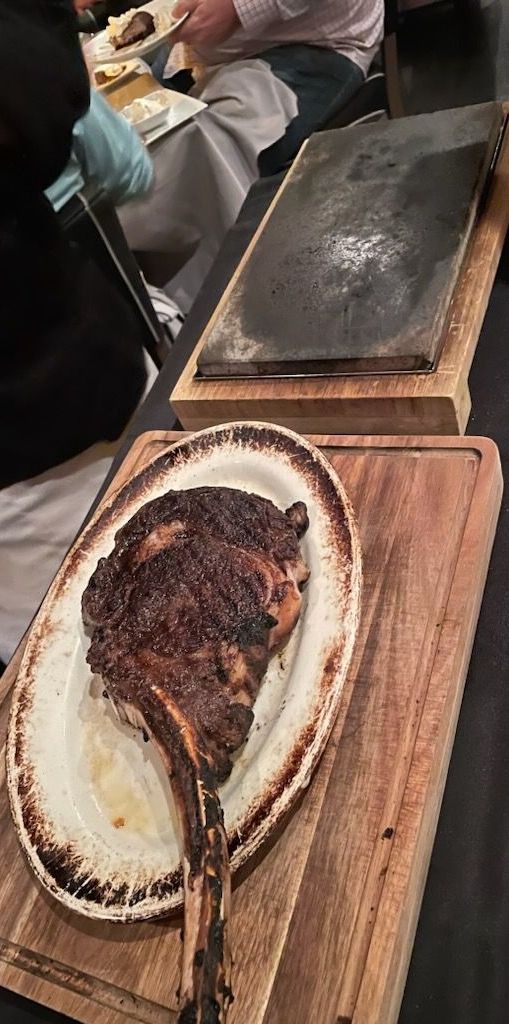
I’ve also treated us to several lush meals in diverse locations. The latest was at Blackstone here on Long Island. We had really delicious oysters from Canada, tuna sashimi, a Vietnamese-spring-roll-style sushi roll, lump crab, and a tomahawk Wagyu steak. I had a beaujolais. Tom had the banana cream pie.

It’s a fine dining restaurant in an area of strip malls. The interior was made to feel old-school, wooden, warm. Yet, the exterior is contemporary suburban monoculture – sigh, I guess that’s everywhere now. Here though, they take things they want and put them together for the convenience and then make them at the highest quality available in the same place … good steakhouse and good sushi, has emerged. The fish was fresh, prepared very well. The steak, unique, delicious.
Spending time with Tom has been exorbitant fun, controlled chaos and a good re-bonding experience. I know we’ve been helpful to each other, though we don’t discuss it. I worried about him when things were looking bad, I don’t now.

Tom, like many New Yorkers, does for himself and his own, but won’t ask for assistance. He will take what’s offered without guilt and enjoy it lustfully, which I find fun and uplifting. Until it’s not. Then he gets arrogant and deaf.

I was walking through Golden Gate Park two weeks ago when my cel flashed, indicating my phone was ringing. Seeing it was Tom, I answered.

“Thought you were coming out this summer, ” he said.

I told him I got busy with a three week, 2200 mile road trip to drive my beloved car Sylvie out west.  Tom said:

“Well, there’s only Labor Day pool party left, unless you want to come New Year’s Eve for Phish.”

I put the phone down, bought a one-way ticket to JFK, booked a hotel in Long Beach for a week, and bought tickets for Arthur Ashe Stadium at the U. S. Open tennis grand slam.

It had been a year and eight months since we hung out and I knew I wouldn’t make NYE in NY. I rationalized, too, that Tom wanted me to visit so I could see that he’s cool now and things are going well.

I had been trying to help get him away from it all to process his thoughts. That’s why I took him to Amsterdam and the Opera and supported his travel to Africa – to wholly extricate him from his own life as a break.

Our meals in Manhattan, in Amsterdam and here, are all, in part, a separation from our lives – to talk deeply about things that matter. I was thrilled to help him travel with his daughter and their class to Senegal.

The Labor Day Pool Party at Tom’s townhouse in Lido is the final party at the pool before it’s closed for the off-season. All the families and friends of families enjoy swimming, food, drinks, music, a raffle, and the most important events: games!

The table tennis and cornhole tournaments are highly anticipated and competitive. Yet from the moment I arrived, Tom told me, “I’m winnin’ that.”

He crowed to every neighbor we saw for two days that he was winning the cornhole tournament. It got so ridiculous, at one point when we were alone in the car, I said, “Yo, man, you are talkin’ a lotta smack about this cornhole thing.”

Now cornhole, like shuffleboard, requires team play. I know these tournaments use random selection for team mates. How could he possibly guarantee he’d win? But the thing about Tom is …

It was done and dusted.

That’s something Tom gives me – and I think he gives it to everyone he knows – chutzpah.

It was a great time. I saw Tom’s mom and family. We all jumped in the pool together at the end of the party, by tradition. The food was great. Lovely day, wonderful people. I felt welcomed.

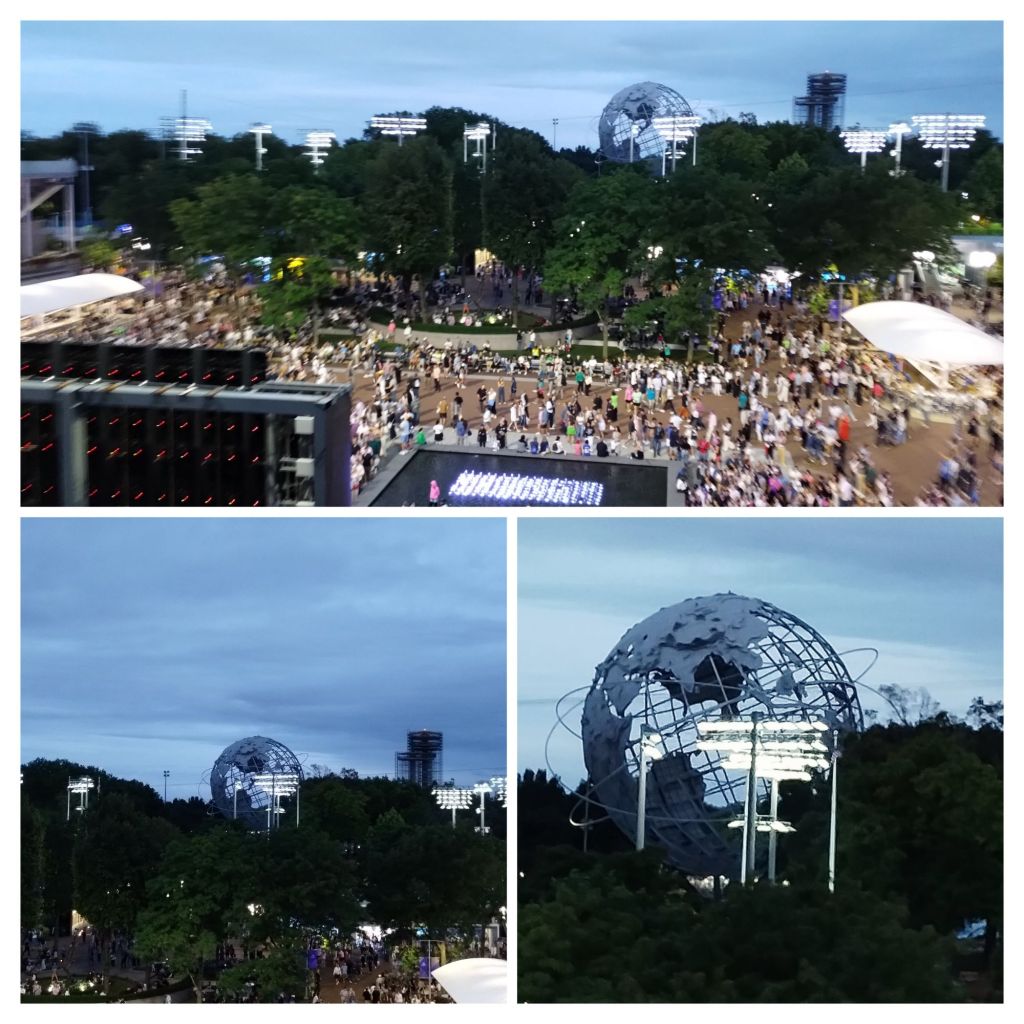
So for my contribution on this trip, I took Tom to the USTA Center in Flushing for a match at the U.S. Open Grand Slam tennis tournament, something he and his neighbors would never do.

I grew up with tennis because of my Indian parents. Tom’s people prefer hockey, football, basketball and baseball. I know I expand Tom’s cultural landscape, as I know he expands mine.

Through luck of the draw we got a match featuring perhaps the greatest tennis champion ever, Novak Djokovic, and, in a stunning upset, Nolé was defeated by Australian Alexei Popyrin.

I concluded it was because of fatigue from playing in every previous Grand Slam Final and then meeting in the Olympic Gold Medal match that Djokovic and Carlos Alcaraz, world number two and one respectively, were eliminated in the early rounds at New York.

Apparently the men’s endurance limit is four championship tournament finals. But it was pretty cool to see Nolé combat the Aussie Popyrin at Arthur Ashe Stadium.
By contrast to my material gifts, Tom has been  generous with things that have no calculable value, including counsel and trusted conversation. He has picked me up, dusted me off and demanded I go at it again more than once.

On brief occasions, over the last four years, we’ve enjoyed food, wine, weed and travel as single men in mid-life.

We’ve shared meals and conversations and consulted one another on these occasions, separate from our responsibilities, to decide how we will make our way. He has lifted my spirit and confidence. This is priceless.

Tom has introduced me to his friends and family, who keep a tight circle. I am, for the first time, meeting his oldest friends and the people he has known for four decades, a community within which he is now the eldest surviving male of his family.

We both battle depression under the weight of our self-perception. We both do it in solitude, often not sharing it with anyone else.

Instead of staying in the city and visiting for a night,  I’ve come out to LI to stay in Long Beach, with Tom for a couple of nights and in local hotels .

It’s now the season they call “locals summer,” when the tourists leave and the weather is pleasant and locals get to enjoy what the island has to offer before it gets too cold. It is a lovely, peaceful beach town now.

Long Island’s a place that has been described so often by others that it’s hard to put it in original terms anymore. From The Great Gatsby to Jaws to Everybody Loves Raymond, the literary, artistic, social, and now digital, presence of the place masks the reality.

The reality, which I am gaining an understanding of through Tom and his community and my extended visit to the area, is private, energetic, vibrant and physical. Long Beach is more diverse than I imagined. Other areas of Long Island are not.

Meanwhile, many helicopters and private planes still pass by the beach and overhead daily – shuttling the wealthy back and forth between the City and the Hamptons, or Montauk or wherever.

It’s half-September.

Many of my friendships have faded because all I do is get really close to people and then leave disgusted with where I am. For example, I could never live here.

New York remains a place that repels and attracts. I hate the way people look at me here for my long hair and wearing bright colors. I feel an almost constant basic racism of otherness. It’s a famously white and restricted place that demands you behave to belong.

My unwillingness to be treated less than for being exactly who I am has meant friends have faded from my frame of reference away into their own lives.

Now, at mid-life, some old ones re-appear. I find they are younger than me by just a few years and they are all going through what mid-life brings us: break-ups and deaths and a powerful existential energy.

The French call it “l’energie d’age.” Which is such a better term than “mid-life crisis.”

This was a really cool kite flown at Long Beach, Long Island

Since I’m on the East coast, I decided to try and see some other friends who, like Tom, reconnected with me just after Dad died, in that fateful Spring when the pandemic plunged us all into various solitudes.

These friends, a married couple with two sons in college, have been dealing with enormous soulache from numerous deaths in their family and community, including a fraternal suicide and a very recent loss to cancer.

The emotional weight of it is staggering. But when I saw them I was inspired by their resilience. It falls to us, in our 50’s to bear and manage the circumstances. We’re the adults now.

My rediscovered friends here on the East coast impress me deeply with their strength and fiercely organized approach to the spiritual and practical demands of mourning. They press on.

Though busy with funerals and memorial services, they were able to break away for a couple of days to spend time at a forested property in New Hampshire, where we had a good walk in the woods.

and lovely vistas of trees.

Though the visit was short, it was affirming. It’s good to trust others again.

When we returned from New Hampshire, I was in a suburb of Boston, with time on my hands. This gave me the opportunity to visit Fenway Park, the oldest major league stadium and a baseball-lover’s bucket-list destination.

This was indescribably wonderful. It’s an intimate place where they adore baseball. You can read about my first trip to Fenway on Giants Baseball Corner, my baseball blog, if you click that link.

and here are the Red Sox fans, in their glorious baseball Ashram, enjoying their song, Sweet Caroline by Neil Diamond:

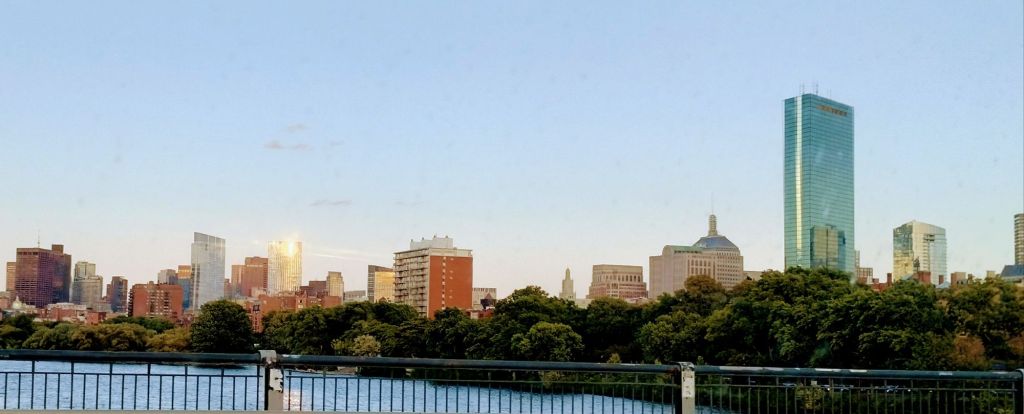
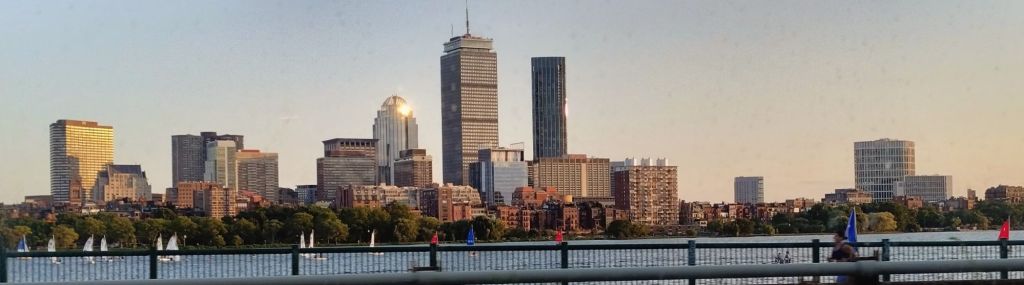
And here are some stills of Boston I took from the windows of various cabs:
I also managed to sneak in a visit to MFA Boston, the Museum of Fine Art which is, remarkably, open until 10pm on Thursdays and Fridays. I’m sure Friday it’s packed, but to have that place all to myself on a Thursday for four and a half hours was fantastic.

I will write a separate blog about that when I get a chance. Here’s the train back from Boston:

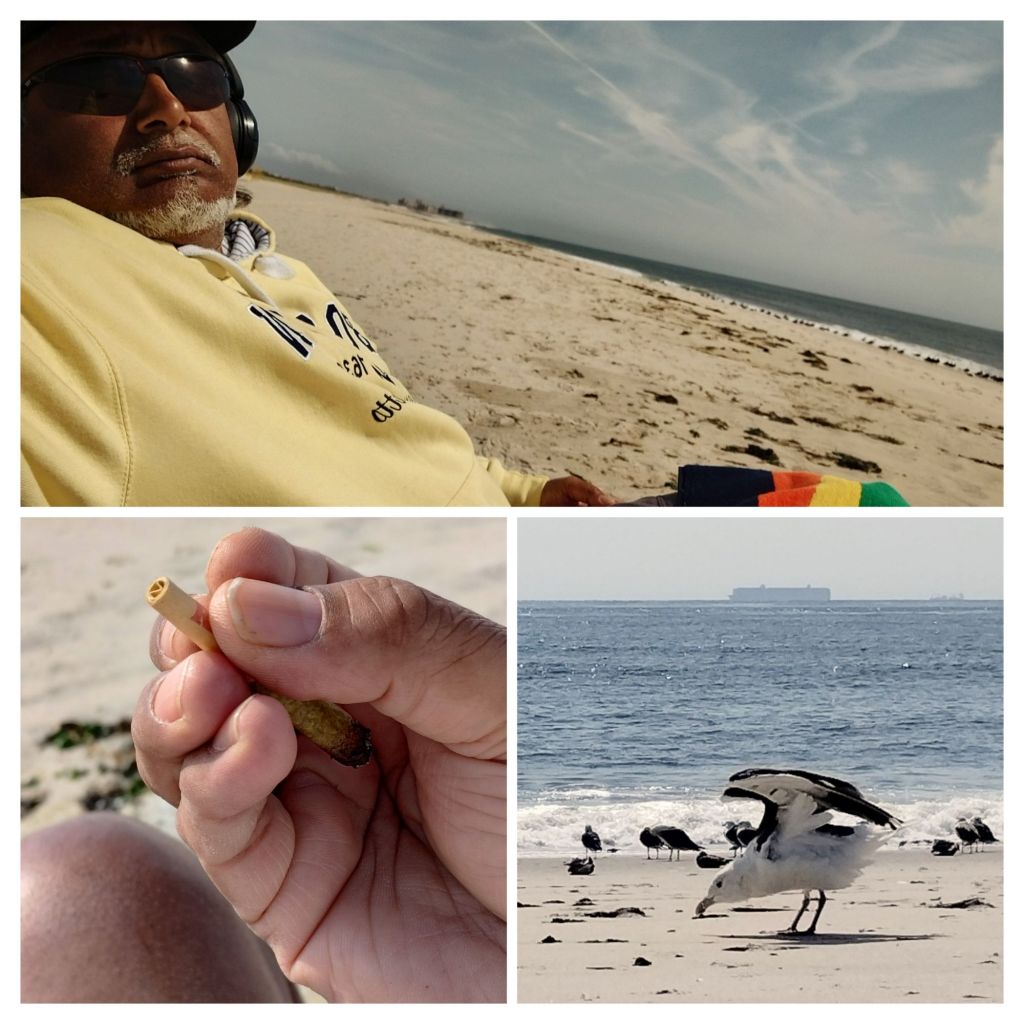
Meanwhile just xilling on Long Island:
San Gregorio Lagoon

15 Thursday Aug 2024

Posted by mtk in 2024, Coastal Cali, Road Trips

≈ Leave a comment

Tags

beach, california, cliffs, Gregorio, lagoon, Laguna, San, sand, waves

Kollam (Rangoli) Exhibition, Puducherry Promenade

24 Saturday Dec 2022

Posted by mtk in 2022, art, Asia, collage, India, Tamil Coast

≈ Leave a comment

Tags

beach, Exhibition, India, kollam, Nadu, pondicherry, promenade, puducherri, puducherry, rangoli, tamil

Puducherry

24 Saturday Dec 2022

Posted by mtk in 2022, India, Tamil Coast

≈ Leave a comment

Tags

beach, India, Nadu, pondicherry, pondy, promenade, puducherri, puducherry, Rock, tamil

Goededag

01 Tuesday Nov 2022

Posted by mtk in 2022, Coastal Cali, Commentary, conceptual art, weather

≈ Leave a comment

Tags

all, beach, de, dia, eve, halloween, Karthik, las, m.t., mtk, muertas, ocean

I’m coming to Amsterdam. Next week.

Beachcombing for Sand Dollars

19 Thursday May 2022

Posted by mtk in 2022, Coastal Cali, mollusks, S.F.

≈ Leave a comment

Tags

beach, beachcombing, combing, dollars, Francisco, Karthik, mtk, ocean, San, sand, sf

Review: Manhattan Beach by Jennifer Egan

22 Sunday Oct 2017

Posted by mtk in Book Review, reviews

≈ 1 Comment

Tags

2017, beach, book, Egan, jennifer, Karthik, m.t., manhattan, mtk, new, novel, review, Scribner

I’d never read a single word of Jennifer Egan’s work until Manhattan Beach, released by Scribner this month, despite that Egan has published four previous novels and won the Pulitzer and a National Book Critics Award for A Visit From the Goon Squad (2010), a novel that has been acclaimed in effusive terms for its inventiveness and originality in all quarters of the literary community.

Everything I read about Goon Squad makes it seem like my type of book. Weird, futuristic, made-up languages; character-POV-shifting chapters … I don’t know how I missed it. Trust me it’s on deck.

Though I’m late to the party, I think it might give me a different perspective on Manhattan Beach. I read it as a straightforward, third-person novel set in the mid-20th century.

Nearly all the early reviews of this novel mention how different it is from Jennifer Egan’s previous work and in specific, often quite vociferously, from Goon Squad. For an author who has been exploratory and inventive with form, Manhattan Beach is a contrast, a historical period piece.

But it turns out Egan worked on this novel considerably longer than any others. She told Alexandra Schwartz in a long form interview for the New Yorker last week she had been working on it for the last 15 years, struggling to put together a story “anybody is going to want to read.”

I recommend it.

Manhattan Beach is an extremely well-researched and fast-paced story set predominantly in Brooklyn near the end of World War II that transports the reader to New York City in the mid-1940’s and fills it with presence and character. Egan has crafted an intriguing family story with which to reveal the city and the times, with particular focus on life in and around the Brooklyn Naval Yards.

The protagonists Anna Kerrigan and her father Eddie, and their family, friends, colleagues and enemies carve out their lives cast in the meager circumstances of a wartime economy that we know from history is coming to a close. Manhattan Beach takes us on a richly detailed tour of the corruption and culture of Brooklyn, New York, the Mafia and the Navy in a very particular period in history: the handful of years before the end of the war, between Pearl Harbor and the fateful flight of the Enola Gay.

It’s an American story about a Brooklyn family and how their life is changed in a tumult. The war hangs at a distance and we see the city – and in particular the Navy Yard and its surroundings as most young, able-bodied Americans are being sent abroad to fight.

Anna is a tremendously likable character and her journey at the Navy Yard to become a diver is a fascinating and well-detailed arc that weaves through the mystery and intrigue of her father’s disappearance and the nefarious underworld of the gangster Dexter Styles.

Egan’s style is crisp, well-researched and yet poetic when necessary. Balanced in approach, one doesn’t get a nostalgic feeling for this period, but rather a view of it as if through a veil. The story unfolds, characters slowly discover things and we get to see something we haven’t been able to see.

The sea – riding upon it, staying alive in it, walking in divers gear and trying to see  through it – plays a significant role in this work and yet it, like the war in the distance functions more as a powerful medium for the development of the characters.

By contrast, the plumbing of Egan’s characters – their thoughts and emotions buffeted about by war, crime and sea change – is lucid and clear. Egan is excellent at interior monologue and reflection by her characters. She gets at rooted feelings with wide-open eyes. This often results in gorgeous passages.

The story includes a brilliantly imagined voyage on a merchant marine vessel named the Elizabeth Seaman. The nod to Nellie Bly goes unmentioned, a subtlety at which Egan is graceful – letting history fall into place where it belongs.

Egan captures the longing and isolation of Eddie Kerrigan, in his stateroom 47 days at sea, suddenly gripped by the notion that he has forgotten the face of his beloved –

” – could hardly picture her anymore. Faraway things became theoretical, then imaginary, then hard to imagine. They ceased to exist.”

Then, almost immediately, a torrent of thoughts pour through him about the first time they met, about her children and their times together. Finally he concludes,

“It was all still there, everything he’d left behind. Its vanishing had been only a trick.”

The story here, of a child and father separated by fateful decisions who alternate between avoiding and seeking one another out, is woven expertly and filled with surprises that emerge, unfolding until events feel inevitable. That’s good storytelling. The characters have a weight and realness to them because they endure and grow. There are deaths and children and gangsters and action.

But the story takes place in a different America, a different New York and it’s glaring on occasion. Characters deliberate over ethically conservative matters with earnestness but it never escalates. How women are perceived, how abortions and unwanted children are handled; these matters are described but never raise up into full blown issues. Racial hierarchies are described with the vernacular of the day: “micks,” “wops” and “Negroes” but racism never emerges enough to be addressed as an issue. It’s just how things were is the feeling one gets.

Manhattan Beach faithfully portrays some Brooklynites, in particular Irish-American, Italian-American and Naval families during World War II and an era of transition from a more sexist, racist and somewhat naive past just up to the doorstep of a future we live in today.

I review without spoilers, so I’ll conclude by saying Manhattan Beach is a great book. New Yorkers will love it and Egan will be helped during awards season by that. But more, I enjoyed Jennifer Egan’s language – lovely turns of phrase – and her character’s introspections. She has managed to create a compelling tale from immense research.

3/5 stars


Cosco Long Beach Monrovia Enters Port of Oakland

26 Wednesday Jun 2013

Posted by mtk in Coastal Cali, fishing, North Oakland, Oakland, SF Bay, vehicles

≈ Leave a comment

Tags

beach, california, container, Cosco, Karthik, long, m.t., Monrovia, mtk, oakland, ship.Port

Image

sunset on stones, Ocean Beach, SF

09 Tuesday Oct 2012

Tags

beach, Francisco, ocean, San, sf, stones, sunset

Posted by mtk | Filed under photography, S.F.

≈ Leave a comment

surfers at Ocean Beach, SF

08 Monday Oct 2012

Posted by mtk in Coastal Cali, S.F.

≈ Leave a comment

Tags

beach, Francisco, gate, golden, Karthik, m.t., mtk, ocean, pacific, San, surf, surfers

a gorgeous Monday afternoon.

Cityscapes and Landscapes

27 Monday Feb 2012

Posted by mtk in photography

≈ Leave a comment

Tags

beach, building, chennai, chicago, cityscapes, empire, enoshima, indian, landscapes, madras, manhattan, ocean, san francisco, sears, State, tower, yokohama

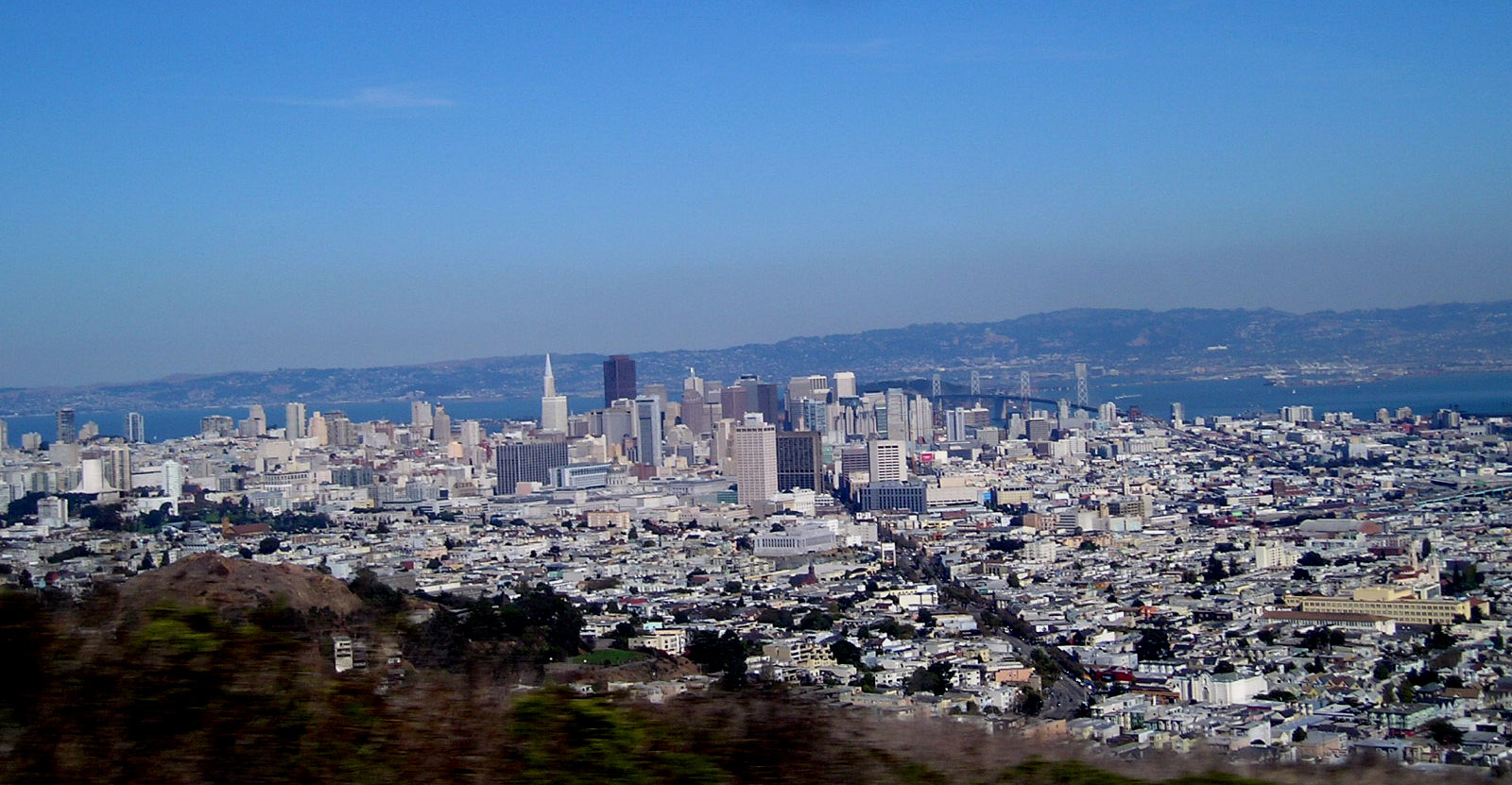
added some cityscapes of Chicago,

Manhattan,

San Francisco,

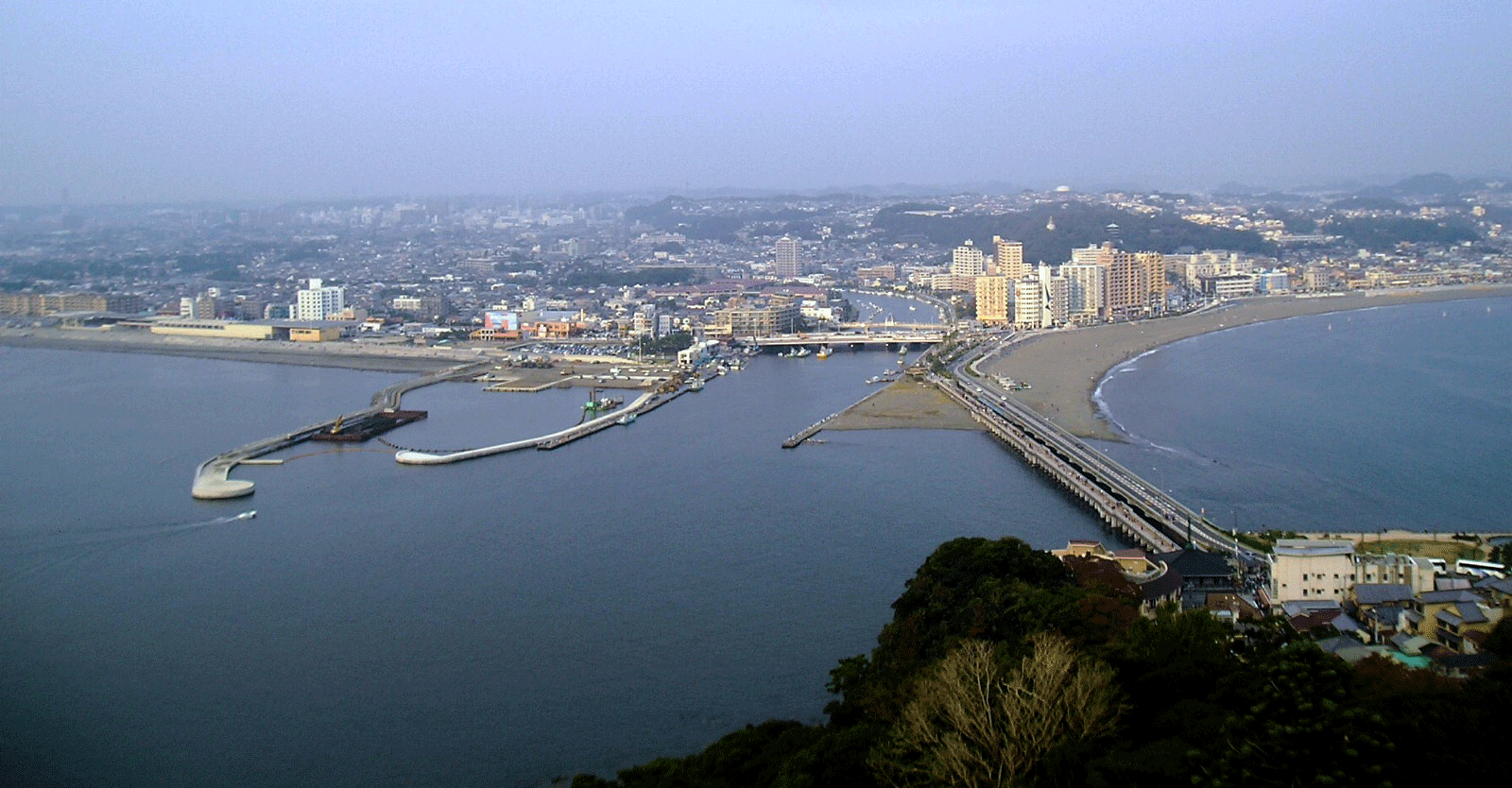
Yokohama and Enoshima

and some images of beaches in Kamakura and Chennai

and elsewhere, all in the landscapes tab.

79 Days Before the Towers Fell

23 Saturday Jun 2001

Posted by mtk in journal entries, NYC

≈ 2 Comments

Tags

2001, beach, before, brooklyn, chinatown, coney, days, fell, greenpoint, island, m.t., m.t. karthik, mtk, subway, towers, walk, williamsburg, wtc

Rent in Williamsburg has risen to the point where a small, clean, $700-a-month, one-bedroom apartment is impossible to find, requests for roomshares are on the rise and complaints about the cost-of-living are played out.

Next door on this very block, “loft building” banners have gone up across construction sites in two empty warehouses. The owners advertise cookie-cutter, 750-1200 square-foot apartments for $2000 – $4000 a month with amenities like all new appliances, double height ceilings, gas heat and hot water; on flyers at the local deli where, yesterday, a woman picked up a flyer, stared at it and seriously muttered, “there goes the neighborhood.”

Burns, a bicycle mechanic and bassist, and Dr. Tracer, an instructor at a local community college, live on a four-year-old lease and pay $1000 a month for perhaps 700 sq. ft. – the back space of which Burns has converted into his bedroom.

Ten days ago I took the world’s longest nonstop flight from Hong Kong to Newark.

I’ve been sleeping here in Burns’s room when he leaves for gigs or work and writing with his laptop on the nightshift.

I rose from my daysleep just after midnight to find Dr. Tracer had dropped acid.  He was about an hour into his trip when I awoke and he offered me a tab. I meditated, ate and dosed.

It was 1:20 in the morning and I was awake and alert for the next 15 and a half hours for a cool, rainy trip on a Saturday morning in June in Brooklyn and Manhattan.

Dr. Tracer illustrated without malice, frustration or the use of traditional spoken language that as a result of only 180-degree sensory input, a person who cannot hear evolves under a powerful sentiment of paranoia about what is behind them or out of their field of vision.

We began walking through Williamsburg at 2:30 in the morning, past the swinging doors of a bar. Partied-out, Friday-night boozers stumbled into the street looking for taxi or subway or deli or restaurant doors, their eyes blearily seeking something recognizable, the stench of smoke and alcohol wafting off them.  Music drifted faintly out the open doors.

We stopped at a deli, where a broad swath of bottletops had been crushed into the asphalt in a dense, rectangular splay of circles – a speckled count of the beers drunk at the cornershop on hot summer days, when tossing a bottlecap out onto the street meant it got stuck in black, melted goo. A girl was hanging around the pay phone, Brooklyn summer night; couples fell into each other, lazy eyes smiled, engines fired up, a black sedan pulled away from the curb.

We had a coffee and made our way to a bar off McCarren Park. I drank a couple of martinis, Tracer had cold white wine.  We conversed until 4:30, discussing broad philosophical topics casually. We were specific on the matters of death, writing and deafness.  At one point Tracer and I agreed that when we were children, we were surrounded by others who did not understand how to communicate with us, whose methods were sympathetic but crude. This we agreed, drove us to write.

Two women, a redhead and a brunette, walked in and seduced two men.  The women sent one man home alone and, as he stumbled out, but before the door had fully closed, the brunette said coldly to the redhead:    “T-G- H-G!”-  in time with his steps, with the door swinging closed and with the click shut, she mock-laughed as she fell forward on her stool, elucidating: “Thank. God. He’s. Gone.” as she turned back to the man who remained.  At last call, they walked home with the second man, the brunette told him they wanted to teach him something. We were the last customers and left shortly after this.

A few blocks away, we ran into Tracer’s former roommate, a German who shared his apartment for the three years before Burns moved in. The German’s wife and child were out of town and he was up at 5:00 in the a.m. strolling neatly out of a bar, wide-eyed, looking for cocaine, asking if we had any – we did not.

The sun rose quickly, early on one of the longest days of the year. Dr. Tracer and I returned to the apartment, rolled a joint and continued talking.  The joint was affirmative and Tracer had a broad laughing fit while in the bathroom alone. We decided to travel.

We had a coffee, then took the G and the F trains to the ends of their lines, arriving at Coney Island just past 8:00 a.m. It was a rainy morning and thick, grey clouds masked the sun. The light was a cold-white glow behind them.  The beach was a neat, empty, expanse of sierra-colored loam, darkened by wetness in neat lines by tractors pulling wide metal rakes. The sand was made soft by the thin, white line of foam that the edge of each wave drew as a loose parallel to the horizon, a black straight-edge between the gray sky and the grey sea.

We began walking from the boardwalk to the beach silently, occasionally signing as we walked. We passed an elderly, disheveled woman, who was entirely wrapped in a blanket lying on the beach. After we passed this lump of cloth and human flesh, I saw peripherally that she rose from her reclined position. I then clearly heard her say, “who knows … maybe they like walking on the beach.”

I have never known LSD to contribute to paranoia in me. My use of it has generally resulted in hyper-attenuated hearing and sight and an alertness and remoteness of character. But even now, I wonder about what I heard and saw in that moment.

It could have been a woman on a phone call talking to someone else about something else, but her physical movements implied awareness of us. It could have been a crazed, semi-lucid homeless person babbling incoherently to herself, afraid of people approaching and passing her encampment on the beach or, it could have been an agent of some U.S. policing department observing us as we visited the beach. More engagements with seemingly random others on our trip would increase my feeling that we were being closely observed.

Dr. Tracer and I sat by the ocean, waded, ate a bag of chips on the lifeguard’s chair, had Saturday morning at Coney Island Beach for forty minutes and decried the lack of sunshine. I tape-recorded the sound of the waves and the seagulls to listen to back in the city.

I hoped, pathetically, that the sun would emerge until Tracer pointed out that the storm off the coast was headed inland.  We left the beach before the rain started.  As we left the boardwalk, vendors were opening for business.  We had a coffee.  The first drops of rain struck us as we crossed the street to the subway. We decided to go to Chinatown.

We caught the N and smoked a bowl in an empty car during the long stretch between the end of the line and 50th. Then we switched to the operator’s car to watch people.  On the way back, I glared out the windows at the grey sky defiantly until we went underground. Dr. Tracer finally joked, “when we get out on the other side the sun will be shining down on you … vindictively!”

A black, 40-plus-year-old man, clean shaven and slightly balding, got on and sat beside me carrying a rustly collection of objects in two plastic bags; black plastic covering a white plastic bag inside. He had a small band-aid strip stuck on his head exposed below his high hairlines. The obvious rectangular strip was set perpendicular across a straight, red line of blood above the temple – the wound was obviously fake, staged. The man fumbled with his possessions, continuously muttering to himself. He could as easily have been a semi-crazed denizen of New York as an undercover NYPD detective.

Once we moved from the empty car in the back to the operator’s car, many people who got on the subway on their way to Manhattan seemed like characters, with staged aspects, or too-perfect appointments. I wore headphones, listening to a CD of sarangi and hearing the outside world leak in. Two women with children sat beside us, a young boy in a stroller, his mother holding his infant sibling. They were northeastern Asians, maybe Korean. Their grandmother was gently inspiring the children to be friendly.  The son, cool, observant and thoughtful, seemed worried; the baby was still at the age of wondering at the world.

This was the operator’s car on the N, Saturday morning at 10 o’clock from south Brooklyn to Manhattan on a rainy day in June and I report with the impunity of a witness: public space in New York is undeniably equally peppered with lonesome egos, expressors of unimaginable histories, and potentially dangerous operatives for larger interests, both governmental and mafioso.

Another example: Agent 99, who subsequently led us to Canal street, starts with a pair of plain, white leather sneakers with silver dots evenly-spaced along the edge of the sole – thumbtacks – and a short, hot, controlled blaze of red, orange and yellow flames painted on the outer skin of each shoe, burning up, licking at the clean white leather shoetops toward the short, white, rolled columns – socks – that lead to a pale leg elegantly colored with intricate flowers of reds and blues – tattoos – into a sea of limpid green: an opaque, green silk skirt with a lime-orange border.

She wore a plain blouse and her hair was colored with straight, serene blonde streaks. She was reading a hardback with a romance cover and flowery letters that read, “The Sorcerer’s Apprentice.”  The glance of anyone on her side of the train who bent over to set something down, pick something up or tie a shoe was met with that leg, rocking up-and-down, regular as a pendulum, leading to a carefully put-together young woman on her way to Mallhattan.

We emerged from the subway to the rainstorm we’d seen hovering dark over the ocean. The World Trade Center Towers disappeared into thick, coal-colored clouds. The curved disks of the shoppers umbrellas floated through space, most were black, bobbing with the motion of their porters.  The storm had traveled overhead as we traveled underground and was now present broadly over Canal street.

The huge, warm, tropical drops, falling down, on and around street signs and ads with Chinese and English text, reminded me of Taipei where I’d been two weeks before during the see-bei-oo rainy season.

We stood under the awnings of the Asian marketplace as rain poured down. Oblique, glowing flashes of white light flooded the clouds internally, leaked out the edges.  Thunder rolled.  Rain fell and we passed through it, mindless, walking between the drops.

We crossed between corners and in front of the slow-moving traffic. Many people shopped. Two tall women, one with a necklace that spelled, “dirty south,” in cursive, solid gold letters, awaited a man, shorter, rounder, balding, mustachioed, who was buying a souvenir.  Young southern Europeans, women, were shopping.  An elder, African-American man bought a pair of scarves. Il pleut.

We stopped at a Vietnamese cafe, had hot tea, then pho, rolls and beer.  We returned to Brooklyn on the J. It was past noon.

Burns had gone to gig a wedding.  His cats, Percy and Mingus wandered around the house, mewling for food.  We fed them.  We rolled another joint.  We’d spent 27.00 on food, 25.00 on liquor, 4.50 on transportation and 3.00 for three coffees each, USD 59.50, total.

We were coming down. I was sitting in a chair opposite Dr. Tracer in his room in the apartment.  It was silent.  The grey light of the sky outside was only visible through crevices in the blinds and around their edges.  Tracer had angled a desk in such a fashion that, sitting behind it, he could see himself and me and the door out, mirrors reflecting the interior of the room around him and nothing else.  His back was to the window and the room behind him. I was able to see the window and the lightning that flashed outside.

This was the end of our trip, 12 hours after dosing and after a big meal and a long, wet walk in the rain. In my fatigued simplicity I became conscious of the sound of the weather. We were talking and the thunderstorm was accentuating Tracer’s speech.  It grew in intensity and I could no longer focus on what Tracer was saying – the anxiety of it made me jump up. I suddenly remembered that the window in Burns’s room at the back of the apartment was open. I made my way to the back of the apartment saying, over my shoulder, “the rain! … I left the window open!” I realized only later that perhaps Tracer could not hear me or see my lips.

It was pouring.  There was the continuous sound of thunder following ever-nearing lightning.  At the back of the apartment, rainwater was hammering the wooden sill and dousing objects that lay near the window with a fine spray.  Some water splashed my arm in just the time I took to shut the window.  I went back to Tracer’s room flush with the excitement.  He remained behind his desk, but was standing, pacing as he spoke.

I began to realize my error and clumsily showed him my arm, which now was hardly wet at all.  He continued speaking and I realized I wasn’t following him. I sat down opposite him again, trying to compose the communication space that I had broken.

“… and <crack> … things that aren’t funny … No!” is what I heard him say as he took his seat and pointed down the hall.

Then, not immediately, but a second or two later – as Tracer continued speaking – there was an intensely loud, short, sharp <CRACK>! corresponding to a bolt of lightning that must have grounded somewhere very near to the apartment. It was shocking – by far the loudest sound I’d heard in days.

From the open window, I heard voices on the street raised in unison about the sound and flash – the remarks of people standing by the building outside for cover. Tracer’s face and posture showed no notice of any of it. I apologized for interrupting and we resumed our conversation about rent, writing and philosophy. The storm ended after twenty minutes.

Specifics of our conversation have been edited or lost to sobriety and the mindwash of sleep.

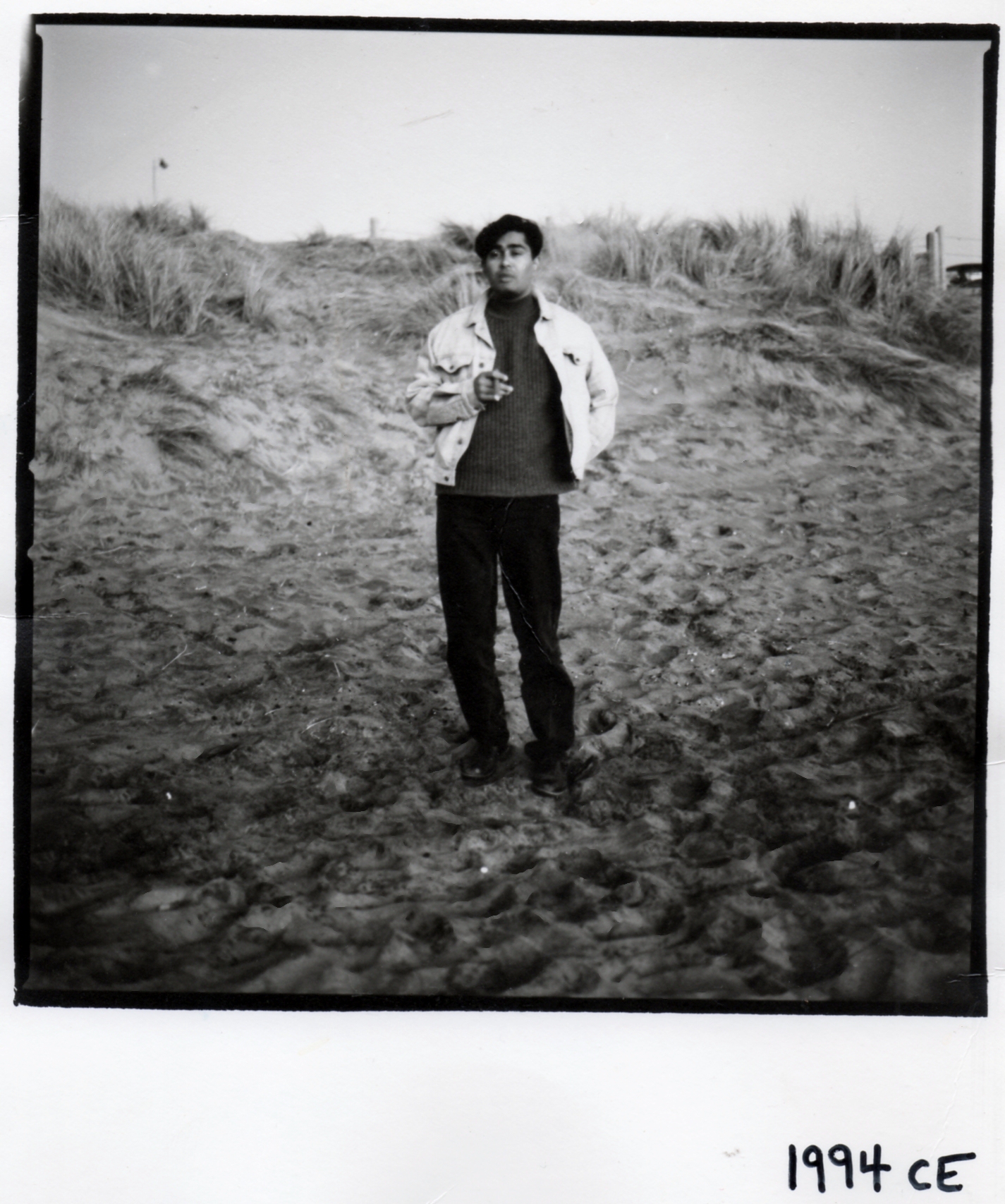
me at 27, Ocean Beach, SF, 1994

08 Saturday Oct 1994

Posted by mtk in Coastal Cali, S.F.

≈ 1 Comment

Tags

1994, beach, Karthik, kenny, m.t., mtk, ocean, trice

Molokai, Hawaii, 1993

20 Friday Aug 1993

Posted by mtk in conceptual art, photography, travel

≈ 1 Comment

Tags

1993, beach, Ha'alawa, halawa, Hawaii, Karthik, m.t., m.t. karthik, Molokai, mtk, valley

this is 35mm film digitized. below, the Halawa Valley

M.T. Karthik

Unknown's avatar

This blog archives early work of M.T. Karthik, who took every photograph and shot all the video here unless otherwise credited.

Performances and installations are posted by date of execution.

Writing appears in whatever form it was originally or, as in the case of poems or journal entries, retyped faithfully from print.

all of it is © M.T. Karthik

a minute of rain

https://www.youtube.com/watch?v=QYLHNRS8ik4

Top Categories

2022 2024 2025 Asia baseball beliefs birds Coastal Cali elections essay fauna flora India journalism landscape Letter From MTK Los Angeles music video North Oakland NYC performance photography poetry politics reviews S.F. short film social media thoughts travel

Archives

  • December 2025
  • November 2025
  • September 2025
  • August 2025
  • July 2025
  • June 2025
  • May 2025
  • April 2025
  • March 2025
  • February 2025
  • December 2024
  • November 2024
  • October 2024
  • September 2024
  • August 2024
  • July 2024
  • June 2024
  • April 2024
  • March 2024
  • January 2024
  • December 2022
  • November 2022
  • October 2022
  • September 2022
  • August 2022
  • July 2022
  • June 2022
  • May 2022
  • April 2022
  • March 2022
  • January 2022
  • December 2017
  • November 2017
  • October 2017
  • September 2017
  • August 2017
  • July 2017
  • June 2017
  • May 2017
  • April 2017
  • March 2017
  • February 2017
  • January 2017
  • December 2016
  • November 2016
  • October 2016
  • September 2016
  • August 2016
  • July 2016
  • June 2016
  • May 2016
  • April 2016
  • March 2016
  • February 2016
  • November 2015
  • September 2015
  • August 2015
  • July 2015
  • June 2015
  • October 2014
  • August 2014
  • July 2014
  • June 2014
  • May 2014
  • April 2014
  • November 2013
  • September 2013
  • June 2013
  • May 2013
  • April 2013
  • December 2012
  • November 2012
  • October 2012
  • September 2012
  • August 2012
  • July 2012
  • June 2012
  • May 2012
  • April 2012
  • March 2012
  • February 2012
  • January 2012
  • December 2011
  • November 2011
  • October 2011
  • September 2011
  • August 2011
  • July 2011
  • June 2011
  • May 2011
  • April 2011
  • March 2011
  • February 2011
  • January 2011
  • December 2010
  • November 2010
  • October 2010
  • August 2010
  • July 2010
  • June 2010
  • April 2010
  • October 2009
  • July 2009
  • June 2009
  • May 2009
  • April 2009
  • November 2008
  • October 2008
  • April 2008
  • January 2008
  • November 2007
  • October 2007
  • July 2007
  • May 2007
  • April 2007
  • March 2007
  • February 2007
  • January 2007
  • December 2006
  • November 2006
  • September 2006
  • February 2006
  • January 2006
  • December 2005
  • November 2005
  • October 2005
  • September 2005
  • August 2005
  • April 2005
  • February 2005
  • January 2005
  • December 2004
  • November 2004
  • August 2004
  • June 2004
  • April 2004
  • December 2003
  • October 2003
  • September 2003
  • March 2003
  • February 2003
  • December 2002
  • November 2002
  • October 2002
  • September 2002
  • May 2002
  • April 2002
  • September 2001
  • July 2001
  • June 2001
  • February 2001
  • November 2000
  • August 2000
  • June 2000
  • March 2000
  • December 1999
  • October 1999
  • July 1999
  • June 1999
  • April 1999
  • March 1999
  • October 1998
  • July 1998
  • June 1998
  • May 1998
  • April 1998
  • February 1998
  • January 1998
  • December 1997
  • November 1997
  • October 1997
  • September 1997
  • August 1997
  • June 1997
  • March 1997
  • January 1997
  • December 1996
  • November 1996
  • October 1996
  • September 1996
  • August 1996
  • July 1996
  • May 1996
  • April 1996
  • March 1996
  • February 1996
  • December 1995
  • November 1995
  • October 1995
  • September 1995
  • August 1995
  • June 1995
  • May 1995
  • February 1995
  • January 1995
  • October 1994
  • September 1994
  • August 1994
  • May 1994
  • August 1993
  • August 1992
  • April 1992
  • November 1991
  • February 1991
  • December 1988
  • October 1984
  • May 1982
  • July 1981
  • April 1977

Blog at WordPress.com.

  • Subscribe Subscribed
    • MTK The Writist
    • Join 54 other subscribers
    • Already have a WordPress.com account? Log in now.
    • MTK The Writist
    • Subscribe Subscribed
    • Sign up
    • Log in
    • Report this content
    • View site in Reader
    • Manage subscriptions
    • Collapse this bar
 

Loading Comments...
 

    Privacy & Cookies: This site uses cookies. By continuing to use this website, you agree to their use.
    To find out more, including how to control cookies, see here: Cookie Policy