• About
  • Fauna
  • Flora
  • Landscapes
  • Radio
  • sketchy stuff

MTK The Writist

~ my blog and journal

MTK The Writist

Category Archives: journal entries

Journaling as Substantiation of a Philosophy of the Self

22 Monday Sep 2025

Posted by mtk in 2025, Commentary, journal entries

≈ 2 Comments

Tags

blog, journal, notes

Nothing is as it appears in the media now. Public life in this country is an orchestrated presentation through multi-platform digital media that assaults the senses of the planet with staged cities, uses locations as sets, and employs repeated catch-phrases and frames of reference to define a USA – and its philosophy – independent of the actual nation. The loudest and most definitive are owned by a handful of people. Musk owns X.

We are held hostage to the extremist nonsense.

It suffocates. It numbs. It stupefies with ignorance and active disinformation.

Journaling on a blog is separate and distinct from using “social media,” in that ownership of the words is mine, not Zuckerberg’s nor Alphabet’s, and so not subject to their algorithm’s censorship.

But also not availed of their reach.

It is a separate exercise to blog as a means of reportage upon our times and for defining a reliable self within ever-shrinking freedoms of speech and of the press.

It’s a Monday and you are not insane.

root thoughts emerge …

07 Sunday Sep 2025

Posted by mtk in 2025, history, journal entries, Letter From MTK, midlife, thoughts

≈ Leave a comment

Tags

biography, m.t. karthik, memoir

Separation as Opposed to Isolation

19 Thursday Jun 2025

Posted by mtk in 2025, beliefs, Commentary, journal entries, Letter From MTK

≈ Leave a comment

Tags

blog, books, Francisco, Karthik, life, m.t., mtk, San, travel, writing

It has been a month and a half since last I wrote. The statistics for this site reveal that no one reads what I write. It is, and has been, a resource for documenting my view of this existence in which I was born the eleventh mouth to feed in a two-room apartment in India, moved at two to the United States of America, the youngest of a family of five that disintegrated.

And who then travelled alone for years and lived in Austin, Taiwan, Japan, India, Thailand, Washington D.C., and New Orleans before moving to San Francisco in 1993, to New York in ’97, and L.A. in 2002 – where I fathered a child and was a local radio personality – and back to Japan for all of 2005; India ’06 – ’07 and finally back to Oakland and the San Francisco Bay Area.

Ten years ago, I began to split my time between SF and San Antonio, Texas, where my father – undeniably a great American – wished to die.

Now, five years in the wake of his passing, I write to you from back home in my favorite city, San Francisco, where I am alone.

My eighth trip around the world was embarked upon from here in late 2022 when I spent significant time in Amsterdam and same in Bangkok in 2023.

It has taken me 40 years to free myself of the burdensome garbage I’ve had to participate in – just to be an American.

But now, I consider myself like Tolstoy after the wars, or the young boys of the golden era of dutch painting, wealthy scions of colonists bringing everything from around the world back to Amsterdam. I’m financially stable, experienced, educated and have been writing and making art for 30 years.

I am widely disliked and in 55 years of being in the United States, I never made a friend. What friends I made are no longer friends, and I’m now separated from my family and from my ex- and our child, who has not spoken to me in more than five years.

In the United States now, I am persona non grata for my beliefs first and my behavior in societal situations next. Most people who meet me have no interest in befriending me any more because I reject the society and maintain the uncompromised position that is a thread throughout my life and work. Being true to myself has “cost” me every relationship I ever made.

In a controlled way, and very aware of the audience, I still perform somewhat loudly in public space – coffeeshops, bars, alleys – as I have done for thirty years in the United States, expressing my truths … but now they tire of the “act,” that has been my existence here.

I continue to read in public as well, promoting the act of reading and general intellectual pursuits. I have been reading novels for decades and intend still to write a good one – let’s see.

To most, I am merely an immigrant they can either use or forget.

To me this separation was an inevitable eventuality to my methodology. It is not to be railed against, but to be rolled with and seized for the immense value it has. I have time, resources, abilities I need to let flower. Please support me or leave me alone, thanks.

love,

mtk

MTK is on BlueSky

24 Sunday Nov 2024

Posted by mtk in 2024, journal entries, journalism, Letter From MTK, literature, social media, thoughts

≈ Leave a comment

Tags

app, Blue, BlueSky, Karthik, media, mtk, sky, social

I quit socials in 2021. I was on Twitter for exactly ten years: as MTKsf from April.4, 2011 to April 4, 2021.

I have started BlueSky as of November 24, 2024.

https://bsky.app/profile/mtksf.bsky.social

Driving Sylvie Home (Via PARS)

29 Monday Jul 2024

Posted by mtk in 2024, Arizona, journal entries, landscape, Letter From MTK, Road Trips, travel, TX

≈ Leave a comment

Tags

antonio, Francisco, road, San, Sylvie, trip

— Village of Oak Creek, Sedona, AZ

This is my new love, Sylvie.

She’s 17 years old. I’m 57. So it’s a May/December relationship.

Last August, I put a search bot on Craigslist with three terms: “manual transmission, high performance, under $10,000.”

On Leap Day, February 29th of this year, after six months of poor responses, I received pictures of Sylvie from San Antonio, Texas. I flew there, and met, fell in love with, and bought her.

Sylvie and I have just completed the 1100 miles from San Antonio, Texas to Sedona, Arizona by traveling in the early morning and at night to avoid the heat.

The highlight of the journey was when Sylvie achieved 100,000 miles on her odometer at 7,000 feet altitude in her 17th Year!

We stopped in Pecos,

Albuquerque

Roswell

and Sedona.

It’s a route I’d recommend and will take again so I’ve named it (PARS).

Here’s sunset on US285 between Roswell and Albuquerque

Here’s dawn on the 40 between ABQ and Sedona

And here’s the ongoing playlist of our adventure.

Love,

MTK

Um, Hello, uh, World

29 Saturday Jun 2024

Posted by mtk in 2024, First Post, journal entries, Letter From MTK, SF Bay

≈ Leave a comment

Tags

2024, blog, post

Woody Allen completed and released his fiftieth movie, writing and directing this time in French, por le premier fois. When I typed that sentence it became at once, the first thing I’ve written since I submitted my last piece of fiction to The New Yorker (a habit I’ve had for thirty years as an endpoint to process) and the first blog post I’ve written sitting in comfort at a keyboard in San Francisco, my preferred place of residence, in many years.

I would just sit here noodling a story ad infinitum if I didn’t use the New Yorker that way. Some past submissions can be found on this site under the category fiction … here

I am at last Hipolito, the failed writer.

Though to many I have not tried because I refused to participate in the hijacking of literature we have endured under the commercial models of the digital generation. Rest assured, I am finger-peck typing onto “Notepad” software that has NO artificial intelligence or generative tech. When you get MTK, it’s ONLY ever MTK.

When I completed these paragraphs they became the first blog post I’ve written since 2022, when I last went around the world’s northern hemisphere.

In November and December of last year, I contemplated participating in or covering the 2024 Election in the USA once again. I made 15 eps of a podcast as prep, trying to motivate myself to step up to it. But I just can’t do it.

I am at last Thompson.

I cannot cover Trump and Biden, a racist farce run by religious cults; reality and truth masked and drowned by leagues of bullshit, science and the Constitution ripped to rags.

I’m the atheist who screams, “Why, oh Lord, Why have you forsaken me?” and immediately crack up laughing. Works every time. If I’m depressed, quite useful.

I have recently, after many years of never mentioning it to anyone, told some young people the story of meeting Mr. Thompson at the airport hotel bar that rainy night in ’94, when it was sheeting outside and nobody was going anywhere and the monitor on the wall read “DELAYED,” next to every flight.

Why? I don’t know. I even did a Gonzo-journo for the digi-gens of Thailand when they opened a third mega mall in Bangkok. Ha!

Why, oh Hunter, why have you forsaken me? hahahahahahahaha

All right, so I’m blogging again.

love,

Karthik

My Observations on the Occidental Quadrisphere

16 Tuesday Jan 2024

Posted by mtk in 2024, beliefs, essay, Final Post, journal entries, Letter From MTK, midlife, philosophy, politics, public letters, San Antonio, self portrait, thoughts

≈ Leave a comment

Tags

who

Who I am as an immigrant

Surrealism Beyond Borders at The Met, Friday

21 Friday Jan 2022

Posted by mtk in 2022, art, journal entries, journalism, NYC

≈ 1 Comment

Tags

Aime, Alberto, Aleksander, Alexander, Andre, art, Beyond, Boghossian, Borders, Cesaire, Dorothea, Giacometti, Greil, Harue, Helen, Joans, Joyce, Karthik, Koga, Lipstick, Lundeberg, m.t., Magritte, Mansour, Marcus, Metropolitan, mtk, Museum, Oelze, Penrose, Rene, Roger, situationists, Skundar, Surrealism, surrealists, Suzanne, Tanning, Ted, Traces

Everybody in my generation remembers chapter ten of the late great Greil Marcus’ book, Lipstick Traces, which came out my senior year of university (1989). Chapter ten dealt with the birth of the situationists, via the Easter Sunday performance at Notre Dame in 1950. Marcus wrote that the Surrealists, then ensconced figures in the art world in Europe and New York, claimed the act as that of their protégés, while the artists themselves rejected the notion. Surrealism was over.

The distinction between the situationists and the Surrealists and Dada was for us, an awesome thing to consider that way. The grandparents crowed about them and they rejected their successful grandparents. As a result of being educated from that perspective – a college kid looking at the 1950’s and learning from Marcus how this was a part of the birth of punk – my perception of Surrealism was, if not tainted, at least given greater contrast.

A bunch of us 20-year-olds in the early 90’s became fascinated by the situationists and DeBord. We were watching as they built the cities into grand stages for the Spectacle all throughout that decade. The Millennium was the Spectacle. Until it was 9/11. Everything DeBord foresaw was right in front of us. They even pulled down a few.

<<Flash Forward to 2022>> 

If you want to call Booklyn, a fine arts collective dedicated to book arts, you dial my first number in New York. I was romantic about DeBord back then and so refused traditional entry into the group (or any group), but participated in its birth and establishment in Brooklyn in its early days. Booklyn is why many artists I know are in important collections around the country and the world. The collaboration was good and became incredibly important after September eleventh.

I called Booklyn when I dropped in to NYC and Marshall Weber called me back promptly. He chastised me for coming to town to support businesses that Booklyn would be protesting. He included the MOMA and the Met and the Opera. I didn’t bother to mention I was going to the Gugg the next day.

It is to say, the Metropolitan and MOMA have a labor problem. They have a diversity problem. They have a problem reframing the collections in the era of Black Lives Matter and MeToo and LGBTQ+ rights.

The Joseph E. Yoakum retrospective at MOMA I attended the day before and the Surrealism Beyond Borders exhibition I would be attending today were trying to address the issue: the Yoakum show was directly engaging a Black artist and the Metropolitan’s Surrealism Beyond Borders attempted to show how Surrealism was embraced by diverse groups of people around the world in various states of revolution. It sought to internationalize and radicalize visitors’ perception of Surrealism. It was closing at the end of the month. I went.

Armoire Surrealiste, Marcel Jean, (1941)

Sidenote: Again, I had to schedule a time for my visit as the museum attempted to encourage social distancing by timing the number of entrants. The temperature was in the 30’s and I was fully bundled up.

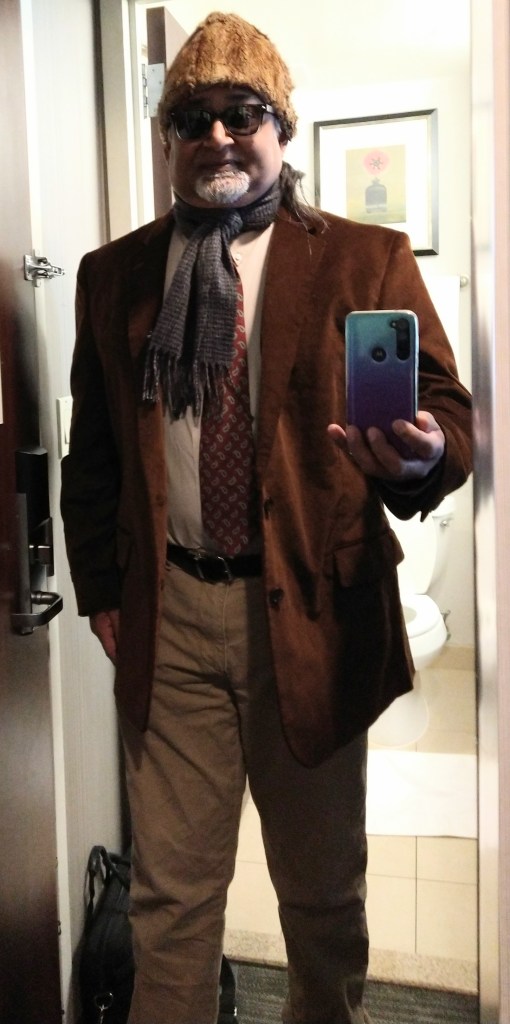
bundled up for freezing temps

Only trouble is there was no coat check! Yet another victim of the pandemic was a coat check for all your winter gear when visiting the museums. It was hot inside and we visitors all had to lug all this winter gear around, ha!

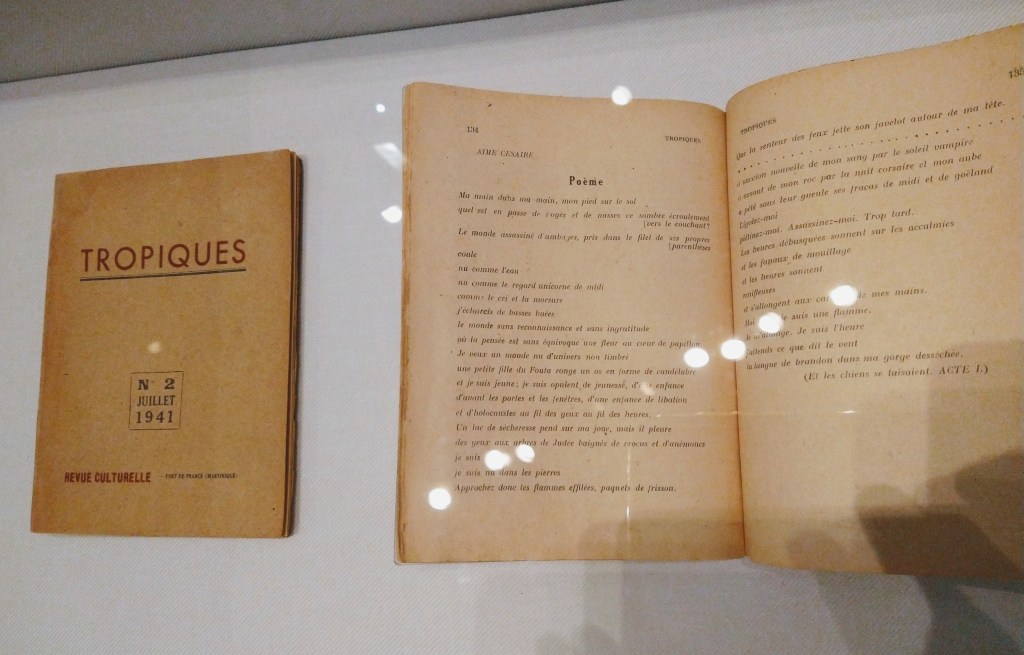
Of particular interest to me was the area dedicated to Black Surrealists. I did not know how deeply Aime Cesaire had embraced Surrealism. Originals of his journal Tropiques (1941)

and Retorno al Pais Natal were a thrill to see.

The influence of Surrealism was apparent.

a quote from Suzanne Cesaire summarizes the cross-pollination

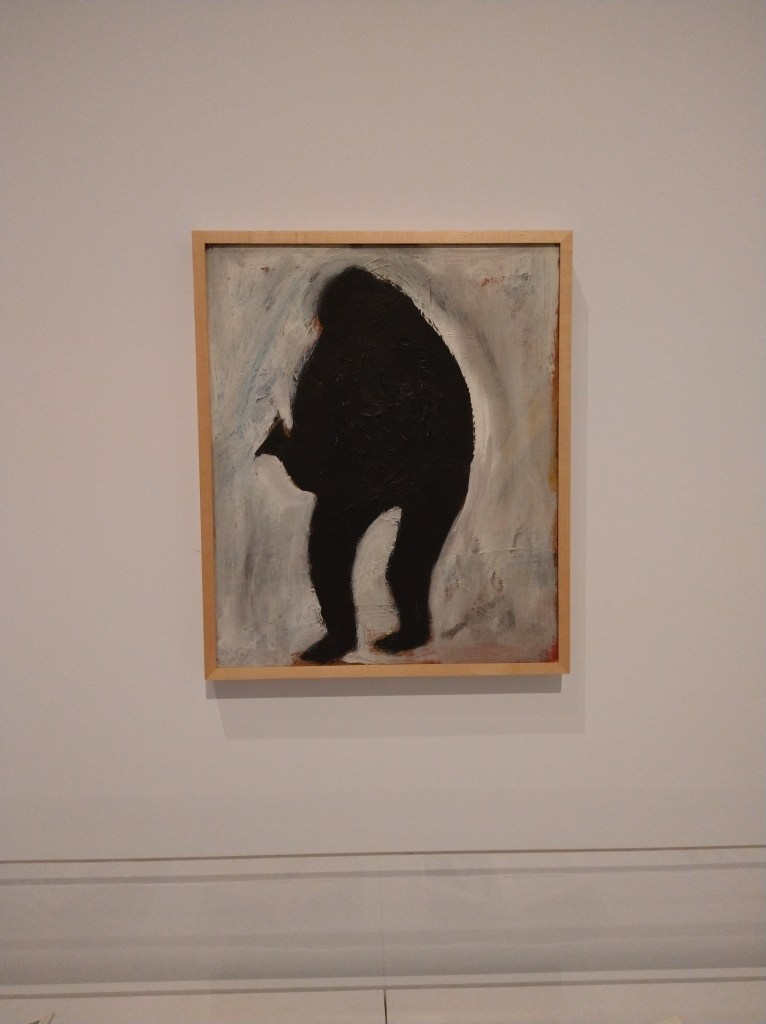
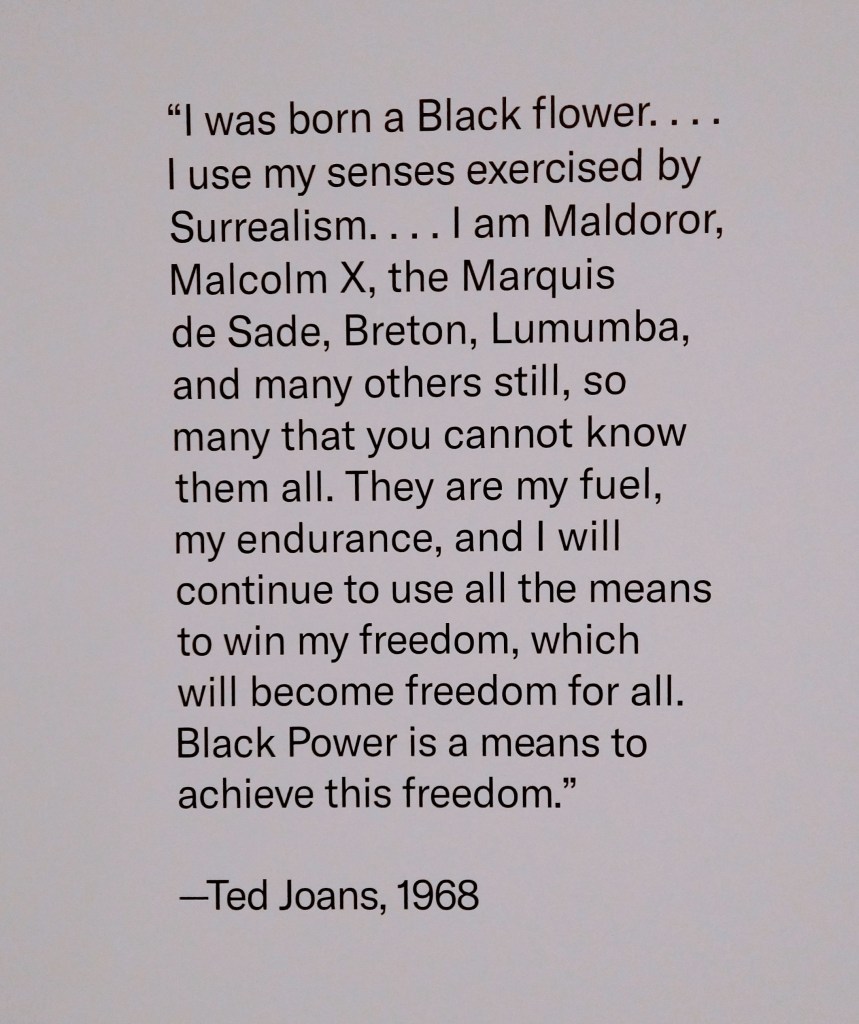
was also very deeply touched by this portrait of Charlie Parker by Black Canadian-American Surrealist Ted Joans, entitled Bird Lives! (1968)

But there was so much more from around the world. This shocking work, entitled Tagliche Drangsale (Daily Torments) by the oft-forgotten German Surrealist painter Richard Oelze (1900 – 1980), was painted a year after the National Socialists assumed power in Germany, (1934)

There was this brilliant Giacometti

Cage (1930-31), Alberto Giacometti

Alexander “Skunder” Boghossian was an Ethiopian-Armenian painter and art teacher. He spent much of his life living and working in the United States. He was one of the first, and by far the most acclaimed, contemporary Black artists from the African continent to gain international attention. Here’s his Night Flight of Dread and Delight, Skundar Boghossian, (1964).

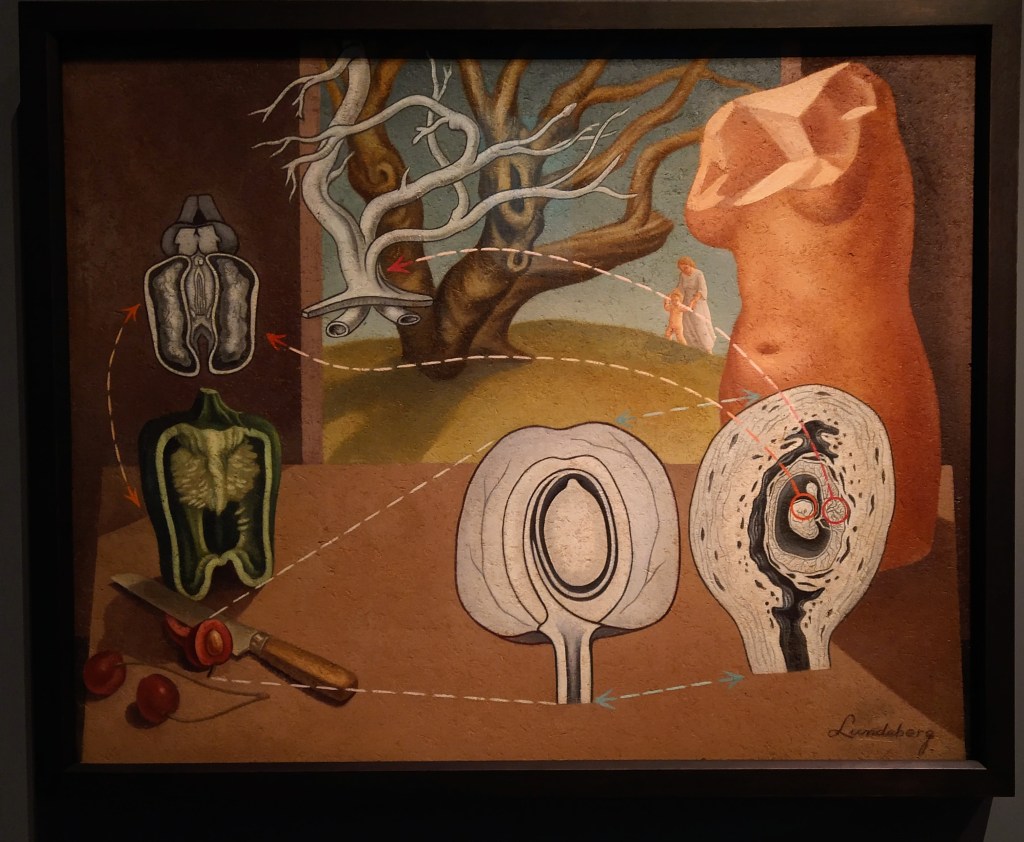
The Southern California artist, Helen Lundeberg, often credited for movement to Post-Surrealist work, was represented here in a Surrealist painting – Plant and Animal Analogies, (1934 -35).

And an early Surrealist work by the American painter, printmaker, sculptor and writer, Dorothea Tanning – Eine Kleine Nachtmusik, (1943).

Roger Penrose was included with this sculpture, entitled The Last Voyage of Captain Cook, (1936-7)

It was my first time seeing the Exquisite Corpse in person.

Cadavre Exquis: Figure,  Andre Breton, et al (1928)

And this great Magritte, I was born the year he died, you know.

La Duree Poignarde (Time Transfixed), Rene Magritte (1938)

And one of my all-time favorites

Umi (the Sea), Koga Harue, (1929)

Salvador Dali’s Lobster telephone

Telephone homard (Lobster Telephone), Salvador Dali from (1938)

There was much more to consider in the exhibition, website here.

But one piece stood out amongst the many I saw in my first visit to museums since the coronavirus pandemic struck. It was an obscure sculpture made of nails and sponge by French artist Joyce Mansour and it was entitled Objet Mechant, which means Nasty Object. It looks shockingly like the nastiest respiratory virus in human history. Yet it was made 50 years before Covid-19 struck.

Untitled (Objet mechant) (Nasty Object), Joyce Mansour (1965 – 69)

Pretty good exhibition. so says I.

Beliefs: the anthropocene

25 Tuesday Dec 2012

Posted by mtk in journal entries, North Oakland

≈ 1 Comment

Tags

anthropocene, belief, god, isolation, Karthik, liberal, m.t., mtk, neo, oakland, post

I believe I’m a species of animal born to my parents forty-five years ago in what we call Tamil Nadu. I believe our species, which we categorize homo sapiens sapiens, is very much like other animal species that share this organism, our planet – particularly those in our family, mammalia.

However, I also believe we’ve grown in a unique manner from all living things and we have been inventive.

We invented God.

We empowered ourselves above all living things with this great rationalization, and we alone became intelligent beyond our design.

We then spent the last hundred years dismantling our invention. Humankind is responsible for itself.

We began devoting our time to other inventions: sciences, maths, money, power and all manner of feats of engineering. We’ve launched satellites and a space station that gives us a permanent presence in space. We’ve explored the moon and sent robots to Venus and Mars. We have sent deep space probes so far away they are about to leave the heliosphere.

We’ve explored and mapped our planet in great detail. We have conquered many diseases that used to kill us and have now grown to a population of at least seven billion individual human beings. We understand statistics and our species enough to know we will make it to ten billion, unless we experience a cataclysmic event.

We are the only living thing capable of creating such an event.

I believe the era must be called the anthropocene. The Age of the Human.

It is important to do so because it implies a willingness to take responsibility. It makes our legacy as a species even more important because we are now the stewards of this world.

We connect by use of these machines instantaneously all over the world and can exchange ideas and thoughts with unprecedented speed, which implies the ability to make massive, global change in thinking toward similar goals possible. Corporate culture has dominated such mass media.

The Digital Generation is significantly different from human beings who came before them. I’ve written we ought to consider categorizing the digital generation as a new species of human being: homo sapiens digitalis

I am a father and a son and of a transitionary generation between sapiens and digitalis. Having unmade God and seeing how much of an effect we are having on our world, I feel disconnected from society.

I see this age as the anthropocene and long to take greater responsibility for my fellows, but instead, I grow isolated and separate from most because of my beliefs.

Post-Neo-Liberal Isolation is not an illness. It is a state of awareness. From within it, I compose my expressions in an attempt to work through it, not to escape it. It cannot be escaped. Beyond it lies the future of humanity and indeed, of this world.

That is my belief.

Well, at least, that’s my belief today.

M.T. Karthik, 2012

03 Friday Aug 2012

Posted by mtk in conceptual art, journal entries, North Oakland, Uncategorized

≈ Leave a comment

Tags

2012, Karthik, m.t. karthik, mtk

Over the past 200 days, I’ve populated this blog with 200 posts.

Many are backdated – material collected over the past thirty years – but I’ve also posted three to five times a week in 2012, with mostly photographs of baseball games, flora, fauna and landscapes.

There’s a distinct and deliberate difference in the work of these last five years from the work before. In my 40’s, my work is decidedly less political, more image-oriented and produced with and for the plastic, digital fluidity of the inter-webbed world. This is by design.

I do not wish to be known as a political artist.

I promised myself decades ago I would work socially on political matters until I turned 40, when I hoped to turn the mantle of activism over to a younger generation. I have helped this happen and documented its occurrence.

When I was 15 I wrote that I’d make these changes to process when I turned 40, including the addition of filmmaking – which I waited decades to take seriously.

At 15, watching the first of the Macintosh computers come out, I also knew that new media would arise over the years. My generation was the very first to own a personal computer or send an e-mail.

I have tried to be judicious about studying and using tech. I do not play games.

Of new media, Youtube has been the most interesting to me. I started my first Youtube account at 40 and have several now which I use to embed videos to this site.

Continuing my methods over the past year, at 45, I joined Facebook and Twitter during seminal years for both companies. I observed closely as Twitter was given tax-breaks to move to San Francisco and FB created its massive IPO.

I’ve deactivated my account on FB and will not post there again.

I will continue to use Twitter in concert with this blog. I’ve come around on Twitter. I still decry the tax break created and approved by Ed Lee, David Chiu and the SF Board of Supervisors, but I am a Twitterer and will remain so.

The work until I turned 40 is represented here by posts of work I produced between 1981 and 2007. It’s detailed and requires time to sift through. I’ll continue over the years to add work from the past and to edit the contemporaneously written material describing work from my 20’s and 30’s.

I hope to leave behind a sound record of what I consider my work via this blog.

I dream of a reader willing to consider the continuity of thought here as a kind of single expression of a humanistic free radical living in the latter half of the 20th century and the dawn of the 21st. I am lonesome because of my work.

I like blogging and after some years of experimentation, I believe in WordPress as the best free way to do it.

Thanks to any visitors in advance; I love comments, likes and interactions. I am blessed that my site gets visits from many many different countries around the world. You are welcome here.

I remain, M.T. Karthik, author, artist, producer and director in pursuit of art, culture and change.

Concerning the Author’s Previous Attempts at Fiction

05 Tuesday May 2009

Posted by mtk in Berkeley, Commentary, essay, journal entries, Letter From MTK, novel, self portrait, thoughts

≈ Leave a comment

Tags

fiction, history, Karthik, m.t., m.t. karthik, mtk, nobels, novel, stories, story, writing, writings

Between 1995 and 1997 I wrote my first novel, Mood. Because digital printing and imaging were nascent technologies, and because I was growing increasingly interested in doing art myself, in making visual art myself, Mood was conceived and designed specifically, with a graphic element that drove the creative engine of the work: the passage of an image of the changing moon moving through the margins, and the presence of the night sky on the pages by making the pages dark and the letters light, with the slightest alteration of color and contrast of the pages and letters as the book progresses to correspond to the light provided by the moon as it passed through a fortnight of phases during the course of the narrative of the novel. The pages were to be the night sky and the letters the stars – paragraphs were constellations.

The timing of the narrative takes place during the fortnight represented by the physical pages and artwork, and as a conceit, the main character’s name changes with each phase of the moon. Set in San Francisco, I employed many contemporary businesses – bars, restaurants – that were popular among scenesters then. I punnishly changed names, or not, on a whimsical basis. Anyone who went out to hear live music or DJs or art in The Mission, North Beach, SOMA or elsewhere in the mid 1990’s would recognize many locations by their descriptions in the novel, Mood.

I physically took Mood to New York City in August of 1997, and attempted to have it published. I hand delivered copies to Sonny Mehta at Random House and at all the major houses. This was the exact moment when many of NYCs oldest and most famous publishers were being bought out by large German corporations.

Response to Mood was almost negligible. Only one agent wrote back at all, a handwritten note to say he liked the style but that the work was too experimental. The book was never produced as imagined and for a dozen years has existed as only a single, 187-page hardcopy, bound in 1997 (which may be lost in India), and as files stored on floppy disk. In January 2000, one chapter of Mood was published as a short story by the Conde Nast women’s monthly, Jane magazine. That story, Shanti, was roughly 1500 words long and represents my first published work of fiction that had a national audience. More than 50 readers wrote to an e-mail established to receive feedback. All the feedback was good.

I stayed in New York to attempt to write more and address the publishing industry, but grew increasingly disappointed in the changing face of the industry and writing in general. The New Yorker rejected seven of my submissions between 1997 and 2009, though once they wrote by hand that I was on the right track, “this one is more like what we might run,” the unsigned note read.

In 2001, my short story, Close the Piano, was published in an anthology of South Asian writers out of Toronto, Canada, under the pseudonym Raj Balas. I did a public performance as Raj Balas reading a part of that story aloud to a group gathered at the Asian American Writers Workshop in Manhattan, in April of that year – four months before the September 11th attacks which changed my career trajectory, somewhat, as I began and have been doing much more art, performance, news and journalism rather than fiction writing, ever since.

After 9/11, I nearly stopped writing fiction altogether. This has been an intense period in my life that includes the birth of my son and years of writing hard news and politics for Pacifica Radio, as well as anti-war essays and e-mails for a half decade. I was very politically active during the Bush/Cheney era. I also completed a lot of art, performance and installation work that was politically motivated in response to our changing world.

My explorations into visual art – which began in 1996 with Rigo 23 in San Francisco – began to fruit in New York in part as a result of collaboration with Christopher Wilde, Marshall Weber, Mark Wagner, Sara Parkel, Amy Ferrara and others at Booklyn Artists Alliance, and also because, on an irregular but intense level, I began assisting Rigo 23 with large scale art and installation projects all around the world. I became a working artist somewhere between the year 2000 and 2003 – when most of my placed work found its home in educational and arts institutions in the U.S.A. This is also when I founded Fifty Foot Pine Tree Press (Los Angeles, April 25, 2002) to begin producing limited editions, artist’s books, prints and digital art, now on the web at www.ffptp.org

In the 21st century, I began to make artists books and to do collage, drawing and painting more than to write fiction, however, I did write one more novel and five more short stories while in New York City. None of this work was published, though the novel was posted page by page, online, in its entirety, by a now defunct website. That novel remained online for a full year, December 1999 to January 2001.

I have only finished one story since 9/11, as raising my son has made it nearly impossible to find the mental space and time to write what I want to write. The only fiction I have finished in the last 3 years is Before You Came, the opening chapter of a novel with the working title, The Outsider Inside.

M.T. Karthik

Berkeley, California

May 2009

The Attacks on Mumbai, India 11/26/2008

29 Saturday Nov 2008

Posted by mtk in India, journal entries, journalism

≈ 1 Comment

Tags

2008, Attacks, m.t. karthik, mtk, Mumbai

The Attacks on Mumbai, India
[posted by mtk, 2230 IndianStandardTime, Saturday, November 29th]

Late Wednesday night, in Mumbai’s priciest district, on the city’s south coast shoreline, two-member teams of gunmen suddenly appeared, fanned out and fired AK-47 rounds randomly into crowds while hurling grenades out of their backpacks.

They targeted luxury hotel restaurants and eventually seized hostages and whole floors of two major hotels and a Jewish Center, from which they launched a firestorm of bullets and incendiary devices aimed at Mumbaikars, tourists, police, anti-terror forces, and the colonial-era hotels themselves.

Gunfire began at or near the Oberoi Hotel at Nariman Point around 9:30pm, and by 11:30 the coastal Marine Drive was a war zone of ambulances, police vehicles, satellite TV vans and trucks filled with heavily armed soldiers. Soldiers moved into the Oberoi even as seven grenade explosions rocked the Taj Mahal, which burned for hours. Simultaneous grenade and gunfire attacks by armed gunmen began at the central railway station, a taxi stand and a hospital. Fierce battles between police and terrorists lasted more than 50 hours and have been described as urban warfare.

Two full days later, the death toll stands at nearly 200, including 22 foreigners, three high-ranking Indian anti-terror police, and at least nine of the terrorists. One has been captured, nine others detained and the nation of India stands shocked to attention.

The attacks themselves relied on multiple, audacious gunmen and were conducted with organized and well-trained execution, implying greater terrorist infrastructure, but most serious experts doubt the involvement of al Qaeda.

At the Trident Oberoi and Taj Mahal luxury hotels, the “terrorists” sought and killed foreigners. American and British guests were targeted in particular, but among the dead are a Greek millionaire, a Japanese tourist and at least two Australians. The attacks were brash, loud, pointed and violent. Many are still wondering who would do such a thing and why?

On Thursday morning, speaking from inside the Oberoi, where foreigners were held hostage, a man identified as Sahadullah told India TV he belonged to an Indian Islamist group seeking to end the persecution of Indian Muslims: “We want all mujahideens held in India released and only after that we will release the people.”

This claim and a written fax #stating responsibility was with a group called “Deccan Mujahadeen” – a regional identification with the South Central Deccan Plateau in India – masked the true authors and were meant to inspire “homegrown” terrorists within India.

The attacks are cast thus somewhere between a suicide bombing and a revolutionary assault. But they seem hyper-provocative – an orgy of public violence for an unlikely single objective. There are strong reasons to believe they are provocations with other authors and objectives.

We can describe four:
1. Hindu Extremists
Mumbai has a history of Election year violence and investigations continue into an internal political agency for the attackers. There are accusations against Hindu Nationalists in pursuit of a harder-line policy, concerning Kashmir and Pakistan in specific, and Muslims in general. Extremist Hindus have executed attacks or organized them to create a greater fear of terrorism and push the election toward their policy.

It has been reported that Hemant Karkare, chief of the city’s anti-terrorism squad, who was gunned down Wednesday in the line of duty, was in fact on the trail of Hindu extremists in the cases of certain attacks in previous years. This from Amaresh Misra [tel:91-9250305699]:

“The Mumbai ATS chief Hemant Karkare and other officers of the ATS have been killed. These were the same people who were investigating the Malegaon Blasts–in which Praggya Singh, an army officer and several other noted personalities of the BJP-RSS-Bajrang Dal-VHP were arrested. Karkare was the man to arrest them. Karkare was receiving threats from several quarters. LK Advani, the BJP chief and several other prominent leaders of the so-called Hindu terrorism squad were gunning for his head. And the first casualty in the terrorist attack was Karkare! He is dead–gone. the firing by terrorists began from Nariman House–which is the only building in Mumbai inhabited by Jews. Some Hindu Gujaratis of the Nariman area spoke live on several TV channels–they openly said that the firing by terrorists began from Nariman house. And that for two years suspicious activities were going on in this house. But no one took notice.”

UPDATE: China says don’t rule out Hindu extremists on the basis of “the red thread” around the wrist of attackers – a Hindu practice, that wouldn’t be necessary camo/costumery where they were attacking, a westernized part of town. Read the “Red Thread” China angle here. (Chinese Red Thread, ha! multicultural poetry, I say) The only other named agent in all this then is Dawood Ibrahim (discussed below) who serves as the transition to:

2. Unseen Hands in Pakistan
China, the USA, Russia and Iran all have their hands in “leaderless” Pakistan, since the collapse of Musharraf and the murder of Benazir Bhutto. China has negotiated a port with Pakistan to allow the Chinese access to Caspian Sea oil by pipeline. The United States is actively interested in Indian/USA alliance to balance China. Iran is the source of the China oil, Russia seeks to counterbalance USA’s presence in region. Jane’s has alredy identified a China/Russia/Iran Axis that seeks Pakistan. Countered by a USA(via Iraq/Afghanistan and now)/India alliance – trying to get India into aggression with USA versus Pakistan. All of these hands have interests and remain largely unseen could any of them be involved in these attacks? Are there terrorist or operatives willing to deal with anyone for the highest price? Who are they? Could this be from Pakistan but having no relation to Zardari or ISI?

3. Israel/BJP connection?

There are claims that when the BJP was in power in 2001 (when it allowed Sharon to visit as the first Israeli PM recognized by India) secret alliances were made between Extremist Hindus and Zionist Jews to address Pakistan more aggressively. It has been claimed that as recently as this summer, Israeli Security and Mossad Agents have been involved in training these Indian Extremists. The idea of Mossad involvement here is far-fetched, but possible. Could extremist Zionist and Extremist Hindus be running provocation false flag attacks to incite violence? Again, Misra:

“It is clear that Mossad is involved in the whole affair. An entire city has been attacked by Mossad and probably units of mercenaries. It is not possible for one single organization to plan and execute such a sophisticated operation. It is clear that this operation was backed by communal forces from within the Indian State. … Muslims and secular Hindus have been proven right. RSS type forces and Israel are all involved in … destabilizing … India. India should immediately snap all relations with Israel. We owe this much to Karkare and the brave ATS men who had shown the courage to arrest Praggya Singh, Raj Kumar Purohit, the army officer and several others.”

the radical blogster aangir fan agrees and thinks Dawood Ibrahim (if you don’t know who he is, it’s detailed in clip) is a pawn of both Pakistan’s ISI and USA’s CIA! [BTW, after the NYT blamed them yesterday, the L-e-t have since issued a denial] so Ibrahim serves again as a transition which leads us to:

4. Bush/Cheney Actively Agitating Covertly (cf. Iran)
Seymour Hersh reported in The New Yorker this year that Bush/Cheney received the go ahead from Nancy Pelosi and seven other Congressmembers – four Democrats and four Republicans – to earmark $400 million dollars for covert actions in Iran. COVERT US military within the sovereign country of Iran! These are resources and personnel allocated to agitation. Bush/Cheney and the neocons’ stated policy is to agitate and push these countries into action in an attempt to get the US military involved to “settle” it as a part of their War on Terror. Are the bombing of the Marriott Hotel in Islamabad and these attacks on Mumbai covert agitiation black-ops out of USA’s Pentagon?
UPDATE: Professor Michel Chossudovsky of The Centre for Research on Globalization at Univ of Ottawa has an excellent piece on the whole affair! with deep details into U.S./I.S.I. relations. It concludes with this smart rebuke of “what we are seeing now” in the English-language press:

“The role of the US-UK-Israeli counter terrorism and police officials, is essentially to manipulate the results of the Indian police investigation.
It is worth noting, however, that the Delhi government turned down Israel’s request to send a special forces military unit to assist the Indian commandos in freeing Jewish hostages held inside Mumbai’s Chabad Jewish Center (PTI, November 28, 2008).

Bali 2002 versus Mumbai 2008
The Mumbai terrorist attacks bear certain similarities to the 2002 Bali attacks. In both cases, Western tourists were targets. The tourist resort of Kuta on the island of Bali, Indonesia, was the object of two separate attacks, which targeted mainly Australian tourists. (Ibid). The alleged terrorists in the Bali 2002 bombings were executed, following a lengthy trial period, barely a few weeks ago, on November 9, 2008. (Michel Chossudovsky, Miscarriage of Justice: Who was behind the October 2002 Bali bombings? Global Research, November 13, 2009). The political architects of the 2002 Bali attacks were never brought to trial.

A November 2002 report emanating from Indonesia’s top brass, pointed to the involvement of both the head of Indonesian intelligence General A. M. Hendropriyono as well as the CIA. The links of Jemaah Islamiyah (JI) to the Indonesian intelligence agency (BIN) were never raised in the official Indonesian government investigation –which was guided behind the scenes by Australian intelligence and the CIA. Moreover, shortly after the bombing, Australian Prime Minister John Howard “admitted that Australian authorities were warned about possible attacks in Bali but chose not to issue a warning.” (Christchurch Press, November 22, 2002).

With regard to the Bali 2002 bombings, the statements of two former presidents of Indonesia were casually dismissed in the trial procedures, both of which pointed to complicity of the Indonesian military and police. In 2002, president Megawati Sukarnoputri, accused the US of involvement in the attacks. In 2005, in an October 2005 interview with Australia’s SBS TV, former president Wahid Abdurrahman stated that the Indonesian military and police played a complicit role in the 2002 Bali bombing. (quoted in Miscarriage of Justice: Who was behind the October 2002 Bali bombings?, op cit)”

All of this must be considered and investigated seriously, and restraint and calmness must be encouraged in India. Let us mourn and heal and investigate.
Indian investigators, from the street level up to the Prime Minister’s office, state that forces responsible for the attacks are “based outside the country” – and the world’s press has rapidly presumed Pakistan. There has as yet been no explicit charge against another nation, but it has been revealed that the one captured terrorist is from Pakistan[and stated he had accomplices in Mumbai] , and a guarded, but confident and firmly-worded statement from the Prime Minister warned “neighbours” of consequences if they continued to allow the use of their territories to terror groups.

[posted by mtk, 2230 Indian Standard Time, Saturday, November 29th]

Some Thoughts On Film in the Last Five Days of 2007

01 Tuesday Jan 2008

Posted by mtk in journal entries

≈ Leave a comment

Tags

Allen, Downey, film, Gilliam, Godard, Jarmusch, Karthik, Kelly, Kubrick, Kurosawa, la jetee, Lee, Marker, Moore, mtk, sans soleil, Scott, shoot the piano player, Spielberg, Tarantino, Truffaut, Varda.Attenborough, Wong Kar-Wai

December 21-26, 2007
some thoughts on film after seeing:

Chris Marker’s Sans Soleil [1983] and La Jetee [1963]
Agnes Varda’s The Gleaners and I, and after two years [2000/2002]
John Cassavetes’ Shadows [1959]
Jean-Luc Godard’s masculin feminin [1966]
Todd Haynes’ Far From Heaven [2002]
Abbas Kiarostami’s Five [2004]

and late on the 26th adding – la double vie de Veronique by Kieslowski

– all for the first time.
and enjoying Jarmusch’s Dead Man [1995?] for the first time in a dozen years.

also earlier this year, in June, marks my first viewing of:

Godard’s Vivre sa vie and Bande a part [early 60’s: ’63, ’64 …breathless is ‘60]
Kurosawa’s Throne of Blood, Sanshiro Sugata and I Live in Fear [mid,late 50’s bxw] Fellini’s City of Women [early seventies]

Marker’s two works separated by 20 years and varda’s doc have uncommonly sharp and fluid writing, that merges seamlessly and profoundly with the audio and film – I find it confident.

Marker
Christian Francois Bouche-Villeneuve

Krasna is the author of the texts and the images (separately), Marker the editor, conceptualist. and choosing the woman to voice the thing is great third layer (nonlinear). she delivering: “he wrote” is mechanical-vox. AWESOME. [Kubrick’s HAL is a male, but tenor]

Sandor Krasna, Hungarian cameraman, b. 1932 in Kolozsvar, Budapest Film Academy made Erdelyi Tancok (Transylvanian Dances), and assisted in another film, left Hungary in 1956 (returned in 1966 does travel diary piece) chances to join with a volcanologist Haroun Tazieff (footage), travels, shoots Cabo Verde, Guinnea Bissau and Japan, where he stays longest and has a deep affinity for culture.

THE FELLING OF A GIRAFFE, the volcano claiming a town and images of his long years in Japan and visits to Africa, specifically Guinea-bissau and Cabo Verde? are the visually intense gems of sans soleil.

Marker’s contextualization of the letters of his cameraman is a masterpiece of editing but all of it is still less to me, now, today, 24 years later, than the wordless entirety of the felling of the giraffe. there’s IMAGE (seule) and TEXT (seule) … and then there’s crossing over into the merge and all the “infinity” that comes with it. But still there is this solitude right now, that exists – you can get people there … with footage, nearly raw, of the felling of a giraffe by rifle – for how many years more, we don’t know, maybe few.

Marker comments: “I write this in 2002, as a new wave is rising, of which my young comrades of Kourtrajme (french collective of actors, directors, writers, filmmakers) offer a heartwarming example, and which perhaps has already found its Breathless in Isild Le Besco’s Demi-tarif.” [[half price] made in 2002, young actress, maybe her only film, definitely her first. film about/involving youth.-helen]

and from the notes on Marker himself, comes this gem:
“… and quietly lending a hand to fellow committed filmmakers like Patricio Guzman, whose landmark film on the downfall of the Allende government, The Battle of Chile [1975], reputedly owed to Marker an indispensable gift of film stock.”

Kurosawa/Kiarostami
The intensely slow, long takes in Kurosawa’s Throne of Blood with a single move in the middle of the take (i.e. the wife moving slightly forward on the tatami mat and then stillness again), return with the stick on the beach in ONE of FIVE, Kiarostami for Ozu

Haynes
the period music in Haynes’ film isn’t from the period of the film. the male-male kiss here and her reaction is amazing. she is a genius. she is so good. how old is she?

Godard
by the time we get to masculin feminin, (hindsightedly) Godard’s conceit is played out: (fashionista, too chic) also, it’s all quite hetero-sexy and even the toilet kiss is played with such outsider

anti-vietnam punk, text blams all great. close-ups of cute girls (bo-ring). straight guys chasing cute girls (boring). sudden-gun-blam has become his trademark. by ’66.

Truffaut
December 30, 2007, sunday
just finished Shoot The Piano Player [1960]
Truffaut/Moussy [Goodis]/Aznavour

brill.
excellent passage when Saroyan’s wife lays into him for his “fame” and arrogance.
‘you repeat yourself ten times’

the flash to the fight poster just before the fight.

the too-slow before entering the impresario’s office to the wordless exchange of violin for piano music by the two musicians at audition

the flashback to his previous life as transition, fullness of this flashback (Pulp Fiction)

the “day that changes everything” starts with them deciding to quit. but it was the day that ended, the day before – when they escaped the bandits – that keys this.

a crime movie. an emotionless and sympathetic central figure (Bogart’s Rick).

and last night, December 29

Eternal Sunshine of the Spotless Mind [2004]
Gondry/Kaufmann/Jim Carrey
[Alexander Pope as delivered by “Mary”]
hammer to kid thing is a moment. weird running though the psyche stuff.
the magicality of it ends up linearizing a mental territory that has multiple dimensions – I don’t like this. even in science of sleep I find it sorta lame … too linear a dimensionality even with all its magical elements is still too linear a dimension to describe the mind – the psyche. point. and it smacks of creative dearth. an engine running out of steam.

Last Day of 2007
a list of my contemporary favorite feature length
films/movies/directors of the last 50 years

1. 2001: A Space Odyssey [Kubrick]
2. Singin in the Rain [Kelly]
3. Dead Man [Jarmusch]
4. Throne of Blood/The Bad Sleep Well [Kurosawa]
5. The Nights of Cabiria [Fellini]
6. Vivre sa Vie/Weekend [Godard]
7. Jackie Brown [Tarantino]
8. Bladerunner [Scott]
9. Shoot the Piano Player/Small Change [Truffaut]
10. Do The Right Thing/He Got Game/She Hate Me [Lee]
11. Crimes and Misdemeanors [Allen]
12. Blood Simple/Barton Fink/No Country for Old Men [Coen Brothers]
13. Gandhi [Attenborough]
14. The Gleaners and I [Varda]
15. As Tears Go By/Days of Being Wild/Chung-King Express [Wong Kar Wai]
16. Sans Soleil/La Jetee [Marker]
17. Brazil/Time Bandits [Gilliam]
18. Putney Swope [Downey]
19. Bowling for Columbine [Moore]
20. Minority Report [Spielberg]

aboard Singapore Airlines flight 15 from San Francisco to Seoul

23 Thursday Nov 2006

Posted by mtk in Asia, journal entries, travel

≈ Leave a comment

Tags

777, airlines, dateline, Karthik, layover, m.t., singapore airport

November 22nd didn’t happen for me.
It disappeared in the space-time void caused by crossing the dateline and traveling for 20 hours on a 777 from SFO to Seoul.

Now it’s the 23rd, Thursday at 315am in Singapore where the airport is pretty quiet. But for teenagers with semiautomatics, managers with clipboards and baristas, pie-eyed at their coffee stands.

A girl slept at one of these – I could have taken anything … from her coffeeshop and she would never have known.

I was tempted. But didn’t.
Landed and watched “Live and Let Die”
In the free movie theater they have here .. what a weird zone.
I can sleep for six hours in a hotel for $40 I have $255. I slept well on the plane and so figure I’ll stay up as long as possible so I can get the most of my six hours sleep time when I finally take the room – if I take the room

I don’t really feel tired. A little hungry … but not for something gross.

Enough about what I am feeling all the fucking time. I feel like Nathaniel Hawthorne.

edits are the slicing away of all that shit toward a clean expression.

Wickedy.
Off to munch.
Next entry will be November 23.
k

my education to 2006

01 Sunday Jan 2006

Posted by mtk in essay, journal entries

≈ Leave a comment

Tags

2004, education, Karthik, m.t. karthik, mtk

Pacifica Station KPFK 90.7fm Los Angeles
2003-2005 radio

Independent Study with Booklyn Artists Alliance, Brooklyn, NY
1998, 2000-2002 book-making, art, development, grant writing

Independent Study with Rigo 23, worldwide
1996-2006 art, art handling

The New School University, Manhattan, NY
1998 creative writing, data conversion, project management

Genentech, Incorporated, South San Francisco, CA
1994 FDA Clinical Trials Research, relational databases, data management

Tulane University School of Public Health and Tropical Medicine, New Orleans
1993 biostatistics
1992 international health and epidemiology

Independent Study and Travel, Asia
1990-1992 Taiwan, Thailand, India, Japan, Korea, China, Indonesia

University of Texas at Austin
88-89 radio, political science, history, French
87-88 radio, political science, history
86-87 radio, television, film, art, history
85-86 engineering, physics, biology, chemistry

Tom C. Clark High School, San Antonio, TX
84-85 senior Physics, Calculus, Music, Literature
83-84 junior Physics, Trigonometry, Music, Literature
82-83 sophomore Chemistry, Music, Literature
81-82 freshman Biology, Music, Literature

William P. Hobby Junior High School, San Antonio, TX
80-81 8th grade
79-80 7th grade
78-79 6th grade

Locke Hill Elementary School, San Antonio, TX
77-78 5th grade
76-77 4th grade
75-76 3rd grade
74-75 2nd grade

Books Read in 2005

31 Saturday Dec 2005

Posted by mtk in Asia, Book Review, Japan, journal entries, literature

≈ 1 Comment

Tags

2005, Asia, book, books, Japan, Karthik, m.t., mtk, read

The Wind-Up Bird Chronicle, Hard-Boiled Wonderland at the End of the World, Wild Sheep Chase, Norwegian Wood and Kafka on the Shore [Umibe no Kafuka]

Haruki Murakami

The Woman in the Dunes

Kobo Abe

Friend of the Earth

T.C. Boyle

Idoru

William Gibson

Airframe

Michael Crichton

The General of the Dead Army

Ismail Kadare,

Harry Potter(s) and The Prisoner of Azkaban, The Order of the Phoenix

J.K. Rowling

The Setting Sun and No Longer Human, Blue Bamboo short stories

Dazai Osamu

The Curious Incident of the Dog in the Night

Mark Haddon

A Mature Woman

Saiichi Maruya

Rashomon and other stories

Akataguwe

Non-Fiction:

Imperial Overstretch

Jim Tarbell

significant parts of Harry Braverman’s Labor and Monopoly Capital

and the eco-biography Planetwalker, John Francis

We Do More Before 9 am …

27 Thursday Mar 2003

Posted by mtk in journal entries, protest

≈ Leave a comment

Tags

awe, bombing.baghdad, editorial, gulf, iraq, mtk, shock, two.II, war

Well, before, 9am, for every person in the country of Iraq on this day …

what idiots for generations will call the 27th of March  … of some stupid 2thousand3, on this day,

1000 extremely specifically-trained members of the United States Army dropped out of airplanes that were being flown illegally over the people called Kurds in the Northern Region of the country established by definition of the UN Charter as Iraq, and,

using parachutes landed – american newspapers, radio and television newscasts casually called them “paratroopers” – to begin one mission: to seize control of an airbase.

For more than 2500 years, the Kurds have been living in the mountains of this region – stateless and unaffected by the west – but for the will of the British, Russians and Americans to posses the dark crude oil that lies beneath the Caspian Sea region. It is the most valuable property on earth.

Thanks to numerous experts we have had on the air here at KPFK, we know what was offered to Turkey – 15.6 Billion U.S. Dollars – to allow the U.S. to use an airbase in the southern part of that country or at least to share one belonging to the Turks in order to let 62,000 military personnel and 300 flying machines capable of carrying death and destruction – including the most world-renting bombs yet invented – into the region.

And the Turks emphatically said “NO!” in their democratically-elected Parliament, a body that is widely recognized as legitimate, and there was much debate there and particularly courageous editorials were written in Turkish dailies.

The pre-Erdogan deputies of the Parliament of a government that has been growing ever-closer to Europe, in fact nears becoming European – as per the Maastricht Treaty that has created the European Union; the Pre-Erdogan deputies of the Turkish Parliament are heroes of peace.

And as a result of their action, before 9am Baghdad time, 1000 paratroopers landed in the mountainous regions of Iraq.

This act is illegal on so many levels.

It violates every treaty signed since the second world war: the UN Charter, the Geneva Convention, Warsaw and Nuremberg codes.

Why I Wanted to Have a Child

05 Wednesday Mar 2003

Posted by mtk in essay, journal entries, Los Angeles, our son

≈ Leave a comment

Tags

child, have, Karthik, m.t., motivation, our, reason, son, why

Why I wanted to have a child

  • to give myself a reason to stay alive
  • for the experience
  • because Tifa wanted a baby and I knew we could do it
  • I immediately knew the WTC buildings were demolished in a controlled way
  • I wished for a child to whom I could tell the truth, based on my own experience

October 05, 2003

Los Angeles, CA

three days before my son’s first birthday

What Motivates My Writing

17 Monday Feb 2003

Posted by mtk in beliefs, Commentary, essay, journal entries, Letter From MTK, Los Angeles, thoughts

≈ Leave a comment

Tags

Karthik, m.t., motivates, mtk, my, what, writing

What motivates you in your work?

In a slow, measured and lucid way, a way that has revealed itself to me with heaviness over the past fifteen years, I have come to believe I am seeing the end of something.

Humankind must put an end to war or war will put an end to humankind.

To isolate oneself in contemplation, no matter how comfortable it may seem a position from which to view the world, is simply unacceptable; costly.

We must use the extremely complex tools we have invented for this purpose: to focus our energies and work toward more equitable and efficient distribution of the earth’s available resources.

We must put an end to warmongering.

We must disarm and then de-militarize first the United States.

It must be held accountable for its excesses and waste. It must assume responsibility for the Colonial Era and the good U.S. Americans, who know the truth, must begin the task of admission of the ongoing genociding of cultures in USA, of the economic reality that the current power structure has been built on slave’s labor [for the Millennium?]

Rampant, bloated overdependence as a result of the Era of Capitalism must be tamed and harnessed to bring the world together peacefully.

Those incapable of diplomacy should be jailed until they have calmed down and seen the error of their course.

I am motivated to aid those who see that thieves and dacoits have stolen the greatest of the earth’s resources for the last five hundred years and are not through yet and must be held to task for such barbaric idiocy; that seeks to interfere with the great continuity of human thought.

The USA is the world’s greatest impediment to peace, stability and progress; it must be told by humanity to stand down in the exact manner that international humanism told South Africa, “Aparteid will not stand.”

M.T. Karthik, February 17, 2003, Los Angeles

Transcript: UN Security Council Proceedings FEB 05, 2003

05 Wednesday Feb 2003

Posted by mtk in essay, journal entries, journalism

≈ Leave a comment

Tags

2003, 5, accuse, chemical, february, iraq, Karthik, m.t. karthik, mtk, Powell, pre, Security Council, UN, war, weapons, wmd

United Nations Security Council Proceedings
FEB 05, 2003
simultaneous translation via e-mail chat
[final three pages, rush transcript]

M.T. Karthik: Germany now. crash of space shuttle/condolences
thanking powell for info … emph. that the UN is the place for this

(QUOTE) findings have to be examined carefully
findings of powell co-incide with much of our other info
we must work with all info to clarify quickly and fully
and iraq has to answer elements provided today by powell
this is why the sanctions w/ no-fly exist

iraq must disarm

the presence of the inspectors has already effectively reduced the threat

but still the full disarmament is goal of res. 1441

iraq must answer w/out delay.

future trips by blix and baradei

1441 provides for the tools … the dangers of military action and its conseq.
are plain to see. we must continue to seek peaceful solution

in the world of the 21st century the un is

MTK says: (wow, idealistic words) …

(QUOTE CONTINUED) on the basis of 1441 we need to enhance the instruments

we need a tougher approach

by tightening inspections we are creating an opportunity for a peaceful solution

french colleague made proposals we should consider (wow)

MTK says: sounds like … USA/UK/SPA/BUL/CHILE vs.
RUS/GER/FRA/MEX/SYR/GUI/PAK/ANG
IRAQ has now been invited to speak …

(QUOTE) my delegation extends congratulations to Germany on assumption of the presidency of the council.

IRAQ
we wish we had more time than a few minutes to rebutt a two-hour presentation and  accusation by Powell … I shall be polite and brief.

the pronouncements in powell’s statement are utterly unrelated to the truth

no new info was provided

mere sound recordings that cannot be ascertained as genuine …

you might have seen me smile when the tapes were played here

(QUOTE, CONTINUED) there were words I will not translate

there are false assumptions, incorrect assumptions etc … in this tape

S. Hussein has said we are totally with/out WMD.

we have been saying it for over a decade.

Christopher says: (is that Aziz?)

MTK: powell could have saved all of us the time by providing the info to the UNMOVIC and IAEA (no … another foreign minister)

Christopher says:(valid point)

MTK: (REPEAT) Powell could have saved all of us the time by providing the info to the UNMOVIC and IAEA

(QUOTE CONTINUED) at any rate the forthcoming visits by Blix and co. on 8th will continue to verify …
… detailed info coming
and we are working daily w/ inspectors.
… NOV 27, 2002 … inspectors cranked up with more than 250 UNMOVIC and IEAE staff  including more than 100 inspectors
as of FEB 4 of this year: 575 inspect. 321 sites
sites named in bush’s report sept 12, 2002, and blairs report and cia reports topped the lists by inspectors … and they ascertained all allegations were not true

this confirms we are w/out WMD.

water, soil, plants and air samples were taken.

factory remnants and production remnants from vast areas

throughout iraq

analyses … show … conclude: absence of any indication of prescribed chem,
bio or radiological agents or of any …
(DETAILED etc …)

END QUOTE. EDITORIAL BEGINS.

MTK says: Blix confirmed – Times, Jan 30, 2003
gotta go … sorry Christopher, have to run to the station now …

Christopher says: I gotta run myself

Christopher says: I’ll find you later

Christopher says: thanks for all that

MTK says: seems like UN standing in way of USA/UK to me

UNSCcassetteMTK2003001

The Delicate Comfort of Anonymity

20 Friday Dec 2002

Posted by mtk in essay, journal entries, Los Angeles

≈ 1 Comment

Tags

2002, anonymity, delicate, m.t. karthik, mtk

We push, sit upon and ride the half-ass, trickety jalopy we call the Internet at the dawn of international communication in real-time, awaiting a sensibility to take hold of the government that isn’t fundamentalist Christian and radically right-wing or from Texas with a hardline agenda or wearing an elephant tiepin in the form of the flag of the United States of America.

It is apparent and obvious to absolutely everyone now that the United States of America is occupied by a political force that can only be called a faction. This faction controls communications media with near-absolute restriction of content, controls agencies that monitor, manage and distribute the collective funds of the largest bank account in the world, and controls the military to which it granted 400 Billion dollars last year, the best funded, most powerful war machine on earth.

Among the fools in this faction there are elderly bigots who are given swan-songs of attention, there are hyper-militarily minded protocol hounds who have seized the language they wrote only two and a half generations ago. There are House Niggers. And House Wiggers, too. House Immigrunts.

All have been seized by soldier mentality and blood-lust – that is the stage play CNN, NPR, PBS, ABC, CBS, NBC, Fox, HBO, The New York Times, The Washington Post, and every major news outlet in the United States is meant to project because what has happened is:

The free-est economy in the world puffed itself up for eight years – wrapped itself into a Y2knot by getting dumbed into a hitch in the 90’s – and had to be “system re-booted.”

Thus, 9/11.

When all intranet debts were erased by a tidal wave of media, all pumping the same fiction (a well-known – not obscure – mafia move). All the drunk parasites clinging to the largest multi-media assault on international humanity ever attempted by any country, any peoples.

This faction is guilty of producing, staging and titling “9-eleven” to salvage the failing economy and stimulate younger generations of participants into their System of Society. They do this with pride.

We witness these people drop megatons of death from the sky upon the heads of others, elsewhere, anywhere in the world they wish. These, who have said aloud – and continue to say it – they believe they are doing God’s work: murder, manipulation of masses, demagoguery, espionage, political deceit, covert operations, corporate protectionism over truth and environmental needs.

(and their remains this stubborn question of “whiteness”. A demon they have given political birth to and won’t let go of. This ugly American Racism born from the evilest of the fictions they claim … the “discovery”of “Colombus”).

How does one address a bigot? How does one approach an enraged fundamentalist in order to seek common human spirit and tranquility among us all? One imagines s/he is most susceptible during religious ceremonies, when they claim to be open to God’s word.

The Peace Movement is God Asking Humanity to Stand Down.

Make Peace. Calm yourself and your species of its ill-will and avarice. Earth hangs in the balance. Human arrogance deafens and dumbs you in the delicate comfort of your anonymity.

Put a stop to it.

Americans United to Stop War
we must learn to do without oil

mtk 12/20/2002 Los Angeles

Our Son and His Country, 2002

12 Saturday Oct 2002

Posted by mtk in essay, journal entries, Los Angeles, our son, protest

≈ Leave a comment

Tags

2002, Karthik, los angeles, m.t., mtk

Family:

Ocean Mandela Milan has been born to my partner TRW and myself.
He enters the western calendar at 9:13 a.m. (PDT, GMT-8) on 8th October, 2002, a Tuesday.

He weighs in at 3170g and has a full head of black hair. His eyes initially appeared blue! But now they are getting browner by the day. We are not getting much sleep, but we are thrilled to have him with us.

We conceived Ocean purposefully, with all loving intent, courage and will, last winter. It is our first child. We have known each other only as adults. I met TRW in San Francisco when she was 22 years old and I have known her for more than seven years. We lived together in New York City for 18 months. We have relocated to Los Angeles. I am 35. She is 28.

In my partner’s work with young children (aged 0-6), and through her studies in college, preschool and in intimate family settings, it has become apparent that loving family structures benefit a child greatly. We have read, studied and personally observed that the most important factors in children’s development and happiness are parents who are attentive and loving and the presence of love, kindness and attentiveness in any extended family; parents, grandparents, aunts and uncles who are supportive, kind and encouraging.

Here in the U.S., we have both witnessed single parents, divorced parents, and unmarried couples who are more involved and loving than many of their married counterparts and who do have happier, more balanced children. We want to provide a safe, stable, loving, educational and enlightened environment for our child in which POSSIBILITY is a fundamental that makes life worth living and fulfilling. We do not want to create an environment that symbolizes RESTRICTION of possibility. We want to be organic in addressing the needs of our child. We do not want to create formalistic rules based on pre-existing social structures, rules that might limit the growth of our child’s mind, soul or body.

Recently, friends, family and others have asked if we are married or worse, if we plan to marry, or worse still, why we aren’t married.

Young children don’t know or care whether their parents are married; it’s simply not an issue before age 6. And while it’s true that as children become older (6 and up, school-age), they are more aware of social structures and may be influenced by peers or others who may imply that their parents are “supposed” to be married, we have witnessed this stigma lessening every year as times change. We are confident, from watching and learning from families and children and society around us, that in 2008, marriage will not be as serious a societal expectation and that our decision will not affect our child’s self-esteem or security.

We are quite proud to provide for our child’s friends, an example of a relationship in which parents are individually whole, total and perfect equals, mother and father, neither reduced or inflated by the socially-weighted titles of “wife” or “husband”, providing a happy and healthy home for their child. We are proud to be strong enough, stable enough in our love for one another and secure enough in our knowledge of self to be unmarried partners in the endeavor of raising a child.

We met in San Francisco and moved thousands of miles, abandoning personal projects and employment, to make our family and settle here in California, a place we love, where we feel secure. We made this decision to have a child because we care deeply about our world, are devoted to making it a better place, and feel that by raising a kind and conscientious child we can change the world. This pregnancy is happening now because we are lucky, and because it is meant to be. The world needs peace-minded, enlightened, non-violent, intelligent, humanist parents, badly.

Neither of us feels the institution of marriage is for us. We recognize marriage as something that many people have grown to expect of those who love one another and who want to have a child – but marriage, as an institution, has no personal meaning for either of us.

Religious marriage ceremonies conducted when any party is NOT a faithful believer in the philosophy under which the ceremony is being held have always struck us both as hypocritical and fundamentally bogus bonding rituals. And licensed marriage under a State that STILL refuses to recognize same-sex marriages and is completely unrepresentative of our political views is ethically reprehensible to us. We think of ourselves as brave in our deep commitment to TRUTH and honesty in politics, life and our love. We do not want to participate in rituals or support institutions in which we do not personally believe.

If we were to ignore the discomfort we feel and marry to satisfy our family’s, state’s or anyone else’s expectations, we would both soon regret it, and we strongly believe that we would be starting out on this venture with a negative feeling. Resentment—toward each other, toward the family or state that pushed us into it—would be sure to develop quickly. We don’t want that.

We have both witnessed tragic and debilitating divorces, and have seen the heavy expectation that marriage places on relationships. I was an unwilling participant in the terrible strain that orthodox concepts of marriage placed on my parents at an age when I should have been free of such concerns. Separation has been good for my parents as individuals and would have been easier to cope with had the heavy expectation of marriage not been such a significant factor. Many people trapped in marriages they do not want suffer needlessly in relationships that no God or good person would wish for any sentient being.

Neither my partner nor I know any couples in wildly successful long-term marriages. We do know couples who have been together for many years without marrying and who have strong relationships. Some of these couples do not have children but wish they could, eventually hope to. Marriage has never been a positive consideration for them in that decision-making process – only a negative: “Well, if we do have a child, we’ll HAVE to get married.” They say it because they are considering HAVING to satisfy someone ELSE. This (sadly common) sentiment in these relationships actually prevents beautiful, stable and wonderful people from committing to bringing new life into this world.

We both feel that if we were married we would lose control of the pure and honest love that we are daily working so hard to build. By deciding to have a child, we feel we are leading by example, providing an alternative for other unmarried couples – those who choose to be together and may have similar feelings but lack the personal security or the courage to have a child.

We are proud to assist in reducing the expectation society places on anyone in love.

There are things we each feel strongly about, and overwhelmingly, remarkably, my partner and I agree with each other about the most important environmental factors that will help determine what kind of person our child will grow up to be. That is in large part why we have decided we’ll be good partners in parenting. We enter into all our decisions together and with great thoughtfulness, foresight, and clarity.

This decision, not to marry, was the first of many decisions we made and will make together. It is a decision that reflects our personal beliefs, our experiences and the ways in which we hope to change this world and our child’s experiences in it.

Just as we respect others’ different opinions—and know that they are what make our society and world a diverse and fascinating place filled with cultural and social variance—we expect respect for our opinions in return.

Now, to his name:

We have considered dozens of names in the past year. I won’t go into the many possibilities, but I will tell you some of the things we like about the name we have given to our new son.

We both decided early on that we didn’t want to take either of our family names – we feel that a third new surname would serve to bond our family better since we chose not to marry. To this end we have given our son his own first, middle and surname. We will eventually decide whether or not we wish to take his name for ourselves, likely we will.

TRW and I have swum in many oceans and seas. We have both always loved the Ocean, having been born by it ourselves – TRW near the Pacific and I by the Bay of Bengal. It was a great day early in this pregnancy that we agreed that the English name for Ocean could be used for either a boy or a girl and that French, Portuguese, Spanish or Sanskrit variants could be used by anyone who chooses to do so (Oceano, is the Spanish, Swedish and Portuguese, and a particular favorite of mine). It’s easily translated.

It was TRW’s idea that a second initial with an ‘M’ would make “OM” and we agreed that would be nice. Had he been a girl, the name we first thought of was Madeleine (a French name that TRW has always liked and I remember enjoying in the children’s book of that title). After she had chosen the girl’s name she asked me to think of a three-syllable, ‘M’ name for a boy. Within seconds, the first thought was of one of my heroes, Mandela.

TRW agreed that the name Ocean Mandela has both a wonderful sound in English and carries international significance for its socio-political importance (a sidenote: Nelson Mandela titled his autobiography “Long Walk To Freedom” after a quote from Nehru)

The hardest part for us was choosing a surname for the baby. We ended with Milan because it means “union” or “coming together” in Sanskrit. We are an inter-racial couple and we feel this name is progressive and beautiful. In addition to creating the sound ‘OMM’ with his initials, the name has the following anecdotal niceties.

As letter number 13, ‘M’ is the center of the western alphabet providing balance.

The numbers of letters in each name corresponds to the number of syllables in the haiku form of poetry from Japan – 5,7,5.

Only afterward did I remember Milan Kundera the GREAT Czech writer – exiled in Paris – whom I have read and enjoyed for decades.

I, for one, call him “Little Man” and approve of Manny or other variants as long as they are tasteful. We look forward to introducing you to our son, Ocean Mandela Milan.

I mean that as the aforementioned Czech-writer Milan Kindera once wrote: “An illusion revealed and a rationalization unmasked have the same pitiful shell. Nothing is easier than to mistake one for the other.”

My life in the USA has been a constant disagreement with the powers that be. I find them deeply bigoted, fascist and corrupt. But until 9/11/01, I allowed myself the thought there was hope for this place. I always worked hard to believe I was helping to educate and create a better USA than the one I was forced to move into. That we would one day come to common ground. What nonsense! This place is run by supremacists and pseudo-Christians who suck oil, water, air and energy from the rest of the world and then justify their bloated, self-serving attitude. 9/11/01 only made what was covert, overt. Unmasked the rationalization of empire.

We were all spending the last decade talking about “post-colonialism” only to find that in the Christian’s 21st century, colonialism is alive and well, and its latest manifestation, the USA under Bush and Cheney, is no different from the ones who locked up my grandfather in a jail in his own country in 1928 and 1931, and who claim to have “civilized” India with railroads. They are only wearing a different mask.

My son, my partner and I vociferously protest the American military intervention planned for Iraq and the covert operations that these pigs continually run around the world – in the Philippines, in Colombia, in Afghanistan, in Africa, with armadas on all high seas, overtly militant, with global positioning technology accurate to the size of a dime.

Because of my protest work for the last fifteen years, (and because of the sensitive work my father did for the American military) I am absolutely certain that my e-mail and phone are monitored by the NSA. Though I have always followed their rules and have struggled mightily to work within their system, there is no real freedom for me here and there never has been.

The American nightmare is what I hope my son can avoid. My partner and I – truly global citizens who believe in world peace and harmony between peoples – intend to raise him to lead us away from war – to disarm the USA and to demand multi-lateral, peaceful disarmament of the entire world for his grandchildren.

Three Days After the Birth of Our Son

11 Friday Oct 2002

Posted by mtk in essay, journal entries, Los Angeles, protest

≈ Leave a comment

Tags

2002, journal entry, L.A., LA, los angeles, mtk

11 October 02
Los Angeles

Last night as I sat in the baby’s room with TRW and we tried to calm Oceano as she breastfed him, the radio broadcast the U.S. Senate roll-call vote on Resolution 45 that authorized the use of unilateral military force against Iraq for George W. Bush. It was O.’s third night “on earth.”

This country makes up only 7% of the entire population of the world. 7%!!! Where do you get off telling 93% of the world how to live?! You suck so much more oil, water, power and energy than anyone else anywhere. You produce more waste – nuclear, plastic, noxious gas – and force garbage onto others. You have a military presence in most places – your military commands global positioning technology down to the size of a dime.

What is happening in the United States of America is shameful, pathetic and racist. Americans, drunk on technology or passed out from over-indulgence weren’t even woken from their reverie of engorgement when slapped HARD on 9/11. We need you to wake up! Your elders have no idea what they are doing. They refuse to leave the world stage quietly.

Instead they force their high-tek-savvy grandchildren to create pro-war content that glorifies them as “The Greatest Generation” – which they, being kids, do for a paycheck, weekly doses of “Friends” and sexual freedom. The warmongering generation dumbly rattle the wheels of their chairs like sabres – scream blindly about wars past as though they have an understanding of weapons of the day – they don’t. World peace can only happen through peaceful, multi-lateral, disarmament.

There is little representation in Congress for this idea – embraced by most Americans – and yet we are deeply taxed to pay the salaries of our so-called representatives. Taxation without representation was the basis for the “revolution” that gave birth to this system. Today, unrepresented people taxed to pay for this system number in the tens of millions. Bush placed last after Nobody and Gore. And the paper screams that Congress supports Bush’s proposal for attacking Iraq. Meanwhile the radio this morning presents a “community calendar of anti-war demonstrations” that includes 16 different protests to take place across L.A. Several are ongoing, weekly protests. It is time for another revolution. We must disarm the USA.

Television programming devoted to sports, entertainment and even to watching each other behave stupidly has been so successfully marketed to the under-educated Americans that they have become skittish and defensive about their own ignorance – unable to admit they know nothing about the world – indoctrinated by the endless sloans of Big Brother in the schools, churches and moviehouses: “Columbus discovered America.”

The USA is an idiot-child in a world of ancient cultures – China, India, Africa, Australia, Europe – and it’s being led down the toilet by a crusty, stubborn, rigid, militant culture headed by pseudo-Christian haters who have audaciously remade Thou Shalt Not Kill into its opposite.

They spit venom at others while acting out all evil human behavior themselves – bombing, killing, butchering, name-calling, hatred, bigotry – and they see no hypocrisy in it; pathetic, repressed, idiot-children of humanity, you will be the death of us all. The USA sucks. It sucks oil like no one else. It sucks water and power and energy and it shits out more poison than anyone. It’s freedoms have spawned unsupportable gluttony. All in the name of the white man’s Liberty – his unsatiable need to consume all property, have total control of humanity.

And what will you Bush-Americans do after you “regime-change” Iraq? What will you do about China? And India? They are nuclear powers. What if they start to hate you because you are so stupid you don’t even see what a mess you are making? What if rogue Al Qaeda members choose to hide in China?

Where are America’s priests, rabbi, brahmins and imams? Reduced to pawns in a political battle of ever-shifting factions of power-seekers. Right now, we couldn’t see or hear any God trying to communicate with us anyway, because the enormous din of our own machines of war and oversexed marketing – billboards, screaming ads, hyper-powered narratives of false prophets – drowns out everything, even the chirping of crickets.

Fuck you silent Americans who let this charade continue that leads to death by nuclear or bio-chemical attack – Bush is asking for it, baiting others to give it to you and you won’t even say: stand down, dammit, before you kill us all. Stop the USA. Stop the warmongers. Tranquillize the bellicose.

79 Days Before the Towers Fell

23 Saturday Jun 2001

Posted by mtk in journal entries, NYC

≈ 2 Comments

Tags

2001, beach, before, brooklyn, chinatown, coney, days, fell, greenpoint, island, m.t., m.t. karthik, mtk, subway, towers, walk, williamsburg, wtc

Rent in Williamsburg has risen to the point where a small, clean, $700-a-month, one-bedroom apartment is impossible to find, requests for roomshares are on the rise and complaints about the cost-of-living are played out.

Next door on this very block, “loft building” banners have gone up across construction sites in two empty warehouses. The owners advertise cookie-cutter, 750-1200 square-foot apartments for $2000 – $4000 a month with amenities like all new appliances, double height ceilings, gas heat and hot water; on flyers at the local deli where, yesterday, a woman picked up a flyer, stared at it and seriously muttered, “there goes the neighborhood.”

Burns, a bicycle mechanic and bassist, and Dr. Tracer, an instructor at a local community college, live on a four-year-old lease and pay $1000 a month for perhaps 700 sq. ft. – the back space of which Burns has converted into his bedroom.

Ten days ago I took the world’s longest nonstop flight from Hong Kong to Newark.

I’ve been sleeping here in Burns’s room when he leaves for gigs or work and writing with his laptop on the nightshift.

I rose from my daysleep just after midnight to find Dr. Tracer had dropped acid.  He was about an hour into his trip when I awoke and he offered me a tab. I meditated, ate and dosed.

It was 1:20 in the morning and I was awake and alert for the next 15 and a half hours for a cool, rainy trip on a Saturday morning in June in Brooklyn and Manhattan.

Dr. Tracer illustrated without malice, frustration or the use of traditional spoken language that as a result of only 180-degree sensory input, a person who cannot hear evolves under a powerful sentiment of paranoia about what is behind them or out of their field of vision.

We began walking through Williamsburg at 2:30 in the morning, past the swinging doors of a bar. Partied-out, Friday-night boozers stumbled into the street looking for taxi or subway or deli or restaurant doors, their eyes blearily seeking something recognizable, the stench of smoke and alcohol wafting off them.  Music drifted faintly out the open doors.

We stopped at a deli, where a broad swath of bottletops had been crushed into the asphalt in a dense, rectangular splay of circles – a speckled count of the beers drunk at the cornershop on hot summer days, when tossing a bottlecap out onto the street meant it got stuck in black, melted goo. A girl was hanging around the pay phone, Brooklyn summer night; couples fell into each other, lazy eyes smiled, engines fired up, a black sedan pulled away from the curb.

We had a coffee and made our way to a bar off McCarren Park. I drank a couple of martinis, Tracer had cold white wine.  We conversed until 4:30, discussing broad philosophical topics casually. We were specific on the matters of death, writing and deafness.  At one point Tracer and I agreed that when we were children, we were surrounded by others who did not understand how to communicate with us, whose methods were sympathetic but crude. This we agreed, drove us to write.

Two women, a redhead and a brunette, walked in and seduced two men.  The women sent one man home alone and, as he stumbled out, but before the door had fully closed, the brunette said coldly to the redhead:    “T-G- H-G!”-  in time with his steps, with the door swinging closed and with the click shut, she mock-laughed as she fell forward on her stool, elucidating: “Thank. God. He’s. Gone.” as she turned back to the man who remained.  At last call, they walked home with the second man, the brunette told him they wanted to teach him something. We were the last customers and left shortly after this.

A few blocks away, we ran into Tracer’s former roommate, a German who shared his apartment for the three years before Burns moved in. The German’s wife and child were out of town and he was up at 5:00 in the a.m. strolling neatly out of a bar, wide-eyed, looking for cocaine, asking if we had any – we did not.

The sun rose quickly, early on one of the longest days of the year. Dr. Tracer and I returned to the apartment, rolled a joint and continued talking.  The joint was affirmative and Tracer had a broad laughing fit while in the bathroom alone. We decided to travel.

We had a coffee, then took the G and the F trains to the ends of their lines, arriving at Coney Island just past 8:00 a.m. It was a rainy morning and thick, grey clouds masked the sun. The light was a cold-white glow behind them.  The beach was a neat, empty, expanse of sierra-colored loam, darkened by wetness in neat lines by tractors pulling wide metal rakes. The sand was made soft by the thin, white line of foam that the edge of each wave drew as a loose parallel to the horizon, a black straight-edge between the gray sky and the grey sea.

We began walking from the boardwalk to the beach silently, occasionally signing as we walked. We passed an elderly, disheveled woman, who was entirely wrapped in a blanket lying on the beach. After we passed this lump of cloth and human flesh, I saw peripherally that she rose from her reclined position. I then clearly heard her say, “who knows … maybe they like walking on the beach.”

I have never known LSD to contribute to paranoia in me. My use of it has generally resulted in hyper-attenuated hearing and sight and an alertness and remoteness of character. But even now, I wonder about what I heard and saw in that moment.

It could have been a woman on a phone call talking to someone else about something else, but her physical movements implied awareness of us. It could have been a crazed, semi-lucid homeless person babbling incoherently to herself, afraid of people approaching and passing her encampment on the beach or, it could have been an agent of some U.S. policing department observing us as we visited the beach. More engagements with seemingly random others on our trip would increase my feeling that we were being closely observed.

Dr. Tracer and I sat by the ocean, waded, ate a bag of chips on the lifeguard’s chair, had Saturday morning at Coney Island Beach for forty minutes and decried the lack of sunshine. I tape-recorded the sound of the waves and the seagulls to listen to back in the city.

I hoped, pathetically, that the sun would emerge until Tracer pointed out that the storm off the coast was headed inland.  We left the beach before the rain started.  As we left the boardwalk, vendors were opening for business.  We had a coffee.  The first drops of rain struck us as we crossed the street to the subway. We decided to go to Chinatown.

We caught the N and smoked a bowl in an empty car during the long stretch between the end of the line and 50th. Then we switched to the operator’s car to watch people.  On the way back, I glared out the windows at the grey sky defiantly until we went underground. Dr. Tracer finally joked, “when we get out on the other side the sun will be shining down on you … vindictively!”

A black, 40-plus-year-old man, clean shaven and slightly balding, got on and sat beside me carrying a rustly collection of objects in two plastic bags; black plastic covering a white plastic bag inside. He had a small band-aid strip stuck on his head exposed below his high hairlines. The obvious rectangular strip was set perpendicular across a straight, red line of blood above the temple – the wound was obviously fake, staged. The man fumbled with his possessions, continuously muttering to himself. He could as easily have been a semi-crazed denizen of New York as an undercover NYPD detective.

Once we moved from the empty car in the back to the operator’s car, many people who got on the subway on their way to Manhattan seemed like characters, with staged aspects, or too-perfect appointments. I wore headphones, listening to a CD of sarangi and hearing the outside world leak in. Two women with children sat beside us, a young boy in a stroller, his mother holding his infant sibling. They were northeastern Asians, maybe Korean. Their grandmother was gently inspiring the children to be friendly.  The son, cool, observant and thoughtful, seemed worried; the baby was still at the age of wondering at the world.

This was the operator’s car on the N, Saturday morning at 10 o’clock from south Brooklyn to Manhattan on a rainy day in June and I report with the impunity of a witness: public space in New York is undeniably equally peppered with lonesome egos, expressors of unimaginable histories, and potentially dangerous operatives for larger interests, both governmental and mafioso.

Another example: Agent 99, who subsequently led us to Canal street, starts with a pair of plain, white leather sneakers with silver dots evenly-spaced along the edge of the sole – thumbtacks – and a short, hot, controlled blaze of red, orange and yellow flames painted on the outer skin of each shoe, burning up, licking at the clean white leather shoetops toward the short, white, rolled columns – socks – that lead to a pale leg elegantly colored with intricate flowers of reds and blues – tattoos – into a sea of limpid green: an opaque, green silk skirt with a lime-orange border.

She wore a plain blouse and her hair was colored with straight, serene blonde streaks. She was reading a hardback with a romance cover and flowery letters that read, “The Sorcerer’s Apprentice.”  The glance of anyone on her side of the train who bent over to set something down, pick something up or tie a shoe was met with that leg, rocking up-and-down, regular as a pendulum, leading to a carefully put-together young woman on her way to Mallhattan.

We emerged from the subway to the rainstorm we’d seen hovering dark over the ocean. The World Trade Center Towers disappeared into thick, coal-colored clouds. The curved disks of the shoppers umbrellas floated through space, most were black, bobbing with the motion of their porters.  The storm had traveled overhead as we traveled underground and was now present broadly over Canal street.

The huge, warm, tropical drops, falling down, on and around street signs and ads with Chinese and English text, reminded me of Taipei where I’d been two weeks before during the see-bei-oo rainy season.

We stood under the awnings of the Asian marketplace as rain poured down. Oblique, glowing flashes of white light flooded the clouds internally, leaked out the edges.  Thunder rolled.  Rain fell and we passed through it, mindless, walking between the drops.

We crossed between corners and in front of the slow-moving traffic. Many people shopped. Two tall women, one with a necklace that spelled, “dirty south,” in cursive, solid gold letters, awaited a man, shorter, rounder, balding, mustachioed, who was buying a souvenir.  Young southern Europeans, women, were shopping.  An elder, African-American man bought a pair of scarves. Il pleut.

We stopped at a Vietnamese cafe, had hot tea, then pho, rolls and beer.  We returned to Brooklyn on the J. It was past noon.

Burns had gone to gig a wedding.  His cats, Percy and Mingus wandered around the house, mewling for food.  We fed them.  We rolled another joint.  We’d spent 27.00 on food, 25.00 on liquor, 4.50 on transportation and 3.00 for three coffees each, USD 59.50, total.

We were coming down. I was sitting in a chair opposite Dr. Tracer in his room in the apartment.  It was silent.  The grey light of the sky outside was only visible through crevices in the blinds and around their edges.  Tracer had angled a desk in such a fashion that, sitting behind it, he could see himself and me and the door out, mirrors reflecting the interior of the room around him and nothing else.  His back was to the window and the room behind him. I was able to see the window and the lightning that flashed outside.

This was the end of our trip, 12 hours after dosing and after a big meal and a long, wet walk in the rain. In my fatigued simplicity I became conscious of the sound of the weather. We were talking and the thunderstorm was accentuating Tracer’s speech.  It grew in intensity and I could no longer focus on what Tracer was saying – the anxiety of it made me jump up. I suddenly remembered that the window in Burns’s room at the back of the apartment was open. I made my way to the back of the apartment saying, over my shoulder, “the rain! … I left the window open!” I realized only later that perhaps Tracer could not hear me or see my lips.

It was pouring.  There was the continuous sound of thunder following ever-nearing lightning.  At the back of the apartment, rainwater was hammering the wooden sill and dousing objects that lay near the window with a fine spray.  Some water splashed my arm in just the time I took to shut the window.  I went back to Tracer’s room flush with the excitement.  He remained behind his desk, but was standing, pacing as he spoke.

I began to realize my error and clumsily showed him my arm, which now was hardly wet at all.  He continued speaking and I realized I wasn’t following him. I sat down opposite him again, trying to compose the communication space that I had broken.

“… and <crack> … things that aren’t funny … No!” is what I heard him say as he took his seat and pointed down the hall.

Then, not immediately, but a second or two later – as Tracer continued speaking – there was an intensely loud, short, sharp <CRACK>! corresponding to a bolt of lightning that must have grounded somewhere very near to the apartment. It was shocking – by far the loudest sound I’d heard in days.

From the open window, I heard voices on the street raised in unison about the sound and flash – the remarks of people standing by the building outside for cover. Tracer’s face and posture showed no notice of any of it. I apologized for interrupting and we resumed our conversation about rent, writing and philosophy. The storm ended after twenty minutes.

Specifics of our conversation have been edited or lost to sobriety and the mindwash of sleep.

Musical Influences ‘Til Age 33

06 Tuesday Jun 2000

Posted by mtk in journal entries

≈ Leave a comment

Tags

influences, m.t. karthik, mtk, music

journal entry from June 6, 2000

USA 1981 – 1990:
aged 14 to 22
Ellington, Basie, Miles, Coltrane, Parker, Diz, Ella, Billie, Monk, Jobim, Gilberto, Getz, Bill Evans,  Irakere, Hancock, Corea, Hubbard, Breckers, Stravinsky, Strauss [Richard], Debussy, Copeland, Bach, Brahms, Mussoursky, Tchaikovsky, Mozart, Beethoven, Stevie Wonder, Carol Kane, Elton John, The Police, the Fat Boys, Kurtis Blow, Rapper’s Delight, Duran Duran, The Cars, Devo, Billy Joel, Talking Heads, Public Enemy, Tears for Fears and then at college:  The Housemartins, Sade, Trip Shakespeare, The Cure, The Smiths, Morrisey and Indigo Girls, Bob Marley, James Taylor and Joni Mitchell and every Beatles record ditto REM and U2 and a big Dylan period and The Stones and Public Enemy and RUN DMC, and (finally) Zeppelin and CSNY and de la soul, Sinead O’Connor, James Brown, Maceo, Prince, Fishbone, Buckwheat Zydeco, and live music where I was: Stevie Ray Vaughn, The Reivers, Timbuk 3, Poi Dog Pondering, twang-twang-shock-a-boom, but basically I bought what I was sold for a long time until leaving the US and worse, I bought it late.

Asia 1990-1992:
aged 22 to 24
International music in Asia, Tribe Called Quest, Jane’s Addiction, Nirvana, Dylan, John Prine, Dead, The Band, Tom Petty

New Orleans, USA 1992 – 1993:
aged 25 to 26
Nevilles, Howling Wolf, Dr. John, Professor Longhair, Fela, Aster Aweke, Lucky Dube, Screamin Jay Hawkins, Marsalis’s, Rebirth Brass Band, Boozoo Chavis, Zydeco, Cajun, Los Lobos, Nina Simone, Klezmer-shit, Arrested Development, Gangstarr, Disposable Heroes of hiphoprisy, gypsy kings, Pandit Bhimsen Joshi, L. Subramaniam, Zakir Hussain

SF 1993 – 1997:
aged 26 to 30
primary musical influence was dj consuelo who brought me to much of the following: Funkadelic, 4 hero, ten city, horace silver, mingus, roach, ellington, coltrane, strayhorn, roni size, nu yorican soul, anohka, talvin singh, Rahsaan Roland Kirk, Abdullah Ibrahim, Paul Horn, Ravi Sankar, Shakti, Zakir Hussain, Ali Akbar Khan, John McLaughlin, Tony Williams, Wayne Shorter, Lee Morgan, maxwell, charlie hunter trio, broun fellinis, wallace roney, pharoah sanders, disposable heroes of hiphoprisy, warp, photek, bjork, Cachao,  Steely Dan, Johnny Cash, Bob Wills, more Willie Nelson and Paul Simon, Brothers Johnson, Harlem Underground, digable planets, Nick Drake, Cesaria Evora, Ben Harper, countless unknown labels and sounds.

New York City 1997 – 2000:
aged 30 to 33
Hariprasad Chaurasia, mos def, talib kweli, common, djpremier, asian dub foundation, LKJ (live), Hendrix, Medeski Martin and Wood, D’Angelo, Dead Prez, Mobb Deep, DMX, Prodigy, John Zorn, Steve Coleman, Greg Osby, James Carter, Eric Allen, Michael Burns, Brent Kirkpatrick, Nusrat Fate Ali Khan, Fiona Apple

— MTK June 02, 2000

Musical Influences 'Til Age 33

06 Tuesday Jun 2000

Posted by mtk in journal entries

≈ Leave a comment

Tags

influences, m.t. karthik, mtk, music

journal entry from June 6, 2000

USA 1981 – 1990:
aged 14 to 22
Ellington, Basie, Miles, Coltrane, Parker, Diz, Ella, Billie, Monk, Jobim, Gilberto, Getz, Bill Evans,  Irakere, Hancock, Corea, Hubbard, Breckers, Stravinsky, Strauss [Richard], Debussy, Copeland, Bach, Brahms, Mussoursky, Tchaikovsky, Mozart, Beethoven, Stevie Wonder, Carol Kane, Elton John, The Police, the Fat Boys, Kurtis Blow, Rapper’s Delight, Duran Duran, The Cars, Devo, Billy Joel, Talking Heads, Public Enemy, Tears for Fears and then at college:  The Housemartins, Sade, Trip Shakespeare, The Cure, The Smiths, Morrisey and Indigo Girls, Bob Marley, James Taylor and Joni Mitchell and every Beatles record ditto REM and U2 and a big Dylan period and The Stones and Public Enemy and RUN DMC, and (finally) Zeppelin and CSNY and de la soul, Sinead O’Connor, James Brown, Maceo, Prince, Fishbone, Buckwheat Zydeco, and live music where I was: Stevie Ray Vaughn, The Reivers, Timbuk 3, Poi Dog Pondering, twang-twang-shock-a-boom, but basically I bought what I was sold for a long time until leaving the US and worse, I bought it late.

Asia 1990-1992:
aged 22 to 24
International music in Asia, Tribe Called Quest, Jane’s Addiction, Nirvana, Dylan, John Prine, Dead, The Band, Tom Petty

New Orleans, USA 1992 – 1993:
aged 25 to 26
Nevilles, Howling Wolf, Dr. John, Professor Longhair, Fela, Aster Aweke, Lucky Dube, Screamin Jay Hawkins, Marsalis’s, Rebirth Brass Band, Boozoo Chavis, Zydeco, Cajun, Los Lobos, Nina Simone, Klezmer-shit, Arrested Development, Gangstarr, Disposable Heroes of hiphoprisy, gypsy kings, Pandit Bhimsen Joshi, L. Subramaniam, Zakir Hussain

SF 1993 – 1997:
aged 26 to 30
primary musical influence was dj consuelo who brought me to much of the following: Funkadelic, 4 hero, ten city, horace silver, mingus, roach, ellington, coltrane, strayhorn, roni size, nu yorican soul, anohka, talvin singh, Rahsaan Roland Kirk, Abdullah Ibrahim, Paul Horn, Ravi Sankar, Shakti, Zakir Hussain, Ali Akbar Khan, John McLaughlin, Tony Williams, Wayne Shorter, Lee Morgan, maxwell, charlie hunter trio, broun fellinis, wallace roney, pharoah sanders, disposable heroes of hiphoprisy, warp, photek, bjork, Cachao,  Steely Dan, Johnny Cash, Bob Wills, more Willie Nelson and Paul Simon, Brothers Johnson, Harlem Underground, digable planets, Nick Drake, Cesaria Evora, Ben Harper, countless unknown labels and sounds.

New York City 1997 – 2000:
aged 30 to 33
Hariprasad Chaurasia, mos def, talib kweli, common, djpremier, asian dub foundation, LKJ (live), Hendrix, Medeski Martin and Wood, D’Angelo, Dead Prez, Mobb Deep, DMX, Prodigy, John Zorn, Steve Coleman, Greg Osby, James Carter, Eric Allen, Michael Burns, Brent Kirkpatrick, Nusrat Fate Ali Khan, Fiona Apple

— MTK June 02, 2000

How Long Have I Been Writing

21 Tuesday Jul 1998

Posted by mtk in beliefs, Commentary, essay, journal entries, Letter From MTK, NYC, philosophy, thoughts

≈ Leave a comment

Tags

answer, esay, essay, how, Karthik, long, mtk, new, NYC, question, Rhae, t., writing, york

July 21st 1998ce

Q: “How long have you been writing?” – T. Rhae Watson, question posed by e-mail – July 17th, 1998ce

A: I have never answered this question before. I include here a discussion only of the things I still possess – that are thus verifiable.

I began writing a journal entry to myself about my own life as I perceived it at the age of 9. It was in a small (maybe 5″ x 5″), square journal given to me by my mother. It had a plastic laminated cover that was mostly white. It had green-bordered edges. There was an image of a yellow, sparrow-like bird on the cover. It sat on a twig or branch of some tree. Inside I made drawings of Snoopy, the dog from the comic strip Peanuts by Charles M. Schulz, riding his doghouse as a WWII pilot chasing “The Red Baron”.

I wrote in it that at night I was listening to classical music on the radio before I went to sleep. I wrote about the San Antonio Spurs basketball team and about other sporting events. I wrote about what we did after school i.e. “built a fort … went caving.” I wrote in it that I had been watching different television shows and of how my sister and I were getting along. I wrote about being afraid to bring home a report card to my father with a grade of b minus in one of my math classes.

I wrote my first short story when I was 8. It was called, “The War of the Saturnanians and the Jupiteranians and other Space Stories” It was typewritten by Ms. Hutzler, my second grade teacher and the first teacher I had in Texas, in the United States. It had drawings that I made myself. I still have it.

The journal entries continued and I began to write about pubescence – about girls in school I had crushes on who rejected me (Jill Prather in the 6th grade) or who took an interest (Michele something-or-other … is it significant that I can’t remember her last name but can remember Jill’s?). I wrote about my teachers and friends whom I felt separate from, separate because of my appearance as an Indian kid.

I began writing more serious journal entries and poetry in the autumn of my 14th year. That year I became an American citizen by oath and against my will and that same year, my parents, after years of bickering and fighting became one of the first Indian families in the US and the first in my ancestry to divorce.

I wrote about loneliness and disaffection from the society in Texas where I lived. I was depressed. Writing helped me to feel less alone. But more than the writing – which I showed to no one, reading helped a great deal. Listening to Jazz was deeply influential to my writing.

I read “Music is My Mistress” (the autobiography of Edward Kennedy “Duke” Ellington) that year. I also first read the Autobiography of Malcolm X. I was listening to Ellington, Strayhorn, Monk, Miles, Coltrane and other jazz musicians avidly. I had taken an interest in Russian literature in this time, too. In particular the work of Anton Chekhov – I can remember that at that time I read “The Bet” and it “changed my life”. I also read a great deal of Kurt Vonnegut’s work, whom I admired.

I wrote more and more short stories and poetry in the next ten years. In high school, I wrote stories and poems – which again I showed to no one, save a few friends, and by young adulthood to one or two lovers (though the use of that term for what we were then is laughable). I wrote a couple of stories for a class in high school – Mrs. Garner’s Honor’s English class. The first one was a fantasy story about an E.R. Burroughs’s Conan-like character who traveled into a mine shaft. The second was a rip-off of “Miracle on 34th Street,” save that it was stupider and less interesting – it was called totally unoriginal by Jessie Burstein, the most talented writer in my class, who had her own column in the school paper called, “Jabberwocky”. I heard the class comment on the story from outside the window. Mrs. Garner who was a great English teacher, told the class who the author of the story was though she promised the readings would be anonymous. Later, she told me she revealed me because she thought, “I could take it.”

In college I wrote about many things. I wrote a paper on the Kurds in Turkey (this was before the big American press blow-up). I wrote about Civil Disobedience and Constitutional Law. I wrote a short story about a guy named Joe who had the most boring job in the world because he was assigned to watch the world’s most accurate clock, to be sure it stayed accurate. Then one day it stops and time stops and alien creatures land and tell him they have been stopping time and visiting all along and that the clock is totally inaccurate but that we all don’t know it because time is a relative concept. Joe is flabbergasted and amazed. It was a stupid story with a bad ending.

I was deeply influenced at this time by the works of Howard Fast, Gabriel Garcia-Marquez, Lewis Carrol and other writers of the “fantastic.” I had been reading science fiction for years. I also began my first serious pursuit of the writings of Buddhists. Prior to this time I had been reading only casually works by Paul Reps and other translators.

After college I worked for a while in Austin, Texas and then made the decision that I needed to leave the United States.

I moved to Asia on a one way ticket and with $10 US on September 6th of 1990. For the next three years I wrote journals and stories. I wrote journal entries about my travels and changes in perspective. I learned Chinese and went back to India. I traveled in Taiwan, Japan, Korea, Thailand, Indonesia and India. I wrote a great deal about language and about my withering and often depressed self. I felt free and alone for the first time in my life. I felt very alone and depressed.

When I returned to the US – again against my will – I went back home to Texas, took the Graduate Record Exams with my mother and then made a series of blunders – moved to Washington DC for four months, then to New Orleans for two years to study for my Graduate degree at Tulane, a “mistake” that cost me $40,000, which I haven’t yet paid back. I left New Orleans in December of 1993 in a driveaway car, with $1000 in cash and up to my ass in debt. I arrived in San Francisco on December 24th, 1993 – Christmas Eve.

I walked and walked and thought a great deal that night. There was a crescent moon over the Transamerica pyramid. I went back to a friend’s place where I was staying temporarily and wrote a list of goals for the time to come. This list included the first practical discussion of my desires to write. I made a list of items I wanted. A novel and a collection of short stories appeared on that list. I intended to use my time in San Francisco to create a body of work.

I worked for ten months at Genentech, Inc. with Dr. Don Francis on an AIDS vaccine project. I saved about $3000. I wrote three short stories in that time – all of which sucked because work was a distraction. One was called The Plan and was about a marathon dance contest. On January 9th of 1995, I met Jonas Salk at a meeting regarding the prophylactic AIDS vaccine project upon which I was working at Genentech. The next day I quit and moved to Ecuador. I arrived on January 15th and began writing what would become a novel and the journalistic experiment I would finish two years later. Jonas Salk died while I was in South America.

For four months I wrote journal entries, some poems and a handful of story ideas while in South America. I spent the time considering what I wanted to achieve. I moved back to the US (again) and sublet an apartment in Austin, Texas. I gave myself a test period, telling myself I would try to write for two months. I reasoned that if I spent the two months just hanging around Austin, enjoying myself and lounging then writing wasn’t for me. If however I actually spent the time writing then I would see into what it would grow. I stopped cutting my hair.

Those two months were the birth of the novel.

I moved back to San Francisco, couch-surfed homeless for ten months, entered the 1995 Anvil Press 3-Day Novel Writing Contest on Labor Day, placed in the top ten, continued writing and writing and writing and finished a skeleton of the novel by January. By February shit was pretty lame – I was broke and homeless.

My friends and family assisted me in getting a room in an apartment on Hayes Street. That was April of 1996. I set myself a deadline of January 15th, 1997, to finish the novel and the writing experiment. In August I was extremely depressed, writing a lot and feeling alone.

That month, I gifted a story I wrote called Eulogy, to my friend Missy as a birthday present. I read it aloud at a party at her house while having my hair, which had grown long by then, braided by you, an editor. You called and expressed interest in my work and between then and January you know the story: you edited fifteen of my works.

On January 17th, two years and two days after I began, I ended the novel, produced a copy and took it to Chronicle Books in San Francisco. It was a sunny Friday afternoon that I chronicled carefully. I walked the book to Chronicle and dropped it off. The receptionist was reticent to accept it because she said it should have been mailed. Then, after consultation by telephone to the inner sanctum, she finally took it.

It was rejected within ten days without being read. I have a confession from the person who signed the letter of rejection that the book was never read. I wrote a reply to the rejection, sealed it in the book and closed it up.

Over the next five months I turned thirty years old and produced the books “Mood”, “Truthful Conceits”, “Sucka Free” and “An Examiner’s Chronicle” – self published texts all: a novel, collection of short stories, of essays and journals.

On June 6th, I decided I would move to New York. During the time I spent in SF, South America, Austin and back in SF, I had created four novels, fifteen short stories, a collection of essays and hundreds of thousands of words in journal entries. I had made a body of work. Megan Sapperstein cut off most of my hair and then I shaved my head.

I moved to New York in summer – writing a novel called “Incognito” on the way across the country – and sending post cards to Sonny Mehta, the president of Knopf publishing as we traveled. I told him I would arrive in New York and deliver my novel to Random House publishing on September 1st. I arrived Sept. 1st and went to Random House. It was closed for Labor day.

I returned on September 2nd and delivered the book, which Mr. Mehta subsequently saw. He suggested I pass it to two other editors. I also gave him a copy of the novel “Incognito” which I wrote while traveling. The novel was a post-modernist collage of flyers and text and characters created in the spirit of “On the Road.” It was written by hand during the summer of the 50th anniversary of India’s independence and the 50th anniversary of Kerouac’s travels with Cassady that became “On The Road.” Incognito is comprised of four journal-sized books and a Compact Disc which I made in Seattle – it is intended to be a disc of one of the characters of the novel singing and telling a story. It is 60 minutes long.

Once “Incognito” was returned by Knopf, I sent it back out on the road by passing it to a reader without my name in it, in a shoebox. “Incognito” is presumably still traveling from reader to reader.

Since that time I have heard nary a word from Random House about my book. The company has been bought by Bertelsmann. I never again heard whether my book was accepted or rejected. I have written three stories in New York City. The first two were called “Mahmoud Singh,” and “The Rubric of Philpot Dot Doc”. The most recent piece I have written is called “Close the Piano”.

I am alone in New York. … and that is the story of my writing career. … I have never written that down nor said it aloud before. Now I have a job I hate – in administration at The New School University in Manhattan. I can be reached at 212/ 229-5662 x286. Messages may be left for me at 212/ 229-5662 x286. Every word I have written here is true to the best of my knowledge.

J.S. Bach’s St. Matthew Passion, New York Philharmonic, Kurt Masur, 1998

18 Wednesday Feb 1998

Posted by mtk in journal entries, NYC, reviews

≈ Leave a comment

Tags

1998, bach, j.s., Karthik, kurt, m.t., masur, mtk, new, passion, philharmonic, st. matthew, york

2/18/98ce
–55 West 13th Street, Manhattan, New York, noon on the third of several grey, cloudy rainy days

Last night I heard the New York Philharmonic perform the St. Matthew Passion, by J. S. Bach, under the direction of Kurt Masur at Avery Fisher Hall (formerly Philharmonic Hall) at Lincoln Center.

The space is considerably less well designed than the Opera Hall in the same Center.  I have not yet visited the Alice Tully Hall space which completes the three.

Crossing the plaza and passing the small fountain as you approach the high-ceilinged, great glass front of the Metropolitan Opera House, two very large canvasses painted by Marc Chagall are visible from all directions.  They are something like 50 feet high and 30 feet wide.  The main stairway of the Opera House passes between the two pieces.  The Avery Fisher Hall is the auditorium to the right when facing the Opera House.  It is lower and more box-like, though it too has a tall, glass-fronted facade.

The Philharmonic Hall is long and rectangular.  The seats are arranged in horizontal rows forming a long rectangle from the stage back to the main doors on the floor of the auditorium.  Above these seats there are four tiers of balcony seats.  The box seats on the side are smaller and a little cramped.  They provide only an angled view of the stage and so one must continually turn one’s head to see the orchestra, the balcony seats in the rear of the auditorium are maybe 100 yards from the stage, but the line of sight is good and straight on from any of the seats in the back of the Hall.

Last night’s performance marked the second time I have heard the St. Matthew Passion by Bach.  I checked it out in San Francisco in 1997ce (see previous material).  This time, the stage set was completely different and the orchestration was somewhat changed as well.

The choir consisted of Thomanerchor Liepzig (The choir of St. Thomas Church, Leipzig) that Bach himself led, several hundred years ago.  They were perhaps 90 strong and provided the choir solo voices for the Apostle Peter and other parts from within their number.  They were split and arranged on benches at stage front left and front right, featured prominently.  The orchestration consisted of a small chamber group surrounding the conductor and a harmonium.  The harmonium was played by the director of the boy’s choir.  The chamber group was comprised of a cellist, bassist, first and second violins, and reeds.  On a platform behind the group were the six soloists.  The secondary strings and flutes and reeds were placed in the rear of the stage behind the soloists and Mr. Masur stood on a raised platform just to the right of the harmonium.

The performance was microphoned and amplified but the volume was far too low to enjoy complex changes in dynamics.  The sound in the corner seats in the rear boxes where we were (went with D.) was good but could have been louder and with more dynamic variance.  The seats were angled hard and somewhat cramped so we had to turn our heads to face the stage stereophonically.

The New York Times ran a review of the performance from the weekend past on the morning I saw the show (cf.: NYT, FEB 17, The Arts, p.4, aside: Siva Vaidyanthan on the cover for an unrelated story regarding a lost scrap of paper written upon by Mark Twain). The article said the work was among Masur’s first with the Philharmonic and suggested the changes and alterations (i.e. using St. Thomas Church choir from Liepzig) were Masur’s continuing efforts to come to know the music of Bach.

The performance was at a quick tempo, not workman-like, but regular. There were some lovely voices in the context of the piece, including the mezzo-soprano whose work was so beautiful.  The tenor who handled the part of the Evangelist may have been a little tired from a weekend’s worth of performance.  He was good, though.

The quality of live music performance in New York City is generally extremely high. Everywhere I go I hear bold, confident, passionate performances.  The players are eager and well-prepared.  In New York, the level of energy and play and quality of sound by any given performer is so much More More More than anywhere else I have been in the US.  There is little doubt or wavering.  The performers have in the context of their relationship to the venue and the audience, a certain confidence that frees them to try to be their best.  Or maybe they are scared witless and just playing their asses off so they can “make it in New York.” But it doesn’t “fee’” like the latter.  Rather it is just the general level of play, that the town attracts the nation’s best.  That is how it feels to me so far. (so why is the coffee so bad?)

The performance had some interesting moments:  the second mezzo-soprano solo in the second part, is predecessed and accompanied by an instrumental sectional.  There is a relationship here between the melody here and the melody of one of the six Violin Concerti for Violin and harpsichord.  The theme is augmented and then toyed with slightly, but check it out.

The section I awaited, had remembered from the last performance, was the simple harmony (or is it even unison?) calling out of the name of Barrabas.  It lacked the impact it had in SF.  There, the choir erupted in the name of Barrabas so loudly and strongly, one could hear the maddening crowd calling the name.  Here the section passed relatively quickly.  The tempo was speeded up and even-handed without such lingering drama.  Perhaps that is an aspect of performance here or by Masur.

He was beautiful to watch.  Had a relationship with the music as he conducted.  His body language, his expressiveness coaxed, pushed and pulled on the sound.  It was nice.  Masur’s an older man, balding (big centered patch over grey, evenly-cut hair all around), with a big frame.  maybe 6’2” or 3” tall.

<Break>


J.S. Bach's St. Matthew Passion, New York Philharmonic, Kurt Masur, 1998

18 Wednesday Feb 1998

Posted by mtk in journal entries, NYC, reviews

≈ Leave a comment

Tags

1998, bach, j.s., Karthik, kurt, m.t., masur, mtk, new, passion, philharmonic, st. matthew, york

2/18/98ce
–55 West 13th Street, Manhattan, New York, noon on the third of several grey, cloudy rainy days

Last night I heard the New York Philharmonic perform the St. Matthew Passion, by J. S. Bach, under the direction of Kurt Masur at Avery Fisher Hall (formerly Philharmonic Hall) at Lincoln Center.

The space is considerably less well designed than the Opera Hall in the same Center.  I have not yet visited the Alice Tully Hall space which completes the three.

Crossing the plaza and passing the small fountain as you approach the high-ceilinged, great glass front of the Metropolitan Opera House, two very large canvasses painted by Marc Chagall are visible from all directions.  They are something like 50 feet high and 30 feet wide.  The main stairway of the Opera House passes between the two pieces.  The Avery Fisher Hall is the auditorium to the right when facing the Opera House.  It is lower and more box-like, though it too has a tall, glass-fronted facade.

The Philharmonic Hall is long and rectangular.  The seats are arranged in horizontal rows forming a long rectangle from the stage back to the main doors on the floor of the auditorium.  Above these seats there are four tiers of balcony seats.  The box seats on the side are smaller and a little cramped.  They provide only an angled view of the stage and so one must continually turn one’s head to see the orchestra, the balcony seats in the rear of the auditorium are maybe 100 yards from the stage, but the line of sight is good and straight on from any of the seats in the back of the Hall.

Last night’s performance marked the second time I have heard the St. Matthew Passion by Bach.  I checked it out in San Francisco in 1997ce (see previous material).  This time, the stage set was completely different and the orchestration was somewhat changed as well.

The choir consisted of Thomanerchor Liepzig (The choir of St. Thomas Church, Leipzig) that Bach himself led, several hundred years ago.  They were perhaps 90 strong and provided the choir solo voices for the Apostle Peter and other parts from within their number.  They were split and arranged on benches at stage front left and front right, featured prominently.  The orchestration consisted of a small chamber group surrounding the conductor and a harmonium.  The harmonium was played by the director of the boy’s choir.  The chamber group was comprised of a cellist, bassist, first and second violins, and reeds.  On a platform behind the group were the six soloists.  The secondary strings and flutes and reeds were placed in the rear of the stage behind the soloists and Mr. Masur stood on a raised platform just to the right of the harmonium.

The performance was microphoned and amplified but the volume was far too low to enjoy complex changes in dynamics.  The sound in the corner seats in the rear boxes where we were (went with D.) was good but could have been louder and with more dynamic variance.  The seats were angled hard and somewhat cramped so we had to turn our heads to face the stage stereophonically.

The New York Times ran a review of the performance from the weekend past on the morning I saw the show (cf.: NYT, FEB 17, The Arts, p.4, aside: Siva Vaidyanthan on the cover for an unrelated story regarding a lost scrap of paper written upon by Mark Twain). The article said the work was among Masur’s first with the Philharmonic and suggested the changes and alterations (i.e. using St. Thomas Church choir from Liepzig) were Masur’s continuing efforts to come to know the music of Bach.

The performance was at a quick tempo, not workman-like, but regular. There were some lovely voices in the context of the piece, including the mezzo-soprano whose work was so beautiful.  The tenor who handled the part of the Evangelist may have been a little tired from a weekend’s worth of performance.  He was good, though.

The quality of live music performance in New York City is generally extremely high. Everywhere I go I hear bold, confident, passionate performances.  The players are eager and well-prepared.  In New York, the level of energy and play and quality of sound by any given performer is so much More More More than anywhere else I have been in the US.  There is little doubt or wavering.  The performers have in the context of their relationship to the venue and the audience, a certain confidence that frees them to try to be their best.  Or maybe they are scared witless and just playing their asses off so they can “make it in New York.” But it doesn’t “fee’” like the latter.  Rather it is just the general level of play, that the town attracts the nation’s best.  That is how it feels to me so far. (so why is the coffee so bad?)

The performance had some interesting moments:  the second mezzo-soprano solo in the second part, is predecessed and accompanied by an instrumental sectional.  There is a relationship here between the melody here and the melody of one of the six Violin Concerti for Violin and harpsichord.  The theme is augmented and then toyed with slightly, but check it out.

The section I awaited, had remembered from the last performance, was the simple harmony (or is it even unison?) calling out of the name of Barrabas.  It lacked the impact it had in SF.  There, the choir erupted in the name of Barrabas so loudly and strongly, one could hear the maddening crowd calling the name.  Here the section passed relatively quickly.  The tempo was speeded up and even-handed without such lingering drama.  Perhaps that is an aspect of performance here or by Masur.

He was beautiful to watch.  Had a relationship with the music as he conducted.  His body language, his expressiveness coaxed, pushed and pulled on the sound.  It was nice.  Masur’s an older man, balding (big centered patch over grey, evenly-cut hair all around), with a big frame.  maybe 6’2” or 3” tall.

<Break>


David Dinkins Lecture, Mingus Big Band, NYC, 1998

13 Friday Feb 1998

Posted by mtk in journal entries, NYC, reviews

≈ Leave a comment

Tags

1998, Band, Big, cafe, David, Dinkins, fez, Karthik, m.t., Mayor, Mingus, mtk, new, new york, ny, the, time, york

2/13/98ce
–55 West 13th Street, Manhattan, New York, noonish on a Friday

Yo, I was set up …  by Mingus
and knocked down  … by The Mingus Big Band
over gin and tonics at the Fez.

Last night after work I went to a lecture by David Dinkins, former Mayor of New York, sponsored by The New School.  It was a part of a series of lectures taking place this semester entitled, “Media and Race Relations.”   Dinkins feels like a really positive old guy.  Very forthright and direct and even-handed.  He read a prepared speech and then fielded questions from the crowd of maybe twenty or thirty people on hand.  The speech was rhythmic and well-paced, addressing the topic in general terms and peppered with a couple of extemporary examples.

He did not say anything too unusual, said what the ex-first-Black-Mayor-of-New-York-City-who-was-embattled-throughout-his-administration-and-who-lost-re-election-by-the-same-slim-margin-he-won-by-first-time-round might be expected to say, that, and I’m paraphrasing here, things under the current administration pretty much suck … unless you’re rich.  That the crime rate being down is a good thing, but that it was his previous administrations programs that were primarily responsible.  That the current Mayor is a bully.  He defended himself against the main controversy of his term.

He is a politician after all and was obliged thus to say some things about America and “this great City,” and so on.   He spoke eloquently about the disparities of this city, though.  Mentioned that the infant mortality rate on the Upper East Side of Manhattan is 5.4 per 1,000 live births and in Fort Green Brooklyn, less than twenty miles away, it is 24 per 1,000 live births.  A frightening and sad statistic.  He mentioned another statistic that I found staggering: regarding the media and it’s treatment of women and women’s issues.

In a recent media study, he reported, it was found that when a person is referred to in the Main section of the paper, 86% of the time it is a male person, in the business section 85%, and in the Metropolitan sections 76% of the time references are to men.  Of the occasions when women are mentioned in the paper, more than 50% of the time it is as a perpetrator of some crime or in some other negative connotation.

These numbers are weird and I can not understand really how they are conceived.  I’d like to look into that.

It’s funny how a thought becomes a statistic becomes a fact and a part of social truth.  Paz:  “the North American … substitutes social truth for real truth which is always disagreeable.”  Labyrinth of Solitude, 1950.

The lecture was good.  I look forward to the next one in the series by the Reverend Al Sharpton.

(Afterward, I came back here to the office and edited the third draft of “Mahmoud Singh.”  It’s a good first story for New York.  I feel tired of it now though.  It doesn’t breathe enough.  Need to make a new one.  When?  When I get some peace of mind.)

MB made 9:00 reservations for us at the Time cafe and Fez Supper Club.

While I was waiting for him at the school, I was chatting with the security guard and a young woman who was also waiting, to meet someone after class.  I said to the guard, “You’ve heard of home-sickness, right? … what do you call it when you have no home and yet you feel a sickness? That is, you have no place to be homesick for but you feel a sickness for a home that exists in your mind?”

The young woman said, “Identity Crisis.”

I waited for MB at my building until ten minutes to 9, then we hopped in a cab to the club at Great Jones and Lafayette streets in the East Village.  Arrived right at 9 and went in.  “Time” is labyrinthine with an upstairs glass-walled, fishbowl restaurant and then a blue archway leading to an inner red-boothed bar, both filled with the pretty people and then a stairwell down into the sanctum, a blue walled hallway leading to the supper club known as The Fez, where we were met by a beautiful young bronzey Black woman wearing a wireless headset who was responsible for seating us.  Girl was fine and had a sweet smile.  I said to her, looking as deeply as I could into her eyes in the darkness of the low-ceilinged club, “it must be difficult walking around with disembodied voices in your head.” and I smiled.  She looked puzzled at first and then was actually interrupted by the voice in the headset to which she responded first and then smiled that beautiful smile and said to me, “Yeah, it gets a little confusing when it’s busy.”  Fine.

We sat and ordered a round of drinks.  MB had the usual.  I was hungry and ordered some Salmon which was not great.  It was boring and tasted like nothing except the sauces and spices which were hardly placed on the plate.  Even the supposed blackened salmon with wasabi-vinagrette that sounded so nice was boring food, and too expensive.

The deal on the gig was that the cover was $18 and there was a two-drink minimum, but you could stay for the second set once you were inside.  Dinner was not included and we were wearing serious critics ears after dropping so much bread for the much-hyped Mingus Big Band.  Much of it was choice of course, because I wanted to estimate the place, quality of the food, seating etc.

I spent three bucks on the coatcheck and 18 to get in and 63 on drinks and dinner.  That’s $84 for the two of us with the show included.  We were there at 9:00 and the show started at 9:30.

The set up:

The Mingus Big Band is a Workshop group that plays the music of Charles Mingus.  They opened the set by telling us they were going to play some music they hadn’t practiced fully, that they hadn’t looked at in a long time.  It was odd.  The performance started with a chart called, “Slippers,” and they were literally signalling and calling out changes and sections to one another.  It felt crowded and unrehearsed. They were working shit out while they played.  It gave MB and I pause.  We figured we had been taken.  $18 and the drinks for this?  We are new to New York, him a year and a half and me a few months, we didn’t know any better than to attend the Mingus Big Band, thinking we’d hear some Mingus wicked-like.

They were struggling their way through the shit when I actually wrote on a napkin at one point, “MINGUS DONE 20 YEARS and STILL KICKING ALL Y’ALLS ASSES”

The band also recognized their benefactor, Sue Mingus who was in attendance, a blonde, short-haired (business cut) older white woman with a kindly, smiley way about her.  Then they introduced a Mingus contemporary, one Mr. Howard Johnson who played in a Mingus septet at one point and who charted an arrangement of “OP,” a tune originally written for Oscar Pettitford.  Mr. Johnson was to direct the band in playing it.  He introduced it with some discussion about his relationship with Mingus and then actually took a moment to remind the band of some changes and notations.  Again it was odd.  Like a practice session.

They flubbed the shit out of it so badly they had to be counted into the “D” section.  It was almost comical. But occasionally our thoughts crept to how much we’d paid to see the show.

The set break came and we decided to take a little stroll around the block.  We got back to try to find some better seats, since the second set was less crowded.  The sweet hostess with the headset made a little small talk with me and smiled that beautiful smile again.  She led us to a pair of seats front and center.  Many people left, but there were several sticking around for the second half.

The Knock Down

Bam! How can I describe the second set to you without explaining that we were HAD!  The dark, low-hanging ceiling of the Fez filled out with the radical sounds of Mingus!  It was crazy.  It was like a different group came on.  They were wild and soloing like crazy and just out of this world.  Hollering and yelling and playing tight tight tight Mingus licks like they weren’t even the same band as the first set.  It was too much.  MB and I kept staring across the table at one another and laughing.  They completely turned us around.  It ended with a raging take on Better Get Hit in Yo Soul which knocked the doors off the place.  It was two different gigs:  a rehearsal/workshop and a straight ahead performance!  Cool.

An instructor from the New School is the bass player in the band and he had a student come up and jam on harmonica at the gig, too.  It was right on to be associated with the cat.  Big-ass shoes to fill, and he did so respectfully and with modesty.  Even had some skills, too.

The deal

The Mingus Big Band plays at the Time Cafe in the Fez Club.  $18 for both sets OR with student ID, $10 for the second set only!!!  They’re saving the shit, man.  Go second half!!!  And find yourself the soul of Mingus kicking through a 15-piece, sweet-ass, tight-playing, booty-kicking band.  The food’s overpriced unless you get something like hummus or chips, and the two-drink minimum is worth it if you’re coming in that late anyway.  Mingus Big Band, a nice time.

So yo,  I was set up and knocked down by the Mingus Big Band over gin and tonics at the Fez.

Afterward we walked for a while and ended up at the Coffeeshop on Union Square for a bite to eat, then I cabbed it home.  Expensive nights are all too much fun in NYC.

Peace.

<Break>

working vacation

← Older posts

M.T. Karthik

Unknown's avatar

This blog archives early work of M.T. Karthik, who took every photograph and shot all the video here unless otherwise credited.

Performances and installations are posted by date of execution.

Writing appears in whatever form it was originally or, as in the case of poems or journal entries, retyped faithfully from print.

all of it is © M.T. Karthik

a minute of rain

https://www.youtube.com/watch?v=QYLHNRS8ik4

Top Categories

2022 2024 2025 Asia baseball beliefs birds Coastal Cali elections essay fauna flora India journalism landscape Letter From MTK Los Angeles music video North Oakland NYC performance photography poetry politics reviews S.F. short film social media thoughts travel

MTK on Twitter

My Tweets

Archives

  • December 2025
  • November 2025
  • September 2025
  • August 2025
  • July 2025
  • June 2025
  • May 2025
  • April 2025
  • March 2025
  • February 2025
  • December 2024
  • November 2024
  • October 2024
  • September 2024
  • August 2024
  • July 2024
  • June 2024
  • April 2024
  • March 2024
  • January 2024
  • December 2022
  • November 2022
  • October 2022
  • September 2022
  • August 2022
  • July 2022
  • June 2022
  • May 2022
  • April 2022
  • March 2022
  • January 2022
  • December 2017
  • November 2017
  • October 2017
  • September 2017
  • August 2017
  • July 2017
  • June 2017
  • May 2017
  • April 2017
  • March 2017
  • February 2017
  • January 2017
  • December 2016
  • November 2016
  • October 2016
  • September 2016
  • August 2016
  • July 2016
  • June 2016
  • May 2016
  • April 2016
  • March 2016
  • February 2016
  • November 2015
  • September 2015
  • August 2015
  • July 2015
  • June 2015
  • October 2014
  • August 2014
  • July 2014
  • June 2014
  • May 2014
  • April 2014
  • November 2013
  • September 2013
  • June 2013
  • May 2013
  • April 2013
  • December 2012
  • November 2012
  • October 2012
  • September 2012
  • August 2012
  • July 2012
  • June 2012
  • May 2012
  • April 2012
  • March 2012
  • February 2012
  • January 2012
  • December 2011
  • November 2011
  • October 2011
  • September 2011
  • August 2011
  • July 2011
  • June 2011
  • May 2011
  • April 2011
  • March 2011
  • February 2011
  • January 2011
  • December 2010
  • November 2010
  • October 2010
  • August 2010
  • July 2010
  • June 2010
  • April 2010
  • October 2009
  • July 2009
  • June 2009
  • May 2009
  • April 2009
  • November 2008
  • October 2008
  • April 2008
  • January 2008
  • November 2007
  • October 2007
  • July 2007
  • May 2007
  • April 2007
  • March 2007
  • February 2007
  • January 2007
  • December 2006
  • November 2006
  • September 2006
  • February 2006
  • January 2006
  • December 2005
  • November 2005
  • October 2005
  • September 2005
  • August 2005
  • April 2005
  • February 2005
  • January 2005
  • December 2004
  • November 2004
  • August 2004
  • June 2004
  • April 2004
  • December 2003
  • October 2003
  • September 2003
  • March 2003
  • February 2003
  • December 2002
  • November 2002
  • October 2002
  • September 2002
  • May 2002
  • April 2002
  • September 2001
  • July 2001
  • June 2001
  • February 2001
  • November 2000
  • August 2000
  • June 2000
  • March 2000
  • December 1999
  • October 1999
  • July 1999
  • June 1999
  • April 1999
  • March 1999
  • October 1998
  • July 1998
  • June 1998
  • May 1998
  • April 1998
  • February 1998
  • January 1998
  • December 1997
  • November 1997
  • October 1997
  • September 1997
  • August 1997
  • June 1997
  • March 1997
  • January 1997
  • December 1996
  • November 1996
  • October 1996
  • September 1996
  • August 1996
  • July 1996
  • May 1996
  • April 1996
  • March 1996
  • February 1996
  • December 1995
  • November 1995
  • October 1995
  • September 1995
  • August 1995
  • June 1995
  • May 1995
  • February 1995
  • January 1995
  • October 1994
  • September 1994
  • August 1994
  • May 1994
  • August 1993
  • August 1992
  • April 1992
  • November 1991
  • February 1991
  • December 1988
  • October 1984
  • May 1982
  • July 1981
  • April 1977

Blog at WordPress.com.

  • Subscribe Subscribed
    • MTK The Writist
    • Join 54 other subscribers
    • Already have a WordPress.com account? Log in now.
    • MTK The Writist
    • Subscribe Subscribed
    • Sign up
    • Log in
    • Report this content
    • View site in Reader
    • Manage subscriptions
    • Collapse this bar
 

Loading Comments...
 

    Privacy & Cookies: This site uses cookies. By continuing to use this website, you agree to their use.
    To find out more, including how to control cookies, see here: Cookie Policy