GBC Recap – The Opening Series v. LA (2-1)

Tags

, , , , , , , , , , , , , , , , , , , , , , , , , , , , , , , , , , , , , , , , , , , , , , , ,

It took a perfect outing from one of the best lefties in baseball – including the first home run he ever hit in his life  – to mar what was otherwise an excellent opening series for the San Francisco Giants.

The Giants looked crisp off the mound and decent at the plate, hitting in rotation situationally and even manufacturing runs. The biggest issue at the plate is we are once again on pace to lead the league in hitting into double plays! But it’s early and that stuff will hopefully start to winnow out. Pitching – particularly Cain, Bumgarner and Romo – was stellar.

The Giants won the series 2-1 over their NL West division rivals the Los Angeles Dodgers to take an early season lead in what will likely be a fight for first place in the division with Arizona. The Diamondbacks made a statement in last night’s game – a scrappy, hard-fought, come-from-behind, 16-inning win over the St. Louis Cardinals to start their season 2-1 as well.

Pitching

Starting pitchers did not allow a single earned run.

Cain was, typically, Big Horse consistent and stable. Bumgarner was intensely precise and Lincecum used balls and walks liberally, but stayed on top of his game.

Madison Bumgarner’s performance was platinum. He had tight, controlled movement and dominated the Dodger lineup. It was great to see from the young, powerful Big Country Mad Bum.

Relief

Bruce Bochy showed smart sensitivity pulling Cain in the first game. Cain and Lincecum are the eldest on our very young staff, and both got pulled before the 7th. This is how to develop middle and late relief and to protect starters’ arms over the long season.

Over the course of the last two years Bochy has slowly shown an increasing willingness to use the bullpen rather than risk fatigue – either of arms in the long term or of minds on the mound in the short term – with our starting pitching. This has culminated in the masterful use of a committee of late relief and closers last year down the stretch.

It’s important because our most significant problem (as pointed out most clearly by Bay City Ball) is depth at Starting Pitching. If one of our big 5 goes down, we’d have to adapt fast.

That said, poor George Kontos …

Image

shake it off homes. freak swing by the opposing pitcher.

Before that Kontos had an excellent 7th inning and looked ready to work the middle and pass the ball over to one of our capable lefties before Romo. It was a shame it shook out like that. We believe in you George, it was a solid outing before the guy decided he wanted to make history in LA.

In a way George, we needed you to take that hit because a LOT of us really don’t want Matt Cain getting any more losses in tight games than he has to. The poor guy has suffered his entire career with win-loss records beleaguered by our inability to produce runs. You took those runs that night so Matty wouldn’t get them and the loss and we appreciate it.

Casilla’s wild pitch, Lincecum’s, others’ can be chalked up to the season being very young and we should be honest and expect more sloppy working it out in the first month or so.

In Casilla’s case especially, the guy is coming off winning the World Baseball Championship – The Dominicans ran the table! and he was overwrought and excellent in relief. (Haft has details on Casilla’s effort).

The guy has played more ball under pressure than most this year – Casilla gets a one month pass.

(DR vs. Japan would’ve been interesting)

TWEET

Casilla’sWP:coming off winning the WBC,beating PR to do it,more ball under pressure than most this year – Casilla gets a one month pass.

Sergio Romo was SOLID GOLD. and he tweeted throughout including one which read that his “goal” was 50 saves! That was exciting to read.

I hope you make it my man … That’s What’s Up!

Batting

Shutdown performance by Kershaw was followed by a solid job of hitting by the Giants in game 2, specifically by Joaquin Arias, but as YahooSports pointed out “The Giants scored their first run on three consecutive one-out hits, including Arias’ RBI single.”

Situational hitting and manufacturing runs was the story of the offense and this continued to game three when Crawford and Pagan joined in on the action. But the team added homers by Pablo and Pence! Thrilling stuff to see the offense coming together – power, contact, base-running (I’m excluding el caballero loco on that last one). Pagan leading off, Scutaro, Pablo and Posey behind him is going to work well.

The problem remains that too often the Giants destroyed opportunities by hitting into double plays. It is the beginning of the season and on any other team I wouldn’t bat an eye, but we have a historic problem that reaches back several years in this regard. Maybe bunt practice in order to take advantage of squeeze chances would help in other situations as well. If we aren’t going get a lot of hits, or score a lot of runs we have to at least keep runners on the paths and continue to manufacture runs as we have been doing the last year and change.

Defense

Infield

With Brandon Belt falling sick, Bochy had a chance to do more moving of the chess pieces. Arias on first and Sanchez behind the plate yielded and didn’t, had succeses and problems, but more I was happy to see this kind of constant moving about of players. I am of the mind we need a flexible team offensive scheme.

(Hec or Bus)ter at plate

Belt, Posey, Arias or Panda at first

Arias, Panda or Scutaro at third

Blanco or Torres in LF.

It’s flex-offense. I love Bochy for this team approach and have no problem with half a season going by with pieces moving in concert or individually to suit opponent, weather, interleague and etc. I have come around on this. Used to chew my nails to shreds over Bochy’s calls, now I see a logic in it. We can recreate units to suit. Cool.

IMPORTANT NOTE: Brandon Crawford also known as @bcraw35 continues to rock short. Golden Glove campaign [BCrawGG13] required.

Outfield

Hunter Pence still looks like a crazy-eyed wild man going after balls. I trust him … and yet … it makes me nuts to see Pence and Pagan still doing the chipmunk act from the old Looney Tunes cartoons .. “After you.” “No, After You. “No I insist.” (ball drops to the field). I know Pence has only been out there a few months for us, but he and Pagan have to work that out because problems we saw last year continue. Pagan manhandled CF again. LF hardly saw any action at all so the platoon was untested.

All told an excellent series for the Giants and a great way to launch Giants Baseball Corner. I will be posting Series Wrap-ups like this whether I post full series game for game or not. Feel free to comment, feedback etc. best is on TWITTER, in my opinion.

Sorry to everybody but particularly to Julian for over tweeting while getting GBC set up.

All are welcome here where we are focused on the relentless flow of the positive river.

Karthik

Tim Lincecum Analysis Articles Collected in One post

Tags

, , , , , , , , , , , , , , , , , , ,

POSTSCRIPT:

Tim Kawakami added this after Timmy’s start, but it’s a good read

PREGAME:

Tim Lincecum’s season debut evokes ink including national press like Senior Baseball Columnist Scott Miller at CBS and ESPN’s David Schoenfield calls it an important start. but Bay City Ball’s excellent two pieces analyzing Lincecum’s numbers over the past few years are best

about what to look for tonight

and

about fastball speed’s decay

Alex Pavlovic’s take in the Merc is here,

McCovey Chronicles post by Bisbee is here and some guy called Dylan Kruse adds drama with Tim Lincecum a Giant Question … in that rag the Examiner

I’ll add links to this post as they appear.

But for now, #RallyTimmy Go Giants! #BeatLA

Bumgarner Platinum, Romo Gold

Tags

, , , , , , , , , , , , , , , , , , , , , , , , , ,

From the program displayed in the video above, as per J. Fletcher quoting Madison Bumgarner’s  high school coach, Jeff Parham at Caldwell South, regarding his second attempt to win the State Championships:”Playing the series at Five County Stadium (AA Mudcats), Bumgarner struck out 12 in a 4-1 victory in Game 1. He capped the championship_clinching win in game 2 with an inside-the-park homer, which ended the game 10-0 by the mercy rule.”

The MAN is a BEAST on the mound and grows strong.

Romo gold.

Developing Middle Relief – Masterful Bochy Evolves

Tags

, , , , , , , , , , , , , , , , , , , , , , ,

Last year, forced into it by injuries to staff, Bruce Bochy became masterful at relief by committee and in so doing joined managers of the future who recognize that the St. Louis Cardinals won the World Series in 2011 under Tony LaRussa by allowing the pitching game to change into a game of specialists and team play.

In the past, fans like myself struggled with Bochy’s decision to repeatedly leave starting pitchers in because he wanted to believe in their toughness and ability to get it done or because, as many said, “he’s a player’s manager.” But last year, forced to create a platoon of relievers to carry tight games (the only kind we really play, since we don’t have a lot of big bats), Bochy learned what Tony LaRussa understood when LaRussa became the first manager in MLB history to win a postseason series using relievers for more innings than starters (50 – 49 in the 2011  ALDS).

Purists and 20th century guys grumble about the closer and middle relievers, but let’s face it: there will never be another 300-win pitcher in the MLB again. Over a long season, it makes no sense to leave a guy in there while your opponent uses a middle reliever to go two innings, a specialist lefty to get one batter out and a shutdown closer to end games.

I’ve been saying this for more than half a decade and most people either disagreed or found it an ugly truth they wish would go away. Instead, it grows and flowers in teams like the 2011 Cardinals and the 2012 Giants. It is an inevitability of the post-steroid era, and of course, pitching wins pennants.

It’s been a long time coming and began with the development of a specialist: the closer.

Now we have left handed specialists like Javier Lopez and Jeremy Affeldt, and hard throwing middle relievers like Mijares, Ramirez and Casilla. We are developing a staff that, if necessary, could pull Timmy or Zito out of a game in the fourth inning of a horrible outing and still win the game. But I think Bochy and Co. are thinking of it out of concern for longevity of our starting five. With any other staff, our glaring weakness would be lack of depth at starting pitcher. LaRussa had to throw Carpenter out there three times to get it done. So resting Cain in the first half is a smart idea.

Developing middle relief has to start early in the season and be massaged and worked all season long. It requires unselfish play by starting pitchers, team play and good defense at all positions and a willingness not only to understand your role as a pitcher but to have the fire and desire to want to perfect it.

But most of all it requires a Manager with the courage to take risks for the sake of the long season’s final outcome.

Yesterday, on Opening Day, I was thrilled to see Bruce Bochy pull starter Matt Cain in a tight game against Clayton Kershaw early in the season without hesitation because he wanted relievers to get work under pressure and on the road. He wants to develop middle, long and late relief alongside a closer. He wants, and doesn’t fear, options.

Bochy, who has gone from good to masterful in the past four years, may just end up as one of those managers who deserves the title of genius.

Bienvenue. Welcome. Bienvenidos. Wilkommen.

Tags

, , , , , , , , , , , , , ,

Welcome to The MTK Independent, a blog made to document much of the art and writing I produced until the age of 45.

For example, I shot all the video and images on this site – like the revolving photos in the headers of Asia, Europe and the Americas. To check out more of my photography – categorized by flora, fauna and landscapes – or to see collage and sketches from over the years, use the TABS in the menu up top.

There are also short stories, journal entries, essays, paintings, drawings and lots more here; stuff I did as a kid. You can use search terms like “conceptual art” or “short fiction.”

Or try the category cloud: click a category, like journalism or photography or fiction or short film and you’ll be taken to a comprehensive list of posts in that category in reverse chronological order from top down. Same applies to places: Oakland, NYC, SF, LA, Asia, to search by date, scroll the archives list in the sidebar which goes back 30+ years by month.

MTK, Oakland, December 31, 2012

A Couple of Post Script Videos

In 2014 I was interviewed about my process and this candid clip from the end of that interview sums up my desire to change direction.


[This is an ARCHIVE – a contemporary site’s here]


Beliefs: the anthropocene

Tags

, , , , , , , , , ,

I believe I’m a species of animal born to my parents forty-five years ago in what we call Tamil Nadu. I believe our species, which we categorize homo sapiens sapiens, is very much like other animal species that share this organism, our planet – particularly those in our family, mammalia.

However, I also believe we’ve grown in a unique manner from all living things and we have been inventive.

We invented God.

We empowered ourselves above all living things with this great rationalization, and we alone became intelligent beyond our design.

We then spent the last hundred years dismantling our invention. Humankind is responsible for itself.

We began devoting our time to other inventions: sciences, maths, money, power and all manner of feats of engineering. We’ve launched satellites and a space station that gives us a permanent presence in space. We’ve explored the moon and sent robots to Venus and Mars. We have sent deep space probes so far away they are about to leave the heliosphere.

We’ve explored and mapped our planet in great detail. We have conquered many diseases that used to kill us and have now grown to a population of at least seven billion individual human beings. We understand statistics and our species enough to know we will make it to ten billion, unless we experience a cataclysmic event.

We are the only living thing capable of creating such an event.

I believe the era must be called the anthropocene. The Age of the Human.

It is important to do so because it implies a willingness to take responsibility. It makes our legacy as a species even more important because we are now the stewards of this world.

We connect by use of these machines instantaneously all over the world and can exchange ideas and thoughts with unprecedented speed, which implies the ability to make massive, global change in thinking toward similar goals possible. Corporate culture has dominated such mass media.

The Digital Generation is significantly different from human beings who came before them. I’ve written we ought to consider categorizing the digital generation as a new species of human being: homo sapiens digitalis

I am a father and a son and of a transitionary generation between sapiens and digitalis. Having unmade God and seeing how much of an effect we are having on our world, I feel disconnected from society.

I see this age as the anthropocene and long to take greater responsibility for my fellows, but instead, I grow isolated and separate from most because of my beliefs.

Post-Neo-Liberal Isolation is not an illness. It is a state of awareness. From within it, I compose my expressions in an attempt to work through it, not to escape it. It cannot be escaped. Beyond it lies the future of humanity and indeed, of this world.

That is my belief.

Well, at least, that’s my belief today.

On the End of Das Racist

Tags

, , , , , , , , , , , , , , ,

With a name like that there was no way it could last.

Over the last few years, it was hilarious trying to tell anybody who hadn’t heard of you about this rap act I really liked. Mind you, since I’m in my forties most of these people hate what they think of as rap anyway, so were already staring at me skeptically when I said:

“They’re called Das Racist”

“Das what?”

Then I’d spell it and they’re like, “Are they German?”

Then I’d be like, “No, it’s like saying (point at something), ‘see that right there … Das Racist!'”

“Oh. Where are they from?

“(sigh) Well, they’re two guys who met at college out East, one’s an Indian kid from Queens (and if I’m talking to a South Asian, here’s the Telegu/Punjabi sidebar) and the other’s from the East Bay, Kool A.D., Tricky Vicky Vasquez …

“Oh, and they have a hype man ….”

Selling something called Das Racist would be a marketing nightmare. Which is why I usually didn’t give a shit whether whomever I was telling this to was really getting it or not. It became a patter I’d use to measure them while they stared at me blankly.

Which reminds me of a lot of your lyrics.

I have really enjoyed the ridiculous package of craziness. Intellectually and poetically and conversationally and literarily and every other adverbally …the stuff was smart and hot.

Unfortunately both the shows I tried to see out here in SF went pear-shaped (first one got moved from the Down Low to Ruby Skye so the crowd was lame and the PA at the second sounded not good). I never got the cohesive, rap band vibe, live … shame. No big deal, though. I don’t blame ya. It ain’t easy, and especially when you don’t really want to be doing it. Forget the dumb shit and appreciate what was great.

To me, it makes total sense you’d split. I associate with each of your ‘products’ differently and in two different parts of my mind.

With Himanshu, our connection to South Asian culture mixes with what my experiences were living in New York City for five years (North Brooklyn at the turn of the millennium – left after 9/11). Whereas with Victor, it’s a Bay Area thing. I love the Bay. So I think I hear some differences in style and approach. Myself, I’m a NorCal man and know I could never live in NYC again.

It seems more amazing that what just happened happened at all. It was thrilling you guys were so ballsy and spit what you spit during that run.

ups to Ashok, Lakutis, Danny, Gandhi, Amaze, and all the rest of the music-making crew. I have it in permanent rotation now.

Thank you, Das Racist, for what was the best rap act of the last four years.

mtk, Oakland, CA

The Triple Kiss and the Side Effects of Slow Motion

Tags

, , , , , , , , , , , , , , , , , , , , , , , , , , , , , , , , , , ,

I refer to this broken bat double which swerved into play, as:

The Triple Kiss

This excellent .gif of The Triple Kiss is by @CorkGaines

Hunter Pence knocked in three runs when this ball left his broken bat after a crazy series of three collisions – the last of which caused it to swerve in the air and bound past the outstretched glove of the shortstop.

Second-year Cardinals shortstop Pete Kozma, who was very well positioned, reacted at lightning speed, but was caught going the wrong way for a fraction of a second because the third point of contact changed the ball’s direction.

The Triple Kiss happened in less than half a second. Watching it live, as broadcast, I had no idea the ball hit the bat three times; not until seeing it like this.

I knew it was a broken bat hit, my shoulders slumped at the same instant that Kozma jumped – and then suddenly, the ball took a crazy turn in the air and, as if it had eyes, bounced past the outstretched glove of the recovering Kozma, on the second base side.

The Triple Kiss was significantly faster than the human eye … even the highly trained eyes of a ballplayer, or an umpire. It affords us the opportunity to discuss the intense amount of new information that slow motion yields.

Slow motion was originally known – in analog filmmaking – as overcranking, a method by which the speed of the film was altered through handcranking the frames. Overcranking was first used in sports as long ago as the 1930’s in the coverage of boxing matches.

It took a long time for overcranking to become slow motion and in that time we got pretty used to it. We allowed slow motion to creep into our observation of games with such ease and normality that the NFL, NBA and MLB now all stop play to incorporate it as a tool in evaluating what has actually taken place.

But yesterday, after a fascinating conversation with an NCAA referee in another sport, David Ma, I began to wonder whether there’s a measurable visual side effect of using high definition slow motion when trying to call a game.

A paranoid part of me also began to wonder whether we’ve already begun what sci-fi feared: letting machines that are ‘more than us’ run our most human aspects.

David Ma believes we should alter the rules of instant replay review so that any referee or umpire using video replay should NOT be allowed to use the slow motion effect in the review.

Ma says, “I have no problem with the use of multiple camera angles for the review, but video review referees should not be allowed to use slow-motion.”

Ma believes there is a significant effect on the field when calling games with video review that includes slow motion, which he refers to as akin to “refereeing under a microscope.”

He points out that no human being could possibly see some of the things that slow motion reveals. In fact, Ma believes referees are already changing the way they call a game because of the presence of the super-slow-motion of HD:

“In pro football now there’s mandatory booth review on any score and in the final two minutes … if you’re a ref and you know that, why would you make a call? The camera can see everything you can’t so you’re most likely going to be wrong!”

Ma speaks with the authority of knowing what it’s like to have to make a call with a super-slow-mo eyeball looking over your shoulder: “With HD slow motion, by far, most of the time the referee’s call is going to be wrong.”

It opens up a discussion about what our perception of real-time is. For example would an umpiring or refereeing crew allowed only to watch the replays in real-time be more effective within the state of play? Ma believes assuredly yes.

This process by which we have accepted the super-slow-mo eyeball as the authority has taken place without significant consideration of the side effect – a human response to the presence of a machine that can see things we can’t.

But perhaps more significantly, the use of slow-mo in sports coverage points out that despite the presence of a tremendous amount of data being added to the information of the events of real-time by slow motion, it’s an effect we’ve subconsciously accepted without critique as a part of our capacity to watch something that has happened.

To David Ma, we’ve stepped onto an escalator which will take us to the point where it will be impossible for a human being to call a game.

I argued that perhaps the refereeing crew could judge the play on the basis of human terms: take in all the data, including the super-slow-mo stuff, and then the video review ref might say: ‘Well, sure we can see that under scrutiny, but there’s no way we could have seen that in real-time’ – thus overriding the machine.

But David Ma reminded me who pays the bills:

“The broadcast media, which is putting out incredibly detailed HD video in super slow-mo will grab that ref by the collar and say, you’re calling it like the nation just saw it, now.”

It rang true. But not one to make an issue of the problem without offering a solution, Ma says the only smart fix is to take slow-mo away from the refs. Alter our use of video replay to remove slow motion.

It’s a bold idea designed to keep the real-time on the field … well, real.

But there would emerge the huge issue that we, the fans, would have the access to all this information that the super-slow motion yields and would be stuck with an unresolvable dispute against the call made by humans trapped in a real-time consideration of events at hand.

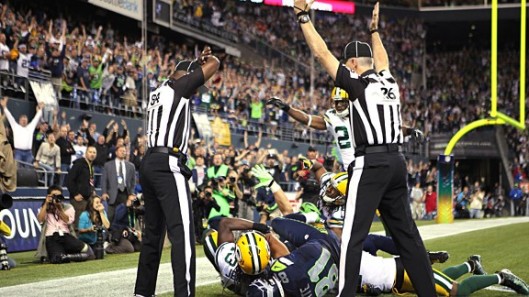
The best example – when such frustration peaked – is the now infamous “intertouchdownception” that gave the Seattle Seahawks a victory in the waning seconds over the Green Bay Packers by virtue of a Hail Mary pass that was impossible to call with the human eye and replacement refs and the current NFL rules and the tacit agreement that management isn’t calling interference on Hail Mary’s (lol).

intertouchdownception

One of the refs on the field who signaled touchdown still believes he made an acceptable call as per one reading of the rule book. Fans remain unconvinced.

CBS, the widest, slowest form of sports broadcasting, interviewed two of the replacement refs a few days later.

If, as Dave Ma suggests, we were to remove slow-motion from the toolbox for referees, could we as fans accept the difference of our view being an enhanced view from that of the refs?

Would we hound the refs for their inability to see what only a machine can see?

Or could we embrace the idea that we are keeping machines out of what is a fundamentally human exercise – sport.

In games like tennis and cricket, slow motion is used to define where or when a fast-moving object or person is at a given moment: the ball on or outside the line, the bat past the line before the ball strikes the wickets and so on.

The absolute exclusion of the slow motion effect would be a pointless exercise. However, it may be that the exclusion of slow motion from video review in certain situations would help keep the game real.

Cruisin’ the Bay Bridge with Steve Miller on the Radio

Tags

, , , , , , , , , , , ,

I identify with Steve Miller whom wiki describes thus:

“In 1965, when Miller returned from New York, he was disappointed by the state of the Chicago blues scene, so he moved to Texas in hopes of finishing his education at the University of Texas at Austin.

“He was disenchanted with academic politics at the University, so he took a Volkswagen Bus his father had given him and headed to San Francisco. Upon arrival, he used his last $5 to see the Butterfield Blues Band and Jefferson Airplane at the Fillmore Auditorium

“Miller fell in love with the vibrant San Francisco music scene and decided to stay.”