Tags
configurations, edition, english, five, Karthik, m.t. karthik, mtk, three, triptych, words

24 Sunday Aug 2025
Posted in 2025, art, conceptual art, MTKinstalls
Tags
configurations, edition, english, five, Karthik, m.t. karthik, mtk, three, triptych, words
28 Monday Oct 2024
Posted in 2024, art, artists books, conceptual art, literature, self portrait, thoughts
Tags
2024, book, m.t. karthik, Writist, zine
The Writist by M. T. Karthik is a 16-page book. It is described during production in the videos below:
24 Saturday Dec 2022
Tags
beach, Exhibition, India, kollam, Nadu, pondicherry, promenade, puducherri, puducherry, rangoli, tamil
28 Monday Nov 2022
Posted in 2022, Amsterdam, art, Commentary, history, Letter From MTK, philosophy
Tags
17th, acknowledgement, Amsterdam, baruch, c., century, colonialism, Dekker, Douwes, dutch, Edouard, enlightenment, Era, Francisco, Frans, giants, golden, Hals, Karthik, m.t., master, masters, mtk, Multatuli, painters, painting, philosophy, post, post-colonialism, racism, Rembrandt, rijks, Rijksmuseum, San, sf, slavery, spinoza
I am writing something and these are my initial thoughts
28 Monday Nov 2022
Posted in 2022, Amsterdam, architecture, art, landscape, philosophy, religio
Tags
Amsterdam, Ayasofya, Breitman, building, Camii, classical, design, dome, Francisco, Karthik, m.t., minaret, mosque, mtk, neo-classical, new, Ottoman, San, Westermoskee, western
The Westermoskee – in Turkish Ayasofya Camii, and English, the Western Mosque – is a blissfully serene, Ottoman-form mosque built in a Neo-Classical style along the canal Schinkel in the Schaasebuurt in De Baarsjes in Amsterdam West – a calm, quiet neighborhood.
Wiki tells us: the building was designed by French traditional architects Marc and Nada Breitman, winners of the 2018 Driehaus Prize and part of the New Classical movement.
Construction started in 2013. the building was completed in 2015, and the mosque unofficially opened in Spring of 2016. It is the largest mosque in the Netherlands. Features of the Ottoman style are the single minaret and large Ottoman styled main dome.
20 Sunday Nov 2022
Posted in 2022, Amsterdam, art, conceptual art, dutch, journalism, landscape
18 Friday Nov 2022
Posted in 2022, Amsterdam, art, Commentary, conceptual art, essay, installations, travel
Tags
Amsterdam, andy, banksy, Basqiat, Damien, Hirst, Jean-Michel, Jeff, Karthik, Keith, Koons, kusama, m.t., masters, MOCO, Modern, mtk, Warhol, yayoi
It was like walking into a university show in Soho in the ’90’s – Kusama, Warhol, Haring, Basquiat, Koons and Hirst – then suddenly it was like street stuff from the aughts: banksy, Stik, Invader.
Then Hayden Kays and KAWS and Takashi Murakami and Abloh is how it morphed into stuff I had only seen over the last five years because Google throws it up on my projector on heavy rotation ad nauseum thousands of miles from here – like Dream. (to old heads, I say big ups to Oaktown DREAM, rest in power). Then there was a Hirst and a Koons and a Warhol and a sweet roomful of Yayoi Kusama.
Moco Amsterdam is housed in the Villa Alsberg, a townhouse overlooking Museumplein in the heart of Amsterdam (between the Rijksmuseum and Van Gogh Museum). The building was designed in 1904 by Eduard Cuypers, nephew of Pierre Cuypers, designer of Amsterdam Central Station and the Rijksmuseum.
It is a good collection of very specifically well-known contemporary art, linked only by their pop. They don’t hide it, Moco calls itself a “boutique museum.” They have a second location in Barcelona. I heard the immersive digital art installation by Studio Irma was the same there.
What is this show exactly? I found out about it from posters slapped around town:
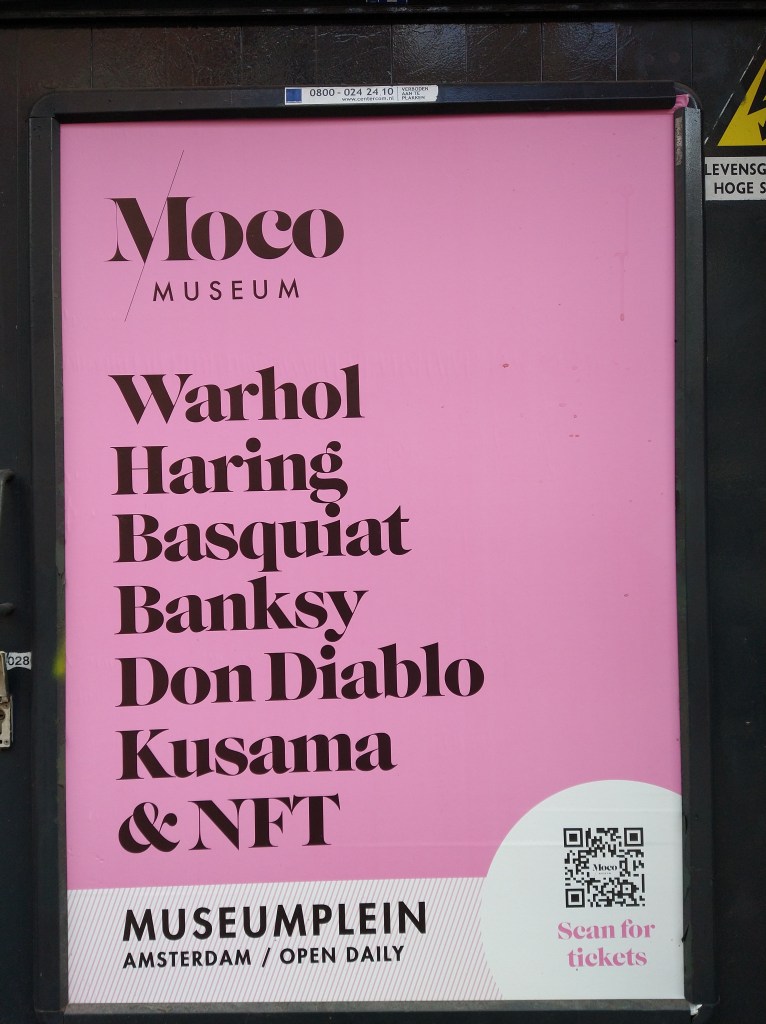
Wait – what? I was standing there in the street thinking that looks like clickbait for a museum exhibition produced by the marketing department. Here’s 4k video of my visit to Moco Amsterdam … check it:
Moco’s building was a privately-owned residence and one of the first family homes built along Museumplein. It was inhabited until 1939. Then, the house was let to priests who taught at the Saint Nicolas School in Amsterdam. Later it was converted into an office for a law firm.
Moco took over the Villa Alsberg and opened the museum in 2016, a traditional Amsterdam townhome on the museumplein, converted into a walk-through collection. But it is densely packed with the art and difficult to navigate when crowded. I was here on a rainy Thursday and it was claustrophobic. They should show less and allow for more space before the art.
Some artists received better purchase, weirdly (read: banksy). The one Warhol inclusion was pretty cool – diamond dust. Kusama is boss. Banksy’s tenner is great. The sculptures in the garden by Marcel Wander were precious. Studio Irma’s digital immersive art was low-tech, high-concept and cool. But it’s a densely installed collection. It was difficult to appreciate a large canvas by Hayden Kays, mounted in a small room. The Harings were also installed in a small square room, jammed with people. It was awkward.
Koons and Hirst were kind of just stuck in the hallways. Rooms were grouped loosely by era, but not distinctly so. They had these vague categories – Modern Masters, Contemporary Masters. It may have been an attempt to contrast-gain through equanimity but the install just felt crammed and poorly considered.
Prints were indicated to have been authenticated by the artists. The provenance for the Invader piece was credited to Jared Leto. Things that were new to me that I enjoyed were the playful works of Marcel Wander, the digital immersive stuff by Studio Irma and the large canvases (panels?) by The Kid.
The Kid, a contemporary painter using oils to create large photocollage-style paintings, had exquisite technique, though the work was conceptually immature. I wondered if there were painters in this land that spawned Rembrandt, Hals and Hooch and Vermeer and Van Gogh – and if so, what were they into? As a young artist, The Kid is into deeply personal concerns at the moment, but he will be good to watch evolve as a painter. I admired his use of pseudonym and rejection of nation-state in the establishment of his identity. Smart kid.
Ultimately, though, the artists were equalized in the hyper-capitalized gift shop that was tragically post-ironic: Campbell Soup Can skate decks beside decks that had banksy’s girl and balloon – where’s that dough going? Basquiat crowns as lapel pins. Is the Basquiat Estate or somebody who owns some weird rights making money here? on hundreds of euros worth of cheap, chinese-made kitschy derivative chunks of plastic? Is this a non-fungible token (NFT) emerging into totally fungible bullshit (TFB) in the museum culture?
Sure enough, the exibit includes NFT: The New Future, which they claim is, “Europe’s first dedicated exhibition space to the NFT phenomenon.” Beeple. It feels half baked. Exhibition spaces for non-fungible things.
Your ticket comes with a free gift from the museum and a discount for the gift shop. The shop was cringe. There were totes and hats and pins and cards and posters, lots of pink and the generalized motto of the museum: In Art We Trust. I mean. Look, it was a decent show or a weird collection of highly successful names in art since like 1990, in a house, but … what is this?
The curatorial sense here seems to be: throw as many recognizable names up as possible to herd in the stoned masses visiting the museumplein. Oh, and cater to the ever-increasing LGBTQ+ tourism euro, by featuring gay cultural icons and the color pink. This show wasn’t so much curated as listicled. Superficial.
By my observation, the corporate partners of high-profile museums in city centers of the colonial era are amidst a reformation, post-George Floyd – a Black Lives Matter effect is international. Woke culture expects more. Millennials are uninterested in the old narratives. Moco seems to seek to fill a void in perspective over traditional museums – that of street art and free expression. But superficial listicle curation for tourist-culture, and capitalist reduction of profound cultural expression, is gauche.
Moco resides somewhere between traditional museum culture and the modern art marketplace. It’s like a brick and mortar pop magazine on the museumplein.
from Amsterdam, I’m
M.T. Karthik
04 Sunday Sep 2022
03 Friday Jun 2022
Posted in 2022, architecture, art, S.F.
21 Friday Jan 2022
Posted in 2022, art, journal entries, journalism, NYC
Tags
Aime, Alberto, Aleksander, Alexander, Andre, art, Beyond, Boghossian, Borders, Cesaire, Dorothea, Giacometti, Greil, Harue, Helen, Joans, Joyce, Karthik, Koga, Lipstick, Lundeberg, m.t., Magritte, Mansour, Marcus, Metropolitan, mtk, Museum, Oelze, Penrose, Rene, Roger, situationists, Skundar, Surrealism, surrealists, Suzanne, Tanning, Ted, Traces
Everybody in my generation remembers chapter ten of the late great Greil Marcus’ book, Lipstick Traces, which came out my senior year of university (1989). Chapter ten dealt with the birth of the situationists, via the Easter Sunday performance at Notre Dame in 1950. Marcus wrote that the Surrealists, then ensconced figures in the art world in Europe and New York, claimed the act as that of their protégés, while the artists themselves rejected the notion. Surrealism was over.
The distinction between the situationists and the Surrealists and Dada was for us, an awesome thing to consider that way. The grandparents crowed about them and they rejected their successful grandparents. As a result of being educated from that perspective – a college kid looking at the 1950’s and learning from Marcus how this was a part of the birth of punk – my perception of Surrealism was, if not tainted, at least given greater contrast.
A bunch of us 20-year-olds in the early 90’s became fascinated by the situationists and DeBord. We were watching as they built the cities into grand stages for the Spectacle all throughout that decade. The Millennium was the Spectacle. Until it was 9/11. Everything DeBord foresaw was right in front of us. They even pulled down a few.
<<Flash Forward to 2022>>
If you want to call Booklyn, a fine arts collective dedicated to book arts, you dial my first number in New York. I was romantic about DeBord back then and so refused traditional entry into the group (or any group), but participated in its birth and establishment in Brooklyn in its early days. Booklyn is why many artists I know are in important collections around the country and the world. The collaboration was good and became incredibly important after September eleventh.
I called Booklyn when I dropped in to NYC and Marshall Weber called me back promptly. He chastised me for coming to town to support businesses that Booklyn would be protesting. He included the MOMA and the Met and the Opera. I didn’t bother to mention I was going to the Gugg the next day.
It is to say, the Metropolitan and MOMA have a labor problem. They have a diversity problem. They have a problem reframing the collections in the era of Black Lives Matter and MeToo and LGBTQ+ rights.
The Joseph E. Yoakum retrospective at MOMA I attended the day before and the Surrealism Beyond Borders exhibition I would be attending today were trying to address the issue: the Yoakum show was directly engaging a Black artist and the Metropolitan’s Surrealism Beyond Borders attempted to show how Surrealism was embraced by diverse groups of people around the world in various states of revolution. It sought to internationalize and radicalize visitors’ perception of Surrealism. It was closing at the end of the month. I went.

Sidenote: Again, I had to schedule a time for my visit as the museum attempted to encourage social distancing by timing the number of entrants. The temperature was in the 30’s and I was fully bundled up.
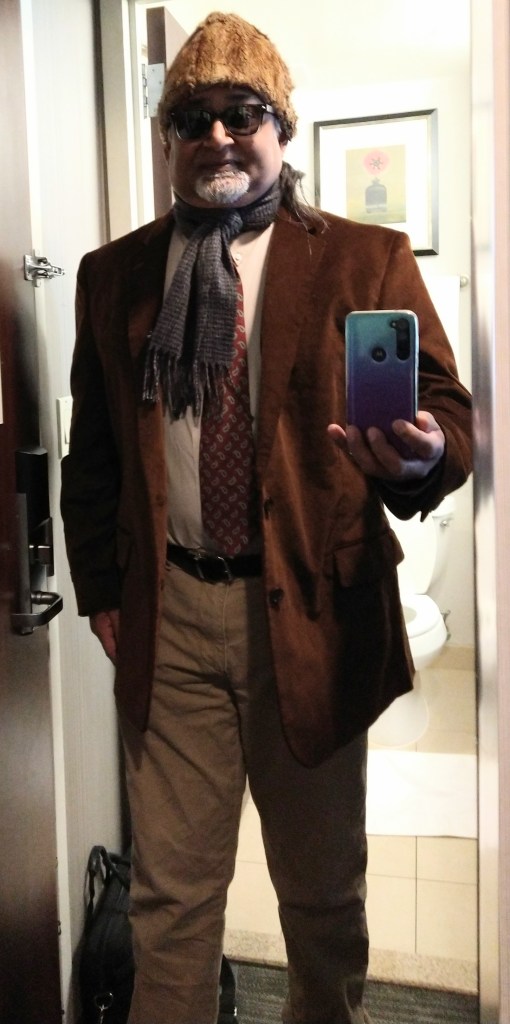
Only trouble is there was no coat check! Yet another victim of the pandemic was a coat check for all your winter gear when visiting the museums. It was hot inside and we visitors all had to lug all this winter gear around, ha!
Of particular interest to me was the area dedicated to Black Surrealists. I did not know how deeply Aime Cesaire had embraced Surrealism. Originals of his journal Tropiques (1941)
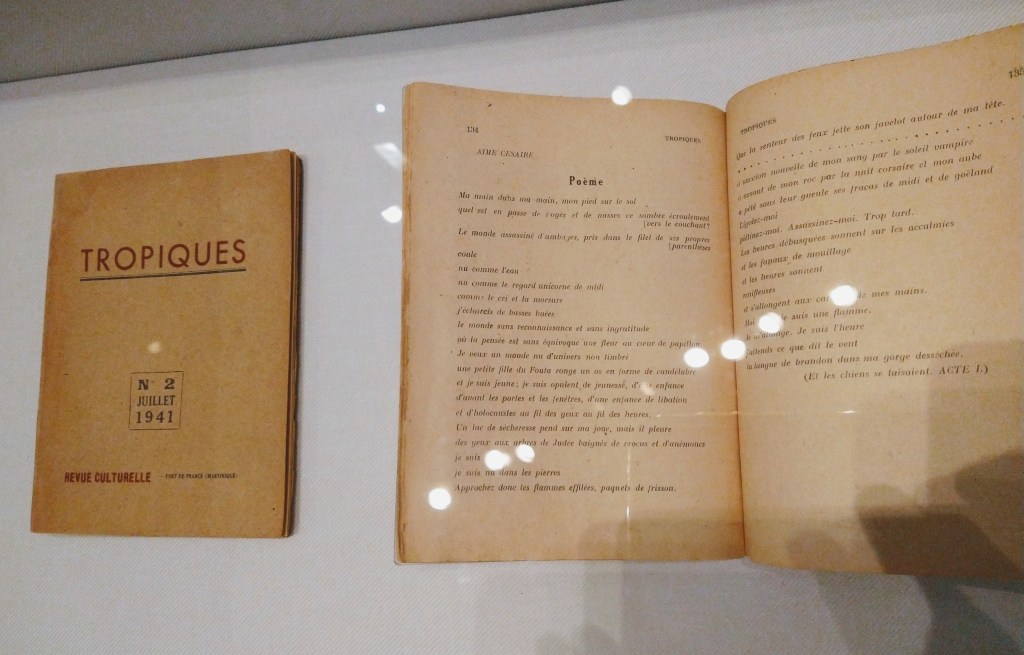
and Retorno al Pais Natal were a thrill to see.

The influence of Surrealism was apparent.

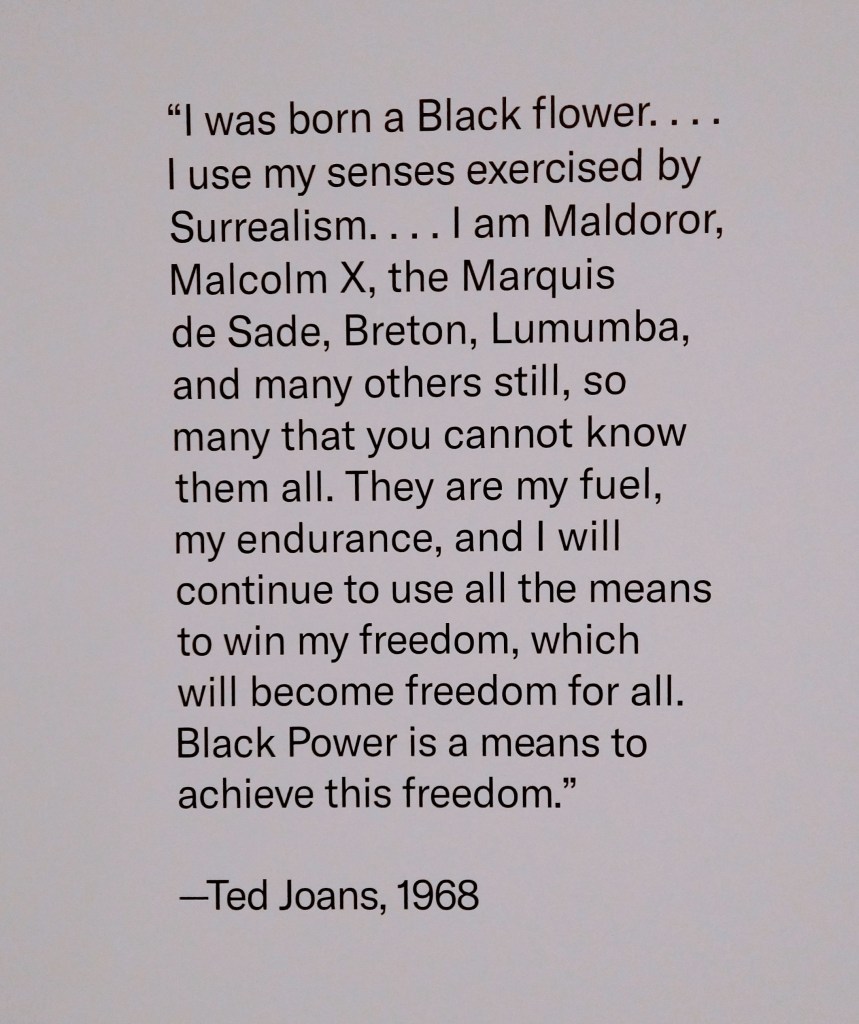
a quote from Suzanne Cesaire summarizes the cross-pollination

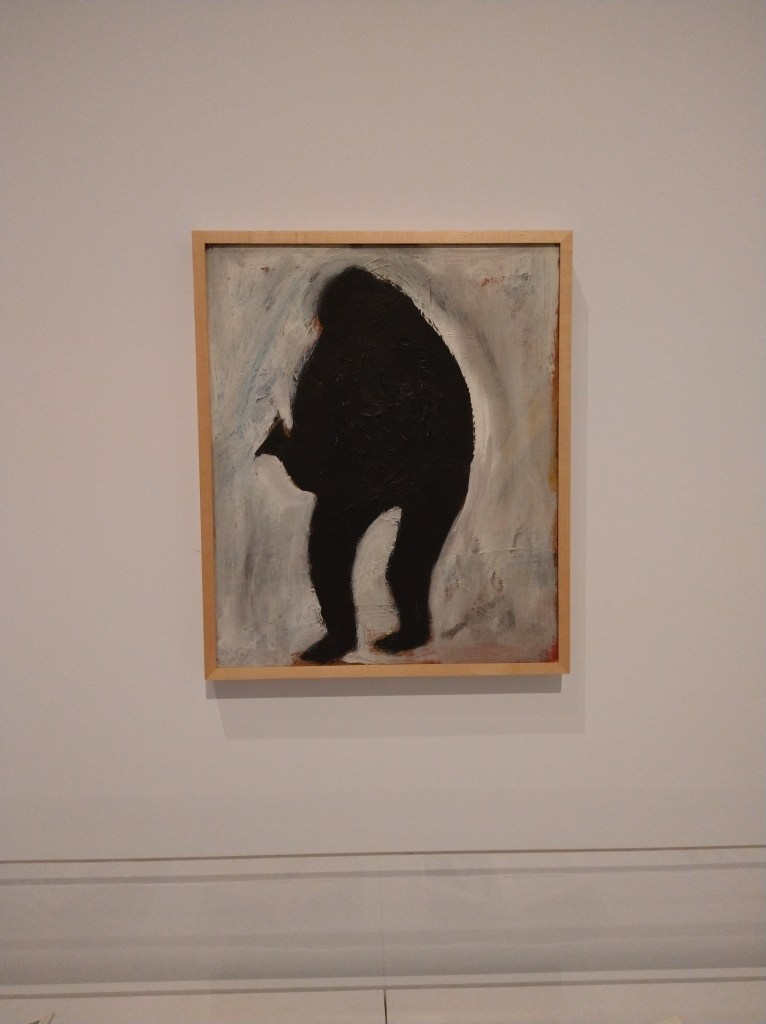
was also very deeply touched by this portrait of Charlie Parker by Black Canadian-American Surrealist Ted Joans, entitled Bird Lives! (1968)
But there was so much more from around the world. This shocking work, entitled Tagliche Drangsale (Daily Torments) by the oft-forgotten German Surrealist painter Richard Oelze (1900 – 1980), was painted a year after the National Socialists assumed power in Germany, (1934)

There was this brilliant Giacometti

Alexander “Skunder” Boghossian was an Ethiopian-Armenian painter and art teacher. He spent much of his life living and working in the United States. He was one of the first, and by far the most acclaimed, contemporary Black artists from the African continent to gain international attention. Here’s his Night Flight of Dread and Delight, Skundar Boghossian, (1964).

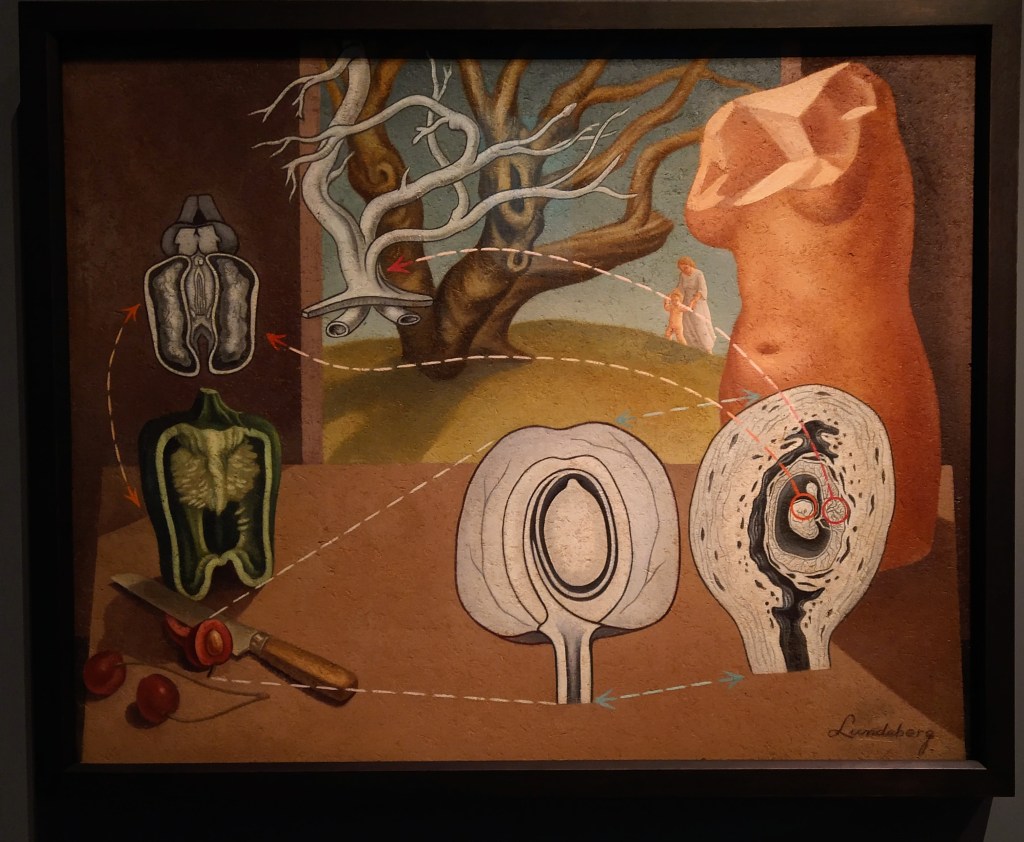
The Southern California artist, Helen Lundeberg, often credited for movement to Post-Surrealist work, was represented here in a Surrealist painting – Plant and Animal Analogies, (1934 -35).
And an early Surrealist work by the American painter, printmaker, sculptor and writer, Dorothea Tanning – Eine Kleine Nachtmusik, (1943).

Roger Penrose was included with this sculpture, entitled The Last Voyage of Captain Cook, (1936-7)

It was my first time seeing the Exquisite Corpse in person.

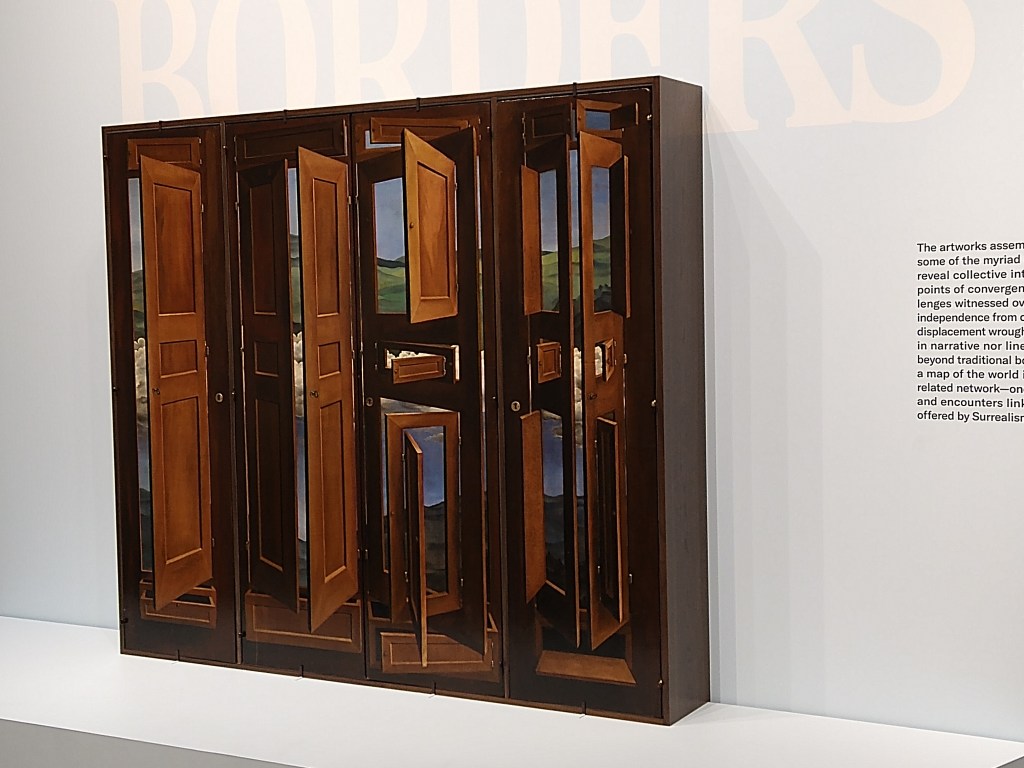
And this great Magritte, I was born the year he died, you know.

And one of my all-time favorites
Salvador Dali’s Lobster telephone

There was much more to consider in the exhibition, website here.
But one piece stood out amongst the many I saw in my first visit to museums since the coronavirus pandemic struck. It was an obscure sculpture made of nails and sponge by French artist Joyce Mansour and it was entitled Objet Mechant, which means Nasty Object. It looks shockingly like the nastiest respiratory virus in human history. Yet it was made 50 years before Covid-19 struck.

Pretty good exhibition. so says I.
12 Tuesday Dec 2017
Tags
audio, birth, book, computers, contact, copyright, dawn, electronic, essay, first, games, gaming, internet, interviews, Karthik, longform, m.t., media, mtk, nascent, plug, Project, technology, television, unplug, web
Between 2005 and 2011, I collected interviews with people about their first experiences with a computer (The First Contact Project) and
wrote a book about our intersection with technology and how I grew up with it and how it became a part of policy and society (Plug/Unplug)
Here I mix them together for a final expression.
29 Wednesday Nov 2017
08 Wednesday Nov 2017
14 Thursday Aug 2014
11 Monday Aug 2014
02 Saturday Aug 2014
Posted in art
10 Tuesday May 2011
Tags
Today I added some of my more recent work as an artist (the last ten years or so) to the resumé on this site, here.
My work as an artist has been social and political and aesthetic and news-related and cultural and about communicating ideas. These experiences have helped create in some small part the candidacy you see before you today. To whit,
since 1985, Audiovisual and Performance Artist
Member, Booklyn Artists Alliance, a non-profit, consensus-driven book arts organization dedicated to the book as art, on the web at www.booklyn.org
SELECTED COLLECTIONS
Getty Research Institute, Los Angeles
Museum of Modern Art, NYC
Occidental College, Los Angeles
Otis College of Art and Design, Los Angeles
Stanford University, Palo Alto, CA
University of Southern California, Los Angeles
University of California at Irvine
Pacifica Radio Archives
EXHIBITIONS, INSTALLATIONS, PERFORMANCES, TALKS
2010 Moving Forward, zine in an edition of 3,000 (1500 en español), distributed free in Fruitvale, Temescal and downtown Oakland, concerning the verdict in the Johannes Mehserle trial
2009 Making Money … Into Something Else, installation and artist’s talk, Deco Art, Oakland, CA
2008 establishment of ffptp.org website (a two year exercise ended in 2010);
new work, local artists group show, Eton Avenue Studio, Berkeley, CA
2007 The Rupee Ganesha, Tamil Nadu, India;
After Po-Mo. [And Before We Agree], artists talk, Certitude, Auroville, India;
Vous êtes ă Puduchcheri, mural, Qualithés Hotel, Puduchcheri, India;
Found in Translation, touring group show, Center for Book Arts, Minneapolis
2006 Artists Talk, Found in Translation, Center for Book Arts, NY;
Found in Translation, Center for Book Arts NYC & Center for the Book SF;
Alternating Currency, Pavel Zoubok Gallery, NYC;
Tricycle Museum, Centro de Cultura Casa Das Mudas, Madeira Island, Portugal
2005 kotataki art, permanent installation, Sun’s Preschool, Kamakura, Japan;
Pluralism of Media in the Age of Surveillance, talk, c-level, Chinatown, LA;
The First Contact Project, streaming Internet audio of interviews
2004 untitled talk on the Presidential Election of 2004, New College, SF;
Troubled Sleep: Art in the Age of Bush, panel discussion, Cal Arts, LA;
Visible Palestine, performance and video, Echo Park Film Center, LA
2003 Art and Political Communication, talk, University of California, Davis;
The SF J18 Manifestation, performance and video, Track 16 Gallery,LA
2002 US=THEM, installation and performance and The Angola Three, a mural, 33 1/3 Books and Gallery, LA; Rare Books of the Future, Center for Book Arts, NYC
I hope you will see why I am best suited to run the City today. I can bring the costs down, get control of the upward spiral of waste and raise the right taxes on the right people at the right time so that:
We will pay less, for a better quality of life.
11 Wednesday Apr 2007
Posted in art, Asia, Commentary, conceptual art, India, talks, Tamil Coast
Tags
after, agree, art, Auroson, auroville, before, contemporary, culture, India, Karthik, lecture, m.t., m.t. karthik, mtk, po-mo, show, slide, talk, we
After Po-Mo and Before We Agree
art talk by M.T. Karthik
Auroville, India 2007
Begin with the piece on The End of Post-Modernism, October 1999. (pause)
But I thik that Giulianis comment, as ignorant and political as it may have been, is indicative of the feeling at the end of the 20th century. Arthur Danto had written The Death of Art in 1994, the century was limping to an end.
*******K Foundation
On 23 August 1994, the K Foundation (Bill Drummond and Jimmy Cauty) burnt one million pounds sterling in cash on the Scottish island of Jura. This money represented the bulk of the K Foundation’s funds, earned by Drummond and Cauty as The KLF, one of the United Kingdom‘s most successful pop groups of the early 1990s. The duo have never fully explained their motivations for the burning.
The incineration was recorded on a Hi-8 video camera by K Foundation collaborator Gimpo. In August 1995, the film—Watch the K Foundation Burn a Million Quid[1]—was toured around the British Isles, with Drummond and Cauty engaging each audience in debate about the burning and its meaning. In November 1995, the duo pledged to dissolve the K Foundation and to refrain from public discussion of the burning for a period of 23 years.
A book—K Foundation Burn A Million Quid, edited and compiled by collaborator Chris Brook —was published by ellipsis Books in 1997, compiling stills from the film, accounts of events and viewer reactions. The book also contains an image of a single house brick that was manufactured from the fire’s ashes.
last year I was with Matthew Higgs
Matthew Higgs is director of White Columns in New York. He is also associate director of exhibitions at the Institute of Contemporary Arts in London, England. He has organized more than forty exhibitions, including To Whom It May Concern and Reality Check: Painting in the Exploded Field at the CCA Wattis Institute. A regular contributor to Artforum, Higgs has written for many catalogs and other publications. As an artist, he is represented by Murray Guy in New York and Anthony Wilkinson Gallery in London.
But I think that the socio-political scene drove arts to find new ways to seek new materials and do things that Rudolph Giuliani could do but which are still art. and to communicate ideas through mass media.
I am going to talk about a few different places and people I have met and known in San Francisco, New York, Japan. India and elsewhere and let you see some work here and get an idea of what is being made and by whom.
It is interesting to me that the Venice Bienale opened today is it and I didn’t go to the site to see who is in it or whatever. I wanted to try to construct this talk from – as Auroson suggested – my own experiences of art and artists.
Vik Muniz (Brazil, 1961) is an avant-garde artist who experiments with novel media. For example, he made two detailed replicas of Leonardo da Vinci‘s Mona Lisa: one out of jelly and the other out of peanut butter. He has also worked in sugar, wire, thread, and Bosco Chocolate Syrup, out of which he produced a recreation of Leonardo’s Last Supper. Many of Muniz’s works are new approaches to older pieces; he has reinterpreted a number of Monet‘s paintings, including paintings of the cathedral at Rouen, which Muniz accomplished using small clumps of pignment sprinkled onto a flat surface.
Vik Muniz’s use of materials is more than a result of aesthetic decisions alone. In his picture of Sigmund Freud, for example, he uses chococlate to render the image. The photograph is printed in such high resolution that one can almost taste the material from which the image is made. In this sense, Muniz is refering to Freud’s theory of the oral stage. Likewise, because of the chocolate’s viscosity and visual similarity to excrement there is an allusion to Freud’s anal stage as well. This conceptual framing of matter is also apparent in his Sugar Children series. In this body of work, Muniz went to a sugar plantation in Brazil to photograph children of laborers who work there. He made the images from the sugar at the plantation. The differential in value between the wages of the laborers, and the fluctuating cost of sugar in the international market as well the price for the photograph, reveal much about geopoltics, global/local economics, and the art world.
Vik Muniz works with the syntax of photography, hut his images are not simply photographic. As Vince Aletti pointed out in the Village Voice, “[Muniz] has teased the medium mercilessly and with an infectious glee. He makes pictures of pictures — sly, punning documents that subvert photography by forcing it to record not the natural world but a fiction, a simulation.” (left: Action Photo (After Hans Namuth), 1997, 60 x 48 inches, Collection of Eileen and Peter Norton, Los Angeles)
Born in 1961, Muniz grew up in Sao Paulo, Brazil where he studied advertising, a field which he acknowledges,”made me aware of the dichotomy between an object and its images.” After he moved to New York in 1983, Muniz made sculptures which he documented in photographs, then began incorporating photographs in his sculptural installations. He discovered that what interested him most was the representation of objects rather than the objects themselves, the dislocation between expectation and fact, representation and reality.
Muniz’s pictures are illusions that draw from the language of visual culture, but they twist and redefine our perception of both the commonplace and the fantastical. His images humorously, as well as critically challenge our ability to discern fact from fiction, reality from appearance. Utilizing a range of unorthodox materials — granulated sugar, chocolate syrup, tomato sauce, thread, wire, cotton, soil — Muniz first creates an image, sculpturally manipulates it, then photographs it. Whether a portrait, landscape, still life, or iconic image from history, Muniz’s works are never what they seem.
More recently he has been creating larger-scale works, such as pictures carved into the earth (geoglyphs) or made of huge piles of junk. His sense of humor comes through in his “Pictures of Clouds” series, in which he had a skywriter draw cartoon outlines of clouds in the sky.
Surasi Kusolwong
born in 1965 in Ayutthaya, Thailand. In 1987 he received his BFA from Silpakorn University, Bangkok, Thailand, and in 1993 he received his MFA from Hochshule für Bildender Künst, Braunshweig, Germany. Kusolwong’s artistic practice includes installation and performance-based work and, since 1996, he has concocted variations on market settings where inexpensive, mass-produced, Thai-manufactured goods are sold for a nominal fee.
The artist has shown widely in Europe, America, Asia, and Australia. Solo exhibitions include Institute of Visual Arts (INOVA), Milwaukee, WI; Arte all’Arte (Arte Continua project), Casole d’Elsa, Italy; Fri-Art Centre D’Art Contemporain Kunsthalle, Fribourg, and Art & Public Gallery, Geneva, Switzerland. Group exhibitions include P.S.1 Contemporary Art Center, Long Island City, NY; Hayward Gallery, London, England; Kiasma Museum of Contemporary Art, Helsinki, Finland; Academia de Francia/Villa Médicis, Rome, Italy; 21st Century Museum of Contemporary Art, Kanazawa, Museum of Contemporary Art, Tokyo, Japan; Pusan Metropolitan Museum of Art, Samsung Museum of Modern Art, Seoul, Korea; Edsvik Art & Culture Center, Sollentuna, Sweden. Kusolwong has exhibited in many biennales including the 2001 Berlin Biennale, Germany; Transfert, 2001 Swiss Sculpture Exhibition, Biel, Switzerland; Kwangju Biennale 2000, Korea; Taipei Biennale 2000, Taiwan; Third Asia-Pacific Triennial of Contemporary Art, Brisbane, 11th Biennale of Sydney, Australia; and the 1997 Vienna Secession, Austria
Lu Jie was born in Fujian, China in 1964. He holds a BFA from the China Academy of Arts in Hangzhou and an MA from the Creative Curating Program in Goldsmiths College, University of London. Lu Jie has curated numerous contemporary art exhibitions internationally including the Chinese presentation at the 2005 Prague Biennale and the 2005 Yokohama Triennale. He is the founder of the Long March Foundation in New York, and the 25000 Cultural Transmission Center in Beijing. Over the past six years, Lu Jie has been concentrating his efforts to produce The Long March – a Walking Visual Display which was exhibited in National Museum of Contemporary Art, Oslo, Museum of Contemporary Art, Lyon, 2004 Shanghai Biennale, 2004 Taipei Biennale and will be exhibited in 2005 Yokohama Triennale, Vancouver Art Gallery and the next Asia Pacific Triennale.
Long March Capital – Visual Economies of TransMedia
Initiated in 1999, carried out on the historical Long March route in 2002, and returning to Beijing from where we are still marching locally and internationally today, the Long March is a multifaceted and complex art project in which the journeys through the realities of different social locations, contexts, and dimensions are part of a process of artistic experience and creation. The Long March’s approach to new media, therefore, extends beyond the faculties of technology, rather looking at the metaphor of the Long March as a medium and methodology in which creative expression can arise. In this regard, the Long March acts not only as an art project but as a “transmediator,” a form of capital which offers a platform, context, and professional service for the realization and display of new media works, as well as a “glocalely” situated “social” as a new media. Participants work together, turning local resources into the international language of contemporary art, and conversely imbuing international art with a local context and significance. As such, the Long March journey becomes a collective knowledge production and performance where both audiences and artists alike become participant observers constantly negotiating the boundaries and relationships of the various visual economies bounded within artistic production.
Lu Jie is the founder and director of the Long March Foundation, New York and the 25,000 Cultural Transmission Center, Beijing. Over the past six years, Lu Jie has been concentrating his efforts to produce the Long March Project, portions of which have been exhibited internationally including in the 2004 Shanghai Biennale, the 2004 Taipei Biennale, at the Vancouver Art Gallery 2005 and The Yokohama Triennale 2005 and Sao Paulo Biennale in 2006.
The Long March Project: : Lu Jie in Conversation with Hsingyuan Tsao and Shengtian Zheng
On the evening of October 12, 2005 the Vancouver Art Gallery presented “Dialogues on Art: Lu Jie in Conversation with Shengtian Zheng and Hsingyuan Tsao.” The presentation was organized in conjunction with the exhibition Classified Materials: Accumulations, Archives, Artists.
Lu Jie: The Long March Project was initiated in 1999 when I was a curatorial studies student at London University. During that time I developed a critique of the representation of politics in the context of international Chinese art exhibitions. I was thinking about the ways that contemporary art practice could connect with social development and social change. I developed the Long March Project as an organic structure that could parallel the grand narrative of the historical Long March initiated by Mao Zedong. I developed the idea that a number of sites could be created according to this historical Long March—this search for utopia, this sharing of resources, this going beyond the limits of body and ideology.
After several years of preparation, the Long March Foundation was established in New York in 2000. I spent two years visiting the six thousand miles historical Long March route. In 2002, we established the 25,000 Cultural Transmission Center in Beijing before launching the project that summer. After a three-month journey, twelve of the twenty planned sites were completed. We already had the contribution of two-hundred-and-fifty local and international artists. People thought that the government would stop us, but there were no political problems.
In the Yanchuan papercutting survey—which we believe is a milestone of the whole Long March up until today—we asked questions such as: what do we do with the so-called folk artists who live in China, whose life and profession is all based on an aesthetic that we do not value? This work is something that other curators and institutions do not deal with. But for the Long March Project—a project that wants to face reality—the different social hierarchies and historical frameworks all connect together to create a new understanding of contemporary Chinese art. So we believed from the very beginning that folk art, such as paper-cutting, is something that should be re-examined.
what’s next?
list and
culture jamming
media pluralism
regionality





 MTK The Writist