Tags
biology, Darwin, evolution, Humboldt, installation, life, natural, selection, tree, von, wallace

15 Monday Sep 2025
Posted in 2025, installations
04 Sunday May 2025
Posted in 2025, audio, beliefs, conceptual art, installations, philosophy, scripts, short film
Tags
18 Friday Nov 2022
Posted in 2022, Amsterdam, art, Commentary, conceptual art, essay, installations, travel
Tags
Amsterdam, andy, banksy, Basqiat, Damien, Hirst, Jean-Michel, Jeff, Karthik, Keith, Koons, kusama, m.t., masters, MOCO, Modern, mtk, Warhol, yayoi
It was like walking into a university show in Soho in the ’90’s – Kusama, Warhol, Haring, Basquiat, Koons and Hirst – then suddenly it was like street stuff from the aughts: banksy, Stik, Invader.
Then Hayden Kays and KAWS and Takashi Murakami and Abloh is how it morphed into stuff I had only seen over the last five years because Google throws it up on my projector on heavy rotation ad nauseum thousands of miles from here – like Dream. (to old heads, I say big ups to Oaktown DREAM, rest in power). Then there was a Hirst and a Koons and a Warhol and a sweet roomful of Yayoi Kusama.
Moco Amsterdam is housed in the Villa Alsberg, a townhouse overlooking Museumplein in the heart of Amsterdam (between the Rijksmuseum and Van Gogh Museum). The building was designed in 1904 by Eduard Cuypers, nephew of Pierre Cuypers, designer of Amsterdam Central Station and the Rijksmuseum.
It is a good collection of very specifically well-known contemporary art, linked only by their pop. They don’t hide it, Moco calls itself a “boutique museum.” They have a second location in Barcelona. I heard the immersive digital art installation by Studio Irma was the same there.
What is this show exactly? I found out about it from posters slapped around town:
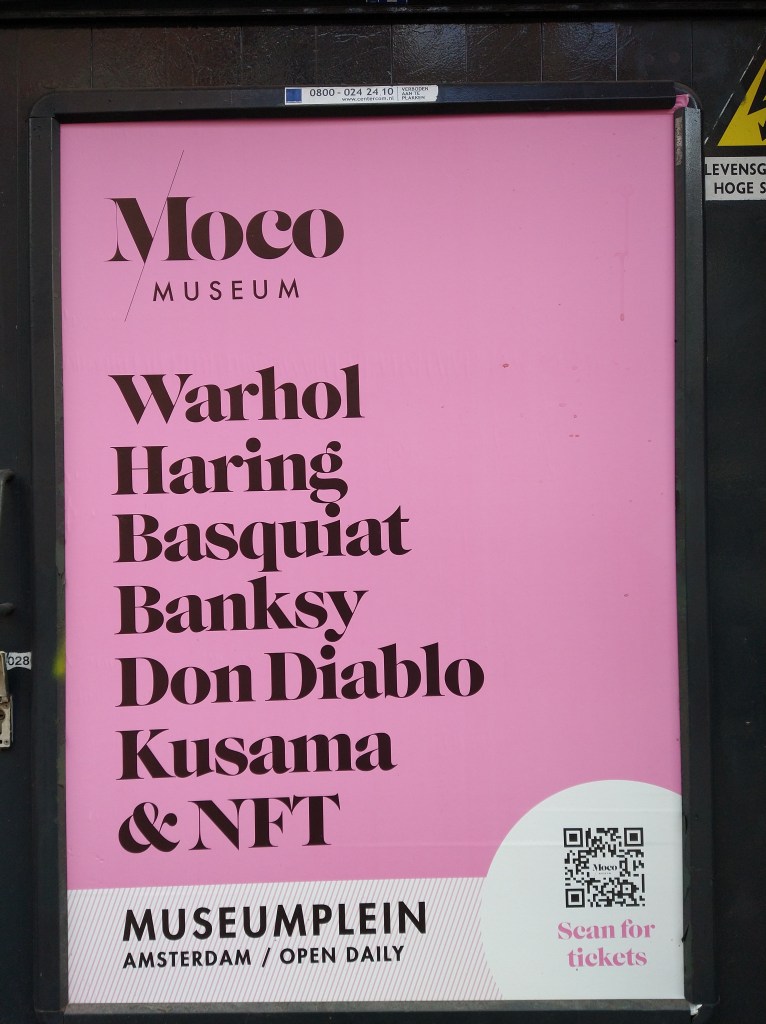
Wait – what? I was standing there in the street thinking that looks like clickbait for a museum exhibition produced by the marketing department. Here’s 4k video of my visit to Moco Amsterdam … check it:
Moco’s building was a privately-owned residence and one of the first family homes built along Museumplein. It was inhabited until 1939. Then, the house was let to priests who taught at the Saint Nicolas School in Amsterdam. Later it was converted into an office for a law firm.
Moco took over the Villa Alsberg and opened the museum in 2016, a traditional Amsterdam townhome on the museumplein, converted into a walk-through collection. But it is densely packed with the art and difficult to navigate when crowded. I was here on a rainy Thursday and it was claustrophobic. They should show less and allow for more space before the art.
Some artists received better purchase, weirdly (read: banksy). The one Warhol inclusion was pretty cool – diamond dust. Kusama is boss. Banksy’s tenner is great. The sculptures in the garden by Marcel Wander were precious. Studio Irma’s digital immersive art was low-tech, high-concept and cool. But it’s a densely installed collection. It was difficult to appreciate a large canvas by Hayden Kays, mounted in a small room. The Harings were also installed in a small square room, jammed with people. It was awkward.
Koons and Hirst were kind of just stuck in the hallways. Rooms were grouped loosely by era, but not distinctly so. They had these vague categories – Modern Masters, Contemporary Masters. It may have been an attempt to contrast-gain through equanimity but the install just felt crammed and poorly considered.
Prints were indicated to have been authenticated by the artists. The provenance for the Invader piece was credited to Jared Leto. Things that were new to me that I enjoyed were the playful works of Marcel Wander, the digital immersive stuff by Studio Irma and the large canvases (panels?) by The Kid.
The Kid, a contemporary painter using oils to create large photocollage-style paintings, had exquisite technique, though the work was conceptually immature. I wondered if there were painters in this land that spawned Rembrandt, Hals and Hooch and Vermeer and Van Gogh – and if so, what were they into? As a young artist, The Kid is into deeply personal concerns at the moment, but he will be good to watch evolve as a painter. I admired his use of pseudonym and rejection of nation-state in the establishment of his identity. Smart kid.
Ultimately, though, the artists were equalized in the hyper-capitalized gift shop that was tragically post-ironic: Campbell Soup Can skate decks beside decks that had banksy’s girl and balloon – where’s that dough going? Basquiat crowns as lapel pins. Is the Basquiat Estate or somebody who owns some weird rights making money here? on hundreds of euros worth of cheap, chinese-made kitschy derivative chunks of plastic? Is this a non-fungible token (NFT) emerging into totally fungible bullshit (TFB) in the museum culture?
Sure enough, the exibit includes NFT: The New Future, which they claim is, “Europe’s first dedicated exhibition space to the NFT phenomenon.” Beeple. It feels half baked. Exhibition spaces for non-fungible things.
Your ticket comes with a free gift from the museum and a discount for the gift shop. The shop was cringe. There were totes and hats and pins and cards and posters, lots of pink and the generalized motto of the museum: In Art We Trust. I mean. Look, it was a decent show or a weird collection of highly successful names in art since like 1990, in a house, but … what is this?
The curatorial sense here seems to be: throw as many recognizable names up as possible to herd in the stoned masses visiting the museumplein. Oh, and cater to the ever-increasing LGBTQ+ tourism euro, by featuring gay cultural icons and the color pink. This show wasn’t so much curated as listicled. Superficial.
By my observation, the corporate partners of high-profile museums in city centers of the colonial era are amidst a reformation, post-George Floyd – a Black Lives Matter effect is international. Woke culture expects more. Millennials are uninterested in the old narratives. Moco seems to seek to fill a void in perspective over traditional museums – that of street art and free expression. But superficial listicle curation for tourist-culture, and capitalist reduction of profound cultural expression, is gauche.
Moco resides somewhere between traditional museum culture and the modern art marketplace. It’s like a brick and mortar pop magazine on the museumplein.
from Amsterdam, I’m
M.T. Karthik
23 Sunday Jan 2022
Posted in 2022, conceptual art, installations, NYC
Tags
2022, chronological, Exhibition, Guggenheim, Kandinsky, Karthik, manhattan, mtk, NYC, ramp, Vasily
The installation Vasily Kandinsky Around the Circle, at the Guggenheim, curated by Megan Fontanella, opened in October and was closing in February, so I added it to my agenda for Sunday morning, my last in town.
The installation website has excellent details about the curatorial decision making. Kandinsky, a complicated figure, is here sensitively exposed. In this exhibition, Kandinsky’s work unfolds in reverse chronological order, starting with his late-life paintings and proceeding upward along the Guggenheim’s spiral ramp.

I had read Peter Schjeldahl’s piece, Choose Your Own Kandinsky Adventure at the Guggenheim, in the November 8, 2021, issue of The New Yorker. Schjeldahl begins:
“Choose a direction for your perusal of “Vasily Kandinsky: Around the Circle,” a retrospective that lines the upper three-fifths of the Guggenheim Museum’s ramp with some eighty paintings, drawings, and woodcuts by the Russian hierophant of abstraction, who died in France in 1944, at the age of seventy-seven. The show’s curator, Megan Fontanella, recommends starting at the bottom, with the overwrought works of the artist’s final phase, and proceeding upward, back to the simpler Expressionist landscapes and horsemen of his early career. This course is canny in terms of your enjoyment, which increases as you go.”
And, given the way the last year and a half had been, I decided to start at the bottom and go up, in reverse chrono, for the canny enjoyment, rather than the decay into madness.

I had, again, scheduled the earliest appointment of Sunday morning. In this instance, I was walking directly from Chez Nick, so arrived early and was first in line, masked and with my vaccination card and i.d.
I have a series of works that relate to reincarnation. I make copies of, or represent works made by artists I respect who died the year I was born. One of these is a rubber stamp print of Magritte’s Labors of Alexander, his last drawing – which became a three-dimensional sculpture. I had prints and was giving them away and leaving them all about town, especially around the Surrealism show.
Standing in line at the Gugg behind me were a young man from France and his parents. The young man lived in New York and his parents were visiting. We spoke French as I welcomed them and we waited. I gave them a Magritte print and explained my interest in reproducing works by people who died the year I was born. The father was skeptical. The mother only asked, “Who else do you do this with?” I only smiled enigmatically to express I had said too much already and they let us in.
Schjeldahl was right, it would have been totally different coming down from up. But this was a comprehensive exhibition of one of the most remarkable minds of the 20th century, either way.


16 Friday Nov 2012
Posted in installations, journalism, mural, S.F., sculpture
Tags
1934, 1985, 5th, An, art, bloody, Bordoise, contract, Injury, July, Longshoremen, memorial, Mission, one, public, san francisco, sculpture, sf, Sperry, Steuart, Steuert, street, strike, Thursday, to, union
Public art to commemorate “Bloody Thursday” at the corner of Mission and Steuart Streets in San Francisco. The four-day general strike in SF in the summer of 1934 led to unionization of all the West Coast ports of the United States:
 37° 47.602′ N, 122° 23.593′ W
Painted in 1985 by an artist’s collective, this mural-sculpture was placed by the International Longshore and Warehouse Union near the previous memorial, this plaque:

When the Hotel Vitale was built in 2004, the sculpture and plaque were moved a short distance and re-erected, with the plaque now mounted on the wall of the hotel. (Source)

The strike began on May 9, 1934 as longshoremen in every West Coast port walked out; sailors joined them several days later. The employers recruited strikebreakers, housing them on moored ships or in walled compounds and bringing them to and from work under police protection.
Strikers attacked the stockade housing strikebreakers in San Pedro on May 15; two strikers were shot and killed by the employers’ private guards. Similar battles broke out in San Francisco and Oakland, California, Portland, Oregon and Seattle, Washington. Strikers also succeeded in slowing down or stopping the movement of goods by rail out of the ports.

The Roosevelt administration tried again to broker a deal to end the strike, but the membership twice rejected the agreements their leadership brought to them. The employers then decided to make a show of force to reopen the port in San Francisco.

On Tuesday, July 3, fights broke out along the Embarcadero in San Francisco between police and strikers while a handful of trucks driven by young businessmen made it through the picket line.
After a quiet Fourth of July the employers’ organization, the Industrial Association, tried to open the port even further on Thursday, July 5.
As spectators watched from Rincon Hill, the police shot tear gas canisters into the crowd, then followed with a charge by mounted police. Picketers threw the canisters and rocks back at the police, who charged again, sending the picketers into retreat after a third assault. Each side then refortified and took stock.
The events took a violent turn that afternoon, as hostilities resumed outside of the ILA the kitchen. Eyewitness accounts differ on the exact events that transpired next. Some witnesses saw a group of strikers first surround a police car and attempt to tip it over, prompting the police to fire shotguns in the air, and then revolvers at the crowd.
One of the policemen then fired a shotgun into the crowd, striking three men in intersection of Steuart and Mission streets. One of the men, Howard Sperry, a striking longshoreman, later died of his wounds. Another man, Charles Olsen, was also shot but later recovered from his wounds. A third man, Nick Bordoise—an out of work cook who had been volunteering at the ILA strike kitchen—was shot but managed to make his way around the corner onto Spear Street, where he was found several hours later. Like Sperry, he died at the hospital.
Strikers immediately cordoned off the area where the two picketers had been shot, laying flowers and wreaths around it. Police arrived to remove the flowers and drive off the picketers minutes later. Once the police left, the strikers returned, replaced the flowers and stood guard over the spot. Though Sperry and Bordoise had been shot several blocks apart, this spot became synonymous with the memory of the two slain men and “Bloody Thursday.”
As strikers carried wounded picketers into the ILA union hall police fired on the hall and lobbed tear gas canisters at nearby hotels. At this point someone reportedly called the union hall to ask “Are you willing to arbitrate now?” (Source for text: wikipedia)

“An Injury to One is an Injury to All”
07 Tuesday Aug 2012
Posted in installations, S.F.
Tags
Bay, california, China Basin, deep, engineers, Karthik, mtk, pipes, san francisco, steel
We were on our way to the SF Giants game last week and saw these immense pilings going deep underwater and into the soil for impending building. This is the very beginning of the huge new public space planned for these unused piers – project approved last year by the Interim Mayor and Board.
Incredible to see the specificity with which these long pipes were being placed – two men on a raft floating near the top of the deeply placed piles, as a surveyor takes readings for their placement and an operator swings the long boom of the crane.
06 Friday Jul 2012
Posted in installations, photography, S.F.
25 Saturday Feb 2012
Posted in Coastal Cali, installations, journalism, photography
Tags
19th, Augustin-Jean, california, century, french, Fresnel, lens, lighthouse, pigeon, point

This past November, we were extremely lucky to be at Pigeon Point Lighthouse Hostel on the exact day they took the lens down from the top of the lighthouse for the first time since it was installed in 1872, a hundred and forty years ago.
The Pigeon Point lens is a traditional Fresnel lens, designed in 1823 by French physicist Augustin-Jean Fresnel for use in lighthouses, and characterized by many thin layers of glass which form a prism, allowing the lens to capture more oblique light from a light source and make lighthouses more visible over much greater distances.
It consists of 1008 separate lenses and prisms, and weighs over 8000 pounds.
You can see the lens stored at ground level in the Fog Signal House at the hostel as they complete repairs on the lighthouse. Read history of the lighthouse here.
17 Friday Feb 2012
Posted in Asia, installations, Japan, our son, S.F., short film
15 Thursday Sep 2011
Posted in installations, North Oakland, performance
03 Saturday Oct 2009
Posted in collage, installations, MTKinstalls, North Oakland
18 Friday May 2007
Posted in Asia, collage, India, installations, MTKinstalls, Tamil Coast
Tags
2007, bar, hotel, m.t. karthik, mtk, mural, pondi, pondicherry, pondy, Pudduchcheri, pudducherri, qualithes, Vous êtes à Pudduchcherri
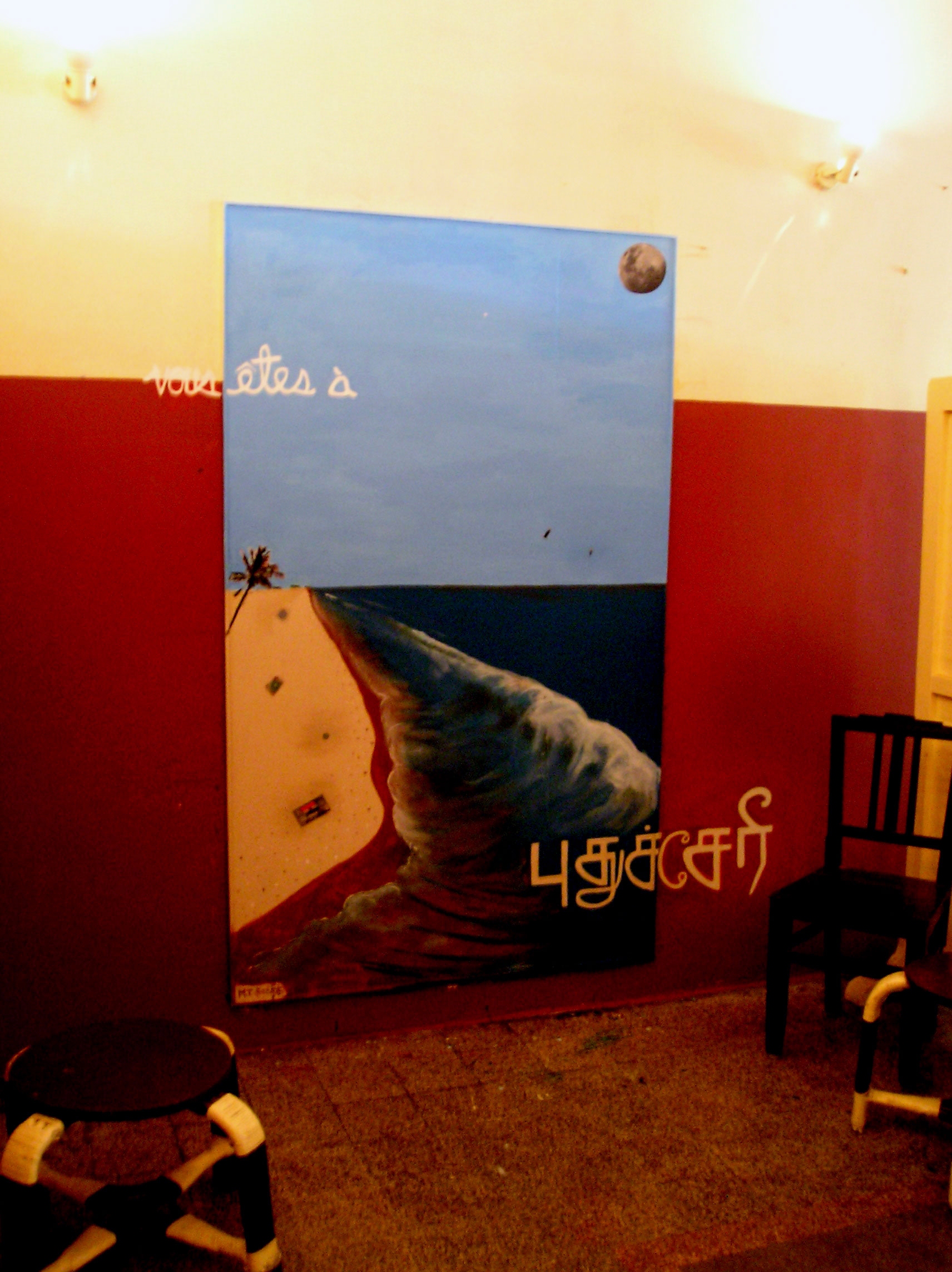
At 40, in my homeland, I painted, collaged and signed, Vous êtes à Pudduchcheri, M.T. Karthik, on the back of the wood liquor cabinet installed in a wall at Qualithe’s Hotel Bar in Pondicherri, Pudduchcheri, Tamil Nadu, India in three weeks in May, 2007.
The cabinet is 84 x 50 inches, 6.5 inches above the floor, and the wall is perhaps fifteen feet wide. It was immediately interesting to toy with the line dividing the lighter upper from the darker lower layers. The text was decided upon after weeks of discourse with locals and regulars – and translates in English to: “You are in Puduchcheri”
Collaged Elements
The image of the moon is an actual photograph taken in 1971 by telescope from observatory of the University of Montana.
The oil well is from the back of the old,purple Indian 1-rupee note.
I photographed the haliastur indus (brahminy kite), pair, myself, from my studio for nine months, and then printed and selected the images of the two raptors collaged into frame – male and female.
The palm tree was photographed at a local beach as well.
The postage stamp is the a magazine reproduction of the first stamp issued by independent India.
the detritus on the beach includes a matchbook and wrapper from a package of firecrackers, and the tiger from the tiger balm packaging.
art students from the Chitra Kala Parishath art college in Bangalore, were invited to add depth to the waves and a second heavenly body, a single white point representing Venus, over the sea.
mtk, 2007
29 Friday Sep 2006
Posted in artists books, collage, installations, MTKinstalls, NYC
Tags
2006, A.P. Ferrara, arts, book, booklyn, books, center, Found, in, Karthik, m.t. karthik, Mark Wagner, Marshall Weber, mtk, new york, translation
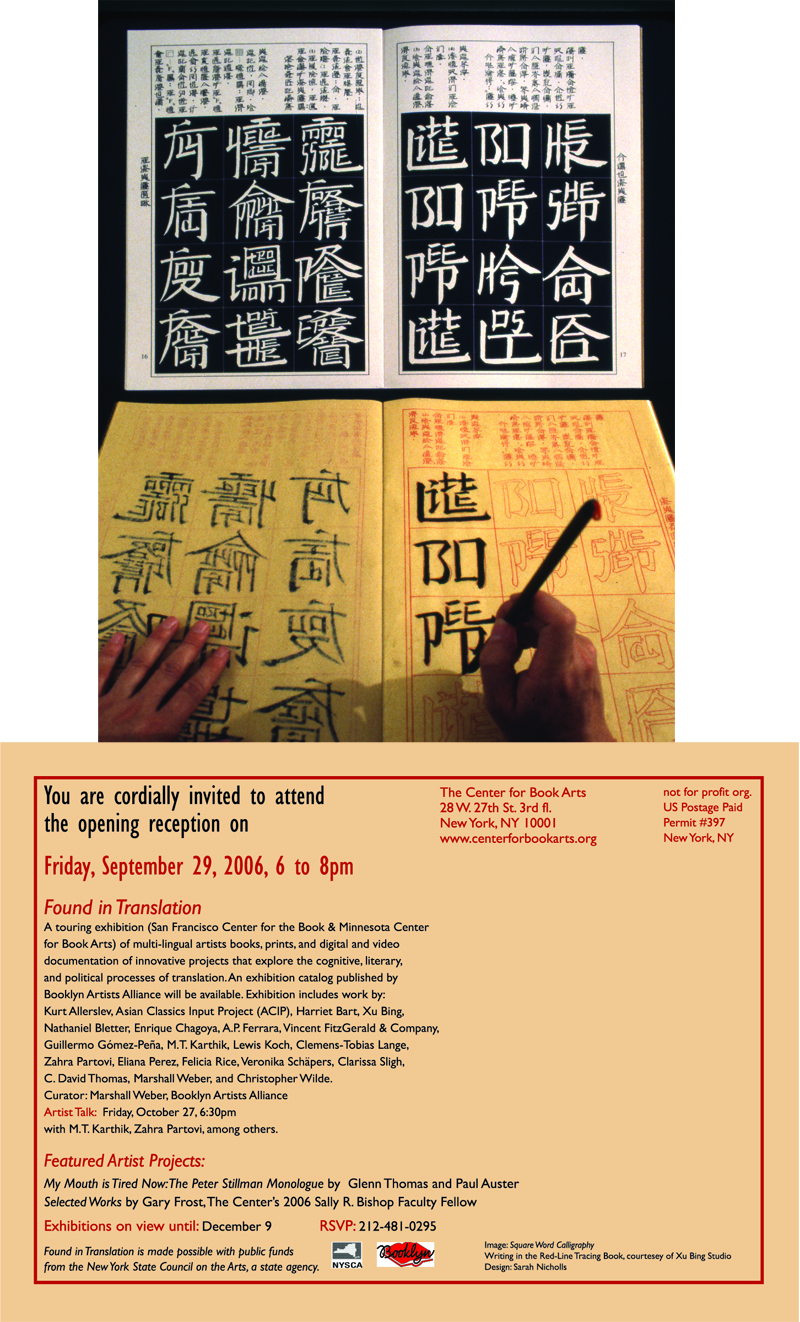
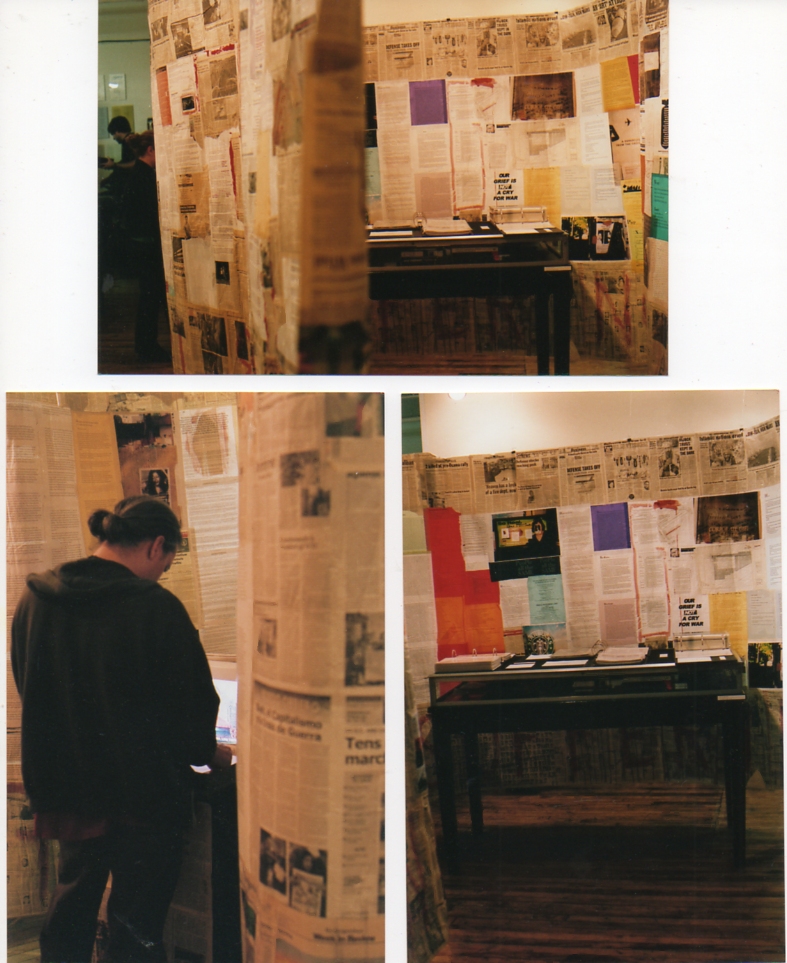
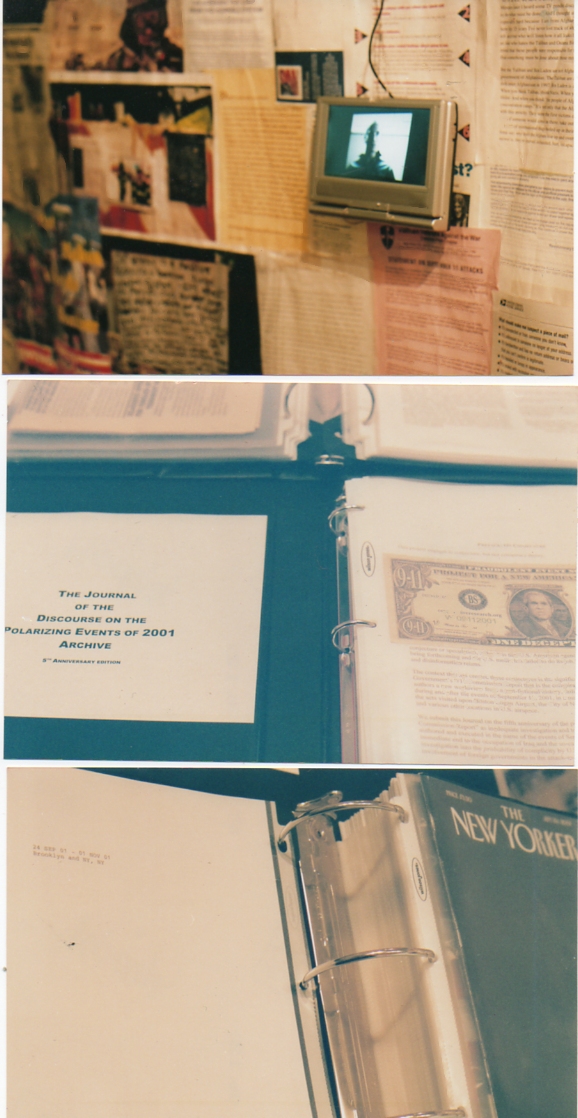
The Discourse on the Polarizing Events of 2001 [MTK with A.P. Ferrara]
installed:
18 Sunday Sep 2005
Posted in Asia, installations, Japan, MTKinstalls, sculpture
11 Wednesday Sep 2002
Posted in artists books, installations, Los Angeles, MTKinstalls, performance, protest, talks
Tags
1984, 2002, 331/3, 9/11, allerslev, aloud, alvarado, anniversary, booklyn, books, brouwer, cyrus, Daullatzai, ferrara, frank, gallery, George, Karthik, L.A., LA, los angeles, m.t., mccabe, mtk, novel, orwell, Parkel, read, Rigo 02, soheil, sosa, spagnuolo, sunset, tactic, us, us equals them, us=them, usa, Wagner, Weber, Wilde, williams


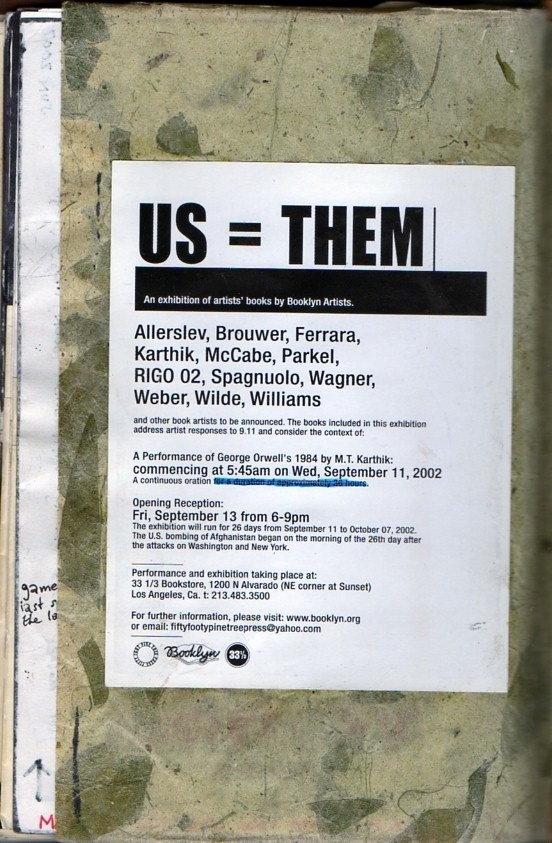
Us = Them, curated and produced by M.T. Karthik, Fifty Foot Pine Tree Press, Wine Hobo Trio, Booklyn Artists Alliance and 33 1/3 Books and Gallery, Sunset at Alvarado, F. Sosa, Proprietor, September 11, 2002
1984, performance by MTK
On September 11th, 2002, beginning at 5:35am Pacific Time, corresponding to the moment the first plane struck the World Trade Center in New York City exactly one year before, MTK read George Orwell’s novel 1984, aloud in its entirety at 331/3 Books and Gallery, at the corner of Sunset and Alvarado, in Los Angeles, ending at sunset:


as a performance element on the opening day of the Booklyn Artists exhibition
11 Wednesday Sep 2002
Posted in artists books, installations, Los Angeles, MTKinstalls, performance, protest, talks
Tags
1984, 2002, 331/3, 9/11, allerslev, aloud, alvarado, anniversary, booklyn, books, brouwer, cyrus, Daullatzai, ferrara, frank, gallery, George, Karthik, L.A., LA, los angeles, m.t., mccabe, mtk, novel, orwell, Parkel, read, Rigo 02, soheil, sosa, spagnuolo, sunset, tactic, us, us equals them, us=them, usa, Wagner, Weber, Wilde, williams
Us = Them, curated and produced by M.T. Karthik, Fifty Foot Pine Tree Press, Wine Hobo Trio, Booklyn Artists Alliance and 33 1/3 Books and Gallery, Sunset at Alvarado, F. Sosa, Proprietor, September 11, 2002
1984, performance by MTK
On September 11th, 2002, beginning at 5:35am Pacific Time, corresponding to the moment the first plane struck the World Trade Center in New York City exactly one year before, MTK read George Orwell’s novel 1984, aloud in its entirety at 331/3 Books and Gallery, at the corner of Sunset and Alvarado, in Los Angeles, ending at sunset:
as a performance element on the opening day of the Booklyn Artists exhibition
01 Wednesday Mar 2000
Posted in Austin, collage, elections, installations, journalism, MTKinstalls, protest
Tags
1st, 2000, austin, Barnes, Bush, canvas, chamber.movements, currency, death, gallery, George, John, Karthik, killed, logo, m.t., March, McCain, mtk, No, Odell, painting, party, Penalty, primaries, Primary, real, Republican, rights, State, super, texas, the, thyagarajan, timeline, Tuesday, voter, voting, W., wrongly
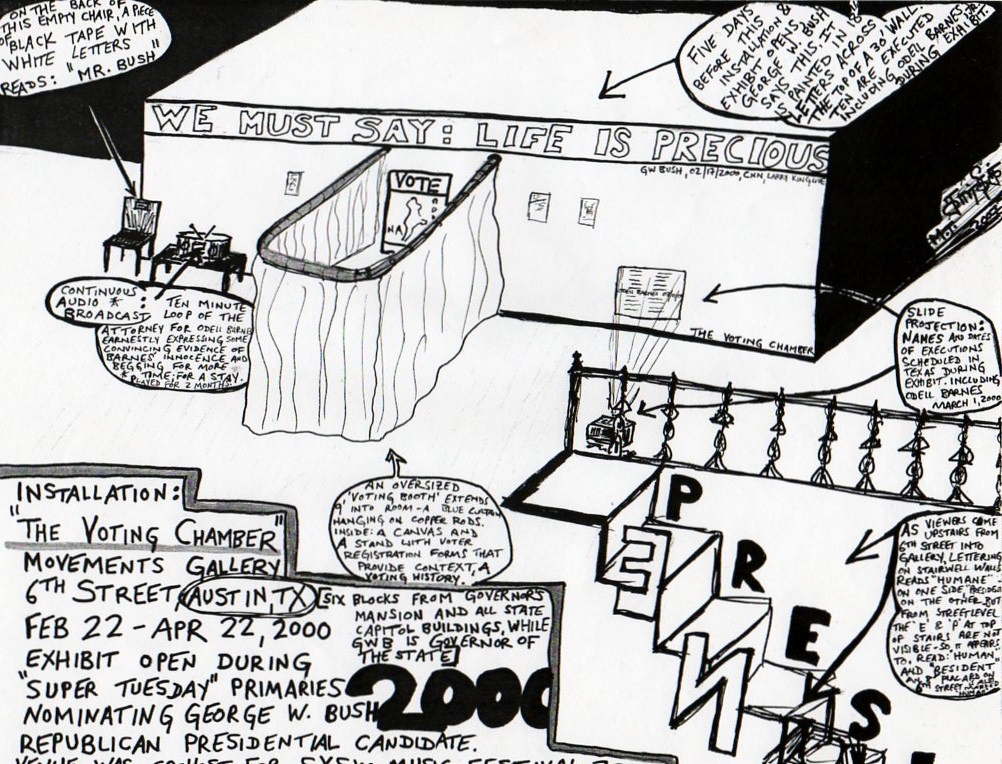
The Voting Chamber was an art installation at Movements Gallery in Austin, TX, six blocks from Governor George Bush’s Mansion, and the exhibition was open during the Super Tuesday Presidential Primaries of Election 2000 and the South x Southwest (SXSW) Arts and Music Festival of that year.
COMPONENTS:
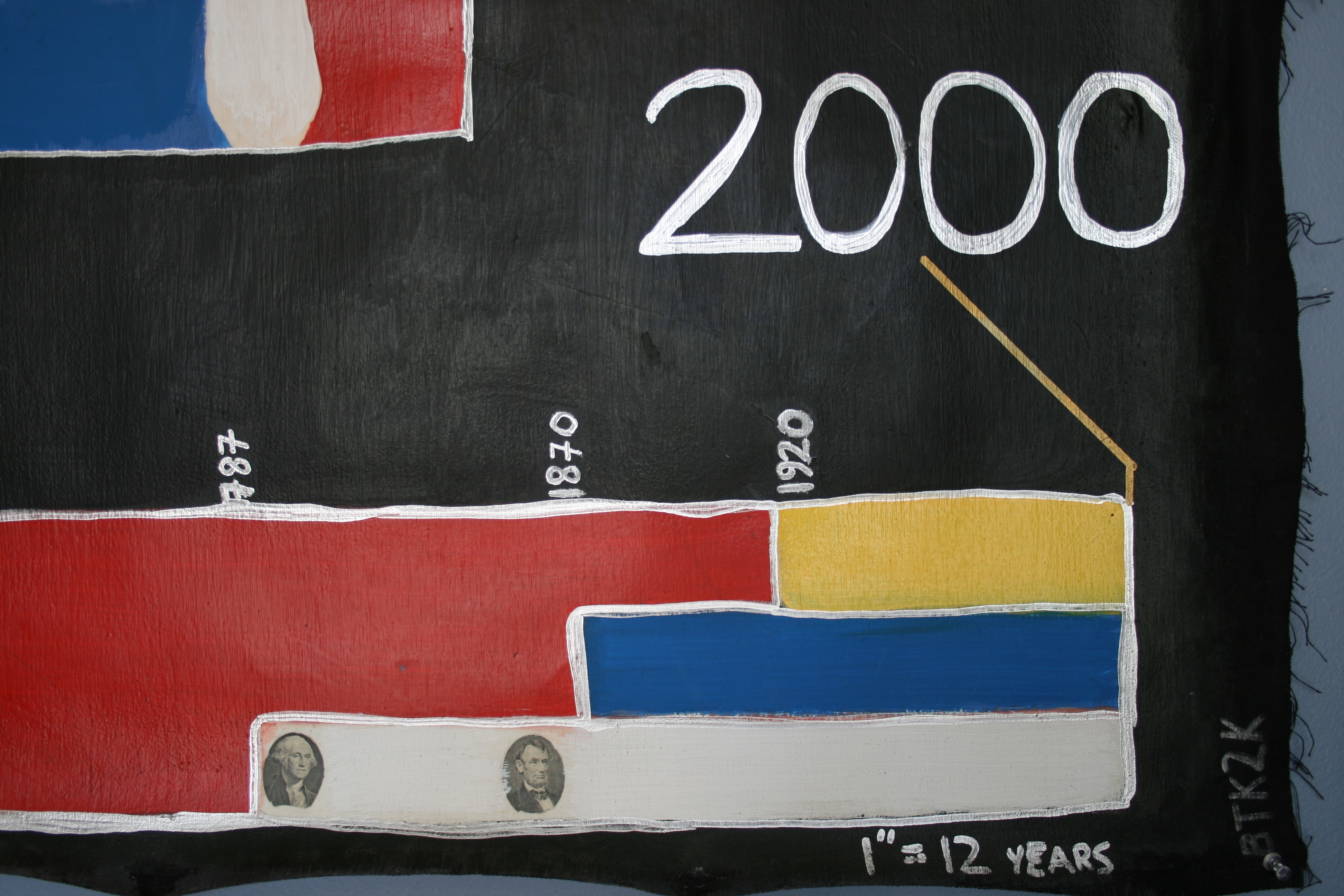
No Real Choice [2000], 5’ x 3’8”, acrylic, currency on canvas
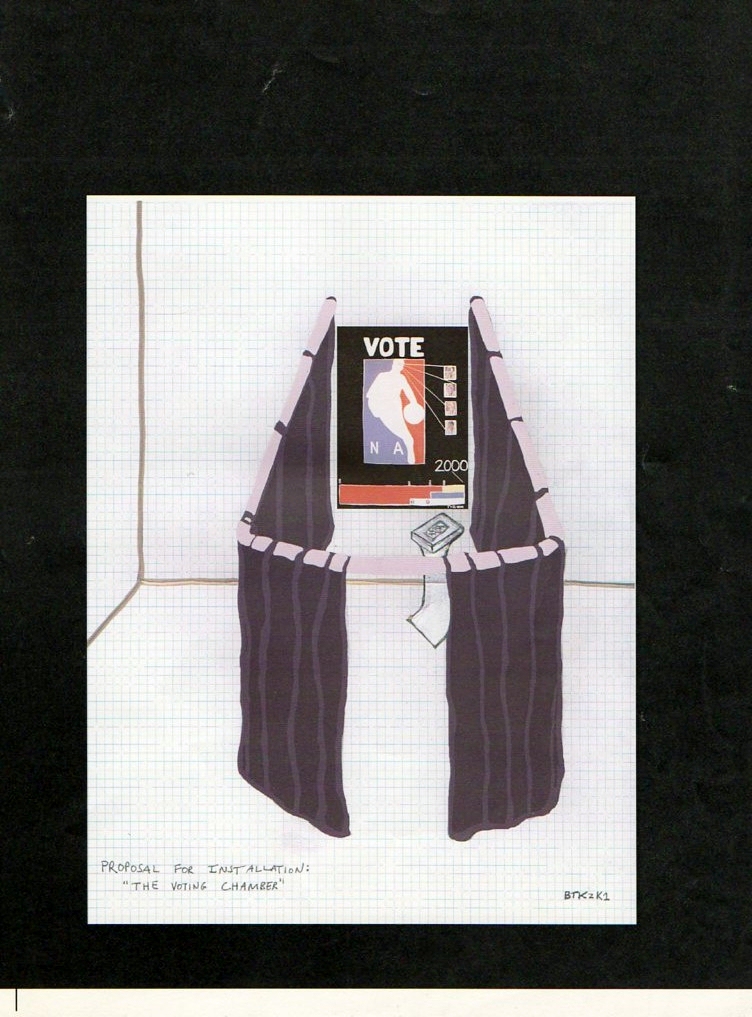
The Voting Chamber (metal rods, fabric curtain, tabletop, audio component
Civic Dimension (acrylic on stairwell walls; chalk on pavement
Internet Component, including data from State Website and Death Penalty Opponents
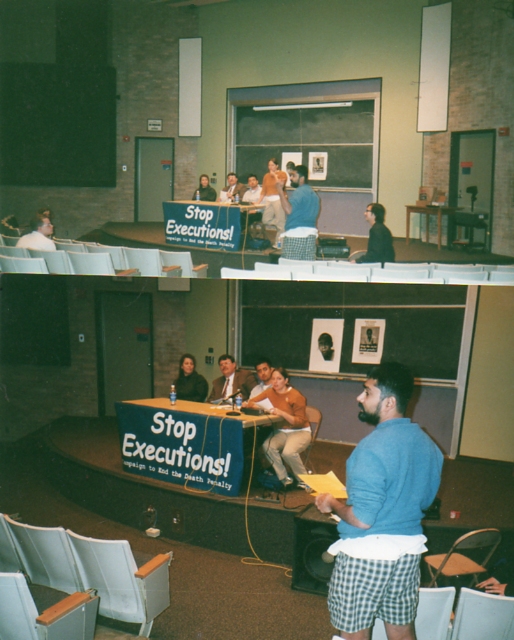
I flew into Austin from Brooklyn and immediately went to a local chapter meeting of an anti-death penalty group and introduced myself publicly as an artist planning to do an installation at Movements Gallery on 6th Street:
installed for about ten days:
PRESS RELEASE
FOR IMMEDIATE RELEASE
OPENING RECEPTION: FEBRUARY 22, 2000
GEORGE WASHINGTON’S BIRTHDAY
6-8 P.M.
MOVEMENTS GALLERY
SIXTH STREET
AUSTIN, TEXAS, USA
“THE VOTING CHAMBER”
FEBRUARY 22-APRIL 22, 2000
A MULTIMEDIA INSTALLATION IN PROXIMITY TO THE TEXAS GOVERNOR’S MANSION
THE STATE OF TEXAS EXECUTES MORE PEOPLE THAN ANY OTHER JURISDICTION IN THE WESTERN WORLD. THE CURRENT GOVERNOR OF TEXAS (1994-2000) HAS OVERSEEN THE EXECUTION OF MORE PEOPLE THAN ALL FIVE PREVIOUS GOVERNORS TAKEN TOGETHER. HE IS CURRENTLY RUNNING FOR PRESIDENT OF THE UNITED STATES AND EXECUTING AT LEAST 18 MORE PEOPLE.
ACCORDING TO A TEXAS A&M UNIVERSITY STUDY, MOST TEXANS FAVOR ALTERNATIVES TO THE DEATH PENALTY OR ARE UNDECIDED:
47.5% FAVOR LIFE SENTENCE
39.5% FAVOR EXECUTIONS
13% ARE UNSURE
Source: http://www.lonestar.texas.net/~acohen/tcadp
“THE VOTING CHAMBER” HAS BEEN DESIGNED BY NEW YORK-BASED FORMER TEXAS RESIDENT AND UNIVERSITY OF TEXAS GRADUATE M.T. KARTHIK, TO PROVIDE A PLACE TO REHEARSE FOR THE UPCOMING PRESIDENTIAL PRIMARIES AND ELECTIONS.
The State posts the Execution Schedule online
Texas State Execution Schedule: 23 Feb – 27 APR 2000
23 FEB 2000 Cornelius Goss, born May 25, 1961
24 FEB 2000 Betty Beets, born March 12, 1937
01 MAR 2000 Odell Barnes,Jr., born, March 22, 1968
15 MAR 2000 Timothy Gribble born, August 27, 1963
22 MAR 2000 Dennis Bagwell born, December 27, 1963
12 APR 2000 Orien Joiner, born, October 27, 1949
18 APR 2000 Victor Saldano, born October 22, 1971
26 APR 2000 Robert Carter, born March 7, 1966
27 APR 2000 Robert Neville, born October 5, 1974
27 APR 2000 Ricky McGinn, born March 11, 1957
Source: http://www.tdcj.state.tx.us/statistics/stats-home.htm
OUTLINE FOR INSTALLATION
COMPONENTS:
“No Real Choice 2000” (5’ x 3’8”, acrylic, water, American currency on canvas)


“The Voting Chamber” (metal rods, fabric curtain, tabletop, agit-propaganda, and audio component)
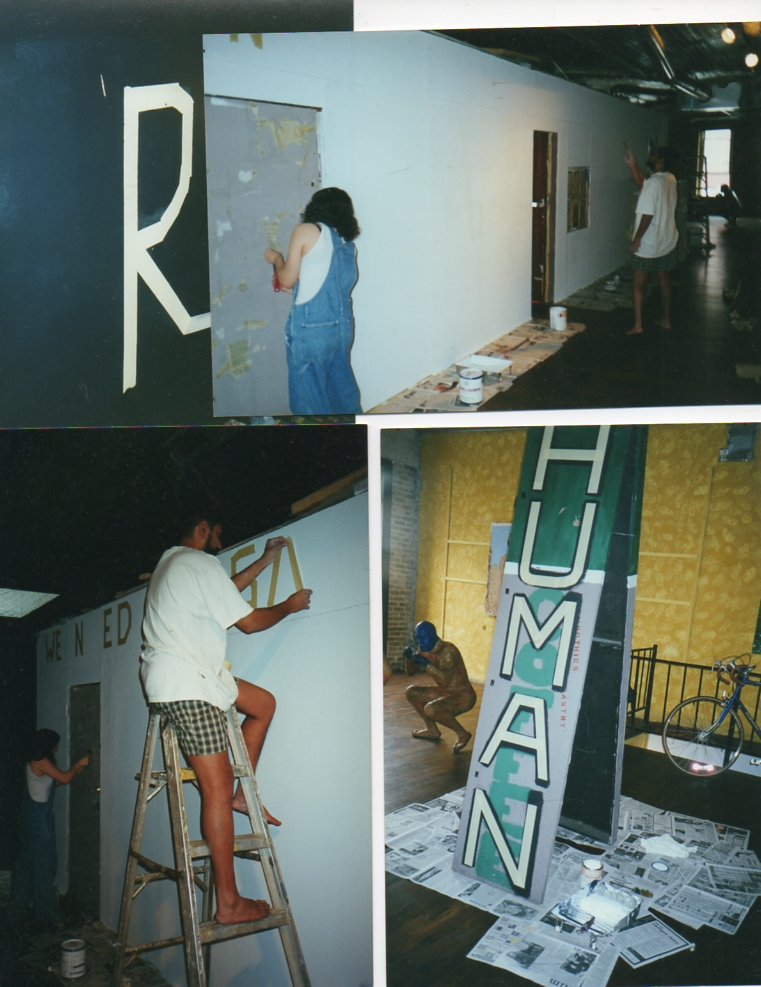
“Civic Dimension” (acrylic on stairwell walls and sheetrock; chalk on pavement)
4. “Internet Component”
THE INSTALLATION:
“No Real Choice 2000” was installed on the wall opposite top of the stairs to Gallery space. The 33’ wall was painted sympathetic to currently existing artwork in gallery while extending the theme of the canvas, including:
“The Voting Chamber,” a simulated voting booth: U-shaped curtain rod with a red curtain. This curtain is to be drawn around individual viewers to simulate a voting booth and allow a private viewing space of the canvas and of specific propaganda material. A looped, repeating audio component of the attorney of one of those on Death Row was played next to an empty chair.

The stairwell from the street to the Gallery floor and the sidewalks from the Governor’s Mansion to the gallery door (as practicable) were marked to point to the booth and to present statistics (see Statistics that follow) regarding the death penalty in Texas.
The Internet component contained elements: from http://www.georgewbush.com, the “Calendar of Events” describing the Governor’s current itinerary, and from http://www.tdcj.state.tx.us, the “Calendar of Executions.” and etc
CONCLUSION, 2008
It’s taken me more than eight years to write anything of what happened in Austin in the Spring of 2000. I installed The Voting Chamber and came to find out that Odell Barnes, Jr., was scheduled to die though likely innocent of the murder of which he was convicted.
The installation included an empty chair with the name “Mr. Bush” taped to the back, sitting beside a cassette player that continuously played a ten-minute audio loop of Mr. Barnes’ lawyer explaining that he needed more time to present the strong evidence of a frame-up he had discovered in Odell’s case.
The installation inspired a march of hundreds in Austin who chanted as they marched around the Governor’s Mansion against the Death Penalty:
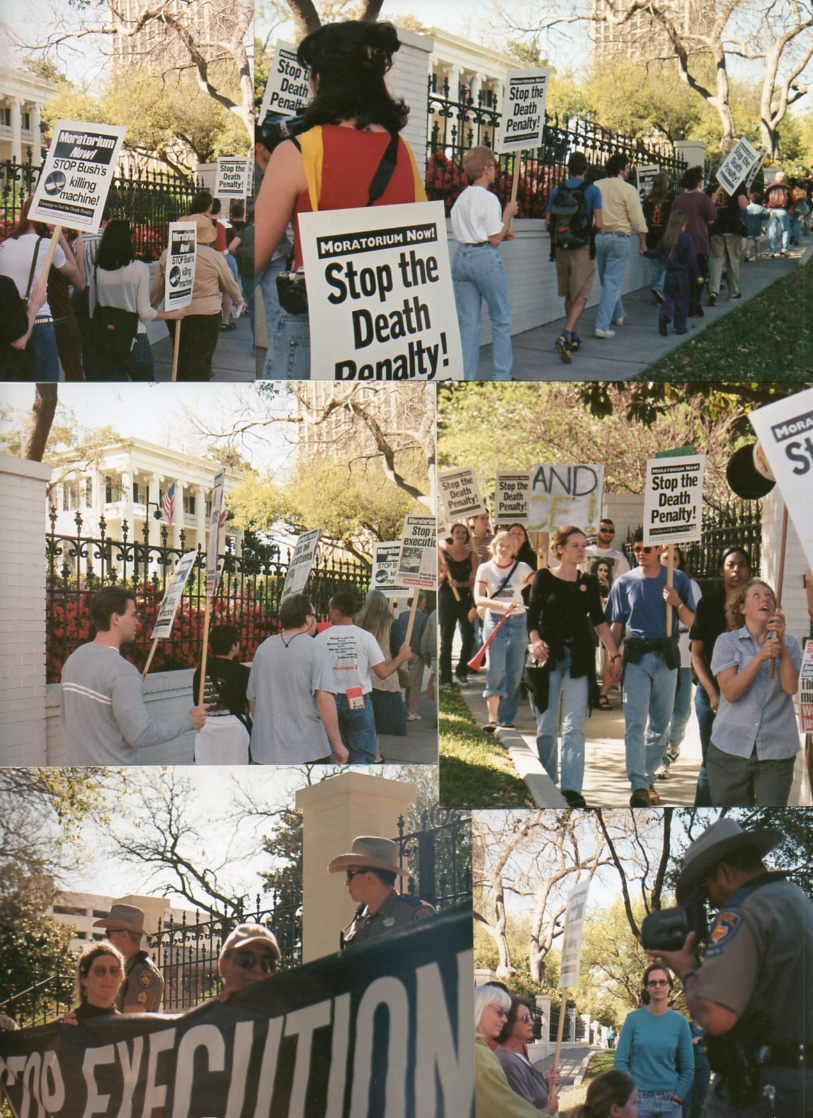
This all occurred during the Super Tuesday Presidential Primaries as George W. Bush, the Governor of Texas, fought Arizona Senator John McCain for the Republican nomination, Spring 2000. The installation was up during the SXSW music festival, and the venue was a site for the Austin festival so thousands saw it.
George W. Bush and The State of Texas murdered the innocent 22-year-old, Odell Barnes, Jr. on March 1st of the year 2000. The message was clear as Bush ran for President on an active record of becoming the single individual Governing the execution of more people in U.S. history.
Odell Barnes, Jr.s’ last meal request was for “justice, equality and world peace,”
and his last words were:
“I thank you for proving my innocence although it has not been acknowledged in the courts. May you continue in the struggle and may you change all that’s been done here today and in the past.”
Nine months later, George W. Bush was appointed President of the United States by the Supreme Court – contravening democracy at the most basic level – thanks to massive problems with vote counting and issues of voter suppression in the State of Florida, where Bush’s own brother, Jeb, was Governor.
The canvas “No Real Choice 2000,” finished two months before the election, was startlingly prophetic.
14 Saturday Jun 1997
Posted in installations, Los Angeles

 MTK The Writist