Tags
BART, brutality, cop, Forward, Grant, guilty, gun, human, Johannes, Karthik, m.t., manslaughter, Mehserle, Moving, mtk, Oscar, police, rights, shooting, Taser, verdict, violation, zine

18 Sunday Nov 2012
Posted in artists books, North Oakland
16 Friday Nov 2012
Posted in fiction, Oakland, performance, S.F., short film
Tags
a.p., airport, Balas, Brooks, consuelo, dangle, dj, earle, ferrara, fiction, film, Francisco, inside, James, jason, JFR, Karthik, Kevin, KoKo's, lloyd, Lounge, m.t., manning, mtk, narrative, OAK, oakland, outsider, Raj, Robert, rosencrantz, San, sf, short, tanner, the, Walt
“The Academy and the Government are always the last, the very last, to state the truth.”
– Dr. Robert Brooks
a narrative short fiction about two academics, one an invited guest of the other, who meet in the SF Bay and discuss aspects of the state of the world, briefly, but disagree.
produced and directed by M.T. Karthik
camera/lighting by Jason F. Rosencrantz
edited by MTK (with JFR); written by MTK (with JFR and Lloyd Dangle)
starring: James Earle as Dr. Robert Brooks, MTK as Dr. Raj Balas
and acting as “the students”: Lloyd Dangle, Walt Tanner and A.P. Ferrara
with Chris as the bartender and DJ Consuelo on decks
music: Alma de cera by Abel Duêrê, undercooled by Ryuichi Sakamoto, zigga zigga bite off 3 Feet High and Rising by de la soul, piano track by Vijay Iyer
thanks to OAK airport and KoKo’s Lounge
16 Friday Nov 2012
Tags
1997, acrylic, Barry, bottle, building, labor, man, McGee, mural, paint, redstone, temple, Twist, ukelele
I watched Barry McGee paint this in the Redstone Building back in the Spring of 1997. Stopped by to snap it a few weeks ago – for some reason was reminded of it today.
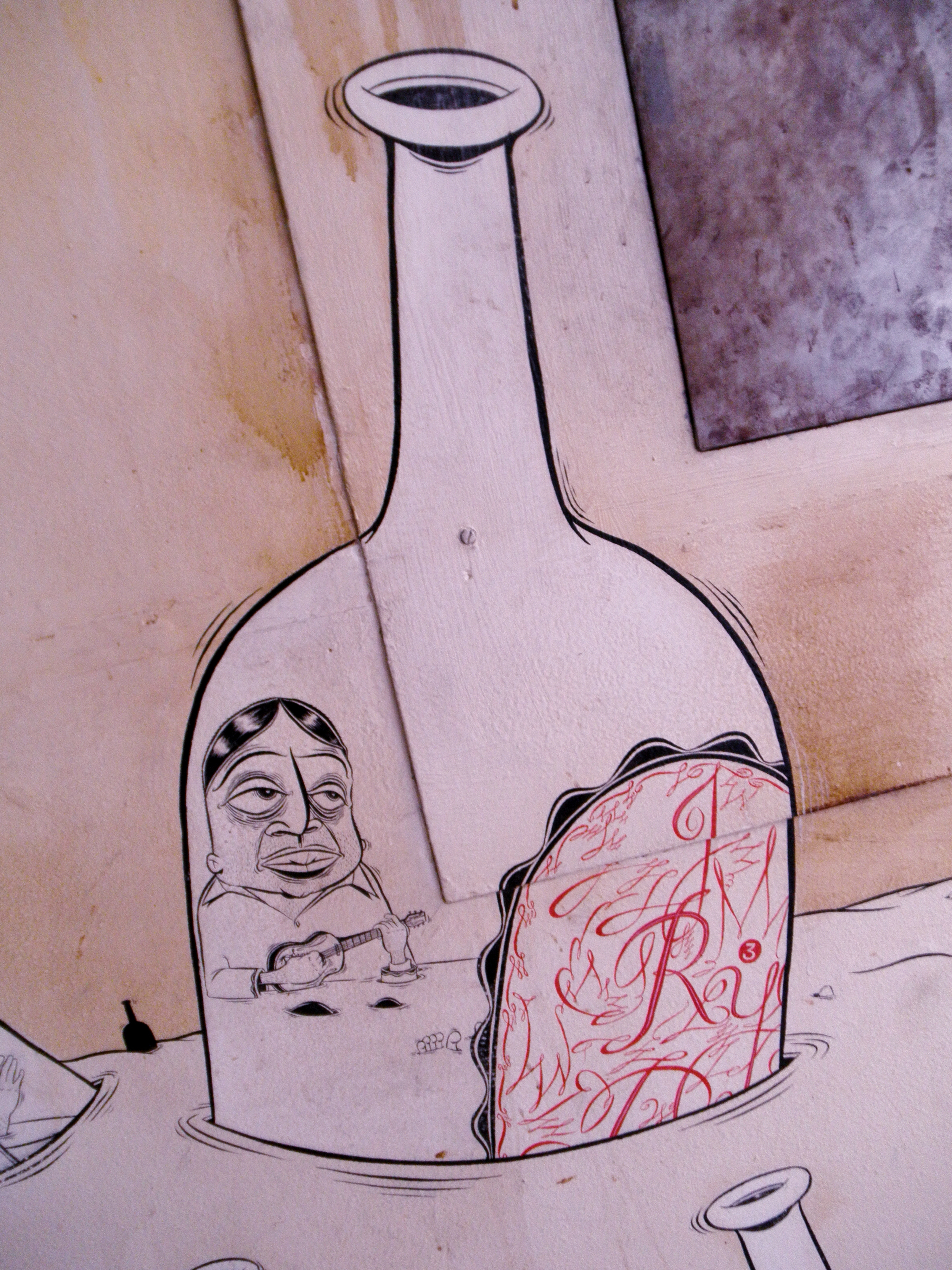
According to Wikipedia “The market value of his work rose considerably after 2001 as a result of his being included in the Venice Biennale and other major exhibitions. As a result, much of his San Francisco street art has been scavenged or stolen.”
16 Friday Nov 2012
Posted in installations, journalism, mural, S.F., sculpture
Tags
1934, 1985, 5th, An, art, bloody, Bordoise, contract, Injury, July, Longshoremen, memorial, Mission, one, public, san francisco, sculpture, sf, Sperry, Steuart, Steuert, street, strike, Thursday, to, union
Public art to commemorate “Bloody Thursday” at the corner of Mission and Steuart Streets in San Francisco. The four-day general strike in SF in the summer of 1934 led to unionization of all the West Coast ports of the United States:
 37° 47.602′ N, 122° 23.593′ W
Painted in 1985 by an artist’s collective, this mural-sculpture was placed by the International Longshore and Warehouse Union near the previous memorial, this plaque:

When the Hotel Vitale was built in 2004, the sculpture and plaque were moved a short distance and re-erected, with the plaque now mounted on the wall of the hotel. (Source)

The strike began on May 9, 1934 as longshoremen in every West Coast port walked out; sailors joined them several days later. The employers recruited strikebreakers, housing them on moored ships or in walled compounds and bringing them to and from work under police protection.
Strikers attacked the stockade housing strikebreakers in San Pedro on May 15; two strikers were shot and killed by the employers’ private guards. Similar battles broke out in San Francisco and Oakland, California, Portland, Oregon and Seattle, Washington. Strikers also succeeded in slowing down or stopping the movement of goods by rail out of the ports.

The Roosevelt administration tried again to broker a deal to end the strike, but the membership twice rejected the agreements their leadership brought to them. The employers then decided to make a show of force to reopen the port in San Francisco.

On Tuesday, July 3, fights broke out along the Embarcadero in San Francisco between police and strikers while a handful of trucks driven by young businessmen made it through the picket line.
After a quiet Fourth of July the employers’ organization, the Industrial Association, tried to open the port even further on Thursday, July 5.
As spectators watched from Rincon Hill, the police shot tear gas canisters into the crowd, then followed with a charge by mounted police. Picketers threw the canisters and rocks back at the police, who charged again, sending the picketers into retreat after a third assault. Each side then refortified and took stock.
The events took a violent turn that afternoon, as hostilities resumed outside of the ILA the kitchen. Eyewitness accounts differ on the exact events that transpired next. Some witnesses saw a group of strikers first surround a police car and attempt to tip it over, prompting the police to fire shotguns in the air, and then revolvers at the crowd.
One of the policemen then fired a shotgun into the crowd, striking three men in intersection of Steuart and Mission streets. One of the men, Howard Sperry, a striking longshoreman, later died of his wounds. Another man, Charles Olsen, was also shot but later recovered from his wounds. A third man, Nick Bordoise—an out of work cook who had been volunteering at the ILA strike kitchen—was shot but managed to make his way around the corner onto Spear Street, where he was found several hours later. Like Sperry, he died at the hospital.
Strikers immediately cordoned off the area where the two picketers had been shot, laying flowers and wreaths around it. Police arrived to remove the flowers and drive off the picketers minutes later. Once the police left, the strikers returned, replaced the flowers and stood guard over the spot. Though Sperry and Bordoise had been shot several blocks apart, this spot became synonymous with the memory of the two slain men and “Bloody Thursday.”
As strikers carried wounded picketers into the ILA union hall police fired on the hall and lobbed tear gas canisters at nearby hotels. At this point someone reportedly called the union hall to ask “Are you willing to arbitrate now?” (Source for text: wikipedia)

“An Injury to One is an Injury to All”
13 Tuesday Nov 2012
Tags
2012, autumn, avatar, contemporary, Karthik, late november, m.t., m.t. karthik, mtk, now
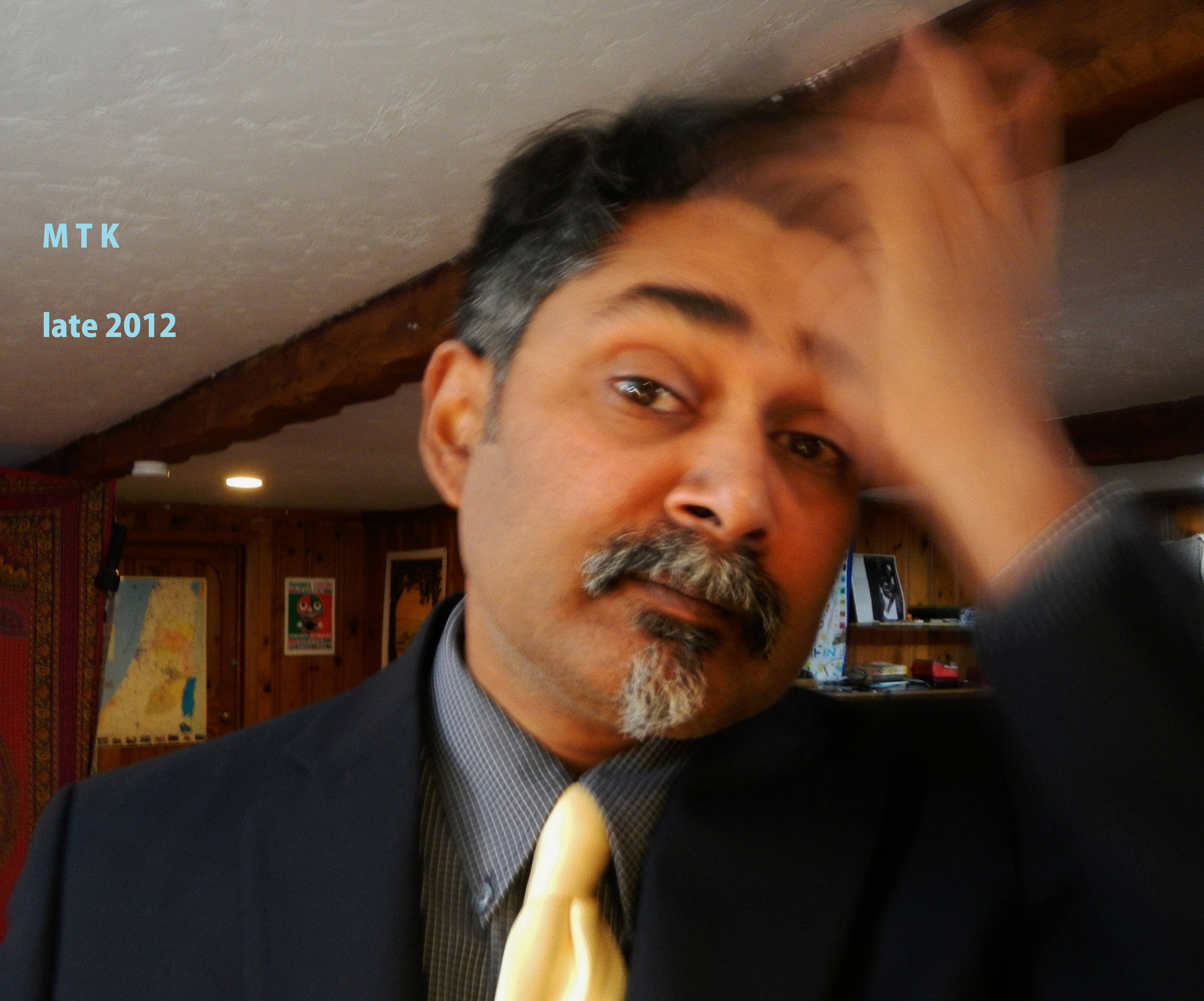
Posted by mtk | Filed under North Oakland, self portrait
09 Friday Nov 2012
Posted in elections, public letters
Tags
5, accords, actions, agenda, antiwar, Bush, cabinet, change, Clinton, close, Democratic, Dennis, department, drone, electorate, end, five, free, geneva, GOP, Guantanamo, Hilary, hope, Iran, iraq, Kucinich, leonard, moves, Nate, obama, pakistan, party, peace, peltier, president, progressive, rebirth, safe, Silver, things, treaty, war, warsaw
The re-election of President Obama has opened a door for believers who bought into the President’s original message of hope and change when he was elected in 2008.
Much of Obama’s support then was a direct result of his vote against the Iraq War. Democrats chose Senator Obama over Senator Clinton for many reasons, but the “Iraq War vote” was an important one that has been wrongly dismissed – it’s what tens of millions with many other differences were agreeing about.
The Iraq War vote was a symbolic difference between Ms. Clinton and Mr. Obama, but with so few opportunities to truly understand our candidates in modern Presidential elections, it became a significant statistic for a large demographic of US voters who have been dismissed and reduced by mainstream media and the two major parties for more than a decade.
There is an anti-war electorate, and it’s a sleeping dragon in the USA.
Millions came out on February 15, 2003, in opposition to George W. Bush’s plans for War on Iraq. The vast majority of these then came out for Barack Obama five years later seeking an anti-war candidate, only to be disappointed by the last four years of capitulation, centrism and even rightist approaches to foreign policy by the President.
Now Obama has been re-elected by the exact same margin that George W. Bush was and the political obligation for standing up for the anti-war and progressive electorate that helped put and keep him in the White House must be addressed.
Here are five simple yet powerful moves Obama can and should make right now – while the political capital exists and the GOP is reeling from the smack in the face of the demographic and ideological realities of the election.
1. Close Guantanamo Bay Prison
2. End the Drone attacks on sovereign Pakistan and elsewhere.
3. Take a strong, open and progressive stand to approach Iran intellectually through discourse rather than via military options.
4. Create a Department of Peace, as first proposed by Representative Dennis Kucinich: taking just .001% of the defense/military budget to finance the creation of a cabinet position dedicated to peaceful outcomes to conflict. Appoint Mr. Kucinich as the first Secretary of Peace in U.S. history.
5. Pardon and Release Leonard Peltier – do it now ,Mr. Obama, at the beginning, rather than at the end of your term. Take a stand for prison reform.
I will not defend these points here, because I’m proposing them for purpose of discussion. Please read, consider, forward and comment.
Rather, I defend the idea that there would be very little or even NO political cost for taking these steps and that the benefits politically, socially and culturally would be immense.
Nate Silver has already pointed out that Obama’s margin of victory in the popular vote is almost exactly the same as Bush’s over Kerry in 2004.
Bush claimed a mandate and bombed and obliterated Fallujah! The triumphalism of the Republicans in 2004 was intensely exaggerated by FOX and the rest of television media. This is what contributed to the views of an ever-shrinking minority being allowed to dominate policy.
This is Obama’s chance to start the clean-break from the policies of Bush/Cheney and in particular the Foreign Policy, which was dominated by aggression, war and violations of every major peace treaty signed in the 21st Century: The Anti-Ballistic Missile Treaty, The Geneva Peace Accords, The Warsaw Accords – Putin said, on the morning that Shock and Awe began in Baghdad, “It violates the U.N. Charter.”
Millions of Americans were the ones in Shock and Awe.
If Obama stood up for peace in the 21st century, tens of millions of voters and hundreds of representatives at all levels of government would support him.
It would also set a tone for his ability to work on topics which Republicans have rigidly blocked for the past four years. Obama could put the GOP way back on its heels.
Progressives would rise to support Obama for being a strong leader and taking steps to better our national character. The Democrats would gain millions who have felt left out by the centrism of the party over the last 20 years.
That is the point of this post: to create a huge groundswell of public support for these five ideas as a part of a National consciousness. That we, the 21st Century Americans, the Digital Generation, the new Americans, stand for a more peaceful relationship with the world.
It’d be easy to sell. The race between Obama and Romney was only close because so many millions did not participate. Many who did vote for Obama before left in disgust, but weren’t willing to cast a vote for the Republicans who do not share their values. These are the one Obama would attract. People longing to believe again.
Less than half the electorate votes. Obama could make huge strides among the disenchanted with principled action.
These are important stands for getting back our dignity as a nation. I firmly believe they would have very little political cost.
One way to measure if I am right is by memes, so if you’ve read this far and agree, I am asking all producers and hype-masters and friends and like-minded thinkers to tweet these five points and use the hashtags #Peace and #FreeLeonardPeltierNOW respectively as means of creating a measure of support.
Please do blog and produce work that promotes these ideals of peace that we all share.
Let’s push this country back on track by letting President Obama know he can be far more progressive without concern for political liability.
Start talking peace and Free Leonard Peltier Immediately – it’s the right thing to do.
08 Thursday Nov 2012
Posted in fauna, North Oakland
 Pretty sure this is the 19-spot, Harmonia axyridris of the Family Coccinellidae – known as the Asian Ladybug.
Looks like it got smeared with dust or flew through light spider webbing. Maybe it just escaped a spider. I let it back out into the garden.
07 Wednesday Nov 2012
Posted in elections, NYC, S.F., San Antonio
Tags
2000, 2004, barack, Bush, chief, City, count, editor, F.Kennedy, fiasco, Filippacchi, Florida, frank, George, Hachette, in, Jeb, John, Jr., Karl, kerry, Lalli, lawsuits, loss, magazine, manhattan, new, obama, publisher, Rove, swiftboat, vote, W., york
In Spring of 2000, Hachette-Filippacchi Inc.,hired me and a half-dozen others to work as independently-contracted temporary employees to fact-check and conduct research for George magazine – whose founder and editor-in-chief John F. Kennedy, Jr. had been killed in a light-plane crash amidst fog off the coast of Maine eight months before. They hired us to ensure George remained, in the wake of its founder’s passing, an audible element of the political discourse during the Election of 2000.
As a national magazine which was read by hundreds of thousands of voters in many states, particular focus was paid to the Presidential Election between Vice President Al Gore and George W. Bush, the Governor of Texas.
My fellow employees, under Editor-in-Chief Frank Lalli, were a tight-knit, smart and savvy crew. In fact, on Election Night we were all together at Mr. Lalli’s beautiful upper westside home where he had invited us to watch returns. But Karl Rove’s fat face and a flipped state later, many of us were back in the office. A few of us stayed up most of the night and by 10 a.m. I was not alone in the office when I was posting coverage of Florida on the George website.
Though admittedly not a heavy-hitter politically, George was engaged throughout the Election and maintained an immense audience of voting readers before the magazine was finally brought to an end in 2001.
In 2003 I covered Schwarzenegger’s Election via Recall of Davis for KPFK, 90.7fm Los Angeles.
I also covered The Election of 2004 and the Presidential Race between George W. Bush and Senator John Kerry for KPFK, 90.7fm Los Angeles and in part for Pacifica Radio. Some of that 2004 Election work exists here and online at Pacifica’s Audioport and in the Pacifica Radio Archives, but I have complete digital copies of everything I did for KPFK and Pacifica between 2003 and 2005 backed up on disc in my studio as well.
In 2008, I was no longer working as a journalist, but did cover Obama’s Victory in Iowa for KPFK and produced short Audio-Visual Installments for Freshjive on the Internet. These were amateurish and clunky by design, yet carried considerable data for anyone who had tuned in to the broadcasts I produced for KPFK four years before.
When Obama won in ’08, I was with Lloyd Dangle, who hosted a book signing and Election Night Returns Party at the Riptide in San Francisco. Earlier in the day I had a drink with former SF Mayor Willie Brown at the St. Regis – we discussed Alaska Governor Sarah Palin’s plans for appointing a Senator to replace disgraced Alaska Senator Ted Stevens, forced to retire.
This year,I did not work as a journalist, but rather observed as a reader of the news media and a regular Californian voter.
The biggest single predictor of the elections of the 21st century has to be the margin of difference in registrations for the two major parties.
There are many reasons for this: smaller parties are being absorbed and disappearing for lack of membership, corporate interests fund the two major parties only, people threatened by one of the two parties runs to join the other and the demography of the nation is changing.
I have successfully predicted the last two elections as a result of my study of data and my knowledge of voting history. I think I see the electorate again.
Some points on 21st Century US Elections:
It’s impossible to write a blog about all my experiences voting and covering General Elections in the United States in the 21st Century, but suffice it to say there is a distinct difference between these and the Elections of the latter half of the 20th century, in which I also participated.
Much of this is discussed in my talk Political Media, Messages and More.
2003 was the Recall Election and spawned recalls in the 21st Century because of Schwarzenegger’s success.
2008 was the Youtube Election.
2012 was the Twitter Election.
Money and media are the driving forces of what has become a political system mired in divided, brutal contests between two immense parties which are financed primarily by corporations and special interest groups that define their policies.
We are in desperate need of a new Federal Elections Reform Act, as was passed in the early 1970’s.
Our democracy is sick. Hardly half the people with the right to vote even participate.
We need to update, nationalize and standardize voting procedures and make them more secure. We need to increase registration and participation. We need to subsidize the creation and maintenance of additional parties in the face of the massive expenditures made by Republicans and Democrats that have taken elections out of the reach of the common person. We need proportional representation in Congress.
Have been saying all of this for years, and it has only gotten worse. Here’s hoping the young people who are increasing in numbers at the polls pull off what my generation couldn’t.
06 Tuesday Nov 2012
Posted in elections
I’ve voted in every election since 1984, eight times for President. I’ve voted for a handful of Senators, and dozens of Representatives, Propositions and candidates for lower office, including judges.
I have voted in Texas, New York and California and once voted absentee from Taiwan – when I cast possibly the most distant vote for Ann Richards for Governor of Texas.
I covered elections for George magazine, Pacifica Radio and local newspapers and went through the Florida Fiasco of 2000 with writers and colleagues in New York City who were also covering the Election.
I covered Bush vs. Kerry for Pacifica and particularly KPFK radio 90.7fm, Los Angeles.
Today, it doesn’t feel good to vote. Not pointless, because the propositions here in California are a strong form of democracy and represent the political will of our State, but basically I feel as though most of the votes I ever cast did nothing to progress our nation on what I consider to be the best path.
At 45, I grow more isolated in my worldview.
Well, off to vote.
My vote:
Yes on Propositions 30, 34, 37, B1
No on Propositions 32, 38, A1
FOR:
Incumbents President Barack Obama and Representative Barbara Lee
Ranked Choices, Oakland City Council District One: 1.Raya, 2.Kalb 3.MacCleay
Rebecca Kaplan, Oakland City Council
Mary London, School Board
Barbara Parker, City Attorney
Rebecca Saltzman, BART Board
05 Monday Nov 2012
Posted in appeals
04 Sunday Nov 2012
Tags
ask, baseball, bolt, Darren, draft, Ford, Francisco, freelance, get, giants, home, jackie, karthikm.t., Mays, mlb, mtk, pinch, play, robinson, rookie, runner, San, series, speed, squeeze, steal, usain, Willie, world
After listening to fans of Usain Bolt talk during the Olympics about using him as a wide receiver or kickoff returner in American Football, it suddenly struck me there may be a better fit for his crossover to commercial US sports:
The San Francisco Giants should hire Usain Bolt to pinch run.
He would never bat, never face a pitch. Why not teach the Jamaican how to position himself, when to run, how to turn the corner and how to slide?
He’d be used in the exact way Bochy used Darren Ford in ’10 and ’11: to manufacture runs in key innings, in late innings and extra-inning games on the road, for our generally run-depleted squad.
Darren Ford’s exploits, which gained him the nickname The Bullet, are well remembered by fans of the current two-time World Series Champion SF Giants.
Most famous was his game-winning run in the 2-1 victory over the Colorado Rockies in September during our run to the division lead in 2010.
“With the game tied 1-1 in the eighth, Mike Fontenot drew a walk. Fontenot runs fine. Ford, however, might be one of the fastest guys on any big league roster. Ford ran for Fontenot and broke for second, and was standing on the bag, when Colorado‘s Ubaldo Jimenez fielded Tim Lincecum‘s quite average sacrifice bunt.” reads this b/r piece on the play.
But in Spring of the following year, Bochy used Ford to do it again.
Usain Bolt might be a very effective pinch runner if he can be taught the mechanics of base-running. Willie Mays stole home 5 times, Jackie Robinson 9 times … how many do you think Bolt could take if he could be put in position? Think squeeze play.
Bay Area Sports Guy hosted a piece on how important base-running is to the SF Giants just before this season started, but anybody who understands baseball and what just happened with the Giants versus the Tigers will get it, so please comment and spread the discourse.
Here’s the man, doin it:
Usain Bolt as solely a pinch runner – a specialist position. Inexpensive, but possibly very effective in tight games, when you have great pitching and defense. Discuss amongst yourselves.
Go Giants!
03 Saturday Nov 2012
01 Thursday Nov 2012
01 Thursday Nov 2012
01 Thursday Nov 2012
31 Wednesday Oct 2012
28 Sunday Oct 2012
27 Saturday Oct 2012
Tags
3, AT&T, away, california, championship, detroit, Francisco, game, giants, knbr, Lurie, Marty, Mays, park, Plaza, radio, ring, Romo, San, San Francisco Giants, series, shutout, tigers, vogelsong, Willie, world

ALL YEAR LONG I HAVE HUGE … OK NOT HUGE, BUT ALL KINDS OF LITTLE DIFFERENCES WITH THIS GUY AND YOU KNOW WHAT HE DOES?
He invites me on the radio to talk about it.
and last Saturday he let me wear the Championship Ring from 2010. wow.
Marty Lurie, radio host who joined KNBR after working to cover the A’s, was immediately a lucky element for the Giants.
He and I stood exactly where we are in this photo two years before, and bore witness during the run that finally made the Giants World Series Champs in San Francisco. Marty walked in and we won.
For decades a criminal defense attorney, and at that a New Yorker, Mr. Lurie became a historian of the game of baseball independent of what he does now for KNBR. If anyone must, Marty Lurie must be associated with the cross-country relationship the Giants have that reaches back to the Polo Grounds in New York City.
But yes, by providence and timing, Marty has grown into a unique role and is now an important member of the San Francisco Giants team.
Mr. Lurie’s an excellent radio interviewer whose competence is a direct result of his research. I loved watching him at the Public House in Game 5 against the Braves back in 2010. He sat down to score the game and pulled out a yellow legal pad to do it. He’s a baseball nerd trained as a lawyer!
Mr. Lurie’s interviews of baseball players and managers, which he’s been conducting season-long for three years now, are a growing chronicle of the game.
Lurie brought a whole lot of AL contacts over to KNBR the first year and was eager to share with us NLers the value of certain stories. But slowly over the past three years, he has joined the stewards of the Giants Championships of 2010 and 2012 who collectively are arbiters of our first time championship memories.
So Mr. Lurie is an attorney who can discuss both leagues’ histories very effectively.
Marty, I’m saying it here for the first time: You’re the only lawyer I really like.
Thanks for letting me wear the Championship Ring and for doing such a bang-up job behind the mic.
sincerely,
“M.T.” and, in 2010, “Carter from Oakland”
(just pissed off a whole lot of lawyers I know who think me and them’re “real close”).
27 Saturday Oct 2012
Tags
2012, AT&T, Carter, from, from oakland, game, house, Karthik, Lurie, m.t., Marty, mt, mtk, oakland, park, public, series, three, world
ALL YEAR LONG I HAVE HUGE … OK NOT HUGE, BUT ALL KINDS OF LITTLE DIFFERENCES WITH THIS GUY AND YOU KNOW WHAT HE DOES?
He invites me on the radio to talk about it.
and last Saturday he let me wear the Championship Ring from 2010. wow.
Marty Lurie, radio host who joined KNBR early in 2010 after working to cover the A’s, was immediately a lucky element for the Giants. He and I stood exactly where we are in this photo two years before, and bore witness during the run that finally made the Giants World Series Champs in San Francisco. Marty walked in … and we won.
For decades a criminal defense attorney, and at that a New Yorker, Mr. Lurie became a historian of the game of baseball independent of what he does now for KNBR. If anyone must, Marty Lurie must be associated with the cross-country relationship the Giants have that reaches back to the Polo Grounds in New York City.
But by providence and timing, Marty has grown into a unique role with the World Series Champs and is now an important member of the San Francisco Giants team.
Mr. Lurie’s an excellent radio interviewer whose competence is a direct result of his research. I loved watching him at the Public House in Game 5 against the Braves back in 2010. He sat down to score the game and pulled out a yellow legal pad to do it. He’s a baseball nerd trained as a lawyer!
Mr. Lurie’s interviews of baseball players and managers on Talkin’ Baseball, which he’s been conducting season-long for three years now, are a growing chronicle of the game.
So Marty Lurie is an attorney who can discuss both leagues’ histories very effectively. He brought a whole lot of AL contacts over to KNBR the first year and was eager to share with us NLers the value of certain stories from the lesser league.
But slowly over the past three years, he has joined the stewards of the Giants Championships of 2010 and 2012 who, taken collectively, have become arbiters of SF’s first time championship memories. (full disclosure, GBC hopes to be included in that group of stewards)
Marty, I’m saying it here for the first time: You’re the only lawyer I really like.
Thanks for letting me wear the Championship Ring and for doing such a bang-up job behind the mic.
sincerely,
“M.T.”
and, in 2010: “Carter from Oakland”
(just pissed off a whole lot of lawyers I know who think me and them’re “real close”).
26 Friday Oct 2012
23 Tuesday Oct 2012
Posted in bats
Tags
2012, bat, broken, champions, change, crazy, direction, double, Francisco, giants, hunter, kiss, Kozma, League, mlb, motion, National, nlcs, overcranking, pence, Pete, rbi, San, slow, slow-mo, triple
I refer to this broken bat double which swerved into play, as:
The Triple Kiss

Hunter Pence knocked in three runs when this ball left his broken bat after a crazy series of three collisions – the last of which caused it to swerve in the air and bound past the outstretched glove of the shortstop.
Second-year Cardinals shortstop Pete Kozma, who was very well positioned, reacted at lightning speed, but was caught going the wrong way for a fraction of a second because the third point of contact changed the ball’s direction.
The Triple Kiss happened in less than half a second. Watching it live, as broadcast, I had no idea the ball hit the bat three times; not until seeing it like this.
I knew it was a broken bat hit, my shoulders slumped at the same instant that Kozma jumped – and then suddenly, the ball took a crazy turn in the air and, as if it had eyes, bounced past the outstretched glove of the recovering Kozma, on the second base side.
The Triple Kiss was significantly faster than the human eye … even the highly trained eyes of a ballplayer, or an umpire. It affords us the opportunity to discuss the intense amount of new information that slow motion yields.
Slow motion was originally known – in analog filmmaking – as overcranking, a method by which the speed of the film was altered through handcranking the frames. Overcranking was first used in sports as long ago as the 1930’s in the coverage of boxing matches.
It took a long time for overcranking to become slow motion and in that time we got pretty used to it. We allowed slow motion to creep into our observation of games with such ease and normality that the NFL, NBA and MLB now all stop play to incorporate it as a tool in evaluating what has actually taken place.
20 Saturday Oct 2012
17 Wednesday Oct 2012
Posted in Berkeley
Tags
ballet, Berkeley, Cal, castle, dance, kirov, lake, mariinsky, Performances, swan, university, Zellerbach
09 Tuesday Oct 2012
08 Monday Oct 2012
Posted in Coastal Cali, S.F.
04 Thursday Oct 2012
Tags
Last night I watched the first of the so-called debates between Romney and Obama.
I haven’t watched one of these live as it happens in years, not since I had to do it as an on-air analyst and host at 90.7fm Los Angeles for the debate shows between Kerry and Bush. (The interview with Daniel Ellsberg on this site was from just before one of those).
In 2008, I watched Ifill with McCain and Obama mostly in clips online using Youtube and the rest of the net. 2008 was the Youtube election. I still prefer my news of such events nowadays dissected so I don’t have to sit and watch. It’s considerably faster and easier to read everybody’s b.s. and then look at the relevant clips.
I wouldn’t have watched last night’s debate at all, except my son’s teacher asked his class to try to watch … so we sat down to do that.
First, let’s be clear about what they are: shows.
They are not debates, and haven’t been for at least a dozen years. I’ve grown tired of using the phrase “so-called debates” and actually have now even seen that term become so ubiquitous as to be without meaning.
So I called Rosencrantz to discuss how we ought to rightly rename what it is we are watching, which are Talk Shows, or Game Shows. The moderator is not a moderator. He’s an MC, or perhaps a game show host. I prefer the former, but Rosencrantz wanted to run with Game Show Host.
Last night’s game show was badly emceed.
The prizes in this Game Show are not just votes, but whole states.
Because of the electoral college, all either of these men have to do in these three shows is gain the respect of a simple majority of the voters in Florida, Ohio, Colorado and Pennsylvania to take the state.
The power of the media is the reproduction of these stage shows into opinion. Colorado may have swung hard toward Romney after last night, but it wasn’t because of the man himself.
It’s the din that builds the bump.
All the political commentators in US media, left and right determine the “winner” and “loser” of the show through a constant blather of opinion thinly disguised as critique, mostly funded by or produced by companies that fund one candidate or another or the President.
This product – this inane chatter of umpteen egoistic voices – is what will establish the opinion of the 51% or more in each of those swing states, far more than the actual Game Show itself or the man who challenges the President for his seat.
Incumbency is nearly outweighed by Obama’s blackness – and they dare call it post-racial.
The difference between the two men was clear. The challenger was bold and entitled in his approach, which neither the President nor the Game Show Host expected.
Then the lies began. But having established his presence and with time short, they were hard to expose. The President became intellectually defensive for the truth and resorted to wonkiness like we haven’t seen in debates for some time.
Michael Moore and Glenn Greenwald today both tweeted their concerns about Obama’s performance.
Because the din does the work and not the men in performance themselves, the replaying of dynamics between the men, the moderator and the camera will be doing the real debating. Hence the President’s approach.
Romney seized the space that was given to him to establish himself, the Game Show Host failed to moderate, and the President didn’t squash the challenger like a bug because he knew what that would look like to the world.
Facts, as usual, had very little to do with the challenger’s approach, and the lists of things he was going to do unsupported by facts will make for excellent Youtube clips.
Absent was Obama’s command of rhetoric. He looked like a man looking out from a personal space within himself. From making his most important point be his anniversary wish to his wife, to his wonky intellectual defensiveness, the President was not on top of this one.
03 Wednesday Oct 2012
Posted in social media
Tags
Karthik, letter, m.t., messer-kruse, mtk, new, open, philip, roth, Timothy, truth, undue, weight, wikipedia, Yorker
There were two stories this year that caught my eye for exposing the problems involved in building a collective encyclopedia the way Wikipedia is being built.
Philip Roth’s Open Letter to Wikipedia via the New Yorker
and
Timothy Messer-Kruse discussing the ‘Undue Weight’ of Truth on Wikipedia in The Chronicle of Higher Education
I don’t have analysis right now, but wanted to post this comparison because I think looking at these two stories says something about Wikipedia that isn’t being discussed.
more to come …
01 Monday Oct 2012
30 Sunday Sep 2012
29 Saturday Sep 2012



 MTK The Writist