Political Media, Messages and More

Tags

, , , , , , , , , , , , , , , , , , , , , , , ,

( a one hour talk delivered to students at Academy of Art University in San Francisco on Friday, March 1, 2012. There was no recording. Slides appear in order here as images, and some video clips and links have been added to this online version).

Good afternoon, I am M.T. Karthik.

I’ve organized this talk chronologically, and into three general parts, starting first with historical examples of mass media used for sociopolitical language here in the US;

then second, a line between politics of the past and the present drawn by the invention and use specifically of television,

and finally politics in the Digital Age, which will conclude with some discussion of the contemporary situation.

The largest arc of this one hour talk is pluralism of mass media in sociopolitical language – from pamphlet to newspaper to radio to television to cable television to the Internet to FB to Twitter over the last 236 years.

In the last part of the talk, I will also be sharing some of my original work in the field. I have sought to report upon, document and portray through art, certain social interests primarily because I believe they are being written out of history, even covered-up by specific interests and aggregation of public opinion around a monocultural viewpoint of our nation’s political past.

No discussion of American political thought and expression can start without the Declaration of Independence –

– Thomas Jefferson’s seminal document authored against the monarchy in England, which set off an age of revolution on behalf of individuals against kings and nation-states and which, with the U.S. Constitution, created the bond between the Colonies that holds as Federalism to this day.

It’s important to read the Declaration in context, because of the scale of Jefferson and the Colonists’ reach.

Jefferson was influenced by the French and other European thinkers as a result of visits there, but really, the scale of the task was unprecedented.

How would you author a letter to all the Kings and governments of the nations of the world declaring the creation of your own new country – led collectively – with an unprecedented democratic governmental structure set up by its citizens?

It’s said Rick Perry, the Governor of Texas, has supported secession of Texas from the United States. How would his Declaration of Independence read, today? Would he address it to the UN, the Senate, the President, the Supreme Court? – none of these institutions existed for Jefferson to appeal to. He was writing to the nebulous notion of a “world at large” and against the British Monarchy.

What kind of persuasive language do you use in such a context?

“When, in the course of human events, it becomes necessary for one people to dissolve the political bands which have connected them with another, and to assume among the powers of the earth, the separate and equal station to which the laws of nature and of nature’s God entitle them, a decent respect to the opinions of mankind requires that they should declare the causes which impel them to the separation.

“We hold these truths to be self-evident, that all men are created equal, that they are endowed by their Creator with certain unalienable rights, that among these are life, liberty and the pursuit of happiness. That to secure these rights, governments are instituted among men, deriving their just powers from the consent of the governed. That whenever any form of government becomes destructive to these ends, it is the right of the people to alter or to abolish it, and to institute new government, laying its foundation on such principles and organizing its powers in such form, as to them shall seem most likely to effect their safety and happiness.”

Epic.

But how was it possible for Thomas Jefferson to set down these words in Virginia with such confidence? The seeds had been sown by a Philadelphian, who wrote and published a pamphlet which became an instant best-seller here and abroad.

Perhaps more than any text in that nascent revolutionary period, Thomas Paine’s pamphlet Common Sense – addressed audaciously to “the inhabitants of America” – pushed the colonists toward independence. The text demanded an immediate declaration of separation from England a full year before Jefferson sat down to write the great document.

With Common Sense, began the era of the political pamphlet in the United States. The authors of the Revolution used the format in the next ten years to author the Constitution. Should we refer to the American political pamphlet as a medium?

Here’s a recent one:

The pamphlet brings with it the creation of whole industries: printing, typography, stenography, journalism, cartooning, and begins an arc of American sociopolitical language that pluralizes to include newspapers, magazines, radio, television, cable television and the Internet. This talk will discuss the use of all of these and pluralism of media over the 236 years since the Declaration of Independence was written.

The serial publication of essays, viewpoints and even texts of speeches became the normative method for political discourse in the Colonies. It birthed the centralization of thought in new-born cities and the media channel of our oldest newspapers and journals.

The Federalist Papers were a series of 85 articles or essays promoting the ratification of the United States Constitution.

77 of these were published serially in The Independent Journal and The New York Packet between October 1787 and August 1788. A compilation of the 77 and eight others were published as The Federalist or The New Constitution in two volumes in 1788.

From these documents and the discussions they generated, came our Constitution and Bill of Rights.

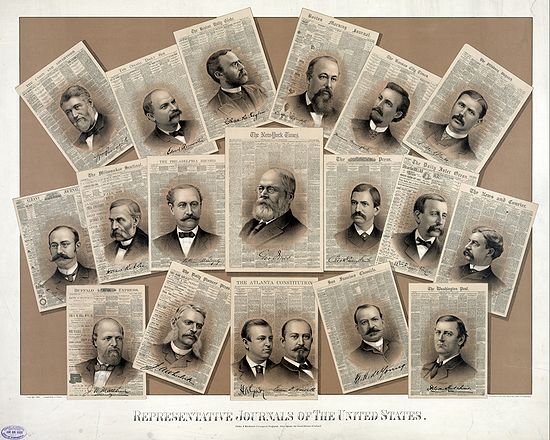
Promptly thereafter, colonial cities birthed the “two-paper town” as the newly minted First Amendment of the Constitution produced contrasting viewpoints in the form of newspapers, which bore, defined and built the “constitution” of American political thought for a hundred and fifty years.

The era made editors-in-chief men of great power a hundred years before Citizen Kane.

Note that the Presidents of the US at this time are mostly forgettable bureaucrats. Perhaps Van Buren stands out for his hemispheric reach, but great debate and intellectual work wasn’t being done by the President. It was occurring in the Senate, at the level of the Supreme Court and with the birth of newspapers’ Editors-in-Chief like Horace Greeley of The New York Tribune – who began to take on greater responsibility for political language.

During the period of 1840 – 1860, after years of the establishment of new civic centers and States, with their own newspapers and journals, the country faced its greatest sociopolitical unrest. Correspondingly, an era of great newspaper publishers and editors representing contrasting viewpoints emerged.

By 1858 it was common for newspaper-editors to employ stenographers to attend speeches and to publish the speeches in totem in their papers.

The Lincoln-Douglas Debates of 1858 were a series of seven debates between Abraham Lincoln, the Republican candidate for Senate in Illinois and the incumbent Senator Stephen Douglas, the Democratic Party candidate. At the time, US Senators were elected by state legislatures so Lincoln and Douglas were vying for control of the  Illinois legislature.

The main issue in all seven debates was slavery and ultimately all of the issues Lincoln would face in the aftermath of his victory in the 1860 Presidential Election – issues which would lead directly to the first dissolution of the Union and the first Civil War in U.S. History.

The debates were held in seven towns in Illinois, but became so popular that they were distributed by papers elsewhere.

But editors of papers who favored Douglas would take the stenographers’ notes and clean them up, fixing errors of notation, context or even meaning only in Douglas’ words. Papers that favored Lincoln did the opposite. The power of the Editor was never before so clearly visible.

Lincoln lost the Senate election, but afterward he had all the texts cleaned, edited properly and republished as a single book – which was read broadly and helped lead him to the nomination in 1860.

The issue of Slavery was defined for vernacular discourse by the Lincoln-Douglas Debates, a remarkable moment in U.S. political history and language. Here’s the Centennial Stamp:

And so for long years newspaper men and politicians were bound in this country and great cultural and social consciousness that helped define the nation emerged through muckraking and whistle-blowing, but also, inevitably, corruption and yellow journalism.

The Spanish-American War may have been born from such yellow journalism, as the sinking of The Maine, falsely attributed to the enemy by papers in the U.S., pushed Americans into the war. More examples exist, and indeed as media pluralizes over the next century, this cozy corruption between politicians and journalists has been exacerbated by new media.

By the turn of the 20th century, the dominant medium was the printed word, and then, the word as heard through radio and both were being used to push political interests and social agendas.

Radio, a warm medium, a tribal medium with which President Franklin D. Roosevelt created the fireside chat, became the primary media tool for information about the wars abroad that defined the century. As Wiki points out, Every US President since Roosevelt has delivered a regular radio address.

News and official information delivered by voice over the airwaves is warm and available, lucid by the intimation of the sound of the voice, not subject to interpretation of the reader. Baseball and music and DJ’s sounded great on the radio and political communicators quickly recognized it.

Writing for broadcast began.

An excellent metaphoric example of the power of radio before television as a vernacular medium in politics can be found in the Coen Brothers musical film, O Brother, Where Art Thou?.

Set in the southern state of Mississippi before television, one narrative thread of the film follows a Governor’s race. Throughout the film, various people in the State are shown at home following the Election by listening to the radio.

Three escaped state prisoners form a musical group on the run, and anonymously record a single at a rural radio station which becomes immensely popular throughout the state through the power of radio. The men appear in disguise to perform their song live at an event which both candidates are attending.

The Governor’s opponent is insensitive to the popularity of the group, focusing instead on denigrating the men for both their fugitive status and their race. In a moment that predates television’s power in this regard, the challenger is revealed to be a racist statewide over the air. The challenger, unlike the incumbent, has no grasp of the power of the radio.

In the climactic scene, the incumbent Governor of Mississippi, seeing the immense popularity of the three escaped state prisoners, pardons the musical phenomenon the ex-convicts have become. The whole of the dialogue is shown to be carried out on radio throughout the State to the folks listening at home, who even hear the challenger run out of the hall on a rail as the Governor leads the crowd in a rousing chorus of “You Are My Sunshine.”

The entire scene is here:

[with respect to the Coen Brothers]

These scenes are remarkably faithful to the truth. In Louisiana, Jimmie Davis, a popular singer and the attributed author of the song, “You Are My Sunshine, became Governor.

The blogger LaLouisiane is eloquent on this matter:

“I remember my granddaddy saying that if Jimmy Davis would come around and sing “You Are My Sunshine”, (he wrote it you know), that everybody in the state would vote for him and never even ask him about a policy, a road, a bridge, nothing. We just really like that song down here, I guess.”

This talk, Political Media, Messages and More, is a follow-up to a talk I gave as News Director and Elections Coverage Producer for KPFK 90.7fm in LA, seven years ago at C-Level Gallery in L.A.’s Chinatown, which was subtitled, Pluralism of Media in the Age of Surveillance [mtk 2005].

Pluralism of media is evident at the addition of each new mass medium – radio doesn’t arrive at the newspaper’s exclusion or the pamphlet’s exclusion.

The pamphlet and certain newspapers remain significant modes of sociopolitical communication. They are at the heart of some, arguably all, of the United States’ greatest movements. Women’s Suffrage,

Socialism, the Labor movement’s successes in the first half of the 20th century.

So Pluralism of Media means we media-include, not media-exclude.

Where before you read pamphlets, now you read pamphlets and newspapers. Where before you read print, now you read print and listen to the radio – you add TV.

We add each medium and the media morph to fit our desires of them. Talk radio, drive-time radio, live radio, each is its own form.

This is what Marshall McCluhan meant when he said any new medium contains all previous media in it.

This is all changing now, of course, as Pluralism of Media has matured since 2005 to become the fluid, the cloud, the totality of data that we swim in today, post-TiVo, at the dawn of the streaming era of the web.

END PART ONE

Part Two: THE TELEVISION PRESIDENCY 1945 – 2008

The Television Presidency, born when Truman used it to announce the end of World War II , instantly made the Office of the President of the United States different from every presidency before TV – and television dominated until the Internet and the digital age, a period of twelve presidents.

Ike was the first President on the tube, and in his most important moment on TV, his exit speech, President General Eisenhower famously warned against the growing presence of a “Military-Industrial Complex”

… perhaps it would have worked in color.

But forever the line that defines the Television Presidency will be the Kennedy-Nixon Debates of 1960.
If you’ve seen Frost/Nixon you know that Nixon to the end of his days considered television, and the close-up, his undoing.

In the televised debates with Kennedy, Nixon’s problems with perspiration accumulating on his lip and his jitteriness in general on TV, came over as nervous and untrustworthy – on radio or via text this would never have been transmitted to the public-at-large. Nixon was ridiculed mercilessly for it by critics.

Imagine the contrast, Kennedy’s cool, youthful good looks and Nixon’s shiftiness.

Kennedy garnered the potency of the new medium, and, thanks in  part to the work of Speaker of the House Sam Rayburn and Lyndon Baines Johnson in delivering Texas, won the election by a slim margin.

I really like the blogger J. Fred McDonald’s take on this, who states, in his excellent essay on Kennedy’s relationship with TV: “For JFK, television could turn defeat into victory.”

Kennedy addressed the people of the country often and personably, but politically used the tool at critical junctures to save himself: after the Bay of Pigs fiasco and during the Cuban Missile Crisis, Kennedy’s use of television was pitch-perfect.

So, the relationship between live color television and the Presidency began with Kennedy’s handsomeness but then, typically of all things new, was taken promptly after discovery to the other extreme, the visual abuse of his savage assassination.

TV then exposed LBJ and Nixon and Kissinger’s dirty wars and the ugly side of the USA: repression, corruption, racism.

The 1968 Olympics were the first televised live and in-color around the world. They took place at the end of one of the most tumultuous years in history, a year I refer to as The People’s Year. This image of a staged protest against race and class oppression, thanks to live television, was impossible to stop:

I participated in making a monument to this moment on the campus of San Jose State University, when in 2006, I worked intimately with others assisting the artist Rigo 23 in the creation of this:

(At this point in the talk, I describe the Tommie Smith/John Carlos statue project anecdotally and include personal, non-published images of the construction of the statues.)

The impact of the moment as seen on television is described well by this Mormon blogger, who tells of being young and white and American and watching with her father. She describes his reaction both at the time and after watching ceremonies of the courageous act on video 20 years later – his change of heart is set in universal terms.

TV was the king of the failure that was The Vietnam War. It ended the Nixon Presidency. But politicians, as they had in the past, reacted by learning to manipulate the new medium to their advantage. Predictably, it was an actor who synthesized the power of the “small screen” for political propaganda.

Ronald Reagan overcame the tool’s power to reveal – with charisma. TV’s investigative potency withered with the mic in his hands.

TV buoyed Reagan into the White House with a full eight-year script, designed just like a Hollywood movie, with a brilliant new dawn at the front and a cowboy riding into the sunset at the end.

Reagan and TV media convinced most Americans that people in Russia lived in a dreary, black-and-white reality, trudging when they walked, standing in interminable lines as black-booted officers of the Kremlin marched past with truncheons to beat them if they acted out.

Reagan asserted our freedom to shop and drive and declare vast spaces ours to tame. Trained and experienced for fifty years in delivering lines written by others, he powered through TV.

Consumer technology was represented in its farthest reach by television, broadcast into millions of homes then on four channels, perhaps a fifth. It was a medium dominated by the Networks, and owned by private corporations. The unholy alliances between corrupt newspaper men and politicians had become de rigeur for relationships with corrupt television execs.

TV was manipulated on the greatest scale by Reagan. In those days, to be broadcast all over the world on US television was as close to “global communication in real-time” as existed and, on the evening of my sixteenth birthday, the actor-president went on television and gravely told us it was imperative to invest our tax dollars in a Strategic Defense Initiative to protect us from nuclear war. Reagan described this SDI as “Star Wars” technology, in the vernacular of the pop-movie phenomenon.

Every legitimate scientist in the world knew SDI was a ploy of language, a technical and political impossibility to deliver, and indeed, it was later revealed that Reagan’s own speechwriters had advised against his including it in public presentation – he’d made the decision on his own that day to do it. Generals, scientists, politicians and writers protested; others were put on the spot, but somehow the language was never exposed.

A naïve public wowed by Reagan, Star Wars, computers and technology in general – and without the Internet to look up the reaction of scientists and writers – ate it up.

Conservatives have used the phrase to justify defense spending for offensive weapons for decades – even now in Europe. Years later we live with these  TV-generated myths, like the “dirty bomb”. (cf. The Power of Nightmares by Adam Curtis)

It was 1984, and the United States was described by most as being a free society, totally unlike the one in George Orwell’s prophetic novel named for that year.

That image – of totalitarian fascism that produced false-flags and enslaved citizens to a national narrative – was projected by the U.S. President onto the Soviet Union, a country he called “The Evil Empire”. It was a term taken directly from popular movies and, wielded by a movie actor through the ubiquity of the medium of television, it became successful political propaganda.

Reagan used his charisma on the small screen to push corporate, private, and even illegal agendas, until the veneer finally broke in the Iran/Contra hearings. But even then, his “I can’t remembers,” delivered pitch-perfect on national television, got him off the hook.

The Dawn of “Pluralism of Mass Media”

By my senior year of high school in 1985, say 10% of students were writing papers with word processors and printing them dot-matrix to take to our teachers. The movement started with stand-alone word processor devices, which were typewriter-like machines that had single-line or paragraph-wide monitors at the top of the keyboard, allowing writers the ability to read what they were typing without printing it first, for the first time ever.

Looking back it seems both obvious and amazing how quickly we made the transition to using the word processor and eventually software on a pc to write. It was a natural step that changed writing forever. Cursive and the typewriter are all but dead. Content began its high-speed ascent. USA Today and CNN were born.

But though the computer was on the verge of changing writing, publishing, and expressing with text and image forever, the single most dominant force of mass media technology wasn’t yet the computer. It was still television, which had expanded through digital technology that created cables delivering far more visual information directly into American homes.

George Herbert Walker Bush, the former head of the CIA, wasn’t close in the primaries when he ran for President in 1980, but was appointed to the bottom half of Reagan’s ticket and became Vice President. Now the actor was termed out.

The Republican Party seized the lessons of the small screen, and having had eight years of method  training by a great actor, extended that training to a former serviceman. George H. W. Bush’s team was precise and almost militaristic at staying on message.

Bush repeated phrases without giving policy details, promised Americans more of what Reagan gave them and then repeated the same two or three positive phrases again.

Democratic Presidential Candidate Michael Dukakis’ imagery was by contrast horribly clunky – footage of him in a tank with an ill-fitting helmet had the opposite effect of projecting the desired image of a strong leader.

Bush had the immense advantage of the Office of the Vice President for air-time, but used it sparingly, with few details. When Bush’s campaign did use TV ads, it was to attack – the Willie Horton ad ran ad nauseum and painted Dukakis as a bad judge of character.

This was the beginning of catchphrase culture.

A culture manifest most strongly on television by ads, and in political communication as satire of the timeliest manner on NBC’s Saturday Night Live, featuring Dana Carvey as a repetitive robotic message man George H.W. Bush against John Lovitz as an exasperated Michael Dukakis, who finally shrugs, and delivers the punchline:

“I can’t believe I’m losing to this guy”

[click that link above to see the bit … Chevy Chase birthed portraying the President on SNL, but Dana Carvey nailed it before Phil Hartman or Will Ferrell]

Though we have been pluralizing mass media from the pamphlet to the television, this era is the dawn of the Pluralism of Mass Media that delivers us to the Internet Era of sociopolitical propaganda – not only because of the birth of word processing and cable television, but because radio returns for what it’s good at.

RADIO and TV in concert

Radio broadcasting shifted from AM to FM in the late 1970s because of the opportunity to broadcast music in stereo with better fidelity.

Rush Limbaugh’s talk radio show was first nationally syndicated in August 1988, in a later stage of AM’s decline. “Limbaugh’s popularity paved the way for other conservative talk radio programming to become commonplace on the AM radio,” states his Wikipedia entry.

Radio became the drumbeat for the President’s made-for-TV messages. The cool medium was used sparingly for headings and rubrics and catchphrases, while radio was used for tribal intercommunication of long, warm discussion of the message.

Limbaugh had an immense following and Bush made sure he got as much access as he needed. My father remembers seeing footage on network news of President George H.W. Bush welcoming Rush Limbaugh, shaking his hand and then picking up his bag for him before turning to walk into a personal meeting.

This potent image deliverable only by television (wordless communication in background footage, not a press conference with the President) was transmitted for the conservative President and his media agent on ABC, NBC, CBS, and perhaps PBS and the TV message – short, cool, specific – conjoined with the radio message, long, rangy, warm – to create a uniform statement.

The 1988 Election was the last Network News Election. The four-channel era of television was over.

Cable News Network, CNN, began and had its watershed moment by being the first embedded network live during wartime. At last, TV had provided war,itself, live and in-color.

George H.W. Bush and his Gulf War versus Saddam Hussein over Kuwait gave CNN more than a billion viewers worldwide, birthed CNN International and pushed Cable News past Network News in terms of relevance.

Television production became tighter, faster, snappier, with jump-cuts and camera motion. Technology was on the cusp of the fluidity of digital. The TV talk show incorporated radio stylings.

The cable news era, which is only just winding down, began with The Gulf War, and the 1990’s are littered with what cable TV invented: Newstainment, and, critically because it signals the demise of the Academy, the creation of star faculty and pundits.

These define cable TV in the 90’s, composing formats used today by Rachel Maddow, Glenn Beck, Bill O’Reilly and so many more pseudo-intellectual, corporate-financed, opinion-making cable TV “shows,” designed by marketing and legal teams, by groovy execs and demographers more than journalists.

Whole channels have emerged – and here the Daily Show/Colbert are uniquely successful – from what was drawn so poorly in the 1990’s. The medium’s highly refined message delivery system operates full-tilt, 24/7, and millions call it real-time.

[END PART TWO]

PART THREE:

The21st Century : The Internet Meets the Television Presidency

Part Three notes are much less formal as the latter part of the talk is filled with anecdotal descriptions of several projects I have engaged in. However, I am writing it up cohesively and will add it here when finished.

This section starts with the 2000 Election that ended in the Florida Fiasco and into Howard Dean’s successes with the Internet, then moves through the Kerry-Bush Election, the first-ever Congressionally-contested election and then the Obama-McCain election, ending finally with the unique situation of politicians in SF running for Mayor and using Twitter for the first time even as they granted Twitter a huge tax-break to stay in the City. I reference works of my own that parallel these circumstances.

19th c. Pigeon Point Lighthouse Lens

Tags

, , , , , , , , ,

This past November, we were extremely lucky to be at Pigeon Point Lighthouse Hostel on the exact day they took the lens down from the top of the lighthouse for the first time since it was installed in 1872, a hundred and forty years ago.

The Pigeon Point lens is a traditional Fresnel lens, designed in 1823 by French physicist Augustin-Jean Fresnel for use in lighthouses, and characterized by many thin layers of glass which form a prism, allowing the lens to capture more oblique light from a light source and make lighthouses more visible over much greater distances.

It consists of 1008 separate lenses and prisms, and weighs over 8000 pounds.

You can see the lens stored at ground level in the Fog Signal House at the hostel as they complete repairs on the lighthouse. Read history of the lighthouse here.

Dear Indugu at the ice cream shoppe

Tags

, , , , , , , , , , , , , , , , , , ,

Jesse Strickman, of the band Dear Indugu, on guitar/lead vocal giving us a smileworthy eve at the ice cream shoppe (harmony, Leiya Mahoney).

oh and the DI website has downloadable music, a presskit and more.These lyrics to this sweet little tune are by no means authoritative, but …

“Let’s sleep together every night
any bed, any floor, any where’s all right
let’s let our bodies reunite
stay up on pills
just talking til daylight

“let’s whisper on train rides
and metal birds in the sky
let’s be madly honest
yeah, let’s keep every promise

“Let’s go out and see the world
and just try to understand
how this mess unfurled

“let’s make reality swirl
eating plants
drinking wine
laugh until we hurl

“You can teach me your languages
I can teach you chord changes

“We can just do whatever forever and ever
and never get tired whatsoever

“Don’t wanna have a brilliant ballad
’bout a girl who got away
I’d rather write a simple song
about a girl who came to stay.”

[is what I heard. and my favorite harmony is “ality swirl”]
mtk

Late February Musings

I created this site to be a fluid, contemporary place for writing and images as well as to store links to other works of mine over the years. Over the past few days I added the tabs up top and began filling the site with content. Root around at your leisure.

Every day I try to read or at least cursorily skim something like 30 newspapers online. I familiarize myself with the headlines of the day in:

SF papers and blogs; in California papers: the San Jose Mercury News, Sac Bee, Chron, LA Times, Contra Costa Times and Bay Guardian; I read The Boston Globe, NYT, Miami Herald, Christian-Science Monitor, WSJ and The Hill; and internationally, I look at The Hindu, BBC, Le Monde Diplomatique, and the Guardian.

It’s a ton of information and obviously I don’t read the papers “cover-to-cover” in the traditional sense. But it still amazes me how much information about so many places and things I have at my fingertips daily. It has changed so much in my lifetime – from four channels on tv as a child and no internet at university.

Thanks for visiting.

WARNING volume is loud

Tags

, , , , , , , , , ,

but these flowers – shot at this exact time of year, late January and February in 2009, a year which was also a drought year – are super rico. I was just adding them to the flora tab and stopped to watch and listen to the crazy loopy sound and visual here.

I mean for this to be projected very large, on a big wall, and with the soundtrack loud, but of course, on your phone or home computer it’s going to be REALLY loud. so mind, okay?

Update

Tags

, , , , , , , , , , , ,

rewrote the ABOUT tab and added INTERVIEWS and INSTALLATIONS and COLLAGE and FLORA and FAUNA and a C.V.

In the Interviews section there is a nice one with Daniel Ellsberg, I was hosting live radio on drive time LA during the Democratic National Convention in 2004.

The Alec Baldwin was a good one, too.

I will dig up some others and add them. I really don’t like how the collage looks online, but am cool with these little ones being up.

Wiki Truth

Tags

, , , , , , ,

I beg you NEVER to create a wiki entry for MTK as it is understood by you to mean me, because for some time now I’ve been concerned about Wiki-culture’s perceptions of truth. Real-world arguments – in pubs, restaurants, cafes, galleries and even libraries and classrooms –  are being built on pseudo-intellectual wiki-bullshit.

Timothy Messer-Kruse’s piece concerning his area of historical research and the “editors” of the wiki world is very disconcerting.

read it here:

Of course the defense of broadening what is and isn’t “just” about the U.S. Justice system is the slipperiest slope of all; it’s just one of the thin veils of our nation exposed.

Let’s build a better USA, together, with honesty. Let us expose sophistry, sycophancy and propaganda from what we collectively, slowly, globally begin to define true.

The Kingfish Pub and Cafe is an Oakland Landmark Building

Tags

, , , , , , , , , , , , , , , , , , , ,

I attended my first City of Oakland public meeting Monday, February 6th, to hear appeals by proprietors and regulars of The Kingfish Pub and Cafe seeking Landmark status before the Landmarks Preservation Advisory Board.

Here’s the agenda, and this piece in Oakland North covers the meeting fairly well.

In what can only be described as rare for an Oakland story about a dive, The San Francisco Chronicle actually did a cover piece on the place and this attempt to achieve Landmark status back in October  (Which was amended by a piece on C-1 of The Chron, by same author, February 12).

This discussion yields an opportunity to address local art, architecture and gentrification, and historical and archival significance of the culture of North Oakland.

We are a decade deep into the digital generation and there are new, complicated reasons to carefully consider how we archive the past. Things have long begun to look more the same and with less character. Huge mega stores and strip malls replace local businesses, and much of what has existed has been erased and destroyed casually because of a lack of concern for the vernacular value of place.

The Landmarks Board has little power in the face of the Planning Commission or the City Council, which are dominated by lobbyists, mostly for vested developers’ interests, but the Landmarks Board exists for a reason and it is imperative we sharply define exactly how much power regular people have to protest rampant development solely for personal profit.

There are serious questions as to whether our City government is sophisticated enough to appreciate and protect what constitutes a Landmark in a specific neighborhood. Though, in fairness, this cannot be said of Valerie Garry, Vice-Chair of the Landmarks Board, who is a preservationist and showed architectural, artistic and cultural sensitivity to the petitioners’ request.

The Board as a whole heard the petitioners, were thoughtful faced by so many in the gallery, and yielded time for public comment, asking relevant questions.

Board Members Daniel Schulman and John Goines III were particularly vocal,  and both voted against the upgrade of the validation request. Indeed both seemed moved, but cynical.

Goines was like a reluctant father trying to help supporters of the pub to get over losing it. Schulman declared he had been to the pub over the years, and recently as well, but argued huffily that a stronger case could be made for The White Horse in the neighborhood – the voice of political reason breaking the hearts of pub regulars. This led to a discussion about the matter and many great, old Oakland bars were brought up.

Staff reminded Schulman that The White Horse, Geo Kayes and others mentioned are storefronts in a building of another purpose, and not a free-standing, crazy-gorgeous, little wooden building built over decades.

It was inarguable that The Kingfish was in the company of all of the very old bars the Board discussed, but that among them all, the Kingfish, as a structure, is wholly unique.

Listening to these two gentlemen try to let folks down easy was one of the things that makes this discussion interesting to me: the suggestion that the petitioners are idealists asking for the moon from a Landmark Board Member who knows political reality.

I don’t know any of the Board Members, but I’ve thought deeply about the matter and inspected the Kingfish’s structure. I have interviewed regulars, owners and new customers and interacted with its extremely diverse clientele. A broad age and race demographic frequents the establishment – many of whom I know to be local residents.

In response to a direct request from the Chair of the Landmarks Board, Anna Naruta, for more oral histories on the Kingfish, I am beginning with this blog entry.

Many new residents of North Oakland are younger, wealthier and work in San Francisco. Some new homeowners are the product of the very last and most successful of the “house-flippers”.

These new owners join a flood of new renters from San Francisco and elsewhere. Rents are astronomically high. It’s hard to get a reasonable rent and dozens of high-rent apartments built during the fantasy boom stand empty, unrented. Greed has governed decision-making far more than culture.

Condos on the spot are economically and culturally unnecessary in this neighborhood and far more so if it requires removing the Kingfish, which is a remarkable structure filled with collage art and made from materials culturally syncretic to vernacular building in the area in the early 1900’s.

The first thing I told the Landmarks Board was that I am not a regular of the Kingfish Pub and Cafe , nor a friend of the owner/management petitioners. I stood before them as a local resident and urged the board to vote unanimously on behalf of the petitioners for Landmark eligibility status, because The Kingfish is a totally unique structure and a living collage of materials.

Management and regulars related that the Kingfish was begun as a bait shop in the early 1920’s, when it was built by a single individual from vernacular materials contemporary to its era, mostly wood planks.

Its location is excellent for fisherfolk because of very easy access to roads leading to many different parts of the Delta from Telegraph and Claremont. But also, for decades the Temescal Creek ran through here – until it was aquaducted so it now runs under here – and people fished it, too. The Kingfish Bait Shop must’ve been the hub for fisherfolk here.

It became popular and grew into a pub and restaurant in the 1930’s, and by the 1950’s had at least two generations of fathers, sons, mothers and daughters that had spent time buying bait, and then eventually sandwiches and beer, in what had grown into the ramshackle form it still takes.

My son and I fish. It’s clear we can get to many different fishing spots in the Bay easily from here. We notice less parents fishing these days. As computer games, digital culture and home entertainment dominate our society, less parents and children learn to fish and about the management of water-dwelling life. Less families spend time near the water.

The Kingfish is attached to a long vernacular history of people who cherish fishing here, leading up to ourselves. As a pub, because of this history, the ‘Fish attracts contemporary fisherfolk who maintain vernacular knowledge of climate, tides and environmental quality. It collects locals of a fading culture.

In the 1950’s and on into the 1970’s a second unique clientele began enjoying the ‘Fish. The pub lay just beyond the one-mile dry radius from the University of California. The Kingfish and many other local pubs became a hangout for college-aged students and, in the Kingfish Pub’s case, particularly for student athletes.

Cal players, coaches and managers as well as those from professional teams in the area, like the A’s, have long made the Kingfish a center of sports talk and culture. Its low-key, egalitarian atmosphere allows the most well-known or empowered athlete or manager to be able to co-mingle with younger athletes and students without the formalism of civic space.

The walls speak to years of this kind of activity, as sports memorabilia applied throughout the establishment exhibit the significance of The Kingfish as a Sportsperson’s Place. It’s clear that as with local fishing lore, a second, vernacular history is collected and archived by regulars of the ‘Fish, that of local sports.

The materials used and indeed the very “look” of the place are what attract me to this argument about its status as a Landmark of North Oakland. Many features of the Kingfish conjoin to demand consideration as cultural artifact of the region it inhabits, with powerful archival elements, protected solely by the managers and regulars of the pub – the petitioners.

The uniqueness of the application of the sports memorabilia is that while they are affixed in a seemingly uncurated and random manner, each comes with a story, and often regulars relate stories of how they came to be where they are on the walls. In fact, while some are quite valuable I am sure, no one would ever remove or move any of them.

Secondly, the Kingfish lets in very little light and has a low wooden ceiling. These are almost perfect conditions for archiving the materials in question! Through an oddity of its vernacular design, the culturally sensitive material affixed to the walls cannot be removed and are perfectly preserved over decades. Philosophically, from an arts and architecture standpoint, there is much to be considered here.

Representatives of the owner/developer are objecting to Landmark status and have claimed a vested interest and state-driven right to develop the land; that they had plans to do so and had those plans approved in 2007. Thus, in reality, what the Landmarks Board would have to do to support the petitioners would be relatively extreme.

The fact is, the developer’s plan was made in another universe – exactly at the peak of speculation in 2007.  The immense and global crash that has occurred since 2008 still dominates the economic environment. No numbers generated for projects then could possibly make sense now.

The Kingfish has a diverse clientele in age and cultural background, attracting new generation residents like myself and 30- and 40-year customers. It feels welcoming while being historically connected – which in my experience is unique.

I told the Board my investigations made me realize lots of local parents and their children go and have gone to the Kingfish over decades, and lead me to approve of my son dropping in to the Kingfish when he turns 21, if the bar still stands in what would be its 99th year.

As an artist living in North Oakland electing not to own a car, and traveling weekly by bicycle and on foot between Peralta Elementary (with history to the late 1800’s) where my son has been a student, and the rock ridge for which the neighborhood is named, my son and I observe and photograph changes to public space and discuss them with others.

In these past five years we have documented:

— seismic retrofit of BART

— revivification of Frog Park and the creek pathway

— removal of the eucalyptus trees at the DMV by external interests

repaving of Claremont to the freeway entrance (likely on behalf of Safeway’s expansion)

— closing of Long’s/CVS, and many older businesses

and the arrival of dozens of new businesses, salons, cafes, restaurants, bars and pubs between 2007 and 2012, including the closure and re-opening of the Kingfish.

The re-opening of the Kingfish by current management was met with enthusiasm locally in this time of revival here. The current petition to maintain the place via Landmark status is an extraordinary result of the most contemporary incarnation of the pub merging with intense cultural connection with its past.

Blog ENDED.

Tags

, , , , , , , ,

First off, if you like comics, hovering over each of the links in the blogroll is good fun.

But the best way to read this site is to use the tabs at the top to read campaign promises and faq’s and then check out campaign videos before using the archive list to the right to go to the actual blog entries, of which there were many during the campaign.

Use the archive list to start with the first blog entries in December 2010 and then follow the campaign through chronologically to the last entries in December 2011.

From Twitter Giveaway to Treasure Island Boondoggle to the 100th running of the Bay  to Breakers and the fiasco that allowed Ed Lee to run, it flows better chronologically.

Karthik

Mark Zuckerberg's Belief in Himself

Tags

, , , , , , , ,

No one I know who can remember being 27, can conceive of the position you have created for yourself, young man.

I just read your letter to the shareholders published in FT.

You have been laboring a decade on a single project, your first – and you’re not even 30.

The move you are making today, Mr. Zuckerberg, is epic. I am surprised by your sturdiness. The scale of ego projected upon you in context is nothing short of an assault by personalities who have no concept what the thing you are producing even is – yet use it daily. The commitment to effort in the face of such an assault is inspiring. You are being called an idealist solely because of your age – it’s a cheap criticism.

This morning it was by chance my 300th Tweet which read:

“Zuckerberg’s thorough. and, frankly withstands criticism with less public rancor than his predecessors. FB’s unprecedented. Z siezes mantle.”

Because I am impressed. Not awed. But pretty impressed by the commitment and effort. The self-reliance the IPO displays is equally impressive. I would caution it’s possible to hold on too tightly to one concept. It’s early  in your career, no matter how successful.

Best of luck,

mtk

Mark Zuckerberg’s Belief in Himself

Tags

, , , , , , , ,

No one I know who can remember being 27, can conceive of the position you have created for yourself, young man.

I just read your letter to the shareholders published in FT.

You have been laboring a decade on a single project, your first – and you’re not even 30.

The move you are making today, Mr. Zuckerberg, is epic. I am surprised by your sturdiness. The scale of ego projected upon you in context is nothing short of an assault by personalities who have no concept what the thing you are producing even is – yet use it daily. The commitment to effort in the face of such an assault is inspiring. You are being called an idealist solely because of your age – it’s a cheap criticism.

This morning it was by chance my 300th Tweet which read:

“Zuckerberg’s thorough. and, frankly withstands criticism with less public rancor than his predecessors. FB’s unprecedented. Z siezes mantle.”

Because I am impressed. Not awed. But pretty impressed by the commitment and effort. The self-reliance the IPO displays is equally impressive. I would caution it’s possible to hold on too tightly to one concept. It’s early  in your career, no matter how successful.

Best of luck,

mtk

Murray State Racers Zigga Zigga 2010 REPOST

Tags

, , , , , , , , ,

Two years ago, I saw the unit that the Murray State Racers have become begin to form.

Led by Isaiah Canaan (pronounced “cannon”), the team thrills.

If you google “zigga zigga zoot zoot” you’ll find my piece about them, written then, but here’s a repost:

Zigga, Zigga, Zoot, Zoot Spinback: Why We Picked the Racers [2010]

Now headed by their assistant coach promoted to head, who has been through this ride with the players, men not much younger than himself, the cohesiveness has grown rather than faded in the absence of their head coach from last year.

For several years now, I predicted and then witnessed the rise of the mid-major programs in the NCAA Division One, based almost solely on the fact that the major programs lose their players to the NBA sooner and often have to introduce rookie point guards to lead a team through the minefield of March.

While mid-major, and even smaller programs, often keep players who end up playing together longer and who get tighter, more cohesive, play as a unit.

Steve Fisher and John Calipari notwithstanding, it was inevitable.

I was pretty excited when I decided to blog the 2010 NCAA March Madness on Yesterday’s Hoops

Ed Lee is No More the Mayor than Emperor Norton Was

Tags

, , , , , , , , , , , , , ,

Evidence of the claims I have been making that the Bay-Guardian, The Chron and The Bay Citizen are not only out of touch, but the worst sort of insider-journalists can be found in their ratification of the results of this year’s election over the reality: only a handful of people decided the political fate of the City.

By contrast, in the blogosphere, SF Appeal, The League of Pissed off Voters (via tweet), and SFist all noted the pathetic voter turnout in the election within minutes of polls closing, which is the story of the election of 2011 – a handful of very wealthy people decided this.

Chris Roberts at SFAppeal notes: “In other words, 112,275 voters — or less than 25 percent of the electorate — decided who became mayor of San Francisco. And of them, 68,721 — or about 14 percent of the electorate, and about eight percent of the citizenry — actually voted for Mayor Ed Lee.”

The absence of coverage of this single most important issue of the election by The Chronicle, The SF Bay Guardian and the newly minted Bay Citizen until now, suddenly this week – when they use it to attack Ranked Choice or Instant Runoff Voting – are exactly what I have been talking about this year.

The reporters and editors of these papers are participating in a cliquish civic theater instead of reporting on the needs, thoughts and desires of residents of our City.

They are engaged in stroking a few candidates and ridiculing anyone who thinks outside the box. They lack courage, conviction and objectivity and cover elections so they can be near the winners and get invited to the party.

The Chron and Bay Citizen and SFBG not only avoided discussing the absurdly low numbers of voters who decided matters until this week, they chose to make their election coverage about defining these very few voters as an aggregate image of the “voters of San Francisco” and to attribute this ridiculously small number of citizens in our town with the general opinion of San Franciscans.

In the Bay Guardian, the political novice Steven T. Jones spent a long column discussing the makeup of “SF voters” – with no mention of the fact that they were not even a third of those eligible to vote! He dares to title the piece San Francisco’s Political Spectrum: a primer – What balls!

The Bay Citizen, however, is the worst and with the furthest reach. The Bay Citizen made an arrangement whereby select pieces appear in print in the New York Times’ Bay Area editions.

So readers of the NYT here in the Bay are informed by a blog started less than a year ago with $5million from the Hellmans (hover over the link to the bay citizen at right).

And the Hellman family’s editors chose to publish a piece by two of their writers that claim that this election “Signals Shift to the Right” in San Francisco! With no mention of the lowest turnout ever!

Again, what balls! Is this so New Yorkers living here can feel that Manhattanization is happening on schedule?! Is that what this is about? Argh. You are killing our City!

These aren’t journalists, they’re mediators.

This was a horrible election because wealthy vested interests manipulated millions of dollars to ensure a handful of viable choices would appear to wrestle for power, while Ed Lee was basically ratified in a confirmation election.

The Chron and The Bay Citizen and The SF Bay Guardian show their true colors even as the Occupy Movement tells the real story of the disenfranchised.

Blame the media – do it. We’d never have such pathetic candidates if instead of gravy-training reporters at the Chron, SFBG and Bay Citizen, we had real reporters and caring journalists.

Twitter Giveaway's First Big Blow: POOF! Goes the Zynga IPO

Tags

, , , , , , , , , , , , , , , ,

Zynga, Incorporated, one of the two large tech companies (with Twitter) who railroaded Mayor Ed Lee and the SF Board of Supervisors to pass the Twitter Giveaway, will be making its Initial Public Offering in the next two weeks.

Zynga’s IPO price is settling in at about $9 billion and the company hopes to raise as much as $925 million.

If the tax-break given to Twitter extends to Zynga, it nullifies the long-standing SF law that would have given 1.5% of the sale to the City.

We will be losing nearly $14 million. That’s nothing to Zynga. They could negotiate it into the offer.

14 million dollars. <poof> just like that …. because of the political aspirations of Lee and Chiu…

Thanks Mayor Lee, and Supervisors Chiu, Farrell, Kim, Weine, Elsbernd, Cohen and Mar. You’re morons on this one.

That’s our new Mayor and Board President at work in the new SF.

Twitter Giveaway’s First Big Blow: POOF! Goes the Zynga IPO

Tags

, , , , , , , , , , , , , , , ,

Zynga, Incorporated, one of the two large tech companies (with Twitter) who railroaded Mayor Ed Lee and the SF Board of Supervisors to pass the Twitter Giveaway, will be making its Initial Public Offering in the next two weeks.

Zynga’s IPO price is settling in at about $9 billion and the company hopes to raise as much as $925 million.

If the tax-break given to Twitter extends to Zynga, it nullifies the long-standing SF law that would have given 1.5% of the sale to the City.

We will be losing nearly $14 million. That’s nothing to Zynga. They could negotiate it into the offer.

14 million dollars. <poof> just like that …. because of the political aspirations of Lee and Chiu…

Thanks Mayor Lee, and Supervisors Chiu, Farrell, Kim, Weine, Elsbernd, Cohen and Mar. You’re morons on this one.

That’s our new Mayor and Board President at work in the new SF.