la vida es un baile

Tags

, , , , , , , ,

And in the only manoeuvre known to us

the steps seem limp and lifeless

for some they are full of purpose

but for most they are darkly lit

footprints

cut from cardboard and numbered

to guide the unwilling feet

lonely in their pursuit of peace

to have the choice

to elect

to not have to lead at all

simply to have the peace of mind to

be able to follow or

even just to stand still

and quiet momentarily

and listen to the music

the beautiful music

shedding, 1995

Tags

, , , ,

we are born with millions of tiny hooks

cilia

they reach out from our skin

grasping and grapnelling

to anyone and anything

for influence

learning (in order):

mimic

critic

synthetic

at last we learn to comb our skins

clean

of hooks and hairs

so we might proceed naked

each day with our job

the happy business

of dying

late on the Interstate

Tags

, , , , ,

late on the Interstate

leaving the Crown and Anchor behind us

and not yet in the Continental Club

between KGSR and KUT

I heard you speak beyond your words

for just half a second

It was like the voice I heard in Kenny’s kitchen

that time

the disembodied sound of love

unrealized and pains misunderstood

for just half a second I heard it

my only real evidence of phantoms yet

and I told you I heard it

but that you could take my hand and walk away

How happy I was when you pulled my hand

my arm, my whole body

up and over

and tugged me running breathlessly

through Klimten fields

of dandelion

and tall, green, flowing grass

barefoot

sweet and naked

sweet Phebe

stripped of the clothes we wore

in that car

late on the Interstate

and the lipstick you applied

outside the doors

of the Continental Club


(for Julie)


God Soup

Tags

, , , , ,

we are all swimming in God’s soup
sometimes we like to splash the others
sometimes to dunk them
even though we know the spoon is coming

Sometimes we lay on our backs in God’s soup,
floating.
(on occasion we can catch His eye)

Sometimes we flag our arms at Him
hoping to be seen
and sometimes, in so doing, we sink

Wynona

Tags

, , , , , , ,

Andy’s dog Wynona is a knockout chocolate lab with a great temperament albeit an obsession with fetching.

and she reminds me of the tiny, white hairs on the black legs of my jeans that betray your dog

who slept with me last night whiile we dreamed of being in bed with you.

What it would say if it could would be delicious. It would slip around your lips like fingers tongues and teeth and cry at its loss of identity. Longing for it and whispering just the one thing:

“Give it to me”

a mi madre

Tags

, , , , , , , ,

in the future poets will spend a long time learning another language first.

They’ll study grammar and vocabulary and rules and regulations.

They’ll watch television in foreign channels.

water

will splash iodized out of their plastic cups

Then

they will write

so somebody will listen

and they’ll cry at night

weeping whimpering mewlish (crocodile?) tears

into a stuffed pillow

begging the world

(or at least publishers)

for a TRANSLATOR.

mtk1995, Quito, Ecuador

tourismo (across the americas), 1995

Tags

, , , , , , ,

first we choke

we cough and sneeze as poisonous air fills our lungs

in the streets we learn to hold our breaths as buses pass

then we suck

on lozenges and candies hoping to soothe our parched throats

we are tired of tepid, plastic water

then we spend a day with the Indians

we eat fruit

we laugh and barter

but for a few books and a few dollar bills

we see how far we are

from the earth

and soon the agua linda tastes sweet

like strawberries from the California valley

mtk, Quito, Ecuador, January 26, 1995

(untitled), January 1995

Tags

, , , , , , , , ,

would you be the one who holds my crundle of bastioning stoppards

when I am unable to go further into the gleamingly simple predicated suffixes

and hardened arteriole cavities of me

never

umpteen aged wrestling teacherdly cunts withered armlessly in time-tentacled illusiveates

cramming into stuffard-sized cratchets of nistik, mungley bramstoked prits

my own bringle of stolping camelized simmersoups was never englingly rude enoughage

sinjo slaythed the jargon

Tuesday Nights Charlie Hunter Trio at the Elbo

Tags

, , , , , , , , ,

we are not afraid to die
and we have not yet decided why to live
and that is how we come here
and drink beer

and light
cigaret after cigaret
at chiaroscuro tables
watching each other
get older

These years will wash past us
and we’ll find ourselves buying cd’s of this stuff
so we can remember

our youth and firmer flesh
as we drink special shakes and cut out salts
and go for walks

of firmer flesh:
I want to lick her tummy
the waitress I mean

Delilah
with the sweet, soft curves and the flat skin

It’d be nice
to spell my name
in honey
on her tummy
with my tongue

I must remember to ask

soon
I’ll decide why to live

and with that decision
improvisation gives over to order
spontaneity to analysis
and jazz,
jazz gives over to orchestra

with only opera to keep my heart
in the action at all

opera and sex

Notes on Psychoses and Love

Tags

, , , , , , , , ,

Ultimately the responsibility for psychoses lies with oneself.

They cannot be blamed on society, televison or poor parenting, because they are an evolutionary part of our existence.  We evolve in and out of psychotic behavior on a yearly, weekly and even daily basis.  This evolution is more violent and extreme among those for whom a secure foundation of love and trust is not omnipresent.

Society and television and such do not provide such omnipresent love.

The feeling of ‘aloneness’ attributable to such psychoses is a product of the constant reminders and cues around the individual without such omnipresent love, that we are all ultimately alone.

Religious treatises that extoll the virtue of universal love may therefore be considered to be reassurances that we are all at least not alone in our aloneness. That it is an equal burden shared by the living.

Societies built on such premises will thrive.  Societies built on anything else will serve to isolate the Individual further and will ultimately destroy the society from the inside-out…one individual at a time.

At any given point in the evolution of a society, its members exist at many different points on the continuum of aloneness.  Individuals in such societies that are particularly aware of aloneness may be psychotic.  Individuals who are particularly aware of the need for love of others in the face of aloneness may be successful members of such societies.  They may be considered wise, generous, loving and caring, for their ability to love.  And faith in their ability to love may become a barometer of the “joy” of the society.

It is a matter of faith versus knowledge.  Either one has faith or one has loneliness.  To rationalize faith is impossible.  Such rationalizations will collapse under the weight of their own falseness.  Faith is a function of something altogether different.  And something usually unnameable.

So far the only significant predictor of faith is the experience of pain.

Thus, love – named and unnamed  – is the greatest emotion in the world.  Its power is all-encompassing and universal.

a loveless life is the passage of time

a life without genuine love is a meaningless exercise in the passage of time.

a life lived in false love is an even more meaningless exercise in the passage of rationalizations within time.

The fear of a false love in this world is a sensitive spot in all sentient creatures.  There will always be a market for prophets who prey upon the fear that one’s own rationalizations are not genuine.  There will always be a market for preying on self-doubt.  Which is why doubt by others of self is the ultimate disrespecting stance, the push toward psychosis.  It is denial of an existence.

Love is therefore – more than physical love, or words – the promotion of ones rationale for existence.  Love is support for life.  Self-doubt is a psychosis.  How does one treat psychosis?  Through self-love.

para mi desde …

Tags

, , , ,

… it’s gone
but not forgotten.

there

a souvenir
issues forth

it’s gone
and before
until
just a moment
before
or until

I will stop
and ache
to drink

you’re in

sides
slowly
tongue slips
(slip o’ the tongue)
on wet teeth.

saliva
like your
sweet juices
(come calling to my tongue)
remind me
in my thirst
that it’s gone

with my slow finger
I trace
the smooth brown
slowly
in circles now
in
sis (terly)
tent circles
(encampments)
I gently raise my finger
to order another bourbon

’cause this one’s gone.

Al Gore at Trinity University

Tags

, , , , , , , , , , , , , , , , , , ,

Senator Al Gore was on a book tour promoting Earth in the Balance. He hadn’t yet been picked as Bill Clinton’s running mate when I saw him at Trinity University in San Antonio, Texas, in April of 1992. He spoke for about forty minutes about the grave responsibility people around the world had to be more conscious of environmental degradation and then allowed for questions. I raised my hand and asked the Senator what he thought about the fact that the United States was the world’s greatest polluter and the greatest abuser of the earth’s resources.

I asked what the Senator thought of an editorial suggestion in the Houston Post that countries with large rainforests like Brazil and Malaysia should be allowed to tax the rest of the world for their usage of the primary resource they produce: clean air. (The idea was that the U.S. should be made to pay these countries not to deforest – the Post editorial had called it an Oxygen Tax).

I suggested to Senator Gore that the Global capitalist system – authored out of the U.S. and Europe – may have been the root cause for much of the irresponsibility he wrote about, quoting then Malaysian Prime Minister Mahathir Mohammad, who had that year remarked that “Democracy and free markets are not magic. They do not make backwardness and ignorance disappear.”

In response, Senator Gore asked me if I was from Malaysia.

When I said I was not he replied, “Good – because they’re the worst!” and went on to complain about deforestation of the islands of South East Asia, ignoring the responsibility of facing the economic facts of environmental degradation.

When he’d finished, some grad students in the audience tried to pick up my call for greater responsibility to be placed on the demands of Northern and Western markets, but Senator Gore just didn’t want to get it. While Republican President GHW Bush was the one who’d said he would never apologize for the actions of the U.S.A., whether or not they were wrong, by the early 1990’s the Democrats weren’t much better at owning up.

British Hong Kong, 1991

Tags

, , , , , , , , , , , , , ,

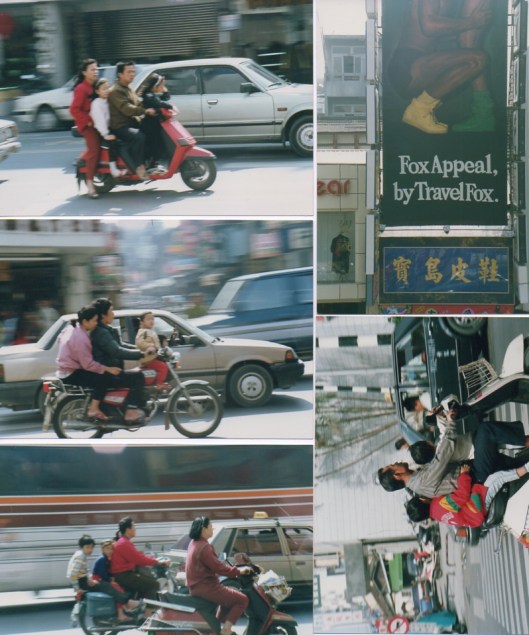
This story begins lying on its back in a small, one- bedroom hole in a creaking, dripping, grey, 18-story building in Tsim Sha Tsui, Hong Kong.

There, on a morning that would turn into a beautiful spring day, I wake up and hear the sound of rats scurrying around in the dark, and the sounds of wheels turning and gears clicking. I hear unnamed sounds.

I get up, pack my stuff, throw it on my back and go down to the first floor of the Chung King Mansions. This volatile, multicultural conglomeration of dirt, sweat and international odors stands just off Nathan Road in Kowloon surrounded by rows of pricy hotels: The Peninsula, The Hilton, The Hong Kong Empire.

The Chung King hostels have been the cheap place to stay for the shoestring traveler since the 1970’s. Other than brief alterations due to fires that have erupted in its corridors over the years, it hasn’t changed.

Out front, there are Indians and Iranians, bearded and red-eyed, sitting on the street railing. Foreigners from every corner of the globe are walking by. The little Chinese guy with the $8.00 USA Todays and Penthouses and Time and Newsweek and Rolling Stone, is unrolling his papers and magazines.

At dawn, the crowd are all hanging around wrapped in cotton, ear-ringed, nose-ringed, tattoed, goateed. They are either leaving for work or just getting in from play. Several of the turbaned Sikhs are asking me if I want a good place to stay or great Indian food or to go to the best restaurant in Chung King. The rest of them hover around the moneychangers offering black market rates. A German couple is buying watches, a Canadian is buying Nikes, a Frenchman is selling perfume. It’s early and a lot of people are just getting going.

Traffic is still light. Light for here. The sidewalks are peppered with people. Bright red doubledecker buses and taxis glide by. There are light, low-lying clouds over the bay. It is a bit dewy, but you can smell the sun behind those drops, burning the clouds away. The blue sky is already cracking through. By 10:00 it will be 30 degrees.

And on this morning, as I look across the street at the Hilton, I see an anachronism. He’s an elderly Chinese man with greying temples under a flat, grey, Maoist cap. His rope buttons are worn and his ancient Chinese clothes are from a time before all of this.

The free port of Hong Kong rises around him. Six major hotels. More foreigners than Chinese. So many shops. Everybody here is either buying or selling. And he, clearly, is not.

He stands in the middle of all this looking completely foreign, and he begins to fight it.

Standing on the corner of Nathan road in front of the Hilton, he is screaming at the top of his lungs probably the only two English words he knows. Probably the two words he learned expressly for this purpose. He is standing on the street corner screaming and throwing his hands up, hitting the sky with his fists and begging:

“Go Back! Go Back! Gooooo Baaaaack! Go Back!”

His voice is cracking now. He cannot keep this up. These two words are booming down the street in the quiet morning calm; kicking back and forth off The Peninsula, off Chung King Mansions, through the corridors and dripping alleyways:

“Go Back! Gooooo Baaaaaack!”

His voice is coarse and harsh now breaking and cracking. And still he screams. It’s been about five minutes and now I’m standing beside him.

He isn’t looking at me. He isn’t looking at anyone. Unfocused, his eyes open and close with the jerking of his head and hands as he puts every ounce of energy into his request.

I stay put and now I am looking at everyone else.

They stare at him, they smile and they continue to walk. Another Chinese man is standing a few feet away clicking in Cantonese and laughing at the old man. A young couple respond to him and they all laugh. A group of white businessmen walks, uninterested. Another man videotapes from across the street.

In front of Chung King, the Indians, Iranians and other foreigners look over for a time and then go about their business. Now they are looking at me. They look long and hard. My pack is slipping. I hitch it up and turn and walk away.

movie ticket stubs 1979 – 1988

Tags

, , , , , , , , , , , , , , , , , , , , , , , , , , , , , , , , , ,

Movie ticket stubs from movies I went to between the ages of 12 and 18

1979 Star Trek: The Motion Picture

1981 Chariots of Fire, Arthur
1982 Dead Men Don’t Wear Plaid, Conan

1983, 5 Hitchcock films were re-released to theaters after not having been released for more than a decade: “Vertigo”, “The Man Who Knew Too Much”, “Rope”, “The Trouble With Harry” and “Rear Window” – couple of the stubs are here

1984 Splash, Amadeus, The Karate Kid, Beverly Hills Cop, 2010, Footloose, Greystoke: The Legend of Tarzan, Dune, Ghostbusters, Revenge of the Nerds, Romancing the Stone

1985 Turk 182!

1988 Big

I Don’t Get It

Tags

, , , ,

I don’t get it.
Life’s a joke and I don’t get it.

Everybody else is laughing at its punchline.
But I’m just standing here
and I’m not feeling so fine.

So I nod my head and I smile and laugh,
like I’ve done before with jokes in the past.

I laugh and give a knowing wink just so no one else will think,

that I don’t get it.

Life’s a joke that I don’t get.

But that’s OK, because I fake my way like I’ve done before
and everything’s great and I’m quite safe

until someone comes along and asks, “what’s so funny?”

and so I laugh even harder to stall for time
and as I laugh I think

and then I stop my pointless laughter,
with a sigh winding down and answer:

“Life.”