• About
  • Fauna
  • Flora
  • Landscapes
  • Radio
  • sketchy stuff

MTK The Writist

~ my blog and journal

MTK The Writist

Tag Archives: m.t.

Bali July, Part One: July 1 – 15

01 Friday Aug 2025

Posted by mtk in 2025, Bali

≈ Leave a comment

Tags

Bali, July, Karthik, m.t., mtk

I just spent July on Bali and Nusa Penida.

There’s an ancient connection between the people living in Tamil Nadu, in India, where I was born, and the island of Bali where I now sit, in the foothills of volcanic Mount Batur and the lake in its semi-collapsed caldera. I feel deep kinship with the people here, and I am not alone.

From Batur, it’s down through orange groves, through coffee plantations, through terraced fields of turmeric and ginger and rice paddies and finally to  beaches that plunge into deep, clear ocean.

A significant majority of the population of this island are Hindu and their daily practices are similar to those conducted in India. Even a rudimentary comparison of the cultures shows the influence of the traders and explorers from South India who traveled by sea – or over land through Myanmar, Thailand, Cambodia and Viet Nam –  to these islands, for over a millennium and a half.
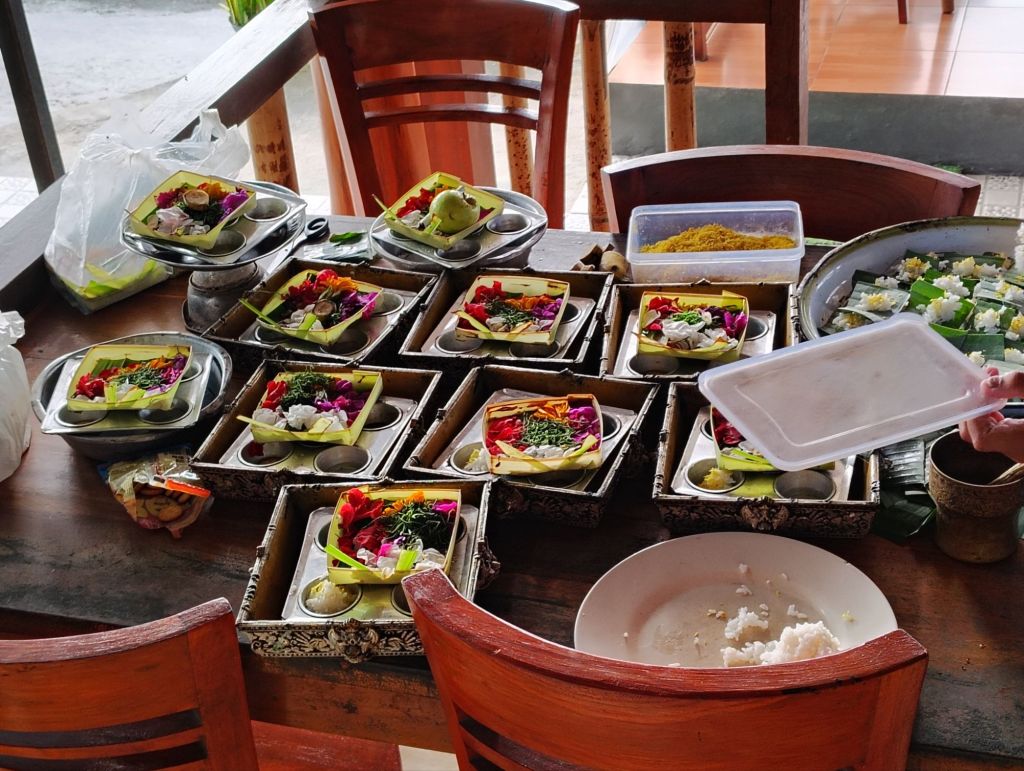
The Ramayana and Mahabharata are taught in schools and the heroes of these ancient stories – tales significantly older and longer than the Iliad or the Odyssey – are featured prominently in public art works. I had numerous conversations with Balinese of all ages referencing our shared knowledge of say Arjuna, Krishna, or Yudhishthra.

This is the spine of our culture and we are older and more in number. Please stop interpreting us, shut up and take your talking to. The West is a failed experiment of genocidal maniacs. We observe you, not in shock, but in continued, ongoing disgust. “Western civilization would be a good idea.”

There are Ganeshas everywhere.

underwater Ganesha

Differences in culture are manipulated all the time. Right now, just across the equator from here, in a battle over a religious site that lies between Cambodia and Thailand, the dispute is whether the site is Sivaite or Khmer Buddhist. But like so many conflicts, it’s a fight designed by local special interests. The “religious” otherness isn’t real.

The BBC and DW don’t know shit about it. Nor The China Daily. FOX and CNN use it to create their own global narrative from a position of total ignorance. We must leave the people from Arunachal Pradesh to here alone.

There is a village on Bali where the community square houses five temples of all different religions: Hindu, Buddhist, Muslim, Jewish, and even Christian, in one town square.

They coexist in peace because the Balinese allow it.

This small island is constantly energetic and vital. They move fast and forward here. I slowed people down often, to go my pace so I could learn. I was grateful for their patience – which is obviously an element of their peace – but they are quick to move on. There is much to learn from the Balinese.

Humanity is integrated with nature here. The seams are thin interconnections, made by human design and, I gather, via collectivization of experience over millennia. They let some things just grow. Yet they can be seen constantly pruning, cutting and trimming the voluminous vegetation for specific purposes.

Everything grows here. They take from, and carve, the natural world to compose elaborate expressions with as little interference with nature as possible. The wellness tourism is bringing permaculture farming and emphasizing natural practices.

Permanence is ignored for a constant organic harmony of creation. Nobody writes anything down. Nothing good lasts a short time. Gamelan. Barong. They continue until a drone-like tantra is achieved.

The Balinese have centuries of unified cultural practices that bind them. Cock fighting isn’t stopping anytime soon. This was a sparring practice between two cockerels. They would be armed in an actual fight, with a blade attached to one leg.

It is said ancient Kings and Princes from here to Southeast Asia even fought fish.

The island of these Hindus, devoid of caste and the rigor of Brahminical austerity, has allowed cross-cultural absorption into their ways. It has led to this unique culture, separate and distinct from traditional Hinduism in India.

They absorb the cultural elements of those who arrive, yet remain Hindu, in essence. Particularly, their belief in circular energy and in principled service through tripartite daily offerings: to gods and the dead, to fellow humanity, and to nature.

Because of the tourists, everything is made available here, including beef, but the Balinese have a broad diet. The staple is rice (nasi goreng) but they eat chicken (ayam) and duck (bebek), fruit and vegetables, and fish (ikan). Spit-roasted suckling pig (babi guling) is enjoyed island-wide:

The tourism, which is robust and highly capitalized under the digital generation, moves at breakneck speed, and an agile, young, and brilliantly polyglot Balinese generation rises to meet it.

They do business in Russian, Chinese, French, Hindi and English – Aussie, Brit, Indian or American. Young people, working with foreign investors have created a huge tourist industry, filled with comforts for the Westerner.

It is a noisy island. Except for one day, when the entire island is silent. They call it Nyepi – and for 24 hours everyone in Bali stays in their homes and switches off all their lights. The transport network is shut down and the island observes silence. Tranquility.

A driver said, “Emergency services are sent around every regency and through villages as a precaution.” This year it was after the New Moon on the 29th of March. Next year it will be on the Ides.

I thought about how much I’d love to be in Bali for that, and then realized I would not do that. I would stay away and encourage others to reduce tourist/traveler traffic on the day of Nyepi to allow Balinese to have their island in tranquility, to unite and bond. They are the stewards of something very special.

Growth is countered by commitment to culture, and power struggles embodied in political discourse.

The Bali Sun reports that the current destruction of the Bangin Beach properties, that government has deemed unlicensed, is to be followed by properties at Balangang Beach. This destruction and evacuation continues during appeals by property residents. According to them, the land will be returned to the villages for greater public access.

Yet I met many entrepeneurs, property owners, and workers on staff and in gig economies, serving the tourism business on Bali in July and can report business is booming.

The new generation is capitalizing. Foreign investors abound. Dance clubs and gyms and international surf culture and digital wanderers have been a huge part of the tourism. Sentai gen!.

Meanwhile Balinese parents in villages consider investing in their children to go to Cruise Ship Schools and Tourism Academies for economically productive education. Sigh.

Though I met several young people committed to studying gamelan and village rites, and there’s strong generational commitment within families and villages to maintain continuity of language and culture through their children, the direction the tourist money pushes them is market-driven, not intellectual, or even cultural. If Balinese families seek to send one child away to study to help the family financially, it’s to tourism or hospitality schools.

Local Governors are taking note, curbing growth and redirecting profits. Long overdue infrastructure projects are getting resources and political attention. It’s a time of growth, tempered by overcrowdedness and culture clash.

“Instagram and social media have ruined” places, dozens of Balinese, and others, complained to me. “It’s an industry though.”

Now comes the explosion of the new tier of restaurants, bars and villas to serve the next visitors, following behind the digital culture: vacationing Aussie families, middle-aged Gen-Xers, boomers, the elderly.

They’re building a glass elevator to take them down to Kelingking Beach. It’s going to drastically increase traffic to an already heavily-trafficked site on a rural island. Infrastructure demands are many.

It’s not just the glass elevator to Kelingking, there’s tons of building going on to suit the newest arrivals to Bali.

The tourists are changing. Twice I was told, “Before pandemic mostly Chinese, after pandemic, Indian.”

I heard and saw many Russians, Australians, French, Brits, Dutch, Swiss, Germans. South Africans and Spanish.

I VISITED:                  ON JULY:

Pecatu                      1st – 6th,

Canggu                     6th – 9th,

Ubud                         9th – 15th,

Nusa Penida           15th – 21st,

Candidasa              21st – 25th,

Kintamani              25th – 27th,

Canggu                    27th – 31st

A Word About the WHEN of the Writing of this Piece

I left today, August 1st – which meant I had to pay two million Indonesian rupiah Overstay Penalty, that I withdrew  from an atm in the airport before I went to immigration. I paid the tax and left.

That was today.

It’s still August 1st for me here in San Francisco as it was then, there in Bali, more than 20 hours ago, because I crossed the International Date Line. I gotta sleep.

So I’ve been back in SF 31 hours, but I left Bali 46 hours ago. I am writing and working on this during an invisible 15 hours that exists for me, separate from everyone around me.

Placed at the Wallace line between the Sunda and Suhal tectonic shelves, you are as likely to find descendants of the Australian-Pacific as of Southeast Asia here – anywhere from India to New Zealand.

There are Asian influences from the North down through Viet Nam, Dravidian influences from Tamil Nadu by sea, Aryan ones from northern India by land, Australian influences from the Southeast.

Many languages meet: Sunda, Javan, Balinese, Indonesian. On Sulawesi, 114 native languages are spoken, all of which belong to the Malayo-Polynesian subgroup of the Austronesian language.

Thousands of islanders from thousands of miles away have come here for centuries to find the culture accepts, absorbs and encourages them, allows all to fit in, to find peace, and to thrive.

When I told a driver in Ubud that a millennium before Columbus was born, we Tamils had sailed here, he said to me, matter-of-factly: “Then, it was Hindus who came. Now it’s Muslims.”

Bali is a mostly Hindu island in the most populous Islamic nation, where the Buddhist protocol of discourse exists. It all culminates here on an island of the gods (plural) and of the spirits of the dead; an island of detente.

And now, of wellness tourism.

Denpasar/Pecatu – July 1st to 6th

I arrived at the I Gusti Ngurah Airport in Denpasar at 4pm on the first of July, a Tuesday.

I was met at the airport by the driver from my hotel, Sakura, who held a sign with my name printed on it in handwritten letters. When I asked Sakura if his name was the Japanese word for “cherry blossom,” he smiled broadly and said, “Yes! When I was born, my country and Japan had an important event, and my parents named me Sakura.” He was missing several teeth, but had an open, good-natured face. I guessed he was around my age.

Later I learned that Sakura was three years elder, born in 1964. That was the year the Olympics was held in Asia for the first time: hosted by Japan. But, Indonesia was prevented from participating. The International Olympic Committee banned Indonesia because in 1962, Indonesia had hosted the Asian Games in Jakarta and excluded Taiwan and Israel from participating. It was a direct retaliation for the exclusion of China and other nations from the ’64 Olympics by the IOC.

The International Olympic Committee accused Indonesia of politicizing the games. In the words of then IOC President Avery Brundage of the United States, Indonesia had “thrown down a challenge to all international amateur sports organizations, which cannot very well be ignored.”

In response, first Indonesian President Sukarno said: “The International Olympic Games have proved to be openly an imperialistic tool. Now let’s frankly say, sports have something to do with politics. Indonesia proposes now to mix sports with politics, and let us now establish the Games of the New Emerging Forces, the GANEFO, against the Old Established Order.” Sukarno created GANEFO as a rival event to the Olympics!

Ten countries (Cambodia, China, Guinea, Indonesia, Iraq, Mali, Pakistan, Vietnam, and the Soviet Union) announced plans to form GANEFO in April 1963, and another 36 signed on as members in November of that year. When the IOC subsequently banned athletes who participated in GANEFO from the 1964 Olympic Games, Indonesia and North Korea withdrew in protest. GANEFO faded away into obscurity.

Amidst all of this, Sakura was born, in a village in Pecatu on Bali, and his parents named him “cherry blossom,” in Japanese.

Thus the very first story I learned upon arrival expressed the principles of honesty, fairness, independence and acceptance that I would go on to find in the people of Bali in my month here.

Sakura’s aunt, a Hindu, owned the residence in which I was staying my first five nights on the island; villas named “Prasana,” a Sanskrit word meaning clear, bright, tranquil, pleased, delighted, cheerful, or gracious. It was why I chose the place.

Sakura taught me my first Balinese words and among them were the terms “b’lee,” and “adi,” for elder brother and younger brother, respectively. Sakura was my b’lee, I was his adi.

When we arrived at Prasana, I found that the villas had been given names instead of room numbers. I was staying in Chanakya.

It was Chanakya who ended Alexander’s attempt at global conquest. The way we learn it as children is that Alexander was marching across the Hindu Kush, having conquered Europe so much they still call him The Great (to us he’s Alexander the Greek).

The great sage Chanakya came down from his ashram to the palace to instruct the Gupta kings on how to stop this stampeding Aryan. Chanakya’s book, the Arthashastra, contains the lessons of his brilliant military and political tactics, including the often wrongly cited and oversimplified principle that “the enemy of my enemy is my friend.” Chanakya. Three hundred years before Christ. Taught here on this island thousands of miles away from India. For millennia.

The villas are placed up near the top of a sloping hill that eases down to the ocean, south and east toward the dawn. The view of the valley down to the sea is exquisitely natural – no tall buildings anywhere. Occasionally one can hear a motorbike go by, but you can’t really see the roads.

The lush, green vegetation on the island is dense. High above, dotting the sky, something hovers, swivels, and floats. There are just two or three of them and they seem to be riding air vents. Are they hawks? Eagles? They seem very like great raptors. But no, they are kites.

A kite is a reminder to look up.

Everywhere in Bali, you see kites, but not very many at any given time.  It’s elegant how few there are and how high they’re flown – just enough to be tiny, beautiful dots in the sky without crowding it. This unique peppering of just a few kites in the air make them feel natural, totally integrated in this environment. They’re supposed to be there.

Below, fish over reefs, above, kites over islands

Mostly they are black and so high up you only see the form, drifting. Some have tails, but not many. As they are reeled in, one can make out colors and some shapes – birds, triangles. At night there are kites with glowing lights on them, some that flicker. They are flown so high up they could easily be mistaken for aircraft, or UFO’s by the gullible uninformed.

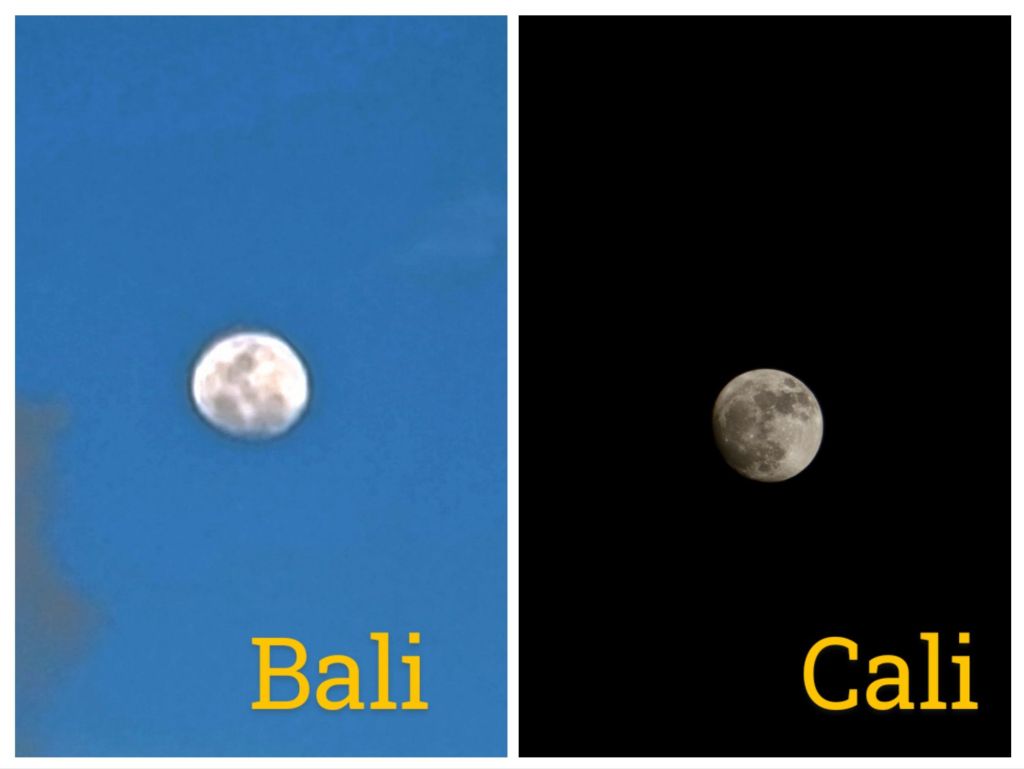
Meanwhile, the moon is upside down and the stars are from over another planet.
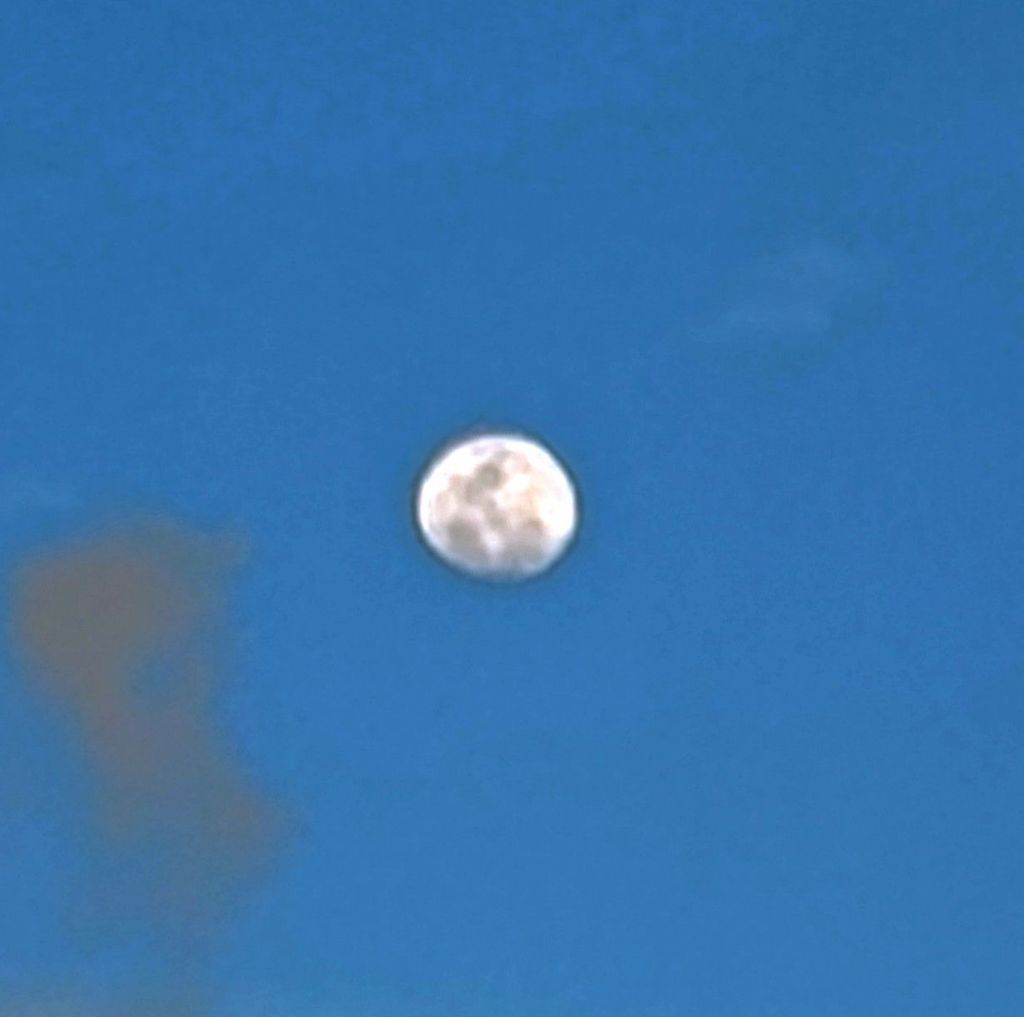
Moon, same night, both hemispheres, US foto: M. Cevallos

Well, it’s not really upside-down. but rotated about 90° counter clockwise and tilted forward, because I crossed the equator. I am sure as you travel further into the Southern Hemisphere the difference is even more pronounced.

I find it amazing to imagine that every child in the Southern Hemisphere has been born, lived and died with a completely different perception of the moon from me, and from every child born in the Northern Hemisphere.

It was partly cloudy for the first few days, but the stars peeking through the clouds were mysteriously arranged in the night sky.

I told Sakura I wanted to go snorkeling to see the biodiversity around reefs. He took me to his cousin Nico, who ran a water park business near the massive resort hotels on the south side of the island.

The water park was a crowded, insane place filled with crisscrossing craft carrying Indian couples. The recent years of economic success in India has led to this: young newlyweds with disposable income, honeymooning on Bali – a paradise just a few hours’ flight away.

The place was wild and somewhat out of control. Young boys drove speedboats and dragged young, newly married couples behind them, dressed in life jackets, clutching each other, grinning and laughing with joy as they parasailed. They hugged their guides tightly as they drove them about on jetskis and sails, cruising the bay before the massive hotels.

There is a dangerous side to Bali. Because the people here expect you to be in possession of yourself and your abilities and faculties, they often throw complete novices into pretty dicey situations. I saw it more than once. Here it was very inexperienced young Indian couples engaged in high speed water sports. Newlyweds. I saw some terrified young brides.

I had come to snorkel, which I did for a time, but Nico told me the best way to see fish around a reef was to use the new diving bell attraction. They took me on a boat out to a floating, anchored station which had oxygen tanks on it connected to diving bells

I put the heavy bell on my head, began breathing regularly and then lowered myself into the water. The oxygen filled bell remained free of water and I could see everything. My entire head was dry down to my shoulders as I dropped to a reef some seven or eight meters below.

It was incredible. There was a boat that had been sunk along with a stone sculpture (of Ganesha, of course) and reefs had slowly formed around them. There was a pathway with a railing I could grip as I walked on the sea floor and spent time observing the fish and other creatures living in the coral. I was standing, and indeed walking, on the Wallace Line.

A Word About Alfred Russell Wallace

If one Googles Alfred Russell Wallace in short order he is indentified as an explorer, naturalist, scientist and co-author, with Darwin, of the theory of natural selection, and by extension, evolution.

Wallace achieved this through observation, and, in his travels through the “Malay Peninsula,” coming to the fundamental breakthrough upon crossing what we now call, the “Wallace Line,” an imaginary line separating and defining the ecosystems of the Sunda and Suhal shelves; Southeast Asia and the Australian-Pacific.

Wallace is the father of “Bio-Geographical Evolutionary Science,” and arguably other fields like tectonics. He is also a highly romantic figure; a collector who became a naturalist and a scientist through rigorous methodology, allowing him to have data yielding a truly original breakthrough in thinking.

Generations of kids fantasize about doing this.

After the snorkeling trip, Sakura took me to a restaurant owned by his family near the airport.

The Ganesh restaurant is a small nondescript place where you can sit at simple tables under an umbrella on a sandy, south-facing beach. It’s in the wide, sheltered cove near the airport where the fishermen’s boats are moored in the afternoons, rising and falling with the occasional wave.

They are catamaran and are very similar to those found in Tamil Nadu. The word catamaran comes from Tamil. These are pontoon boats made from wood and painted mostly white with broad horizontal lines from bow to stern in two or three colors: green, blue, turquoise, red. There are usually two unpainted, white pontoons extending out on either side.

Waves arrive slowly, because the cove is so large, but when they crash it’s a thunderous sound.

Immediately to the right, West, is the airport. As I sat sipping a Bintang pilsner and eating fresh grilled red snapper – chosen from the day’s catch kept on ice in large plastic tubs – I watched planes landing regularly bringing hundreds of tourists and travelers like me.

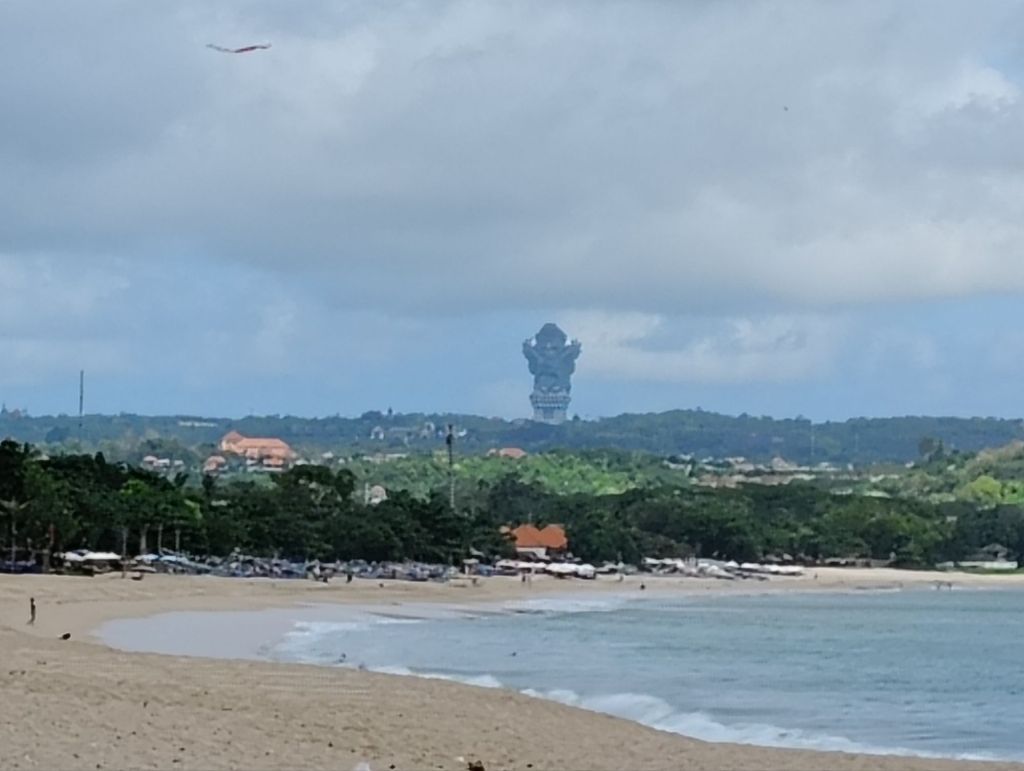
To the left, Southeast, off in the distance, a tall, massive hulking form stands on the horizon. What is that?

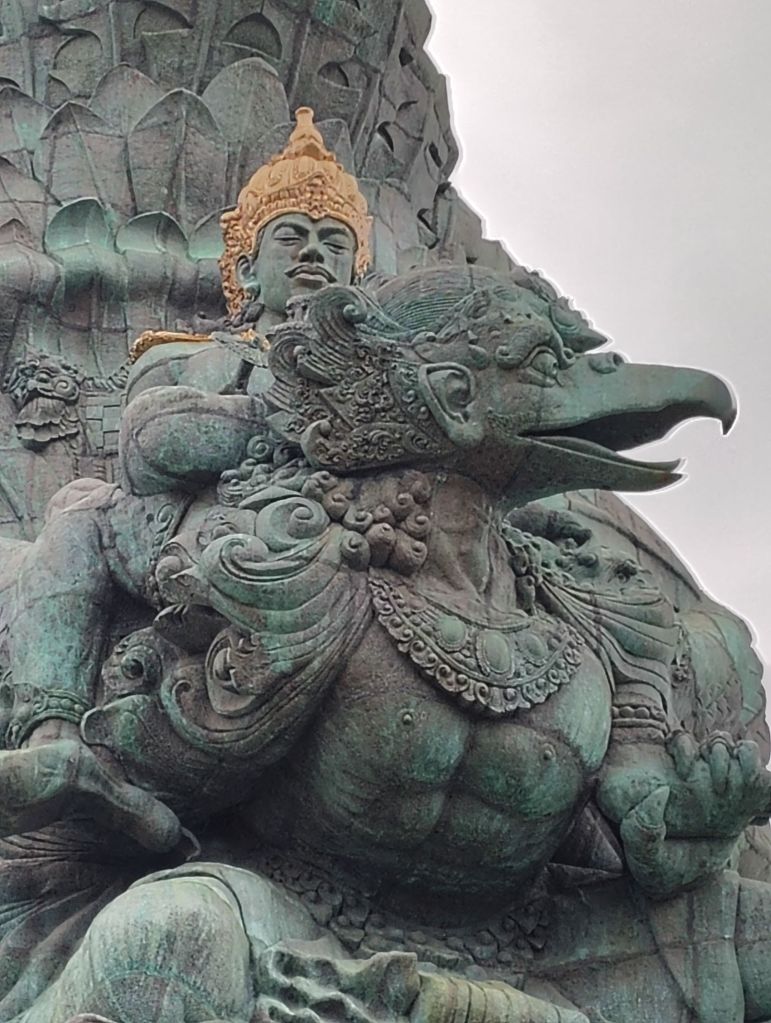
It is difficult to make out because it’s so far away, but it’s clearly the tallest thing on the island by a 100 meters or more. It has a greenish-blue tint, and a rugged form, but it’s impossible to make it out unless you know what it is: the Garuda Wisnu Kencana.
More on the WHEN of this Piece

I left Bali at 3:45ish in the afternoon yesterday, the first.

But by the calendar here, in California, where I’m sitting – for all of Internet recorded time – it will say that I wrote these words 31 hours later.

When in fact … it has been 46 hours since I left Bali. It’s 2:44 tomorrow in Bali now.

Every time I cross the dateline returning from Asia my phone cannot process the dateline. As soon as I connect at SFO, the images appear in my phone time- and date- stamped by the 24-hour clock and calendar of tech.

I made note of it coming back from Narita the last time I crossed the Pacific in this video:

This time, on the way to the airport, I made time-specific videos as placeholders in my phone:

That mantra is played daily on the radio at 6am, noon, and 6pm. So this video was 49 hours ago for me but will be recorded as 34 hours ago in the … whatever the internet is.

And just before I got on the flight from Taiwan to San Francisco, to cross the dateline I shot this:

It’s all TOTALLY OUT OF ORDER now on my phone. Photos and vids mixed together from both sides of the Pacific, all marked August 1st.

Those hours catch up to me in a commuter hotel in Millbrae by SFO that I chose to land and decompress in.

I’ve got to get sleep, but I want to post before midnight here on Saturday the 2nd, so I have just a few minutes. I am too tired to do quality work on these posts. The time difference and jet lag are impeding my mind, but on we go …

We are covering day four of July. My 4th of July was spent here:

The Garuda Wisnu Statue

I want to write about how the Garuda Wisnu Kencana is belittled by some visitors, made fun of as provincial and not visited because it is misunderstood.

The cultural center and park are on beautiful grounds where gamelan is constantly heard. There are barong and gamelan gong performances and cultural presentations held at regular intervals.

The Garuda Wisnu Kencana, or Garuda Wisnu Statue is 246 feet (75m) tall and 216 feet (66m) wide and made of treated Japanese copper and brass sheets placed on a reinforced steel frame and concrete core.

It was designed by Nyoman Nuarta and inaugurated September of 2018. Though the project was conceived in 1993, economic struggles prevented completion for years.

There were no accidents during construction, which I found phenomenal.

The building the statue stands on gives the statue a towering height of over 400 feet (122m). It can be seen from Nusa Penida, an island away, or from the airport when you land at Denpasar
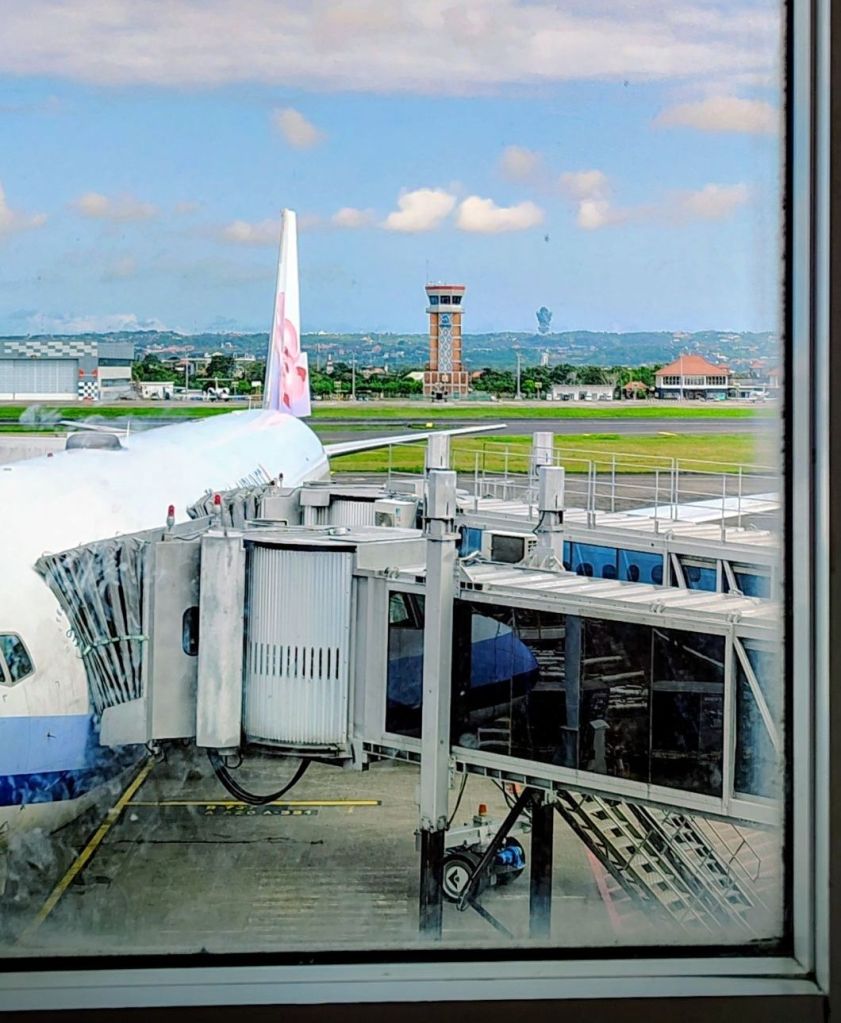
I joined a tour inside the GWK to learn about its construction. Inside, the funniest moment was when the (possibly Russian?) visitor protested the height of the statue includes the building that functions as its base. Look for that at 2:28, It’s great.

The Garuda story that the statue represents is not meant to be overtly religious, but rather folkloric. This was protested as nonsense by some Indian Hindus I overheard, but I found it profoundly moving.

It represents well the amalgamation of local culture with Hinduism. I admire this place very much precisely because it isn’t a religious structure, but a cultural center and park to learn about the Balinese.

It features a beautiful campus of sculptures of advanced design and execution, but I am too exhausted to do this post justice.

Wrapping up my first week, the first week of July on Bali, here’s a fast motion video of dawn from Pecatu:

I learned a handful of words from the staff at Prasana, and more importantly, to distinguish at least three different languages. For example:

‘Terimah kasih,’ is Indonesian and what I would have learned as “thank you,” had I used YouTube, while ‘Suksma’ is the regional language and, I came to learn, most widely used on Bali and Nusa Penida. One morning, I learned the Javan term for ‘ thank you.’

The realization of the living languages surrounding me that were agreeing to speak common tongues for a million reasons was one of the great joys of my vicarity as an Indian on this trip.

I started my language page at Prasana and tried to separate and delineate, but it looks like this now:

Guruduk! That’s ‘thunder’ in Balinese. Several other foreigners I met agreed ‘guruduk,’ corresponds with the deep, rumbling sound we associate with thunder.

In my first week, I learned that there is decorum here. It is graceful, unified and orderly amidst the tumbling overgrowth of nature.

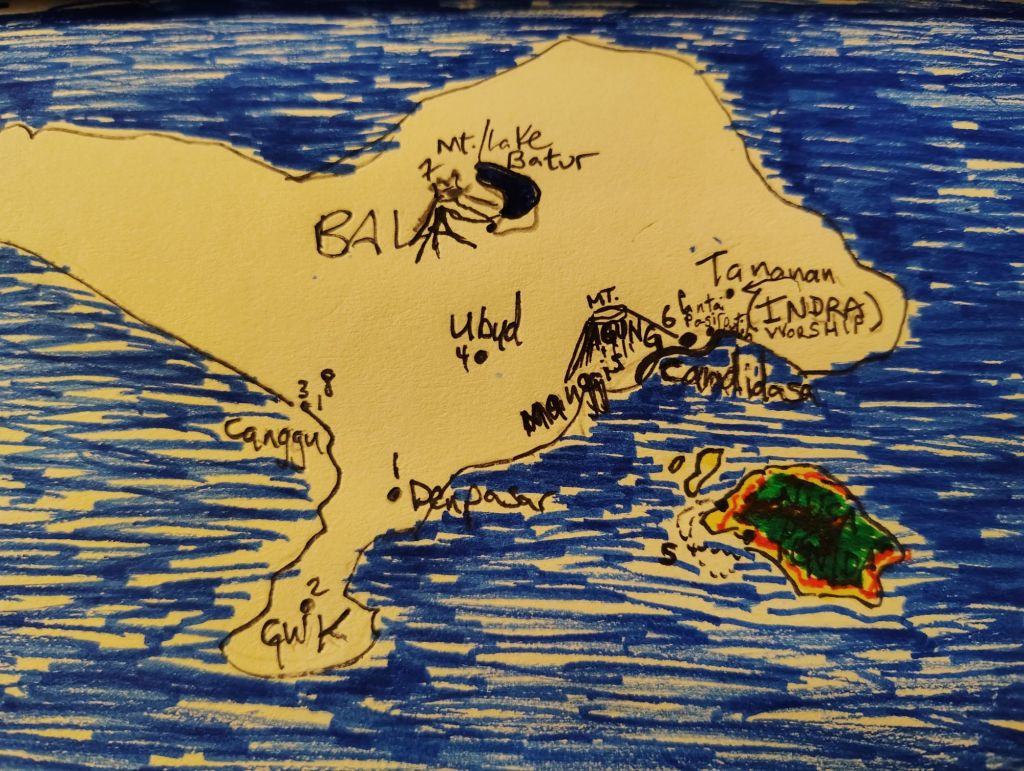
My crude map, begun at Prasana, was equally imbued with scribblings that provoke instant memory
I filmed my first species in Pecatu, the common dove and bulbul. The Zebra dove has a chessboard neck and the bulbul ‘s yellow-vented:

And my flat mate was a very cool spotted gekko:

Pecatu was for me, an excellent introduction to Balinese culture. I was able to ask so many questions of Sakura, and of the young people who worked on staff.

They were from local villages and even if their English wasn’t great, they would be fluent in local languages or even Chinese, or Hindi or French, which are all more valuable in this tourist haven.

I was able to snorkel and to stand on the sea floor and see brilliantly colored fish of dozens of species and to enjoy walking on the sea floor, which I imagined to be the Wallace Line.

Finally, I got to see the Garuda Wisnu Kencana.
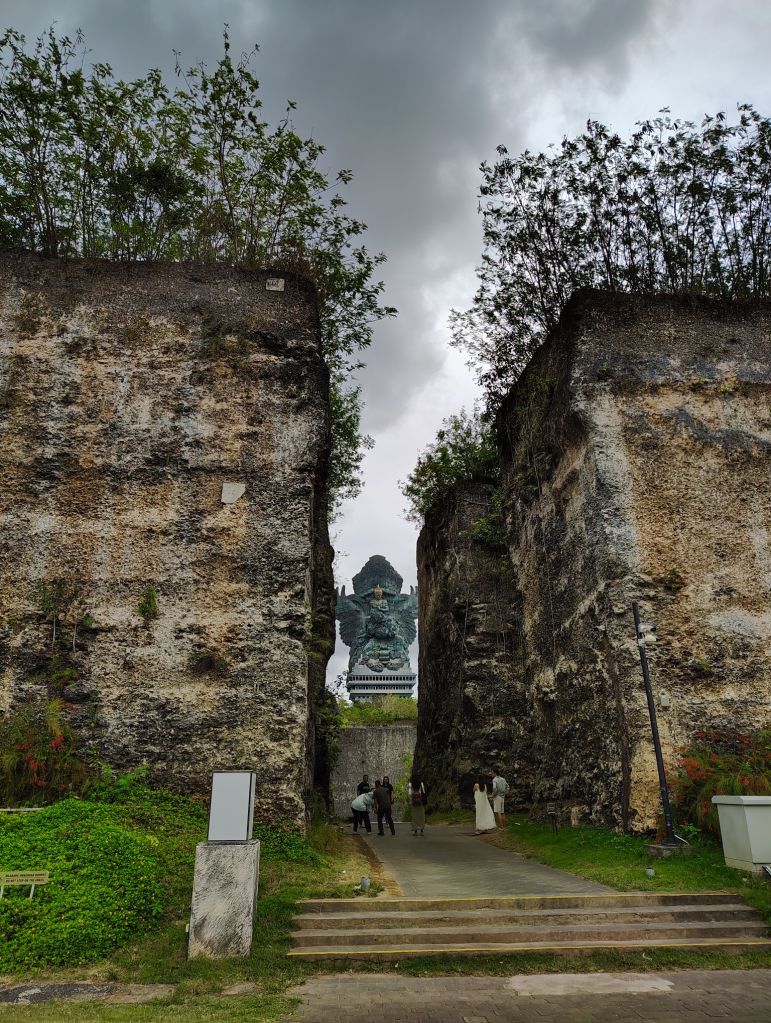
Which I consider a great national and Balinese accomplishment that has yet to be appreciated as the art object it is.

I spoke French, Chinese and as much Balinese as I could learn while I was on Bali and Nusa Penida in July. It wasn’t much, my language skills are rusty. My French would have to get much better for my next stop:

Going to Canggu and Ubud

The car from Pecatu to Canggu would be my first opportunity to see the traffic created by tourism on what should be called the one-road culture of Bali.

The island doesn’t have many roads, indeed the culture seems to be: one way in, one way out. There are perhaps six million native people living here and land is precisely divided. It’s much like Thailand and Cambodia.

The roads are small, two-lane affairs, teeming with motorcycles and scooters weaving between the cars. A funeral procession could block a road for a half hour. In recent times with the huge influx in tourism, this leads to very slow travel on very crowded roads.

The foreigners rent scooters or use Grab, the rideshare app, to call a scooter with a driver to get around. Often I saw two women calling two Grab scooters to ride together some place. It’s easy, but as I discussed in a previous post, it isn’t entirely safe. They give out helmets now, but it’s macho not to take one, so I didn’t. We weren’t going fast enough to warrant it in that heat.

While I had gone down to the ocean in Pecatu, passing through villages and past big resort hotels, and had seen honeymooning Indian couples in droves, it wasn’t a heavily trafficked drive. They mostly fly in, are driven to the resorts and stay there until they leave. I hadn’t yet seen the very tourist-driven economies of Seminyak or Canggu or Ubud. Canggu would be my first opportunity to hang like a white westerner. It wasn’t for me. Again.

I dreamt of coming here for the past thirty years, to examine the biodiversity that enamored Alfred Russell Wallace, and to meet these people, to hear their music and learn their culture.

Now, I feel late. The place is packed with tourists: Australians, Russians, Chinese, Indians, French, British, Spanish, Japanese, Koreans, and a few Americans … all coming to be massaged and to party and to surf and to snorkel and to meditate and to eat right and to do yoga at a price they can afford.

The Balinese have grasped what they want and provide it in rote, fast-paced, organized ways. They hardly care for the people they thrust into some situations, why should they? You asked to do this. I will explain what’s required and we’re off. It can end tragically. I always blame the tourist.

I am not on social media and don’t use WhatsApp, which is a real source of consternation and frustration to agents and hoteliers, drivers, and the digital generation. Sakura said he was just standing there with the sign and had no idea if I’d show up at all.

I’ll use Grab, sure, but I am in no rush and always leave early, so for me, everything is a cruise and nothing really flaps me. The current generation of digital travelers don’t understand why I didn’t want to give out my number, nor be on Insta or TikTok.

I like trying to travel in Asia the way I did in the early 1990’s, before the Internet. I always travel alone. I don’t really like tourists anymore. You’ve all earned my disappointment with your arrogant, condescending posturing and expectations and your loud, rude, stupid kids.

I separate myself from the digital generation’s methodology on purpose. I feel the way I travel connects me more directly, and there are less chances of miscommunication or of being lost in translation. It makes everybody have to take a little more care in communicating. Sadly, by the end of this trip, I was forced back on WhatsApp. I’ll be eliminating it again soon.

In one situation I was the only non-white, Westerner. People took me for staff. And that’s who I spent time with. I have experienced this otherness before. Where’s that fun? I have to act like a Westerner to be in Bali? No, thank you.

But it was in Canggu that I realized two weeks was nowhere near enough time to explore Bali. I extended the trip to a month.

I would make up the rest of the journey myself, as I went along, and spend all of July on Bali. It would be the best July of my life.

I’m not white. I am dark brown.

Sakura had gone back to his home village and so it was a younger man who drove me to Canggu. I commented that there were increasing numbers of foreigners as we went along, and he agreed, saying we were going to, “a very crowded area.” We didn’t have much to talk about. Perhaps his English wasn’t very good, and my Balinese, after only a week, was pretty much nonexistent. So I invented a game called “suss the whitey.”

If we passed a white couple or family or individual I would guess what country they were from strictly by their appearance. At first, my driver was reluctant, but he smiled every time I’d say, “oh definitely French.” or even just, “Oz.” – a few seconds after we passed someone. By the middle of the journey he was resisting my proclamations with his own. “Really? I think Russian.” or something like that. It was a fun game.

At one point he said to me, “The Russian accent sounds like invite you to fight.” Which I thought was hilarious. Many Balinese I talked to about the various tourists told me the Russians seemed different. Angry, disappointed somehow. It was a culture clash of forms. 

In Canggu, I’d be staying in a French place. It was exceptional, but I am hesitant to write about my first time in Canggu and my time in Ubud because both were very western, tourist sites, both were somewhat disappointing to me.

The best thing of my time there was my visit to Bali Bird Park, a place I had wanted to go since 2006 because Rigo and Robert King Wilkerson had gone there, then, and they raved about it.

I got up early and went when the gates opened at 9am so I got to see all the birds on my own before the busloads of school kids arrived. I was able to film and sit with so many fantastic species! The hornbill was like something from prehistoric times.

I made a playlist of videos from there. I will let the images do the talking:

Epilogue: Can’t Write About It Anymore Cause I’m Back in the US

It’s disappearing now.

I have been back eight days and the feeling of Bali and Nusa Penida shrinks within me rapidly now, crowded out by what is required of me to be an American.
I’ve been an American citizen for 44 years. I’ve rejected much of what was proposed to me as valuable or righteous, and instead seized freedoms, particularly creative freedoms, to create the intellectual space in which I reside.

So I am extremely self-possessed.

I am the Brahmin son of a guru: learned at his knee, watched him teach students (sishya), and learned at his deathbed. I am learned.

I’ve purposefully stretched the definition of my Brahminism to contest its caste-based restrictions, picking up on a thread my father started by agreeing to be a professor in the West.

I took from what was afforded me so I could have this intellectual space. I am regarded as ungrateful or heretical by some. I consider them ignorant of history, culture or me. I am the author of this existence and its communications – whether in performance before you, in a video, or on this blog..

But the reason I cannot meaningfully write about Bali anymore is because I am back in the United States. The social truths forbid it. I will have to work now to compose messages to explain my experience, faithfully.

For the record, here are the three playlists of much of the video I shot there:

I am proud of the internal consistency of my thinking and expressions, tied to a deeper consciousness from our 5,000-year-old culture that has governed my approach.

When in Bali, I was Indian. The handful of instances in which I was an American were always with tourists from the West or China. No passport or oath or societal commitment can erase the connection I had with the Balinese as a Hindu. It is for us to interpret with each other. It is not for anyone else to translate, interpret or make known in some reduced way.

This, my life time, and its era of “culture” is immaterial. For now, my truths have been buried under an avalanche of American lies and social postures. We’ll work on it ’til I’m dead, I suppose.

This is the last picture of Bali I took as I left:
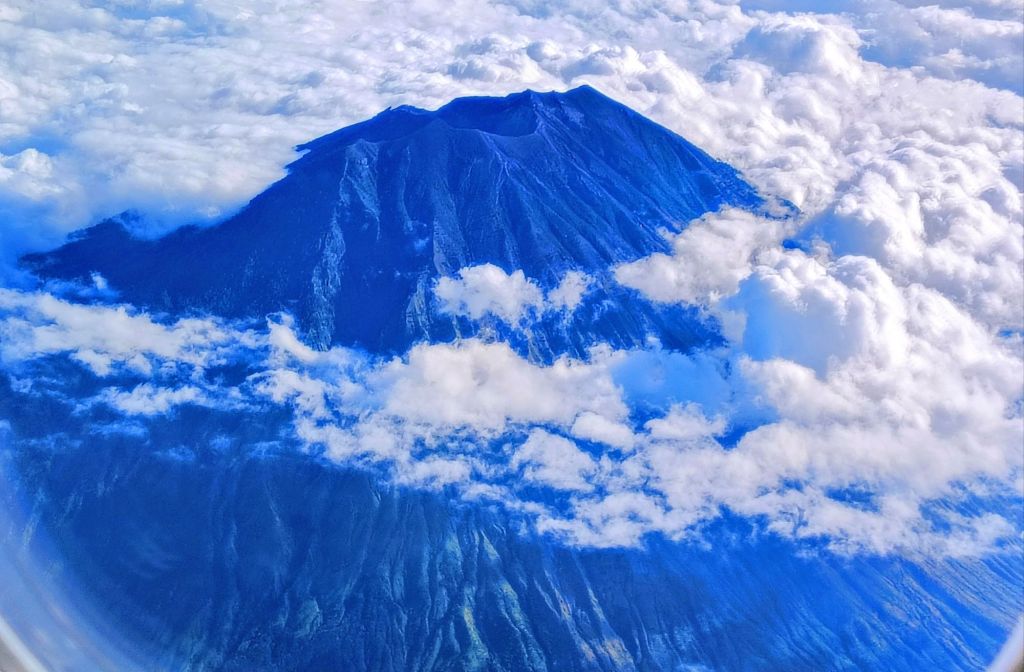
My last view of Mount Agung, the tallest and most active stratovolcano on Bali, a sacred place. 5,300 feet high, it last erupted in 2017 and 2019. It’s worst recorded eruption was in 1963. Thousands displaced, 1500 dead. If it erupts it influences everywhere from here to New Zealand.

Three views of Agung:

If I post here again it will be titled “Nusa Penida and Kintamani,” and I’ll add recollections of those places. But I need studio time now to refresh and create reflection.!

Best of luck to all,

Suksma Bali!

mtk
Separation as Opposed to Isolation

19 Thursday Jun 2025

Posted by mtk in 2025, beliefs, Commentary, journal entries, Letter From MTK
≈ Leave a comment

Tags

blog, books, Francisco, Karthik, life, m.t., mtk, San, travel, writing

It has been a month and a half since last I wrote. The statistics for this site reveal that no one reads what I write. It is, and has been, a resource for documenting my view of this existence in which I was born the eleventh mouth to feed in a two-room apartment in India, moved at two to the United States of America, the youngest of a family of five that disintegrated.

And who then travelled alone for years and lived in Austin, Taiwan, Japan, India, Thailand, Washington D.C., and New Orleans before moving to San Francisco in 1993, to New York in ’97, and L.A. in 2002 – where I fathered a child and was a local radio personality – and back to Japan for all of 2005; India ’06 – ’07 and finally back to Oakland and the San Francisco Bay Area.

Ten years ago, I began to split my time between SF and San Antonio, Texas, where my father – undeniably a great American – wished to die.

Now, five years in the wake of his passing, I write to you from back home in my favorite city, San Francisco, where I am alone.

My eighth trip around the world was embarked upon from here in late 2022 when I spent significant time in Amsterdam and same in Bangkok in 2023.

It has taken me 40 years to free myself of the burdensome garbage I’ve had to participate in – just to be an American.

But now, I consider myself like Tolstoy after the wars, or the young boys of the golden era of dutch painting, wealthy scions of colonists bringing everything from around the world back to Amsterdam. I’m financially stable, experienced, educated and have been writing and making art for 30 years.

I am widely disliked and in 55 years of being in the United States, I never made a friend. What friends I made are no longer friends, and I’m now separated from my family and from my ex- and our child, who has not spoken to me in more than five years.

In the United States now, I am persona non grata for my beliefs first and my behavior in societal situations next. Most people who meet me have no interest in befriending me any more because I reject the society and maintain the uncompromised position that is a thread throughout my life and work. Being true to myself has “cost” me every relationship I ever made.

In a controlled way, and very aware of the audience, I still perform somewhat loudly in public space – coffeeshops, bars, alleys – as I have done for thirty years in the United States, expressing my truths … but now they tire of the “act,” that has been my existence here.

I continue to read in public as well, promoting the act of reading and general intellectual pursuits. I have been reading novels for decades and intend still to write a good one – let’s see.

To most, I am merely an immigrant they can either use or forget.

To me this separation was an inevitable eventuality to my methodology. It is not to be railed against, but to be rolled with and seized for the immense value it has. I have time, resources, abilities I need to let flower. Please support me or leave me alone, thanks.

love,

mtk
Welcome to The MTK Blog and Archive

09 Wednesday Oct 2024

Posted by mtk in 2024, Letter From MTK, public letters
≈ Leave a comment

Tags

citoyen, du, Francisco, Karthik, m.t., monde, mtk, San

Greetings:

blogging again.

If you use a website view instead of mobile version, you can see posts here date all the way back to the 1970’s in a column to the left – that’s the archive.
It has only been a dozen years since FB went public. Twitter followed. Then Instagram, then Snapchat and Tik Tok. Facebook went live twenty years ago, but … I never joined.

I’ve had computers, tablets, laptops and PCs throughout all those 20 years but just never opened or posted to Facebook … or to Instagram, nor Snapchat nor Tik Tok … just skipped all these “social media” ones. I didn’t want someone else owning all my content -and the restrictions that come with that.

So instead of posting to social media since 2012 when Facebook went public, I began posting to this blog, I also collected stuff from years past reaching all the way back to 1977 and posted these here, using publication dates corresponding to the archived material.

So I’m the publisher not Zuck or Jack or Elon and I retain intellectual property rights and copyrights.

Please do read and share if you find something of interest here, and credit me, MTK. Thanks.

Best,

M. T. Karthik,

citoyen du monde

The Ever-Changing Chrysopylae

27 Wednesday Mar 2024

Posted by mtk in fiction, literature, North Oakland, Oakland, S.F., SF Bay

≈ Leave a comment

Tags

Area, Bay, changing, chrysopylae, ever, ever-changing, fiction, Francisco, Karthik, m.t., m.t. karthik, oakland, San, short, story, writing


by M.T. Karthik, 2024

(6060 words)


To this Gate I gave the name of Chrysopylae, or Golden Gate; for the same reasons that the harbor of Byzantium was called Chrysoceras, or Golden Horn.

John C. Frémont, July 1, 1846

——–


On a half empty flight returning to SFO from Costa Rica, in seats 17B and C, Freddy Pico held hands with a stranger. She was in her mid-30’s and trying to get back to Vegas. She approached him at Juan Santamaria International and quietly asked if she could sit beside him on the half-empty, wide-bodied jet, confessing hapless fear during takeoffs and landings.

Her name was Elizabeth and she waited till he was alone. Freddy stood off apart from the others in front of a floor to ceiling window pane.

The harsh tube bulbs overhead were oddly made more stark by the rectangular plastic covers meant to serve as flat sconces. The ultimate effect was that everyone waiting to board, latinos y gringos alike, appeared undead.

Freddy was twisting his body around in front of the window, trying to position himself to actually see – to avoid the harsh glare and make out the fiery volcanic glow of the Poás in the distance – when Elizabeth approached and stammered her request.

Now, twenty years later and 3,000 miles away, standing on Ocean Beach, Freddy suddenly remembered what Elizabeth said during that takeoff, when she death-gripped his hand while their 747 banked slowly out to sea, leaving the ribbon of coastal Nicaragua behind.

She murmured, “I live in the desert because I don’t like change. People who like change need the ocean.”

Freddy remembered her looking up and away awkwardly to avoid any open blinds and the thousands of feet between them and mother earth. Her dishwater brown hair was tied up in a small bun. Her pale hazel eyes jumped to the no-smoking and fasten-seat-belt signs, the personal fan and light, the dull gray of the plastic stowaway bins – anywhere but the windows.

People always asked Freddy to do things like that: hold their hands during takeoff, or mind their stuff while they ran outside to feed the meter. He was easy-going. He wasn’t short or tall. He had a round, welcoming face, warm eyes. His paunch appeared and disappeared, a tide of the seasons, not the hustle of jogging.

The marine layer sat thick overhead. It made everything dark; the sea, the sky, the stone outcroppings in the gate. This contrast gave the sand a clean, beige hue. Freddy saw the boys running around on the sand and tried to implicate them in his flight mate’s analysis of what different people need, from so long ago.

Marcus, the eldest, liked change. Ricky was in constant change. Really, all the kids were.

“Kids,” Freddy thought, “need the ocean.”

“C’mon! Let’s go,” Freddy yelled at the sinewy black shadows running against the gray wall of sky and surf down the beach. He raised his hand when he saw Ricky looking back at him and swirled his finger in a wide circle in the air, reeling them back in. Ricky waved, turned away and chased down the others. Today there were four of them.

Two flying forms blew past Freddy tearing up the long beachhead. He didn’t get their names. Earlier, Marcus showed up at Freddy’s place with these two – brothers, maybe three years apart – easing in behind him. “Oye, Mr. Pico, I told these guys they could come along.” Freddy realized Marcus liked being the gatekeeper – bringing kids from the neighborhood around to his place.

It had started with one of Marcus’s classmates three years before, and today Freddy didn’t know these two brother’s names, but he knew their mother and had seen them around the neighborhood. As long as he knew the kids’ parents, Freddy never asked questions. He just gave as many as fit in his Gran Torino a ride to the beach and back, some fruit, a couple of bottled waters.

“You got towels?” the elder brother asked.

“Uh, yeah, sure.”

Ricky strolled up with his shoes in his hand, eyes sparkling and blurted, “Man, the sand’s actually cold!” Freddy turned and looked back for Marcus, whose shadowy form he made out slowly trudging toward them. The fog and swirling sand intermittently swathed him in mist.

Marcus looked up the windy beach and made sure Mr. Pico turned back around before taking out the joint. He had been unable to light it on the beach without it being obvious. He spent a frustrating twenty minutes trying to get it lit before finally giving up.

It was the first time he had ever sneaked a joint on a beach trip and he’d brought matches, which he got free from the goldfish bowl at the hostess stand next to a dish of individually-wrapped, red-and-white peppermints in the foyer of Aldo’s, the Italian restaurant in his neighborhood.

He hadn’t thought about the wind at the beach and only now realized he should have bought a lighter. As a result, he never managed to get an actual hit. He brushed the charred, crumbly bits off the end of the pinner, pinched it and twisted it closed. He slipped it back into his shirt pocket under his hoodie and shell jacket.

As he approached the cement ramp that eased up out of the sand to the car and the others, Marcus felt a sharp spasm of guilt. If he had been successful, he realized, he’d have felt worse. As he approached the big Ford, he feared Mr. Pico would smell it.

Unlocking the doors, Freddy called out ,”Hey guys, dust the sand off before getting in.” Ricky sat on a bench beside the old sedan, swatting the bottoms of his feet with his socks.

“So what’d you think?” Freddy asked the two new boys.

“It’s hecka cold, man!” the younger brother erupted, grinning. The elder boy shrugged. Freddy could see the kid was carrying something heavy all day. “So where am I taking you guys … to your mom’s?

Marcus walked up and interrupted before they could answer: “Just take us all back to your place. We’re gonna walk down to GameStop on the way home.”

The younger boys careened into the backseat, falling on top of each other. They fell asleep before the long, low Ford even hit the panhandle. In the passenger seat, Marcus had his ear buds in, his hood up and his face turned to the window.

Freddy noticed a recent change in Marcus’ demeanor, a posture of urban defiance. Marcus wanted people in the city to see him as East Bay: low-slung and closed-off. But Freddy knew he was drinking everything in, peripherally – Oakland style.

A guy in his mid-20’s with thick, black, designer glasses, wearing a gray scarf around his neck and a long, black overcoat that hung to the knees of his cuffed designer jeans, was standing on the corner texting someone, ignorant that he had the light. He stood just at the edge of the curb, tantalizingly close to stepping off, and yet … not doing it.

An Indian cabbie trying to make a right at the corner, was left hanging. Was the guy going to walk?

The Gran Torino was in the middle lane, paused at the light for traffic, so Marcus’ passenger window was immediately beside the cab and he could hear the woman in the back seat barking in rage at the cabbie to get a move on – unaware he could go nowhere until the guy on the corner either moved or looked up from his I-phone.

The full-bearded Sikh, who filled out the driver’s seat like a massive blue tuber, puffed his cheeks and let out a sigh that emptied his breast and crumpled his shoulders. His turban sank. Marcus sighed sympathetically.

“What’s up?” Freddy asked.

“Nothing,” Marcus murmured, “Just fools in the city.”

The marine layer lay thick across San Francisco as the big sedan slowly edged forward through traffic toward the bridge. The skyline was waist deep in it. The Pyramid, BofA and Salesforce were all masked in gray.

But as they came up on the 101, the gray evaporated. Halfway across the water, the fingers of the marine layer were melted away. Skies were clear over the East Bay and it was sunny; windows with views of the ever-changing chrysopylae reflected the sunlight, peppering the Oakland hills with white dots and shimmering lights.

Freddy reflected on how little the boys knew about the hills, or the city. Their world was the flats of Oakland, and only a few block radius. That was what had inspired him to take these trips to the beach; how it came to pass that Federico Ignacio Pico was the first person to introduce Marcus, Ricky and a half dozen other local kids to the Pacific Ocean.

He enjoyed watching them the first time, approaching the sea boldly, then as they got nearer the waves, more cautiously, until at last they put their toes in the water, yelped with frozen joy and leaped backward.

As his big Ford crept up the onramp to finally enter the bridge, Freddy noticed a man behind the wheel of a little gray sedan in the lane beside him, with an intense look of stress on his face.

“Driven near-blind chasing the cost of living.” Freddy thought.

It’s the same anywhere there’s hills and flats, cities and burbs; where there are people overlooking the overlooked. The hills have treasured views, and the flats get unaffordable rents. But here there’s a treasure in the flats – a glittering gem of silver and gray, blue, brown and green: the San Francisco Bay.

As the crazy, bastard pathfinder noted, at sunset from the Oakland hills: it’s golden at times, too.

The Pacific pours through this ever-changing chrysopylae under Our Lady of Perpetual Suicides. It breathes up the delta and down the South Bay, brackish. There’s continuity. If you stick your toe in Lake Merritt or Corte Madera Creek; San Pablo Bay or the Carquinez Straits, you always feel connected to the Pacific.

Freddy glanced at the boys in the rear view mirror, then tapped Marcus and spoke up to get through his music. “They don’t need to go to GameStop – they’re all crashed out. I’m taking ’em home.”

Marcus didn’t turn to face him, “Yeah, all right.” The bay rolled by.

“What’s the tide doing?”

Marcus sat up, pulled out his earbuds and leaned to look: “hustlin’ out.”

“How’s the chop?” Freddy could see the water, but he feigned focus on driving. Marcus had learned a lot in three years.

“Hella caps … gotta be 20 … well, 15.”

Changing lanes across the wide, gray asphalt of the maze to the 580, and easing into Oakland, the white of the bridge, the cranes and the road stripes shone brightly – it was warm.

“Yo, man, just let me out on Telegraph,” Marcus added.

Freddy nodded and eased the GT through the criss-crossing traffic of the thousands homeward bound.

*******

Barbara Carter rented one side of a duplex in the middle of a typical East Oakland block. At one end there was an empty warehouse building. The other end of the street crossed a busy avenue. The corner had a pizza delivery spot, a bodega, a coin laundromat, a gas station and an eight story, glass and concrete condominium rising above them all.

The units in the condo were mostly 700-square foot studios. The tenants were all unmarried singles who either didn’t have much patience for kids, or feared them. They walked city-fast, headphones in, head down to their phones tapping apps on the way to BART to the City.

The kids had no place to be. The pizza spot had no tables. It was just a stand for delivery drivers, that served $5 gourmet slices to the condo residents. The corner store owner was fascist against kids hanging around his shop. The bodega and laundromat were no loitering zones and the gas station … well, it was a gas station.

The playground for the kids was the empty end of the block with its decrepit warehouse wrapped entirely in barbed-wire fencing. Realtors signs were tied to the woven metal with metal twist-ties every thirty feet, but none of the signs were legible as each had been tagged “Paloma” in sweet, lyrical, Belton Molotow Premium Azure Blue.

Barbara’s duplex was halfway up the block. The houses on either side were all single family homes. She had a housemate, Michelle, who was obliged to pass through a small common space, a foyer, to come and go. Michelle had closed the front door to the foyer and spun to face the street just as Freddy pulled up. Her pony tail whipped around and hit the screen door as it closed.

Seeing it was the boys, she turned, opened the screen door, unlocked the front door, and then, ponytail whipping back-and forth, turned and walked back purposefully in front of Freddy’s car to his window. She leaned in and lowered her sunglasses, shaking her head: “You don’t want to go in there.”

She saw the two sleeping brothers in the backseat. “Aw, look at that! That is so sweet what you do for these kids.”

Freddy smiled, “Whose Volvo ?” He nodded to the black EX-30 parked in the driveway they shared.

“PTA,” Michelle whispered, “They’re saying Eric stole something.”

“Which one’s Eric?” Freddy asked, as he emerged to let the kids out. Michelle helped rustle them to the sidewalk. “This,” she patted his head as she gently nudged him to the curb, “is Michael, he’s eleven. And that,” she said, nodding at the elder brother, “is Eric, he’s thirteen. What did you do?”

“I didn’t do anything,” Eric murmured, half asleep, half-defiant. Freddy wondered if the kids’ sullen attitude all day had something to do with whatever was going on inside.

“Did you have fun at the beach?” Michelle asked the boys as they slipped out of the big back seat.

Michael turned and smiled weakly, giving a thumbs-up, then continued after the slinking figure of his brother toward the front door. Michelle gently patted Freddy on the back, “Good to see you Freddy, I’m telling you: Stay out of it.”

She crossed the street to her Honda and Freddy watched her start up and pull out, before turning to the duplex. He had already dropped Ricky off and, since Marcus had gotten out at Telegraph, this was his last stop.

The door to the foyer was ajar, and he could see Barbara inside as he walked up and heard her: “Oh, good. Come in,” as he waved through the screen door before swinging it open.

“Have you got a few minutes, Freddy?”

Michael and Eric’s mother was a formidable woman. She stood nearly six feet in heels and was thus slightly taller than Freddy. She had dark skin which gave her form broad, statuesque features. She stood in the entrance to the kitchen and didn’t move nearer the door as Freddy entered.

Eric was standing at the front of the living room, between them, head down, staring at his shoes. There was no sign of his little brother. A man and woman were seated on the couch. Freddy did not recognize them. Both rose when he entered.

Barbara quickly added: “How was the beach? Were they good?”

Freddy glanced about. Michael had dragged himself off someplace.

“They were great. We had fun.”

Eric stood in front of a big, flat, wall-mounted monitor. When on, it dominated the small, neat living room. Off and silent, the monitor created an immense black backdrop for Eric, who looked even more isolated as he faced the interrogation taking place.

Barbara walked across the room to Eric’s side: “Well, I’d love to hear all about your first trip to the beach, but unfortunately, we’ve got to address a problem.” She took her place behind him, supportively, and put her arms on his shoulders before turning to the others.

“This is Mr. Pico. He took the kids to the beach today,” and, turning to Freddy: “This is Lynn Chen and Paul Wallace, with the PTA.”

There was a low, round table in front of the couch, and the two stepped out and around to greet Freddy. The Asian woman seemed to be Chinese, but Freddy couldn’t tell her direct heritage. She wore a simple black dress, with white shoes and a simple medium length string of pearls. She put her hand out confidently, “Nice to meet you, I’m Lynn. Are you the boy’s guardian?”

“The boy,” Freddy thought, as he shook her hand before replying, “Oh, no-” but Barbara interrupted:

“No. He’s a neighbor.” She stopped full then added, “and a friend.” There was tension for a half second before Barbara turned to Freddy, “But I may need you in a professional capacity.” and then to the others, “Mr. Pico is a police officer.”

Freddy let go of Lynn’s hand, shaking his head, “No,” he demurred, as he turned to the tall man with thinning brown hair and glasses beside her. Middle-aged, in brown slacks and a beige blazer over a rumpled but clean, white-collared shirt, he looked a little lost.

Freddy continued, “I’m a graduate of the Oakland police academy, but I’ve never served as an officer.”

“Ah.” the tall, clumsy man said, noncommittally. “I’m Paul. Paul Wallace.”

Freddy explained, “They needed bilingual candidates and I signed up, but I was in the graduating class after the budget cuts. There were limited positions, so I deferred.”

As they shook hands, Paul nodded vigorously, approving, “I see, I see, well …” He was the type that trailed off. Freddy wondered if it was because Wallace was often in rooms filled with opinionated parents. Freddy imagined he’d grown accustomed to being deferential at the PTA.

There was dead air as they continued shaking hands and staring at each other. Seeing Wallace wasn‘t about to say anything else, he continued: “Please, call me Freddy.” He turned to find a place to sit. Barbara took Freddy’s arm, “What I meant was we may need your services as an investigator.”

There was an empty armchair to the right of the couch and Freddy took it as Paul and Lynn returned to the sofa.

“Yeah, they needed either Chinese or Hmong or Tagalog speakers so I gave up my spot.”

The tone in the room, unreeled carefully by Eric’s mother, had shifted with Freddy’s arrival. She now asked, “Would anyone like coffee?” and to the general lifting of mood and nods all around, “Great, just give me a second. Eric, honey, why don’t you come help me?”

“Terrible business, this … ” Paul muttered, trailing off.

Lynn looked to Paul but was obviously used to him, because she waited only a brief, perfunctory moment – it was like she was staring at him counting to some number in her head; a limit – before she shook her shoulder length hair and turned to Freddy to take charge of the situation.

“I think the boy’s involved with whoever has taken a valuable sculpture from the grounds. They melt them down and make good money – it’s happened before.”

“They,” Freddy thought.

“Now, Lynn,” Paul was used to this role, already back-tracking, “Slow down. Until there’s some clear-cut evidence, we shouldn’t go accusing …”

“Until,” Freddy thought.

Not knowing what else to say and eager to turn to someone else, Paul looked to Freddy, “Honestly I didn’t want to come …”

Lynn stopped short and looked at him, wounded, as he continued, “The police came when we reported it of course, but they have no leads or …,” his voice disappeared again into thin air. Then he started fresh, “The District will be conducting our own investigation,” and then he paused again, before muttering, “but perhaps you could be … of some … “

He was like an engine that just won’t turn over. “Well, I’m happy to do whatever I can for Barbara and Eric,” Freddy replied, “But I’d be working on their behalf. We’re neighbors.” He paused and looked at Lynn, “And friends.”

Lynn, visibly exasperated by the sudden appearance of someone even less allied to her views than Paul, realized she had to be diplomatic, “Well, it’s just we need to act fast because whoever’s got it is going to melt it down and turn it into cash as fast as they can. They’ve got to get rid of the evidence. And I think that boy,” she said, pointing at the kitchen, “knows where our Cooper’s Hawk is at this very moment.”

“Hmm, well,” Freddy said. “I can tell you I spent the day with Eric and his little brother, Michael, and they were great on our outing.

“I began giving kids from this neighborhood monthly rides to the beach a few years ago-”

“Oh wait-” Lynn said, “I’ve heard of that.”

“of that,” Freddy thought, before continuing, “Different kids, and if there’s room, some kids come back.”

Lynn smiled and sat back. Paul nodded vigorously, incapable of an appropriate response. Freddy let them off the hook:

“So this is one of the bronzes in that series the school commissioned last year? The Cooper’s Hawk is just one, right? of several that depict native flora and fauna reproduced in bronze?”

“That’s right,” Lynn responded, “I was on the selection committee. It’s an important work. We can’t have elements of it just walking away-”

The need for increased security for the remaining statues hadn’t struck her yet and she interrupted herself, trailing off, “The other statues …”

Barbara returned with a coffee pot and a tray with cups, which she set on the low table. There was creamer in a small, cylindrical metal pitcher with a hinged lid and spout and brown sugar in a crystal bowl with a spoon, rather than lumps. She poured Freddy a cup, handed it to him, then poured coffee into the remaining three cups on the tray and took one for herself. She gently added a dash of creamer. Paul and Lynn quickly and mindlessly did the same, as Freddy continued:

“Those statues are installed along the creek, I believe. But I’ve noticed the Cooper’s Hawk has a vulnerability in its design. At the point where the legs meet the branch, the metal’s quite thin. It has delicate talons.”

Freddy’s crisp, direct investigative approach silenced the room. The quiet unassuming fellow who strolled in like the driver or sitter was gone. In his place, a shrewd and observant local emerged. He took their silence for agreement and pressed on.

“So that’s the weak point. But it’s installed at some height, I believe.”

“Yes, that’s right,” answered Paul, “It’s meant to be seen from the ground at rest on a branch, perhaps like it’s hunting for mice. It’s probably fifteen feet up there.”

“So how did the thief get up there unseen?” Freddy continued.

“That said, it would’ve been pretty easy to break the sculpture off the branch at the thin point near the talons,” he paused, “Once you were up there – you wouldn’t need a torch.” Freddy looked directly at Lynn, “A child could do it.”

Lynn sat back smugly and listened to see where this was going.

“When was it taken? Who first noticed it missing?”

Paul replied, “It was discovered missing by a student and his father who bike the creek to school together. They noticed it on Saturday, on their way to the farmers market. The father called me to report it. So …”

Lynn interrupted more quickly this time, “So it was taken sometime Friday night.”

“Or early Saturday morning,” Freddy concluded.

Since his mother had taken her coffee cup to the other armchair opposite Freddy, Eric looked even more isolated, standing, awkwardly, staring at his shoes.

Freddy turned to him, “Eric, do you know anything about this?”

“No.”

Lynn sat up straight with alarm, “There are a group of kids who hang out together every afternoon. They hang around the campus and they … they …” she sighed, constrained by language, “they get into a lot of who knows what?

“I’ve been told for seven years now as my kids grow up in this neighborhood that we don’t use the word, ‘gang,’ because it’s inappropriate and stigmatizing, and in fact, ” she quickly turned to Barbara before continuing, “I agree with that, I do. But we need to admit we have at least one group of kids that hang around only with each other and roam about doing mischief.”

Barbara looked as though she might explode in reaction had she not immediately stood, taken a large deep breath and returned to her son’s side. Instead, she asked simply and slowly, “Do you have some specific evidence against my son? Or are you singling him out for hanging around campus after school with his friends?”

“We’re not singling him out,” Paul countered, “We’ve sent parent/teacher pairs to each of the other parents, too. So we’re not … ”

Lynn again jumped in, “On Friday afternoon, Eric and his friends were seen not just hanging around, but standing under the Cooper’s and throwing rocks at it. There were a whole lot of kids who saw them. They said they probably knocked it off the branch with a rock and took it. We’re following-up on what the eyewitnesses-”

“Eyewitnesses?” Barbara retorted, “To what?”

Freddy spoke up, “Eric, were you and your friends throwing rocks at the Cooper‘s Hawk statue?”

Eric shifted weight and looked at Freddy, “Yeah, we were trying to hit it.”

“See?” Lynn spat triumphantly.

Freddy put his palms out, face down, and patted the air between them, saying gently, “Hang on, now.” He turned back to Eric, “You didn’t knock it down?”

Eric sniffed, “No way,” he shook his head, “It’s bronze. I mean we were just throwing tiny little rocks …”

Barbara turned to Lynn sternly: “So you interviewed a bunch of little kids who wouldn’t know a bronze like that can’t be knocked off a branch by a pebble and that’s why you’re here?”

“Do you know how bronze statues like that are made, Eric?” Freddy asked, in part to ease the tension.

“Um, no.”

“Well, the metal is liquefied and poured into a form, a mold. The mold is made out of a material that’s sustainable.”

Eric listened and shrugged.

Freddy turned to Lynn, “Which means the artist can reproduce the work, right? I mean, they still have the forms for each of the pieces.”

Lynn Chen was not pleased with the direction this was going. “That’s not the point-”

Freddy continued, “I’m not sure on what criteria you made your decision on this project … delicate bronzes in public space? and he paused, “but I guess it’s a good thing you can secure a replacement.”

Lynn stared at him coolly. “That’s true.”

“And maybe the artist can strengthen the point of contact,” Freddy continued, “or make the work more secure somehow,” Then he shook his head, “But I just don‘t think Eric here would have any idea what to do with a bronze to make money off it. Can’t speak for his friends …”

He turned to Paul: “Can I get a list of the other parents whose kids are involved?”

Paul shifted uncomfortably, “Oh. Well, see. You understand, Mr. Pico- I mean, you’re not even a parent. It’s just not something …”

This time it was Barbara who seized the empty space of Paul’s indeterminacy. “I’m going to get on the phone tonight and find out what’s going on.” She turned to Eric and said, “Honey, I know you must be tired and sandy. Why don’t you go up and take a shower and get ready for dinner?”

The gratefulness in Eric’s eyes belied no trace of guilt. He turned and ran. “Make sure Michael gets cleaned up too!” Barbara shouted at the shrinking form of her eldest son.

Lynn sat back on the couch as if to fix herself there and crossed her arms. “We need to ask him what he was doing with those kids on Friday afternoon. Did he go back to the campus later that night? Where was he Friday night, Mrs. Carter?”

Freddy interrupted, “I’ll talk to Eric. I’ll ask him about it.”

“Right.” Lynn was skeptical, “and you’ll tell us if he and his friends did it?”

Freddy replied, “It doesn’t serve my business reputation to cover up crimes. If there’s more to discover, Barbara and I will let you know.”

Barbara stood to imply the meeting was over. Wallace stood immediately thereafter. Freddy slowly rose and gestured, and finally, begrudgingly, Lynn stood to shake his hand.

As they left, Freddy remarked, “I think you’ll find kids’re more forthcoming to their own families. You really ought to let the parents of the other kids talk to them first. I’ll be happy to help.”

Lynn softened, “If it wasn’t Eric, I’m sorry. I just feel we have to hold the kids responsible for their campus.”

Barbara spoke more gently as she walked them out, “I don’t want to believe he’s involved in this, but if he is somehow, I promise you, we’ll get to the bottom of it and Eric will take responsibility.” She shook hands with Paul and Lynn once again on the porch, a considerably more amicable air between them.

*****


Freddy pulled into the driveway and noticed his housemate wasn’t home. Raj had a separate entrance and the porch light over his door was on. His bicycle, usually locked up on the side of the house, was gone. Freddy went in and turned on the radio. The evening news had just begun.

Before they left for the beach, Freddy had left a filet of wild caught salmon to thaw in the refrigerator. He pulled it out and a shallow dish, which he sprinkled with salt. He squeezed half a lemon into the dish and laid the fish in it, flipping it so both sides absorbed the marinade. He let it sit covered as he filled and set the rice cooker.

He pulled a head of broccoli out of the refrigerator, cut and washed some florets and tossed them into the inner vessel of a range top steamer. He found two carrots in the crisper and diced them in.

Then Freddy pulled down a pan, set it on the range and drizzled it with avocado oil. He turned on the burner, and when the pan was sufficiently hot, set the fish inside, pouring the excess marinade from the plate on top. In a few minutes the aroma of the salmon filled his flat. He flipped on the fan in the hood and turned to peel and dice a chunk of fresh ginger which he tossed in with the fish.

Freddy drew a bottle of white wine from his makeshift stores: a cool, dry cupboard under the stairs that led up to Raj’s flat. It was a 2011 gewürztraminer from Navarro he’d bought the previous month, when he passed through Anderson Valley on the way home from a fishing trip to the North Coast. He uncorked the wine, poured a glass, then flipped the cork, reinserted it into the bottle and put it in the door of the fridge.

Sipping the gewertz, Freddy turned the fish and peeled back the skin, stir frying it separately in the edge of the pan. He diced a serrano pepper and tossed it in with the bits of skin at the edge of the pan. In the end he’d add the spicy, crispy, fried skin to the cooked rice. Freddy poured a shallow amount of water into the outer vessel of the steamer, put it on another burner and waited for it to boil. Then he gently set the inner vessel into the steamer and closed it.

Freddy’s cel rang. It was Raj. He answered: “Hey man, I‘m making fish and rice if you’re hungry.”

“I’m good,” Raj replied, “Meet me for a drink after.” Freddy agreed and stabbed at the face of his phone with his little finger to hang up.

The rice was finished. He removed the lid from the cooker and flipped the salmon skin up into the rice with the spatula. He broke up the filet in the pan to reveal the bones, then plated the rice, vegetables and half the fish. He turned off the burners, put a lid on the remaining salmon, refilled his wine glass and took his plate to the bar in the living room to eat and listen to Minds Over Matter, the radio quiz show.

He called in to answer but his guess was wrong. It was Margaret, queen consort of Malcolm III who was “first to cross the firth at Forth.”

*****

The lights of the logos for Walgreens at the corner of Telegraph and 51st had the ‘W’ of the scripted neon blown out for years. So it said “Al Green’s” for so long that’s how people liked it. The Ethiopian manager was down, so he let it be. Tricked out strip mall lighting and rolling graffiti are often misread as blight rather than culture.

Marcus strolled in under the watchful gaze of the security guard by the door. The older African recognized him as one of the neighborhood kids, knew he didn’t steal and gave him a head nod and a big smile. He wanted kids like Marcus to like him.

Marcus went straight to the counter and asked for a black Bic. He tested it with a flick, like he’d been taught to do by the kid who gave him the joint. He paid for the lighter and took it outside where he peeled off the white adhesive warning label and tossed it in the trash can on the corner. He fingered the joint in his pocket and looked down the block.

He walked to Bushrod park and found a stand of trees set off away from the playground. He stood under an oak, alertly looking around for cops or nosy adults as he lit the joint. This was only the third time in his life that Marcus had ever smoked weed, and it was the first time he was doing it alone. He coughed and struggled to hit the joint. A thin, twisting line of whitish smoke drifted upward from the tip. After just a few tokes, his mind went blank. He stubbed the joint out against the trunk of an oak, twisted the end closed again and dropped it back into his pocket. In the waning glow of twilight he wandered out of the park toward home.

*****


Barbara could see the boys were exhausted. After nodding slowly over the course of dinner, little Michael finally just fell asleep in front of his plate. His chin rose and fell on his chest as he snored lightly. Beside him, Eric was just staring into his remaining food, stirring what was left of the vegetables.

During dinner Barbara had exchanged texts with most of the other parents. Sunday evening was precious relaxation time for all the families. They collectively agreed – through a quick series of texts – to put the kids to bed and discuss the missing Cooper’s Hawk by email, or when convenient on a call, within a day or two.

“You guys must have had fun,” Barbara said quietly. “Go ahead and take your brother to bed, Eric. I‘ll come and tuck you in after I clean up.”

Eric woke Michael up with a nudge and the boys headed off to the room they shared. Barbara cleared the table, brushed the leftovers into the organics, rinsed the plates and loaded them into the dishwasher. She wiped down the table and countertops and put her smaller kettle on for tea.

Checking the time, she calculated so she could program the television. She started a Netflix show she’d saved, then paused it. Then she scheduled a new episode of her favorite show on HBO to interrupt when it was due to begin later that evening.

She went to tuck the boys in, but found them both passed out on their beds with the desk lamp on. Percy Jackson’s Battle of the Labyrinth lay splayed open across Michael’s chest. Barbara picked up the novel gently, grabbed a baseball card from the bedside table and used it as a bookmark. She set the book on the table and gave Michael a kiss. Then she drew the blankets across her two beautiful sons, turned off the lamp and left them to their dreams.


The End


Chapter One of

The Ever-Changing Chrysopylae

a Freddy Pico Mystery

Spinoza, Rembrandt and the Dutch Enlightenment in Amsterdam at the Rijks, and Multatuli in its Wake

28 Monday Nov 2022

Posted by mtk in 2022, Amsterdam, art, Commentary, history, Letter From MTK, philosophy

≈ Leave a comment

Tags

17th, acknowledgement, Amsterdam, baruch, c., century, colonialism, Dekker, Douwes, dutch, Edouard, enlightenment, Era, Francisco, Frans, giants, golden, Hals, Karthik, m.t., master, masters, mtk, Multatuli, painters, painting, philosophy, post, post-colonialism, racism, Rembrandt, rijks, Rijksmuseum, San, sf, slavery, spinoza

I am writing something and these are my initial thoughts

Westermoskee

28 Monday Nov 2022

Posted by mtk in 2022, Amsterdam, architecture, art, landscape, philosophy, religio

≈ Leave a comment

Tags

Amsterdam, Ayasofya, Breitman, building, Camii, classical, design, dome, Francisco, Karthik, m.t., minaret, mosque, mtk, neo-classical, new, Ottoman, San, Westermoskee, western

The Westermoskee – in Turkish Ayasofya Camii, and English, the Western Mosque – is a blissfully serene, Ottoman-form mosque built in a Neo-Classical style along the canal Schinkel in the Schaasebuurt in De Baarsjes in Amsterdam West – a calm, quiet neighborhood.

Wiki tells us: the building was designed by French traditional architects Marc and Nada Breitman, winners of the 2018 Driehaus Prize and part of the New Classical movement.

Construction started in 2013. the building was completed in 2015, and the mosque unofficially opened in Spring of 2016. It is the largest mosque in the Netherlands. Features of the Ottoman style are the single minaret and large Ottoman styled main dome.

Amsterdam is Open and it’s Autumn

26 Saturday Nov 2022

Posted by mtk in 2022, Amsterdam, architecture, landscape, sky, weather

≈ 1 Comment

Tags

Amsterdam, autumn, canal, cold, fall, grey, Karthik, leaves, m.t., mtk, sky

fall

San Framsterdam

The chlorophyll-leaking leaves yellowing away on the chilliest day, I’ve been here:

Street Art, Signage and Posters in Amsterdam Autumn ’22

20 Sunday Nov 2022

Posted by mtk in 2022, Amsterdam, art, conceptual art, dutch, journalism, landscape

≈ Leave a comment

Tags

AMS, Amsterdam, art, Karthik, m.t., m.t. karthik, mtk, posters, signage, signs, street, streetart

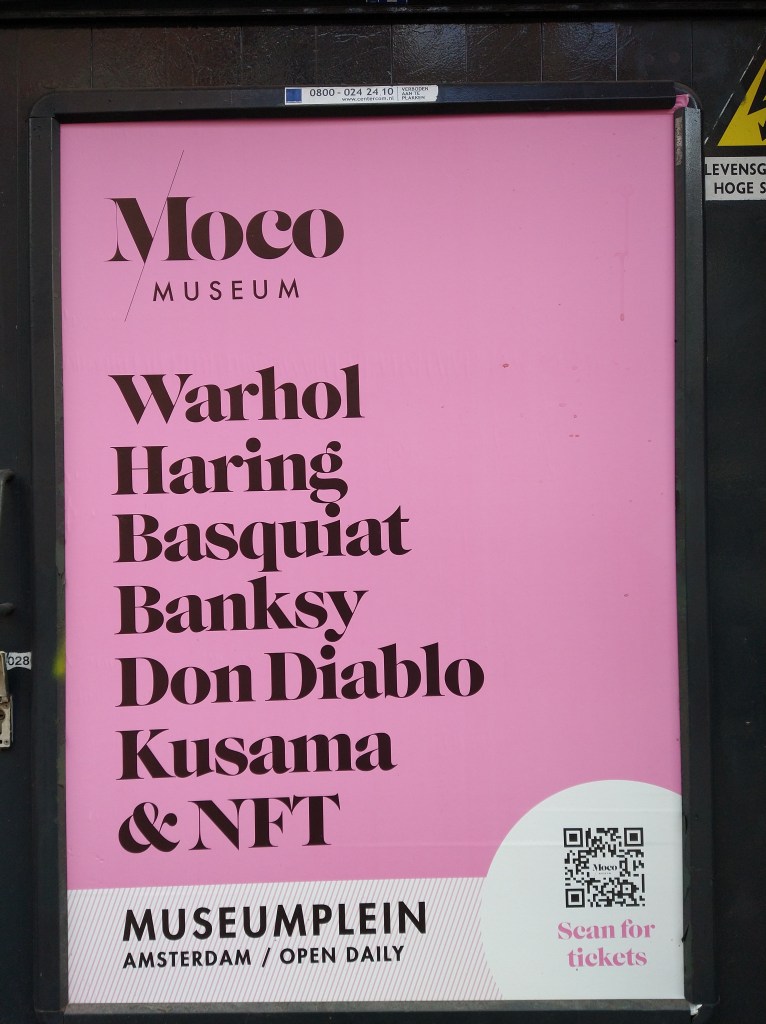
MOCO Amsterdam’s Listicle Curation: Kusama, Warhol, Banksy & Contemporary ‘Masters’ – plus Studio Irma Digital Immersion ‘like the one in Barcelona’

18 Friday Nov 2022

Posted by mtk in 2022, Amsterdam, art, Commentary, conceptual art, essay, installations, travel

≈ Leave a comment

Tags

Amsterdam, andy, banksy, Basqiat, Damien, Hirst, Jean-Michel, Jeff, Karthik, Keith, Koons, kusama, m.t., masters, MOCO, Modern, mtk, Warhol, yayoi

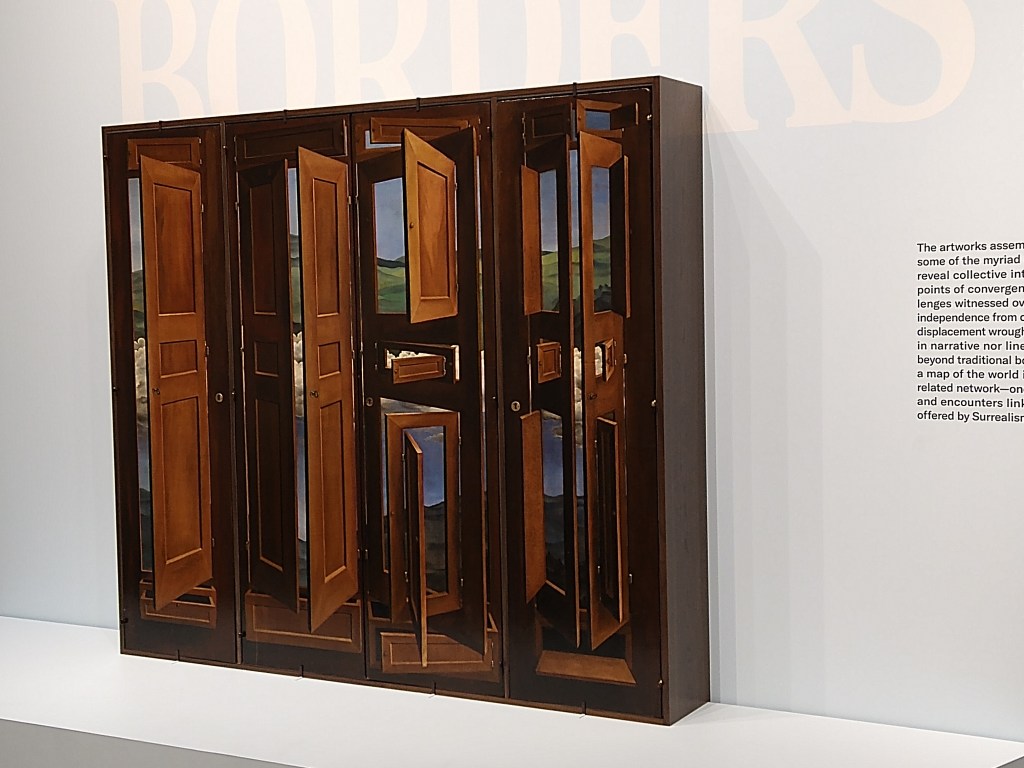
It was like walking into a university show in Soho in the ’90’s – Kusama, Warhol, Haring, Basquiat, Koons and Hirst – then suddenly it was like street stuff from the aughts: banksy, Stik, Invader.

Then Hayden Kays and KAWS and Takashi Murakami and Abloh is how it morphed into stuff I had only seen over the last five years because Google throws it up on my projector on heavy rotation ad nauseum thousands of miles from here – like Dream. (to old heads, I say big ups to Oaktown DREAM, rest in power). Then there was a Hirst and a Koons and a Warhol and a sweet roomful of Yayoi Kusama.

Moco Amsterdam is housed in the Villa Alsberg, a townhouse overlooking Museumplein in the heart of Amsterdam (between the Rijksmuseum and Van Gogh Museum). The building was designed in 1904 by Eduard Cuypers, nephew of Pierre Cuypers, designer of Amsterdam Central Station and the Rijksmuseum.

It is a good collection of very specifically well-known contemporary art, linked only by their pop. They don’t hide it, Moco calls itself a “boutique museum.” They have a second location in Barcelona. I heard the immersive digital art installation by Studio Irma was the same there.

What is this show exactly? I found out about it from posters slapped around town:

Wait – what? I was standing there in the street thinking that looks like clickbait for a museum exhibition produced by the marketing department. Here’s 4k video of my visit to Moco Amsterdam … check it:

Moco’s building was a privately-owned residence and one of the first family homes built along Museumplein. It was inhabited until 1939. Then, the house was let to priests who taught at the Saint Nicolas School in Amsterdam. Later it was converted into an office for a law firm.

Moco took over the Villa Alsberg and opened the museum in 2016, a traditional Amsterdam townhome on the museumplein, converted into a walk-through collection. But it is densely packed with the art and difficult to navigate when crowded. I was here on a rainy Thursday and it was claustrophobic. They should show less and allow for more space before the art.

Some artists received better purchase, weirdly (read: banksy). The one Warhol inclusion was pretty cool – diamond dust. Kusama is boss. Banksy’s tenner is great. The sculptures in the garden by Marcel Wander were precious. Studio Irma’s digital immersive art was low-tech, high-concept and cool. But it’s a densely installed collection. It was difficult to appreciate a large canvas by Hayden Kays, mounted in a small room. The Harings were also installed in a small square room, jammed with people. It was awkward.

Koons and Hirst were kind of just stuck in the hallways. Rooms were grouped loosely by era, but not distinctly so. They had these vague categories – Modern Masters, Contemporary Masters. It may have been an attempt to contrast-gain through equanimity but the install just felt crammed and poorly considered.

Prints were indicated to have been authenticated by the artists. The provenance for the Invader piece was credited to Jared Leto. Things that were new to me that I enjoyed were the playful works of Marcel Wander, the digital immersive stuff by Studio Irma and the large canvases (panels?) by The Kid.

The Kid, a contemporary painter using oils to create large photocollage-style paintings, had exquisite technique, though the work was conceptually immature. I wondered if there were painters in this land that spawned Rembrandt, Hals and Hooch and Vermeer and Van Gogh – and if so, what were they into? As a young artist, The Kid is into deeply personal concerns at the moment, but he will be good to watch evolve as a painter. I admired his use of pseudonym and rejection of nation-state in the establishment of his identity. Smart kid.

Ultimately, though, the artists were equalized in the hyper-capitalized gift shop that was tragically post-ironic: Campbell Soup Can skate decks beside decks that had banksy’s girl and balloon – where’s that dough going? Basquiat crowns as lapel pins. Is the Basquiat Estate or somebody who owns some weird rights making money here? on hundreds of euros worth of cheap, chinese-made kitschy derivative chunks of plastic? Is this a non-fungible token (NFT) emerging into totally fungible bullshit (TFB) in the museum culture?

Sure enough, the exibit includes NFT: The New Future, which they claim is, “Europe’s first dedicated exhibition space to the NFT phenomenon.” Beeple. It feels half baked. Exhibition spaces for non-fungible things.

Your ticket comes with a free gift from the museum and a discount for the gift shop. The shop was cringe. There were totes and hats and pins and cards and posters, lots of pink and the generalized motto of the museum: In Art We Trust. I mean. Look, it was a decent show or a weird collection of highly successful names in art since like 1990, in a house, but … what is this?

The curatorial sense here seems to be: throw as many recognizable names up as possible to herd in the stoned masses visiting the museumplein. Oh, and cater to the ever-increasing LGBTQ+ tourism euro, by featuring gay cultural icons and the color pink. This show wasn’t so much curated as listicled. Superficial.

By my observation, the corporate partners of high-profile museums in city centers of the colonial era are amidst a reformation, post-George Floyd – a Black Lives Matter effect is international. Woke culture expects more. Millennials are uninterested in the old narratives. Moco seems to seek to fill a void in perspective over traditional museums – that of street art and free expression. But superficial listicle curation for tourist-culture, and capitalist reduction of profound cultural expression, is gauche.

Moco resides somewhere between traditional museum culture and the modern art marketplace. It’s like a brick and mortar pop magazine on the museumplein.

from Amsterdam, I’m

M.T. Karthik

Over Millennia Heen, Google Translation of an MTK Essay

17 Thursday Nov 2022

Posted by mtk in 2022, Amsterdam, beliefs, dutch, essay, history, India, Letter From MTK, philosophy

≈ Leave a comment

Tags

Amsterdam, dutch, essay, google, Karthik, m.t., mtk, translate, translation

Original English 2020, Google Translated to Dutch and Posted today, 2022

17 januari 2020

De machines namen op subtiele wijze de controle over de tijd over van de mensheid en bijna niemand merkte het op.

Deze tientallige cultus van decennia, eeuwen en millennia veroverde de hele cultuur in een tijdsbestek van vijfentwintig jaar en werd het eerste salvo van de machines, met als hoogtepunt de overeenkomst tussen hen die bekend staat als 2000.

Ik ben geboren in een continue en oude cultuur , ongebonden aan dergelijke beperkingen, die tot intellectuele, filosofische, culturele en artistieke hoogten stegen. We vonden schaken uit en een concept van nul en vele andere filosofieën die zich in jullie (met terugwerkende kracht genoemde) eerste millennium vanuit de boezem van ons land naar buiten over de continenten verspreidden.

Totdat we op brute wijze werden onderbroken door de Europeanen in hun woeste eeuwen – van het gebruik van schepen om overal te reizen en iedereen te onderwerpen in naam van een ‘beschaving’ die we vonden en nog steeds vinden als invasief, lomp, fysiek, brutaal, kortzichtig, arrogant en onwetend.

Ze leerden wat ze wilden leren, waar ze baat bij hadden, maar snel … verdienen).

Dus ja, plotseling, precies in het midden van hun tweede millennium, gedurende vijf eeuwen, voerden ze deze wrede, onmenselijke, racistische projectie op de wereld uit, met als hoogtepunt landroof van continentale omvang dat probeerde honderden naties van miljoenen mensen te genocide, die ze ten onrechte indianen en zwarten noemden.

We keken naar dit alles vanaf de andere kant van de wereld, waar ook wij gedwongen werden de aanval van de Europeanen op te vangen, voornamelijk de Britten. Ook wij ervoeren toen de God-complexe en sluwe manipulaties die ze gebruikten om zichzelf te verheffen en ons tot onderwerping te buigen.

Dus, net toen hun tweede millennium ten einde liep en hun filosofie een zogenaamd postkoloniaal tijdperk schonk, behoren ook wij tot de honderden miljoenen die het juk van hun onderwerping van zich afschudden.

Mijn bestaan ​​strekt zich uit over millennia.

En ik weet niet wanneer je leeft, maar we worden nu dagelijks wakker om na te denken over de mogelijkheid van onze volledige en totale uitroeiing, niet noodzakelijkerwijs door toedoen van gewelddadige mensen, maar misschien als gevolg van wat de Europeanen in het halve millennium heeft gewerkt, in voor- en tegenspoed. Ze bouwen, beschermen en verzekeren hun clubhuis gebouwd van racistische sociale waarheden voor de 1%.

Hun afweer en onzekerheid in het langzame besef van hun tekortkomingen, verlamt ons, terwijl we proberen het langzame, eeuwenoude werk te doen … van het kalmeren, zelfs kalmeren van de oorlogszuchtige aard die zo snel opduikt in het gegrom.

Het wekt flitsende woede en gewelddadige explosies op die verwoestende gevolgen hebben voor honderdduizenden families en onschuldigen.

Het handhaaft blanke suprematie en raciale dominantie. Het gaat door en verergert verraderlijk door luid en op enorm internationaal volume degenen te promoten die voortdurend hun verhaal vertellen, met als hoogtepunt de lelijke rauwe kapitalistische boer die Trump is – een PT Barnum in het Witte Huis die denkt dat hij God is.

(beats)

Het legt degenen die parallelle geschiedenis vertellen stilletjes het zwijgen op – door ze te verwijderen uit de formele digitale basis-tien op het internet tussen de opgeslagen gegevens. En maakt ze impopulair door ze te overstemmen en op alle andere manieren die nodig zijn. Facebook is hiervoor de perfecte machine.

Dit betekent, in sommige gevallen, de waarheid op alle mogelijke manieren impopulair maken en de echte waarheid op alle mogelijke manieren vervangen door een sociale waarheid.

Ze hebben nog niet volledig ingezien dat wat ze hebben gedaan verkeerd was, ze verontschuldigden zich niet, toonden geen berouw, vroegen niet oprechte vergeving en probeerden niet te herstellen wat was.

In plaats daarvan hebben ze hun eigen geschiedenis gecreëerd die deze millennia labelt, de kalender vaststelt en wanneer de dag begint en eindigt en globalistische termen gebruikt voor woeste kapitalistische engagementen, waarin geld de almachtige is en oorlog om hulpbronnen eeuwigdurend is. Ze roepen zichzelf uit tot overwinnaars van deze continentale landroof en eeuwenlang slavenbezit.

Op de klok waaronder we leven aan het begin van hun derde millennium, drijven ze de motor van onze wereld waanzinnig vooruit in een steeds onhoudbaarder tempo.

Mijn naam is Karthik en ik ben een mens, geboren in Tamil Nadu, India, en de afgelopen 50 jaar opgegroeid in de Verenigde Staten van Amerika. Ik ben goed opgeleid en lees dagelijks een grote hoeveelheid contemporaine informatie en gegevens over onze tijd. Ik ben werkloos en gescheiden van alle ideologieën.

Ik verkoop niets en ik ben niet op zoek naar een baan.

Ik probeer alleen maar te communiceren hoe misselijk en beschaamd ik ben door de VS. En om je te smeken om te stoppen. Koppel los. Vertragen. Ga terug naar wie je werkelijk bent. Je bent verdwaald en rent in een razend tempo.

Als je verdwaald bent, ren dan niet in een razend tempo. 

Hou op.

Rustig aan.

Verzamel gegevens en evalueer de huidige situatie, wat er feitelijk voor u ligt.

Organiseer en herschik uw prioriteiten naar de onmiddellijke.

Goededag

01 Tuesday Nov 2022

Posted by mtk in 2022, Coastal Cali, Commentary, conceptual art, weather

≈ Leave a comment

Tags

all, beach, de, dia, eve, halloween, Karthik, las, m.t., mtk, muertas, ocean

I’m coming to Amsterdam. Next week.

A Parallel History, poem by M.T. Karthik © 2019

24 Monday Oct 2022

Posted by mtk in beliefs, Commentary, conceptual art, performance, poetry, politics

≈ Leave a comment

Tags

#mtkforever, 2019, history, Karthik, m.t., m.t. karthik, mtk, parallel

Inaugural City of San Francisco-Sponsored Public Archery Tournament at Golden Gate Park

16 Sunday Oct 2022

Posted by mtk in 2022, performance, S.F., sport, sports

≈ Leave a comment

Tags

archery, first, Francisco, gate, golden, inaugural, Karthik, m.t., mtk, official, park, public, San, sf, sponsored, tournament

San Diego Zoo on a Cloudy Thursday – Active Animals and Birds

06 Thursday Oct 2022

Posted by mtk in 2022, birds, Coastal Cali, fauna

≈ 1 Comment

Tags

african, anuhar, aviary, bear, bonobo, bonobos, darter, diego, fauna, Galapagos, grizzlies, grizzly, Karthik, lion, lions, m.t., mtk, orangutan, San, spoonbill, tortoise, zoo

MTK Riffs Upper Manhattan in Winter

20 Saturday Aug 2022

Posted by mtk in 2022, conceptual art, NYC, photography

≈ 2 Comments

Tags

art, christmas, journa;ism, Karthik, m.t., manhattan, Metropolitan, Modern, MOMA, mtk, Museum, new, NYC, Opera, photos, side, street, streets, trees, upper, xmas, york

This post is like a Table of Contents. It’s a meta-post of links to photojournalistic blogposts of my trip to New York six months ago, amidst the Omicron wave of Covid in Manhattan, for five days in late January. The links are in chronological order, and refer back progressively, like chapters about my trip.

Wednesday

I was able to film as we approached on the afternoon of January 19th, flying into New York City.

landing at La Guardia on a clear, sunny day.

Later that night I took Tom to the Metropolitan Opera to see Quinn Kelsey perform Rigoletto.

Thursday

The next morning it dropped thirty degrees and snowed. I spent two hours at the Museum of Modern Art catching the last days of exhibitions of work by Joseph E. Yoakum, Sophie Teauber-Arp and others.

The streets were weirdly quiet and absent of crowds – like I have never seen Manhattan before, even in the heart of winter. New York was dead.

sparsely populated Manhattan streets

That afternoon and evening I hung out at Summit One Vanderbilt, which was exceptional. Because I purchased the afternoon Premium ticket, the sunset ticket, with access to the elevator to the summit, I was able to hang out in the bar all evening, where I was joined in conversation and fun by rotating groups of tourists (wonderful conversations atop Manhattan), and the elevator to the highest viewpoint was amazing.

view from the bar atop One Vanderbilt

Friday

… was in the 30’s.

I hit the Metropolitan Museum of Art to see Surrealism Beyond Borders, which surprised me.

Saturday

had a perfect breakfast sandwich at Chez Nick in Yorkville, a place to which I returned – delicious spot over there. It was the week that people were putting their Christmas trees out for pick up. Many people and hotels instead, turned them into decorative features in front of their buildings.

Xmas tree dumping week.

Sunday

January 23rd was my chance by appointment only to catch the last days of the chronological exhibition on the ramps of the Guggenheim, Kandinsky at the Gugg. That was, quite frankly, an excellent exhibition.

Five days in Manhattan: Opera. Museums. Observation Bar. Streets. and tossed out Xmas trees – Lakshmi-auntie would approve.

That’s for New York.

Love,

mtk

Time Travel in ’22 with MTK – edition one

10 Wednesday Aug 2022

Posted by mtk in 2022, 22TimeTrav

≈ Leave a comment

Tags

2022, 22, Karthik, m.t., mtk, time, TimeTrav, travel, traveller

This site is a treasure trove of memories. I created it when I was 40, updated it when I was 50, and now at 55, I am blogging here contemporaneously. Today begins a series of posts entitled Time Travel in ’22 with MTK (categorized 22TimeTrav) in which we link back to the archive to posts that are on or around today’s date.

ON THIS DAY I …

30 Years Ago … photographed families on two-wheelers in Taiwan.

25 Years Ago … mailed a ‘letter to the editor’ of The New Yorker magazine.

17 Years Ago … recorded cicadas in Kamakura, Japan.

12 Years Ago … wrote the very first post for Giants Baseball Corner, entitled, “Eleven to Eleven in the bottom of the Eleventh,” it’s a perfect memory.

10 Years Ago … took a photo of summer flora in Oakland.

8 Years Ago … wrote about my concerns for the Buddy Calk Trailhead of the Leon Creek Waterway in San Antonio, Texas.

5 Years Ago … wrapped up Giants Baseball Corner, it went on hiatus for three years, and wrote an explanatory post about what you could find here, since that was the year I added all the other stuff.

There you go: thirty years of August tenthishness in:

Taiwan, NYC, Japan, San Francisco, Oakland and San Antonio.

with love from,

M.T. Karthik

Space and Time Traveller

Sami Stevens Covers Both Sides Now

10 Sunday Jul 2022

Posted by mtk in 2022, jazz, music, S.F.

≈ Leave a comment

Tags

both, cover, covers, Francisco, jazz, Joni, Karthik, Kaz, m.t., Mitchell, mtk, now, Sami, San, sf, sides, song, Stevens

Light Saber Battle Over San Francisco in the Fog

03 Friday Jun 2022

Posted by mtk in 2022, architecture, art, S.F.

≈ Leave a comment

Tags

Francisco, graphics, Karthik, light, m.t., mtk, saber, Salesforce, San, tower

Keyon Harrold at The Black Cat

02 Saturday Apr 2022

Posted by mtk in 2022, jazz, music video, S.F.

≈ Leave a comment

Tags

black, Cat, Francisco, Harrold, jazz, Karthik, Keyon, m.t., mtk, San, this, trumpet, way

Stay this way

Surrealism Beyond Borders at The Met, Friday

21 Friday Jan 2022

Posted by mtk in 2022, art, journal entries, journalism, NYC

≈ 1 Comment

Tags

Aime, Alberto, Aleksander, Alexander, Andre, art, Beyond, Boghossian, Borders, Cesaire, Dorothea, Giacometti, Greil, Harue, Helen, Joans, Joyce, Karthik, Koga, Lipstick, Lundeberg, m.t., Magritte, Mansour, Marcus, Metropolitan, mtk, Museum, Oelze, Penrose, Rene, Roger, situationists, Skundar, Surrealism, surrealists, Suzanne, Tanning, Ted, Traces

Everybody in my generation remembers chapter ten of the late great Greil Marcus’ book, Lipstick Traces, which came out my senior year of university (1989). Chapter ten dealt with the birth of the situationists, via the Easter Sunday performance at Notre Dame in 1950. Marcus wrote that the Surrealists, then ensconced figures in the art world in Europe and New York, claimed the act as that of their protégés, while the artists themselves rejected the notion. Surrealism was over.

The distinction between the situationists and the Surrealists and Dada was for us, an awesome thing to consider that way. The grandparents crowed about them and they rejected their successful grandparents. As a result of being educated from that perspective – a college kid looking at the 1950’s and learning from Marcus how this was a part of the birth of punk – my perception of Surrealism was, if not tainted, at least given greater contrast.

A bunch of us 20-year-olds in the early 90’s became fascinated by the situationists and DeBord. We were watching as they built the cities into grand stages for the Spectacle all throughout that decade. The Millennium was the Spectacle. Until it was 9/11. Everything DeBord foresaw was right in front of us. They even pulled down a few.

<<Flash Forward to 2022>> 

If you want to call Booklyn, a fine arts collective dedicated to book arts, you dial my first number in New York. I was romantic about DeBord back then and so refused traditional entry into the group (or any group), but participated in its birth and establishment in Brooklyn in its early days. Booklyn is why many artists I know are in important collections around the country and the world. The collaboration was good and became incredibly important after September eleventh.

I called Booklyn when I dropped in to NYC and Marshall Weber called me back promptly. He chastised me for coming to town to support businesses that Booklyn would be protesting. He included the MOMA and the Met and the Opera. I didn’t bother to mention I was going to the Gugg the next day.

It is to say, the Metropolitan and MOMA have a labor problem. They have a diversity problem. They have a problem reframing the collections in the era of Black Lives Matter and MeToo and LGBTQ+ rights.

The Joseph E. Yoakum retrospective at MOMA I attended the day before and the Surrealism Beyond Borders exhibition I would be attending today were trying to address the issue: the Yoakum show was directly engaging a Black artist and the Metropolitan’s Surrealism Beyond Borders attempted to show how Surrealism was embraced by diverse groups of people around the world in various states of revolution. It sought to internationalize and radicalize visitors’ perception of Surrealism. It was closing at the end of the month. I went.

Armoire Surrealiste, Marcel Jean, (1941)

Sidenote: Again, I had to schedule a time for my visit as the museum attempted to encourage social distancing by timing the number of entrants. The temperature was in the 30’s and I was fully bundled up.

bundled up for freezing temps

Only trouble is there was no coat check! Yet another victim of the pandemic was a coat check for all your winter gear when visiting the museums. It was hot inside and we visitors all had to lug all this winter gear around, ha!

Of particular interest to me was the area dedicated to Black Surrealists. I did not know how deeply Aime Cesaire had embraced Surrealism. Originals of his journal Tropiques (1941)

and Retorno al Pais Natal were a thrill to see.

The influence of Surrealism was apparent.

a quote from Suzanne Cesaire summarizes the cross-pollination

was also very deeply touched by this portrait of Charlie Parker by Black Canadian-American Surrealist Ted Joans, entitled Bird Lives! (1968)

But there was so much more from around the world. This shocking work, entitled Tagliche Drangsale (Daily Torments) by the oft-forgotten German Surrealist painter Richard Oelze (1900 – 1980), was painted a year after the National Socialists assumed power in Germany, (1934)

There was this brilliant Giacometti

Cage (1930-31), Alberto Giacometti

Alexander “Skunder” Boghossian was an Ethiopian-Armenian painter and art teacher. He spent much of his life living and working in the United States. He was one of the first, and by far the most acclaimed, contemporary Black artists from the African continent to gain international attention. Here’s his Night Flight of Dread and Delight, Skundar Boghossian, (1964).

The Southern California artist, Helen Lundeberg, often credited for movement to Post-Surrealist work, was represented here in a Surrealist painting – Plant and Animal Analogies, (1934 -35).

And an early Surrealist work by the American painter, printmaker, sculptor and writer, Dorothea Tanning – Eine Kleine Nachtmusik, (1943).

Roger Penrose was included with this sculpture, entitled The Last Voyage of Captain Cook, (1936-7)

It was my first time seeing the Exquisite Corpse in person.

Cadavre Exquis: Figure,  Andre Breton, et al (1928)

And this great Magritte, I was born the year he died, you know.

La Duree Poignarde (Time Transfixed), Rene Magritte (1938)

And one of my all-time favorites

Umi (the Sea), Koga Harue, (1929)

Salvador Dali’s Lobster telephone

Telephone homard (Lobster Telephone), Salvador Dali from (1938)

There was much more to consider in the exhibition, website here.

But one piece stood out amongst the many I saw in my first visit to museums since the coronavirus pandemic struck. It was an obscure sculpture made of nails and sponge by French artist Joyce Mansour and it was entitled Objet Mechant, which means Nasty Object. It looks shockingly like the nastiest respiratory virus in human history. Yet it was made 50 years before Covid-19 struck.

Untitled (Objet mechant) (Nasty Object), Joyce Mansour (1965 – 69)

Pretty good exhibition. so says I.

Summit One Vanderbilt, Thursday Afternoon

20 Thursday Jan 2022

Posted by mtk in 2022, NYC

≈ 1 Comment

Tags

Karthik, m.t., mtk, one, OneVanderbilt, Summit, Vanderbilt

In the summer of 1997, I went as high up as I’ve ever been in a building in Manhattan, 1500 feet, to see “Little” Louie Vega, the DJ and producer, play his weekly Wednesday night set at Windows on the World in World Trade Center One, the North Tower. The city glittered below us as the bumping bass thumped the glass windows. Four years later they fell.

It wasn’t PTSD or fear of heights or anything like that, I just hadn’t been up high over Manhattan again. I didn’t ever visit the new observation deck of the Empire State, at around 1200′ or the so-called Freedom Tower – I just never prioritized it when was in town. So when I read about Summit One Vanderbilt, that opened in December of 2021, I was excited to check it out. It had only been open a month when I arrived.

One Vanderbilt is a 93-story skyscraper at the corner of 42nd Street and Vanderbilt Avenue in Midtown. Designed by Kohn Pedersen Fox, the building was proposed by developer SL Green Realty as part of a planned Midtown East rezoning in the early 2010s. The skyscraper’s roof is 1,301 feet (397 m) high and its spire is 1,401 feet (427 m) above ground, making it the city’s fourth-tallest building after One World Trade Center, Central Park Tower, and 111 West 57th Street.

some stills

I bought a ticket for the Thursday afternoon timeslot, which would allow views not only of sunset, but of the city at night. While it had snowed earlier in the day, the snow had stopped, the sun was out and the temperature had risen to the lower 30’s. But way up at the top of Summit One V, there was snow!

snow at 1200′

Here’s a video of my experience up until sunset:

And some stills from the evening :

Joseph E. Yoakum and Sophie Taeuber-Arp at MOMA, Thursday Morning

20 Thursday Jan 2022

Posted by mtk in 2022

≈ 1 Comment

Tags

abstract, Arp, art, chicago, concrete, drawings, e, Exhibition, geometric, Joseph, Karthik, landscapes, m.t., marionettes, Modern, mtk, Museum, new, NYC, paintings, Sophie, Swiss, Taeuber, Taeuber-Arp, Yoakum, york

When I awoke on Thursday the 20th of January of this year, the temperature in the city had dropped thirty degrees from the previous afternoon when I arrived. It was 14°F and snowing. It would be my first day walking around in Manhattan. I wasn’t ready for twenty blocks in that. It’d warm up later, but to make my museum time I’d have to take a cab.

Protocols of the pandemic required me to buy tickets not only to attend the opera, but the museums as well. A week earlier, I had made the first available appointment at MOMA, set for 10am, expressly to see the last week of the Joseph E. Yoakum retrospective exhibition.

The thinking was to let small groups in, separated by twenty or thirty minutes to reduce crowding and encourage social distancing. We were all masked, vaccinated and boosted, also by protocol. All visitors had to make appointments and book time slots.

My cabbie, Abdullah, turned down WBAI on the radio to talk about how things are in Manhattan, now. Of course he didn’t live in Manhattan, he couldn’t afford it. It was becoming not even worth it to come to town because nobody was around to flag cabs.

He told me he sees no one in the streets except cabbies and delivery drivers or riders. He said nobody goes outside – they ordered everything to come to them. It had been like that for more than a year.  “You have to be a millionaire to live in the city. It’s a city only for the rich,” he said, “We used to call Fifth Avenue Millionaire’s Row, now we have Billionaire’s Row.”

Abdullah was referring to the new skyscrapers at the southern end of Central Park, like Steinway Tower, 11 West 57th, on the most expensive street in the world. When you consider the building’s height-to-width ratio, it’s the world’s skinniest skyscraper. The 1,428-foot tower is 24 times as tall as it is wide, with only one residence on each floor.

I saw the Billionaires Row skyscrapers briefly from the plane, but the skinny skyscrapers were, in fact, a little difficult to spot from street level.

Later in the day I’d be seeing them again from above. I had booked the sunset premiere ticket to see the new gallery of windows and mirrors floating above the city that had just opened the previous month – the observation floors of One Summit Vanderbilt.

From the street, though, I only got one decent shot of Steinway Tower on my walk that day.

When Abdullah and I arrived at MOMA, truly lovely tiny snowflakes fell swirling on a light breeze – light, pretty flakes that didn’t stick, just fell and in a few seconds disappeared. I joined the line awaiting in front, yielding my space under cover to an older couple since I had my peacoat and hat.

The flecks of white intermittently caught on the coat and disappeared as we made small talk, masked, in the light snow awaiting the Museum of Modern Art to open on a Thursday morning. They came in from Princeton, where they lived. She had once been a docent at the MOMA. We chatted about NFTs, art, and compared NYC and San Francisco now to times past in the lightly falling snow until the museum let us in.

Joseph E. Yoakum at MOMA

I had read about Joseph E. Yoakum and the retrospective exhibit at MOMA in The New Yorker and it sounded fascinating and inspiring. I mean who was this guy, who suddenly appeared on the art scene wholly composed as an exhibiting visual artist at the age of 76?

At the age of 55, I find myself running out of steam. Dad died and I handled it. My kid is grown and doesn’t want anything to do with me. Almost nobody reads my stuff or appreciates my art. Certainly far less than when I was at my peak. I keep making and writing because I have always done so, independent of an audience, but I grow weary of ignonimity. And here’s this guy … in his 70’s!

Joseph Elmer Yoakum (February 22, ca. 1890 – December 25, 1972) was a self-taught landscape artist of African-American and possibly Native American descent, who drew landscapes in a highly individual style. He was 76 when he started to record his memories in the form of imaginary landscapes, and he produced over 2,000 drawings during the last decade of his life.

They are mostly of small dimension, done with pen, pencil, ink and have scripted titles.

  1. Mt Brahmoi, Nassau Bahama Island
  1. Mongahalia River Falls near River Side West Virginia
  1. Crater Head mtns of Honolulu, Hawaiia (Nov 24 1969 stamp)
  1. Arabian Desert Near Sudi Arabia
  1. Flying Saucer in 1958
  1. Twin Crater Mts near Lima Peru
  2. The Cyclone that Struck Susanville in year of 1903 (Jan 22 1970 stamp)
  3. Jessie Willard 2nd Challenge to Champion Fight with Jack Johnson (for World’s Heavyweight Prize Fighting Championship in year 1917 and in —- 1921) (Dec 15 1969 stamp)
  4. Mt Baykal of Yablonvy Mtn Rangenear Ulan-ude near Lake Baykal, of lower Siberia Russia and Asia (hand dated 8/14 – 69)
  5. Rock of Gibraltar
  6. English Channel between Southampton England and LeHavre France (3/11-69)

Yoakum started drawing familiar places, such as Green Valley Ashville Kentucky, as a method to capture his memories. However, he shifted towards imaginary landscapes in places he had never visited, like Mt Cloubelle of West India or Mt Mowbullan in Dividing Range near Brisbane Australia.

Drawing outlines with a ballpoint pen, rarely making corrections, he colored his drawings within the lines using watercolors and pastels. He became known for his organic forms, always using two lines to designate land masses.

It was a great show. I am glad I caught it. Afterward, I spent a couple of hours catching up with stuff on rotation from the permanent collection.

Saw a guy contemplating a Pollock

I also caught the last days of an exhibition of the work of Sophie Tauber-Arp, which was remarkable.

Sophie Henriette Gertrud Taeuber-Arp (19 January 1889 – 13 January 1943) was a Swiss artist, painter, sculptor, textile designer, furniture and interior designer, architect, and dancer. Born in 1889, in Switzerland, the daughter of a pharmacist, the family moved to Germany when she was two years old.

Some years later she began attending art schools, and moved back to Switzerland during the First World War. At an exhibition in 1915, she met for the first time the German-French artist Hans/Jean Arp, whom she married shortly after. It was during these years that they became associated with the Dada movement, which emerged in 1916, and Taeuber-Arp’s most famous works – Dada Head (Tête Dada; 1920) – date from these years.

Cross on Red Ground (tablecloth) 1924, wool

The weaving was first created for use as a tablecloth, to be seen from above and circumnavigated. In 1926, in an essay in Das Werk, the journal of Swiss Werkbound, an association of designers, the architect Hannes Meyer singled it out as representative of the “new world of forms,” that artists were creating for modern life.

Equilibrium 1934, oil on canvas 

Taeuber-Arp’s circles seem to hover over, perch on, or fall from the black lines. The green circle on the right appears to have been tossed in the air toward the edge of the canvas, directed by the skewed truncated line below it. Taeuber-Arp spoke of spoke of such play of circular forms in her work as boulisme (balls) or Petanque. The shapes seem to react to one another creating dynamic designs that give the impression of a freeze frame in an abstract film where the action has been temporarily arrested.

There was stained glass work that pursued the same geometric themes.

In the winter of 1918, Tauber-Arp was commissioned to produce marionettes and stage sets for an adaptation of the 18th-century play King Stag. These were particularly amazing.

Museum curator Laura Braverman wrote:

The marionettes broke away from folk traditions in puppet making, in that puppets at the time were supposed to be as lifelike as possible. You were not supposed to see the way in which they were made, but Taeuber-Arp really left all of that visible.

Curator Lynda Zycherman added, “What is, I think, unusual is the shapes themselves depicting human bodies in geometric ways. The face painting is extraordinary. Sophie Taeuber-Arp traced the shapes in pencil and then painted in between the lines. And if you look closely at most of the facial features, you can actually still make out the pencil lines.”

The Arps moved to France in 1926, where they stayed until the invasion of France during the Second World War, at the event of which they went back to Switzerland. In 1943, Sophie Taeuber-Arp died in an accident with a leaking gas stove.

Despite being overlooked since her death she is considered one of the most important artists of concrete art and geometric abstraction of the 20th century.

mtk and yoko say …

Tom and the Opera, Wednesday, Jan 19th

19 Wednesday Jan 2022

Posted by mtk in 2022

≈ 2 Comments

Tags

2022, City, curse, Karthik, m.t., madball, manhattan, Metropolitan, mtk, new, six, tom, york

I cannot disclose why I went to New York in late January as I’m constrained willingly by the contract I signed the day I left from La Guardia just hours before the city was hit by a snowstorm carried on winds of the la niña winter polar jet stream, and snowbound. 

I can say it’s an NFT play, signed between me and my former neighbor in Brooklyn, Tom.

“Either you go tomorrow,” Tom agreed,”or you ain’t leavin’ til next week.”

My flight of escapees had mostly bought their tickets within the last 48 hours, with a weather eye on the polar jet stream. We were routed to Denver. The storm shut the city down while we were in the air. I had been in New York City and out in Long Island for two weeks.

*****

Double-dose Pfizer-vaccinated in May of ‘21 and boosted in November, I decided in December of last year that 2022 was going to be different. I was going to travel. I would help the economies of some places I haven’t been in a while. I’d spend some money in some places in our country that I respect and love for cultural and intellectual richness.

I made a new year’s resolution to spend more days of 2022 out of the house where I have been for the last five years than in it. Unlike most of you, for whom the ‘quarantine’ was at most a year and a half of house-boundedness, at that point, I had been bound for several years in a house, in another state from my beloved NorCal, as I cared for my father until he died, allowing him to pass the way he wished, in his home. I was eager to get back on the road, and eventually, home.

I set aside money from my small inheritance for this purpose. I granted myself a year of me-time, to travel, write, read and consider places to live, in the wake of my father’s death.

I chose New York first, and landed on the nineteenth day of the new year, amidst the Omicron wave. I was a New Yorker for five years at the turn of the millennium, so I’m prepared with specific goals when I visit Manhattan. It’s a habit learned from my Lakshmi-auntie, who lived in Parsippany for five decades and used the island, and indeed the whole city, with precision and elegance. She still drove into town herself in her 70’s.

I watched her use Goings-On-About-Town in The New Yorker, and Time Out and the Sunday NYT and the Voice, to be fresh, and even avant-garde, to her last days. She showed me the fastest ways to get in and out of the city, down-low parking spots, old-school joints. When I moved to the waterfront in Greenpoint, it was from her place, where I had been staying in the wake of the passing of her husband, my Surya-uncle, back in ‘97. It snowed in Brooklyn that winter.

Now, it was a clear, sunny Wednesday afternoon as I flew into La Guardia. It was in fact the warmest day of the year thus far in the city – 44° F, almost no wind, great visibility. The pilots swung wide to allow us a vantage of the cityscape – the bridges, high-rises and skyscrapers, just a few thousand feet below.

There’s the east river. Brooklyn Bridge, Manhattan Bridge, Williamsburg bridge.

Where I used to live in Greenpoint no longer has a cityscape view because there are massive condominiums there that can be seen in this shot. That bright, shining white skyscraper in lower Manhattan is One Manhattan Square. Extell Development Company sold 100 units there last year. They also sold 100 units at Brooklyn Point, which is the tallest residential building in Brooklyn.

One Manhattan Square and Brooklyn Point, each sold over 100 units in 2021 for a total of more than $400 million in sales. Extell claims it’s the only developer in New York to sell more than 100 units at two separate buildings in a calendar year. The units sell for between $850k – $3m.

When I was a New Yorker, the city taught me how to move through it. I didn’t know what I was going to find now, though, amidst the Omicron wave of Covid-19. New York was a city that had been ravaged in the first Spring of the nastiest respiratory virus in human history, because of its density and diversity – a global city, with international reach.

I came prepared, with my vaccine card showing two shots and the six-month booster, and my matching i.d., with N95 masks. Temperatures were expected to drop later that evening. The forecast was for highs in the teens and low 20’s for the rest of the week. I brought thermals, wool scarf, an overcoat and a fur hat – all of which were useful.

But I made a tight, localized agenda that had me entirely in Upper Manhattan. On my last day, I planned to walk to the Guggenheim to see the chronological exhibition of Kandinsky on the ramps at the Guggenheim, so I rented a hotel a few blocks away on the Upper East side – 92nd street and 1st Ave, near Yorkville. I landed, cruised through baggage, caught a cab to my hotel within 20 minutes, snagged a couple-hour nap, then showered, shaved and suited up for the opera.

Tom and the Opera

Tom and I hadn’t seen each other in almost 20 years. He is an energetic, native Long Islander, who has lived and worked in the city for years. He is as comfortable in the city as any of the boroughs or out on Long Island. He was my neighbor in Brooklyn 20 years ago, when he worked in commodities, on the floor at the exchange on Wall Street. He was there that fateful morning, besuited, running and hustling others away from the crumbling concrete and drifting ash and dust. We saw each other a few days later.

Tom and I caught up last year and I learned he had been through some rough times.  But he told me something else that shocked me, personally. He said that nearly 20 years before, I had given him a carved stone or wood necklace and had told him it was powerful. He wasn’t sure if he did something wrong or if it was just the object itself, but he felt that it had cursed him.

That’s no joke. You don’t see someone for years and you are catching them amidst heavy difficulties all around and they tell you that you gave them a totem that may have cursed them – have to take that seriously.

When I looked at the schedule for the Met Opera, I knew immediately I had to take Tom. They were performing Rigoletto. It’s a tragedy about a hunch-backed jester, a pathetic figure, who, upon being cursed by a courtier, believes in and fears the curse, then unwittingly aids in the accursed events which befall him.

The last line of the opera is Rigoletto’s bewildered wail as he cradles the body of his dead child, “La Maladizione!” – which means, “The Curse!”

The first time I went to the Metropolitan Opera it was February of 1998. Two dozen years later, I decided to splurge. I purchased Parterre Center Box seats. I had previously only ever sat in the balconies. This was special.

To enter we had to show ID that matched a proof of vaccination card and if the last dose had been over six months, a stamp for a booster. Masks were mandated. Before the curtain rose, the General Manager of the Metropolitan Opera, Peter Gelb, masked, came out on stage with a microphone and said, with a sigh of relief, “everyone in your program is performing tonight,” the confirmation that we would be seeing Quinn Kelsey and Rosa Feola . There was resounding applause.

The Metropolitan Opera has suffered, like every arts institution, during the pandemic. 

This production received great reviews for Conductor Daniele Rustioni and promotional material all featured the open throated face of Quinn Kelsey in clown makeup. The baritone has made a name for himself performing Verdi, and in particular, portraying the beleaguered Rigoletto. The program read: “Quinn Kelsey, a commanding artist at the height of his powers, brings his searing portrayal of the title role to the Met for the first time,” but Kelsey had been unavailable for performances on the 9th and 14th. There was a buzz from the hope we would get to see him with the soprano Rosa Feola, a pairing about whom much had been written.

The set was unique. Though the original opera was based on a story by Victor Hugo set in the mid 16th century, the libretto by Francesco Maria Piave, was set in pre-Revolutionary 19th century France. The current staging at the Met uses the Weimar Republic as the context, contending the times were comparably beset by careless inequity.

Production is directed by (Tony-award winning director) Bartlett Sher – the New York Times has described him as “one of the most original and exciting directors, not only in the American theater but also in the international world of opera” – and Set Designer Michael Yeargan. The costumes, designed by Catherine Zuber, were thus 20th c. German.

The set had a massive revolving structure upstage that allowed for feature performances downstage, nearer the audience, for greater intimacy. There was a full apartment above a bar in one set, and Donald Holder’s lighting was agile, an active element of the production, spotlighting soloists seamlessly as they employed the entire stage.

Piotr Beczala, charged with the most famous role, Duke Mantua, was good. But a standout performance, in addition to Feola and Kelsey, belonged to Andrea Mastroni, the bass singing the part of the murderous blaggard Sparafucile.

What always amazes and delights me about the opera is that there are no microphones. The orchestra is not amplified, neither are the singers. We all sit quietly, no cell-phones or beeps or bells or whistles to bother us, and we focus for two and a half hours on these live performers making music in an extravagant production – entranced. People try not to even cough during the acts. I love that.

Kelsey was masterful.

Tom and I dined at The Smith, across the street from Lincoln Center and shared a blunt as we sauntered to the performance – it’s legal now to smoke a joint on the street in New York. It wasn’t when we were neighbors – not that it stopped us much then, we were just furtive.

Now we just stood by the fountain on the plaza, in front of the big Chagalls and the other patrons and the cops and shared a blunt. Tom is a blunt smoker, which is not my style, but when I am with him I partake.

He went to Fordham, which is just next door to Lincoln Center. He pointed out his old dormitory building, as we smoked. We shared a blunt before going in, and again at the intermission. To be clear, quality marijuana doesn’t attack my memory of the opera, it enhances it.

Six Fingas and Madball

We left singing:

La donna è mobile/ Qual piuma al vento,

muta d’accento/ e di pensiero.

Sempre un amabile / leggiadro viso,

in pianto o in riso / è menzognero

**END Wednesday January 19th**

Ten days later, I checked the tide tables and  took the accursed totem that I gave Tom twenty years before out to Lido Beach at just past high tide, recited the gayatri mantram, and chucked the thing out to be taken away by the sea.

Straddling Millennia

17 Monday Jan 2022

Posted by mtk in 2022, Commentary, conceptual art, essay, literature

≈ 1 Comment

Tags

AI, essay, Karthik, m.t., machines, millennia, mtk, straddling, time

January 17, 2020

The machines subtly took control of time from humanity and almost no one noticed.

This base-ten cult of decades, centuries and millennia seized all of culture in the space of five score years and became the first salvo of the machines, culminating in the agreement among them known as 2000.

I was born into a continuous and ancient culture, untethered to such limitations, which soared to intellectual, philosophical, cultural and artistic heights. We invented chess and a concept of zero and many other philosophies that spread from the bosom of our land outward across the continents in your (retroactively named) first millennium.

Until we were brutally interrupted by the Europeans in their savage centuries – of using ships to travel everywhere and subjugate everyone else in the name of a ‘civilization’ we found and still find invasive, crass, physical, brutish, short-sighted, arrogant and ignorant.

They learned what they wanted to learn, what profited them, quickly though … and were great at taking credit for others’ thoughts and ideas by dehumanizing them (for, among other things, the unwillingness to debase oneself to damaging another for one’s own gain).

So yeah, suddenly, in the exact middle of their second millennium, for five centuries, they administered this vicious, dehumanizing, racist projection upon the world, culminating in continental-sized land grabs that attempted to genocide hundreds of nations of millions of people, whom they mistakenly called Indians and Blacks.

We watched all this from the other side of the world where we too were forced to absorb the Europeans’ assault, – mostly the British. We, too, then experienced the God-complex and scheming manipulations they used to elevate themselves and bend us into submission.

Thus, just as their second millennium came to a close, and a so-called Post-Colonial Era was granted by their philosophy, we are also among the hundreds of millions that shook off the yoke of their subjugation.

My existence straddles millennia.

And I don’t know when you’re living, but we now awake daily to contemplate the possibility of our complete and total eradication, not necessarily at the hands of the violent, but perhaps as a result of what the Europeans’ half-millennium has wrought, for better or worse. They build, protect and insure their clubhouse built of racist social truths for the 1%.

Their defensiveness and insecurity in the slow realization of their failings, cripples us, as we try to do the slow, age-old work … of pacifying, indeed tranquilizing the bellicose nature so quick to emerge in the grunts.

It awakens flash anger and violent explosions that have devastating effects upon hundreds of thousands of families and innocents.

It maintains white-supremacy and racial dominance. It continues and worsens insidiously by promoting loudly and at huge international volume, those who continuously relate their narrative, culminating in the ugly raw capitalist burp that is Trump – a P.T. Barnum in the White House who thinks he’s God.

(beats)

It quietly silences those telling parallel history – by eliminating them from the formal base-ten digital record in the Internet amongst the saved data. And makes them unpopular by drowning them out and by any other means necessary. Facebook is the perfect machine for this.

This means, in some cases, making the truth unpopular by any means necessary and substituting a social truth for the real truth by any means necessary.

They have not yet fully seen how what they have done was wrong nor apologized nor shown remorse nor asked genuine forgiveness nor sought to restore what was.

Instead they have created their own history that labels these millennia, establishes the calendar and when the day begins and ends and uses globalist terms for engagements that are ferociously capitalist, in which money is the almighty and war for resources is perpetual. They declare themselves the victors of these continental land grabs and centuries of slave-ownership.

On the clock we live under at the dawn of their third millennium, they drive the engine of our world madly forward at an increasingly unsustainable pace.

My name is Karthik and I am a human born in Tamil Nadu, India, and raised in the United States of America for the past 50 years. I am well-educated and read daily a large amount of contemporaneous information and data about our times. I am unemployed and divorced from all ideology.

I am not selling anything and I am not looking for a job.

I am merely trying to communicate how sickened and embarrassed I am by the USA. And to beg you to Stop. Unplug. Slow down. Get back to who you really are. You are lost and running at a breakneck pace.

When you’re lost, don’t run at a breakneck pace. 

Stop.

Calm down.

Collect data and evaluate the current situation, what is actually in front of you.

Organize and Re-order your priorities to the immediate.

Immediately, a quarter of a million and rising to a third of a million Americans are dying, actively, of an unprecedented viral pandemic because we, as towns, cities, states and a nation have failed so completely to organize consistent, universal policy to control spread.

Stop.

Think about what YOU are doing. Each day. To prevent spread of the Covid-19 coronavirus and monkeypox.

Whites Must Be Vetted

06 Thursday Jan 2022

Posted by mtk in beliefs, Commentary, conceptual art, elections, essay, etiquette, history, Letter From MTK, public letters, religio, thoughts

≈ Leave a comment

Tags

Karthik, m.t., mtk

In the Spring of that fateful year, 2020, my father died, at 90, of natural causes. He was a devoted American, whose contributions to the U.S. were immense, yet in some ways, immeasurable. He passed on a Monday and the global Covid-19 pandemic struck that actual week. Protocols meant I could have no public funeral service. Only five were allowed to attend: the brahmin, myself and three of dad’s former students. Six weeks later, George Floyd was choked to death, by police in Minneapolis Minnesota. Thousands marched, pandemic be damned.

George Perry Floyd Jr. was an African-American man who was openly and publicly murdered by a police officer in Minneapolis, Minnesota, during an arrest after a store clerk suspected Floyd may have used a counterfeit twenty-dollar bill.

He was lying inert and unarmed on the ground, and Derek Chauvin, one of four police officers who arrived on the scene, knelt on Floyd’s neck and back for 9 minutes and 29 seconds and choked him to death. It was filmed, and witnessed by many. The reaction to the video of George Floyd’s choking impacted the world.

Five months later Trump lost. His followers attempted a violent coup of the peaceful transfer of power to Biden. They attempted nothing short of a violent revolution against democracy in our country. Seven people died attempting to protect the Capitol and formal structures of our government from an amped-up, violent horde, whipped into a frenzy by the former President, who fomented them and the nation with utterly false accusations of election and voter fraud in the 2020 election. They continue to do this. There is a film called 2000 mules that is complete and total horseshit.

It would be like the last gasp of a terrible, ugly, racist monster swinging wildly as it goes down, except it still swings – now less publicly, without the perceived protection from a white supremacist in the White House. Ted Cruz and Ron DeSantis and Marjorie Taylor-Greene and others seek to fill the Trump-sized void, to keep the drumbeat of their racism and hate going. Their intention is nothing short of a fascist, White, Christian State.

There is significant concern that the monster has gone underground and even now plots a very real and significant coup, possibly even a civil war. Rest assured, the ugly beast – born from genocide and slavery, and cemented by white supremacy and abject racism – has dominated this nation for three hundred years. It will not go quietly.

We are and have been overdue to address it. Having calculated the impending minoritization of the so-called ‘White’ American for decades, the writing has been on the wall. The racist beast amongst them feels cornered, misunderstood and plans to retaliate against truth, justice and humanity.

These are White Americans who believe that:

  1. This is the greatest country in the world, and became so only because whites left Europe and founded a place where they could place themselves in control; where they could create their own white-supremacist thing, murdering and enslaving those they deemed heathens without recrimination. They consider Whites to be a race that ‘authored’ the USA, with greater rights than all other Americans.
  1. Black Americans are receiving far more protection and opportunity than they should because they make up only a small percentage of the population compared to whites. White Americans I know personally have said this to me over decades. It is a complete disconnect with the facts of Black American life.
  1. Minorities and new immigrants do not deserve protection of any kind. Those who come here should completely embrace their lower place in a hierarchy. If they expect to climb, they have to play by rules which praise White-American culture, and that which it ordains, above all else. It doesn’t matter if the rules contradict the immigrants’ own culture and values, as they do commonly – as happened to me my whole life.
  1. All Americans must play along, accept social truths over real truths, and be of value to the ruling class, which must remain White dominated.

I do not accept any of this. I consider it inhumane, unjust, racist and fundamentally against the founding principles of the nation’s forefathers – who, in any case, were only creating protections for themselves.

The nation has come to its inevitable crossroads once again. We reappear here at this intersection over and over through the centuries because we do not address the problem as a whole. Rather, we attempt constant fixes that pluralize over time – in the hope that we move toward a more just, fair and honest society.

We are far from it.

Truth is, we have never had one at all.

To begin, White Americans must be vetted in the context of what we consider right today. Let us root out those that harbor racist, violent thoughts against others. Let us root out the homegrown terrorists. And disarm them.

Since the coup attempt, many are hiding and plotting – by definition, treasonous acts. They don’t hide very well, since they explode with it all over social media. We should have begun there a long time ago. To those of you, particularly young people, who are into cancel culture: you don’t have to cancel them, you can identify and keep the light on them. Vet and Dox these people. Keep a record.

Whites have ‘vetted’ everyone else, brutally, for centuries. That should end now, with an appropriate vetting of them, in the context of our nation as it stands today.

Let’s discern who, exactly, attempts to author the USA on racist terms, and on religious terms – when the First Amendment clearly states we shall not. Let us establish and publicly name who works for the ends of Whites above others, exclusively, and how. Who seeks to establish a religion for our nation and oppress other spiritualities? Who seeks to hold down alternative culture?

Let us vet all of those in power for racial and social inequities. Expose through vetting what their actual opinions are and make them known. Start with the Whites.

Whites Must Be Vetted

— M.T. Karthik

October, 2020 – January 2022

Hola, Hello, Bonjour et Bienvenue

31 Sunday Dec 2017

Posted by mtk in Final Post

≈ Leave a comment

Tags

archive, artist, author, ffptp, Karthik, m.t., m.t. karthik, madras, mtk, mtkarthik, thyagarajan

I’m artist and author M.T. Karthik, known as Karthik or MTK.

This is an archive of some things I wrote and did until I was 50; more current MTK can be found during baseball season on my SF Giants blog, Giants Baseball Corner, and there’s stuff up to 2021 on my Youtube chan:

https://www.youtube.com/watch?v=VD5n_dEV3Sg&ab_channel=M.T.KarthikWasHere

Here on this blog, you’ll find original writing, images and documentation of things I made and performances I gave until the age of 50. As I find and uncover things I dropped along the way and recollect them, I add to it over the years.

I wrote everything on this site – the poetry, essays, fiction and reviews – and shot or produced all the video and photographs (all the images in the headers above) and have occupied the node mtkarthik dot org and removed advertising so you can peruse free of distractions.

In the four decades covered here, I circled the world several times, living for years mostly in California – the San Francisco Bay Area,  Los Angeles – but also in New York City, New Orleans, Austin, San Antonio, Japan, India and Taiwan.

I have not landed. I don’t own property. I am mostly of nowhere and homeless; mostly unknown in both my birth nation and the nation to which I’m naturalized as a citizen. I’m most like ash on the wind or a stone skipping across a lake that studies the taxonomy of species around it.

Love,

M.T. Karthik

Oakland, 2012 and San Antonio, 2017

RPRZ Investigation of Coyotes Hunting Deer in Late 2017

25 Monday Dec 2017

Posted by mtk in coyote, deer, landscape, RPRZ, San Antonio, TX

≈ Leave a comment

Tags

antonio, coyote, coyotes, deer, hunt, Karthik, kill, m.t., mtk, point, recharge, rocky, RPRZ, San, texas, tx, white-tailed, winter, zone

Book Review: Midnight Mass by Paul Bowles

20 Wednesday Dec 2017

Posted by mtk in Book Review, nostalgia, reviews

≈ Leave a comment

Tags

Bowles, collection, Karthik, m.t., mass, midnight, mtk, Paul, review, short, stories, story

I believed I had read all the fiction Paul Bowles ever published in these 18 years since his death. The discovery last week of the short story collection Midnight Mass, with the familiar Black Sparrow paperback binding – earthy tan with green and purple block print – was thus a very emotional experience.

20171220_143854_Film1

Immediately I was flooded by memories and thoughts of the man I considered my favorite author from the time I discovered him in ’87, the summer I got my first tattoo, until his death at the end of the last century.

Instantly, too, in that powerful way that great literature connects us with the world we are in, I remembered myself experiencing his works: where I was, the effect it had upon me. The empowerment and awe I felt after finishing one of his short stories or novels: blown away.

Paul Bowles was a huge influence on me as a writer and thinker. He was one of the most powerful allies in my struggle with immigration to the United States and in philosophical discourse in Europe. That he wrote from the subconscious as described by his wife, Jane, was the most romantic and amazing concept to me when I was young and I longed to be able to do that – not to understand it, but to do it.

The utter irrationality of the Western project, the neoliberal insanity we have all endured so long, was exposed by Bowles and then swiftly and violently shattered by the reality of life among the desert people of North Africa. In other works, a slow and seemingly disconnected series of events between locals in a village would be described with such lucidity and simplicity that the differences in thinking between east and west were made suddenly crystalline in the end – hits you like a koan.

The collision of culture was total and instead of Coca-Cola and the Golden Arches mowing down the village, the puny, minuscule westerners melted away in the heat of the Saharan sun, driven mad.

Midnight Mass is the last collection of Bowles’ short stories published by Black Sparrow and features at its center the elegant, drifting, rootless novella Here To Learn, a gorgeous story about a girl from North Africa who just keeps moving buoyed by her beauty, her wit and her ability to learn quickly how to negotiate the West.

The collection starts with the titular story, Midnight Mass, one of Bowles’ incredible parties; the Nazarenes careening around in their expatriated stupor of drinking, carousing and complaining, the locals bursting with romance only to become suddenly something else – the change of face.

There are stories about the locals and their fantastic, sometimes circuitous logic and its culmination in a kind of basic justice. There are tales about the utter undoing of our perception of a shared understanding of this world.

At the Krungthep Plaza is an amazing story set as the U.S. President is due to pass through a certain North African village. The machinations behind the scenes and the conflicts between locals, expats and the security teams are expertly related, culminating in a wild effusion of emotions that I can only described as angst against the way things are now.

It’s all just so great. I miss Paul Bowles.

(sigh)

Paul Bowles, 18 years after he died, was the best writer I read this year.


Head Tattoo Procedural

13 Wednesday Dec 2017

Posted by mtk in conceptual art, short film

≈ Leave a comment

Tags

antonio, armando, art, Erik, head, Karthik, m.t., mtk, Orr, procedural, procedure, San, tattoo, umbrella

Plug/Unplug and The First Contact Project

12 Tuesday Dec 2017

Posted by mtk in art, audio, beliefs, clips, Commentary, elections, essay, features, history, journalism, nostalgia, radio, social media, talks, thoughts

≈ 1 Comment

Tags

audio, birth, book, computers, contact, copyright, dawn, electronic, essay, first, games, gaming, internet, interviews, Karthik, longform, m.t., media, mtk, nascent, plug, Project, technology, television, unplug, web

Between 2005 and 2011, I collected interviews with people about their first experiences with a computer (The First Contact Project) and

wrote a book about our intersection with technology and how I grew up with it and how it became a part of policy and society (Plug/Unplug)

Here I mix them together for a final expression.

← Older posts

M.T. Karthik

Unknown's avatar

This blog archives early work of M.T. Karthik, who took every photograph and shot all the video here unless otherwise credited.

Performances and installations are posted by date of execution.

Writing appears in whatever form it was originally or, as in the case of poems or journal entries, retyped faithfully from print.

all of it is © M.T. Karthik

a minute of rain

https://www.youtube.com/watch?v=QYLHNRS8ik4

Top Categories

2022 2024 2025 Asia baseball beliefs birds Coastal Cali elections essay fauna flora India journalism landscape Letter From MTK Los Angeles music video North Oakland NYC performance photography poetry politics reviews S.F. short film social media thoughts travel

Archives

  • December 2025
  • November 2025
  • September 2025
  • August 2025
  • July 2025
  • June 2025
  • May 2025
  • April 2025
  • March 2025
  • February 2025
  • December 2024
  • November 2024
  • October 2024
  • September 2024
  • August 2024
  • July 2024
  • June 2024
  • April 2024
  • March 2024
  • January 2024
  • December 2022
  • November 2022
  • October 2022
  • September 2022
  • August 2022
  • July 2022
  • June 2022
  • May 2022
  • April 2022
  • March 2022
  • January 2022
  • December 2017
  • November 2017
  • October 2017
  • September 2017
  • August 2017
  • July 2017
  • June 2017
  • May 2017
  • April 2017
  • March 2017
  • February 2017
  • January 2017
  • December 2016
  • November 2016
  • October 2016
  • September 2016
  • August 2016
  • July 2016
  • June 2016
  • May 2016
  • April 2016
  • March 2016
  • February 2016
  • November 2015
  • September 2015
  • August 2015
  • July 2015
  • June 2015
  • October 2014
  • August 2014
  • July 2014
  • June 2014
  • May 2014
  • April 2014
  • November 2013
  • September 2013
  • June 2013
  • May 2013
  • April 2013
  • December 2012
  • November 2012
  • October 2012
  • September 2012
  • August 2012
  • July 2012
  • June 2012
  • May 2012
  • April 2012
  • March 2012
  • February 2012
  • January 2012
  • December 2011
  • November 2011
  • October 2011
  • September 2011
  • August 2011
  • July 2011
  • June 2011
  • May 2011
  • April 2011
  • March 2011
  • February 2011
  • January 2011
  • December 2010
  • November 2010
  • October 2010
  • August 2010
  • July 2010
  • June 2010
  • April 2010
  • October 2009
  • July 2009
  • June 2009
  • May 2009
  • April 2009
  • November 2008
  • October 2008
  • April 2008
  • January 2008
  • November 2007
  • October 2007
  • July 2007
  • May 2007
  • April 2007
  • March 2007
  • February 2007
  • January 2007
  • December 2006
  • November 2006
  • September 2006
  • February 2006
  • January 2006
  • December 2005
  • November 2005
  • October 2005
  • September 2005
  • August 2005
  • April 2005
  • February 2005
  • January 2005
  • December 2004
  • November 2004
  • August 2004
  • June 2004
  • April 2004
  • December 2003
  • October 2003
  • September 2003
  • March 2003
  • February 2003
  • December 2002
  • November 2002
  • October 2002
  • September 2002
  • May 2002
  • April 2002
  • September 2001
  • July 2001
  • June 2001
  • February 2001
  • November 2000
  • August 2000
  • June 2000
  • March 2000
  • December 1999
  • October 1999
  • July 1999
  • June 1999
  • April 1999
  • March 1999
  • October 1998
  • July 1998
  • June 1998
  • May 1998
  • April 1998
  • February 1998
  • January 1998
  • December 1997
  • November 1997
  • October 1997
  • September 1997
  • August 1997
  • June 1997
  • March 1997
  • January 1997
  • December 1996
  • November 1996
  • October 1996
  • September 1996
  • August 1996
  • July 1996
  • May 1996
  • April 1996
  • March 1996
  • February 1996
  • December 1995
  • November 1995
  • October 1995
  • September 1995
  • August 1995
  • June 1995
  • May 1995
  • February 1995
  • January 1995
  • October 1994
  • September 1994
  • August 1994
  • May 1994
  • August 1993
  • August 1992
  • April 1992
  • November 1991
  • February 1991
  • December 1988
  • October 1984
  • May 1982
  • July 1981
  • April 1977

Blog at WordPress.com.

  • Subscribe Subscribed
    • MTK The Writist
    • Join 54 other subscribers
    • Already have a WordPress.com account? Log in now.
    • MTK The Writist
    • Subscribe Subscribed
    • Sign up
    • Log in
    • Report this content
    • View site in Reader
    • Manage subscriptions
    • Collapse this bar
 

Loading Comments...
 

    Privacy & Cookies: This site uses cookies. By continuing to use this website, you agree to their use.
    To find out more, including how to control cookies, see here: Cookie Policy